
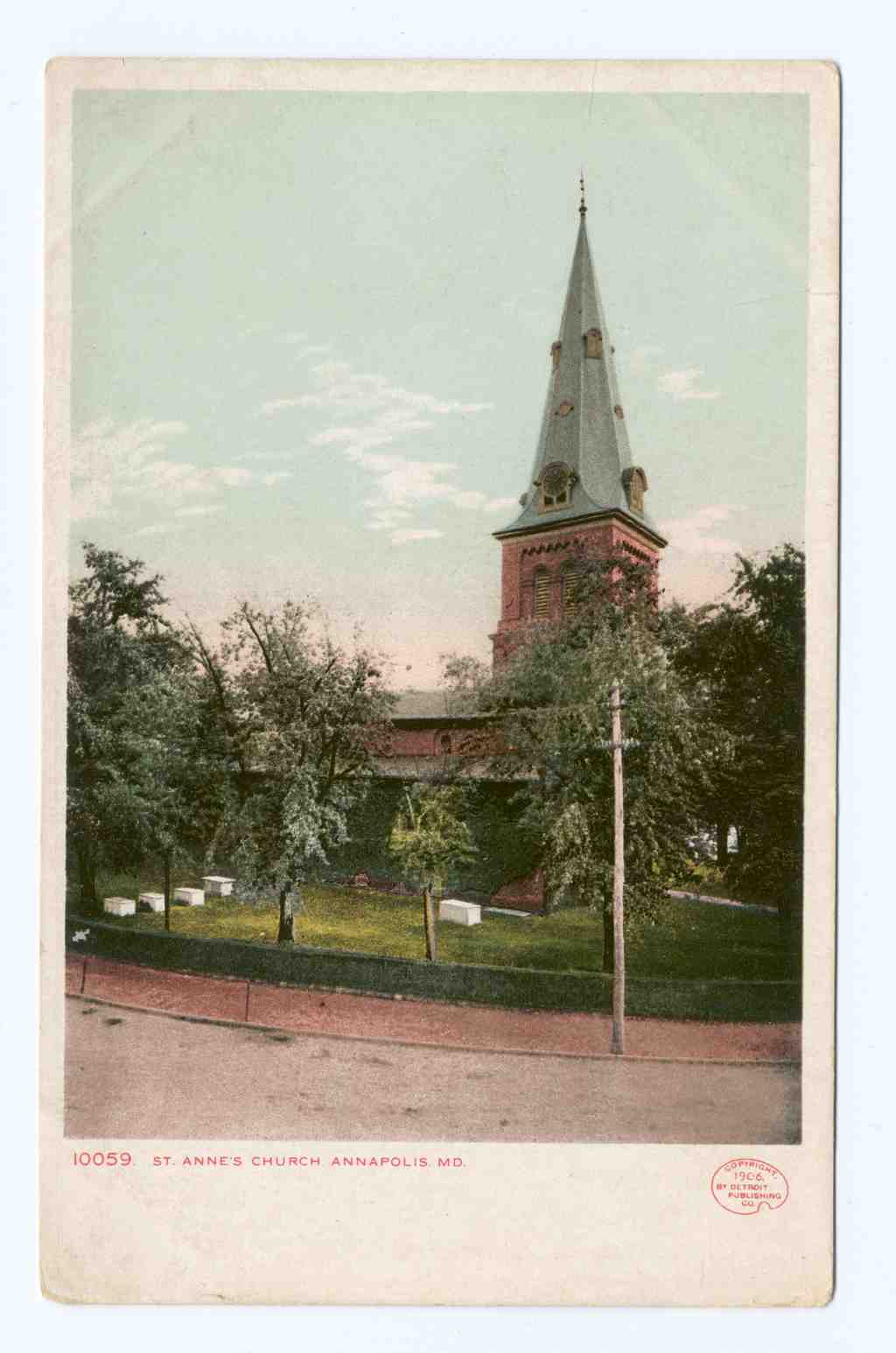
On your left stands St. Anne's Church, a stout red brick Romanesque building anchored by a prominent square tower that houses a large black and white town clock. Romanesque just means it relies on those heavy, rounded arches you see, rather than the pointy spires of Gothic architecture.
This spot has been the spiritual center of Annapolis since 1694. When the royal governor laid out the city streets, he designed them around two circles. The larger was for the State House, and this smaller one was reserved for the church. The official narrative paints a picture of a glorious colonial parish, blessed by royalty. King William the Third gifted the parish a handsome silver communion service, and Queen Anne herself donated a bell for the tower. It was supposed to be a shining monument to British order.
But the reality of colonial engineering was far less polished. The colonial government hired a man named Edward Dorsey to build the first church in 1699. Dorsey was a prominent boatwright and the Keeper of the Great Seal of the Province, but despite his high status, he was completely incapable of actually getting the church built. His contract demanded a structure sixty-five feet long and thirty feet wide, complete with a porch and a bell tower.
Instead of a triumph of engineering, the project stalled out completely. Dorsey was fired and slapped with a massive penalty of three hundred and thirty-three pounds sterling for breach of contract, which is roughly seventy thousand dollars today. He faced total financial ruin.
Fortunately for him, the Reverend Thomas Bray stepped in. Bray pleaded with the assembly to show mercy, arguing that Dorsey had a great charge of a wife and twelve children to support. The assembly took pity on the overwhelmed boatwright and reduced his fine to two hundred pounds, or about forty thousand dollars today.
The church was finally finished by others, but it did not have a happy ending. In February 1858, a furnace fire hollowed out the building. The beloved royal bell donated by Queen Anne plummeted from the tower and melted into a puddle of bronze. Yet, somehow, someone managed to rush in before the roof collapsed and save King William's historic silver, which the church preserves to this day.
The sturdy brick structure in front of you was built immediately after that fire. If you are lucky enough to look inside, you will find an absolutely breathtaking stained-glass window designed by Tiffany Studios. Just keep in mind they are generally open Monday through Thursday from 9 AM to 4 PM.
The history of this circle shows how easily grand visions get bogged down in human incompetence. But across town, different struggles were taking place. Let us take a two minute walk toward the Banneker-Douglass-Tubman Museum, where we will hear how marginalized voices worked relentlessly to reclaim their own history from the shadows.


