
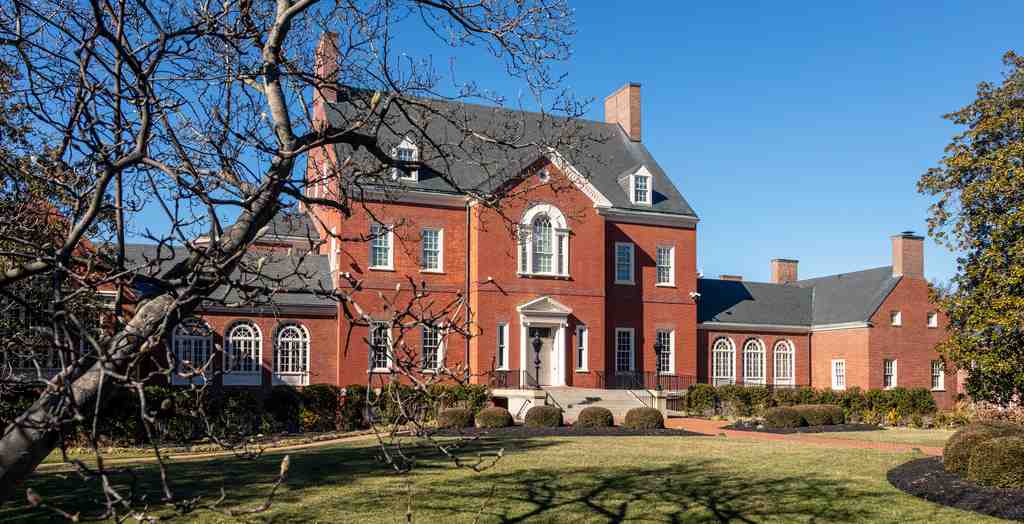
On your left, you will spot the Government House, a large, symmetrical red brick mansion anchored by a prominent white framed arched window directly above the main entrance portico.
We like to imagine the seats of power as symbols of flawless order, but behind these pristine walls lies a history of massive egos, bitter brawls, and architectural ambition gone wildly off the rails. Before this polished residence existed, the path to housing Maryland's executive was paved with spectacular failure. In 1742, Governor Thomas Bladen secured an astonishing four thousand pounds, roughly a million dollars today, to build a colossal fourteen thousand square foot official residence. But his grandiose plans quickly exceeded his budget, sparking a bitter feud with a legislature that flatly refused to give him another dime. The result was Bladen's Folly, an abandoned mansion left completely unroofed to molder on a hill for decades until its framework collapsed.
With Bladen's dream dead, governors instead lived in the Jennings House. You might remember the Jennings House from earlier on our tour, it was the mansion purchased by the Naval Academy in 1869 for twenty thousand dollars, or roughly four hundred fifty thousand today, before being razed to expand their waterfront campus.
By 1870, the state finally completed this current mansion. Originally, it was designed with a French Second Empire mansard roof, which is a steep, four sided roof with a flat top, looking entirely different from the colonial style you see today. Almost immediately, the new house hosted a bizarre tragedy. Reverdy Johnson, an eighty four year old former U.S. Attorney General, enjoyed a dinner party here and a single glass of wine. He asked to be left alone in the parlor, a room designed with tall floor to ceiling windows that functioned as doors. Less than an hour later, he was found dead in the yard, having accidentally walked right out an open window and plummeted to his death. Legend says his ghost still roams the grounds, practicing his court arguments.
In the 1930s, the house was heavily remodeled to match the colonial style of the nearby State House. That historical facelift eventually set the stage for modern drama. In 1980, the state sued former Governor Marvin Mandel, accusing him of stealing twenty thousand dollars worth of state property when he left office, including Waterford crystal and three hundred fifty bottles of liquor. Mandel boldly countersued, claiming the state was holding hostage a marble bust of himself. He eventually paid the state ten thousand dollars to end the embarrassing dispute.
Today, things are a bit more wholesome, featuring a vegetable garden and a hidden apiary, which is simply a collection of beehives, tucked away from the public eye.
Now, let us walk three minutes away to St. Anne's Church, to see how even sacred architecture faced its own earthly struggles.


