
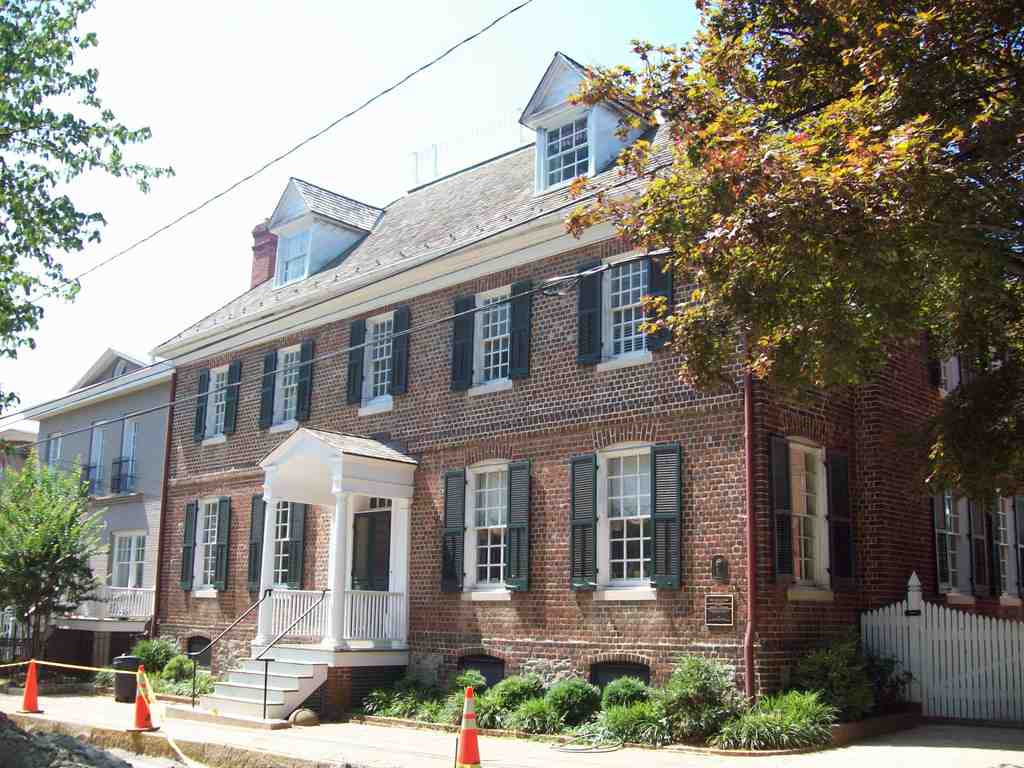
Look to your left and you will see a two-story red brick house sitting on an elevated basement, defined by a small white pillared portico at the entrance and a roof featuring two prominent dormer windows. This is the Peggy Stewart House. If you look closely at that roofline, you are actually looking at a physical metaphor for how history gets rewritten.
Buildings are much the same. The late nineteenth-century remodelings drastically shifted this Georgian mansion's original profile. Originally, it had a traditional gable roof with flush chimneys, typical of colonial Annapolis. But renovations in the 1890s removed that gable in favor of the current hipped roof, which slopes downward on all four sides. They also added the rooftop balustrade, a railing along the top, and completely rebuilt the chimneys to match. Take a quick glance at the before and after image on your screen to see how dramatically its silhouette was altered over time.
Just as the house was reshaped to fit a later era's tastes, the story of what happened here in October 1774 has been sanded down into a tidy patriotic myth. The event is known as the Annapolis Tea Party. It sounds quite dashing. The reality was a terrifying hostage situation.
Anthony Stewart owned this house and a cargo ship named after his daughter, the Peggy Stewart. When the ship arrived in port, Stewart discovered a merchant had secretly hidden over two thousand pounds of tea in the hull to avoid the hated British tea tax. Stewart chose to pay the tax himself. He did not do this out of loyalty to the British Crown, but out of desperation. There were fifty-three indentured servants, laborers contracted to work unpaid for years, trapped aboard the leaky vessel. They had been stuck at sea for nearly three months, and paying the tax was the only way to legally unload them.
The local patriots did not care about his humanitarian dilemma. They saw only a brazen violation of their boycott against British goods. An angry mob surrounded this very house. They erected a gallows in the town square and gave Stewart a grim ultimatum. Destroy the tea, or they would hang him, tar and feather him, or burn this house to the ground with his family inside.
Terrified for his wife and daughter, Stewart rowed out to his ship and set it ablaze himself, burning it down to the waterline as the crowd cheered. Stewart was financially ruined and fled the country, leaving his family behind to ultimately lose the house to foreclosure. A polished tale of colonial rebellion, built on the ashes of a man trying to save fifty-three lives.
Years later, the tragedy continued. Founding Father Thomas Stone bought the house in 1783 to care for his dying wife, Margaret. He even declined his appointment to the Constitutional Convention to stay by her side. She passed away in this home, and Stone, broken by grief, died just four months later.
History is rarely as clean as the monuments suggest. Speaking of remnants that survived the colonial era, the only object saved from the burning Peggy Stewart was a punch bowl, which sits just a three minute walk from here. Head toward the Hammond-Harwood House, where we will uncover a famous local ghost story.


