
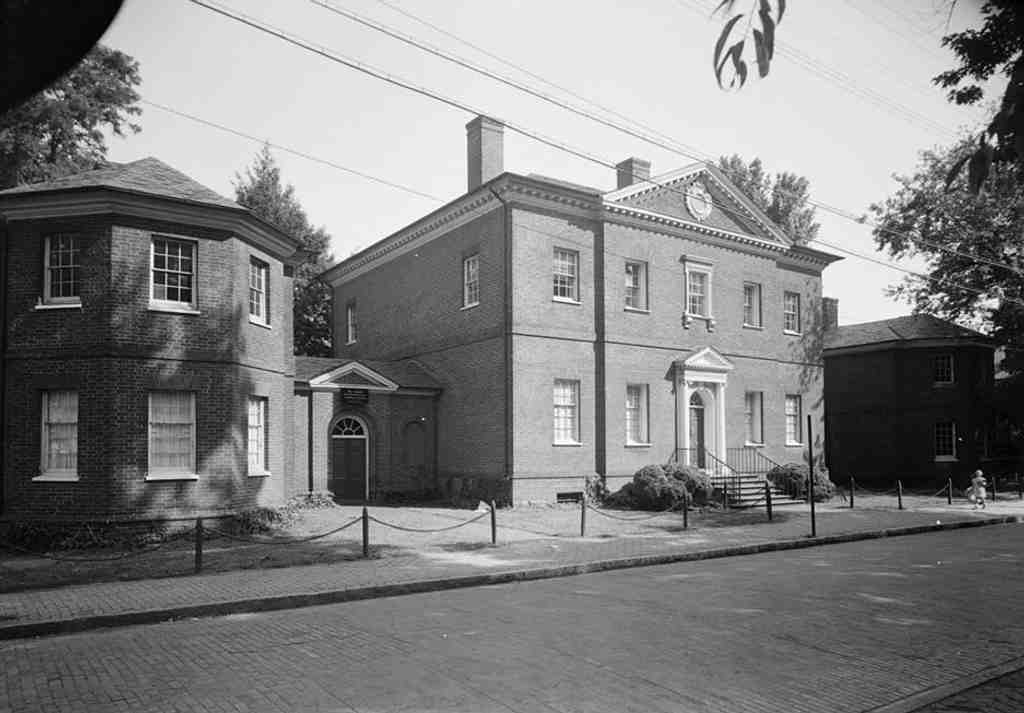
Look to your left and you will spot a sprawling five part brick mansion with distinctive projecting wings and an elegant front door framed by columns. Take a glance at your screen to see a close up of that doorway, highlighting the beautiful fanlight window above the entrance.
This is the Hammond-Harwood House, completed in 1774. It is a masterpiece of colonial design, created by the architect William Buckland for a wealthy farmer named Matthias Hammond. Buckland dreamed big. He modeled this home directly on a sixteenth century Italian villa, adapting the design to include those single story connecting corridors you see between the main house and the wings, which architects call hyphens. You can see how beautifully preserved the exterior remains if you check the historic comparison on your screen.
Now, for over a century, Annapolis locals loved telling a very specific, very dramatic story about this place. According to local folklore, Matthias Hammond built this grand home for his fiancée, but he became so deeply obsessed with perfecting its architectural details that he completely neglected her. As the story goes, she got tired of waiting, broke off the engagement, and ran away with another man. Hammond was supposedly so devastated he abandoned the house forever. People even claim to see the ghost of a woman in a colonial gown gazing out the window.
It is a great romantic tragedy. It is also completely made up.
Historical records show Matthias Hammond was a lifelong bachelor who was never even engaged. Historians eventually figured out that the famous jilting actually happened to his brother, Philip. Philip's fiancée eloped with another man while Philip was away in Philadelphia shopping for furniture. The town gossips simply transferred the scandalous story to Matthias, likely because they could not understand why a single man would build such an enormous house.
But the true history of the Hammond-Harwood House holds a much deeper tragedy than a bruised ego. We often marvel at the polished perfection of colonial architecture, but that perfection relied heavily on unfree labor. Architect William Buckland brought several enslaved individuals with him from Virginia, including a man named Oxford, who was forced to construct this very building.
Later, the house was occupied by Frances and Richard Loockerman. From the outside, they looked like the picture perfect high society family. Behind closed doors, Richard was a heavy drinker with severe financial issues. The family enslaved several people on the property, and whenever Richard's gambling and drinking debts piled up, he would ruthlessly sell or rent out these individuals to cover his losses. The real heartbreak here is not a fabricated runaway bride, but the human beings systematically torn apart to fund one man's destructive habits.
The house eventually became a public museum, but only after nearly being gutted by commercial developers in the 1920s. Saint John's College managed to buy the building for forty seven thousand dollars, which is about eight hundred thousand dollars today. If you want to go inside, the museum is open daily from noon to five, though it is closed on Tuesdays.
Let us keep walking. It is a short three minute stroll to our next stop, the Paca House and Garden, where we will confront a much darker historical paradox.


