
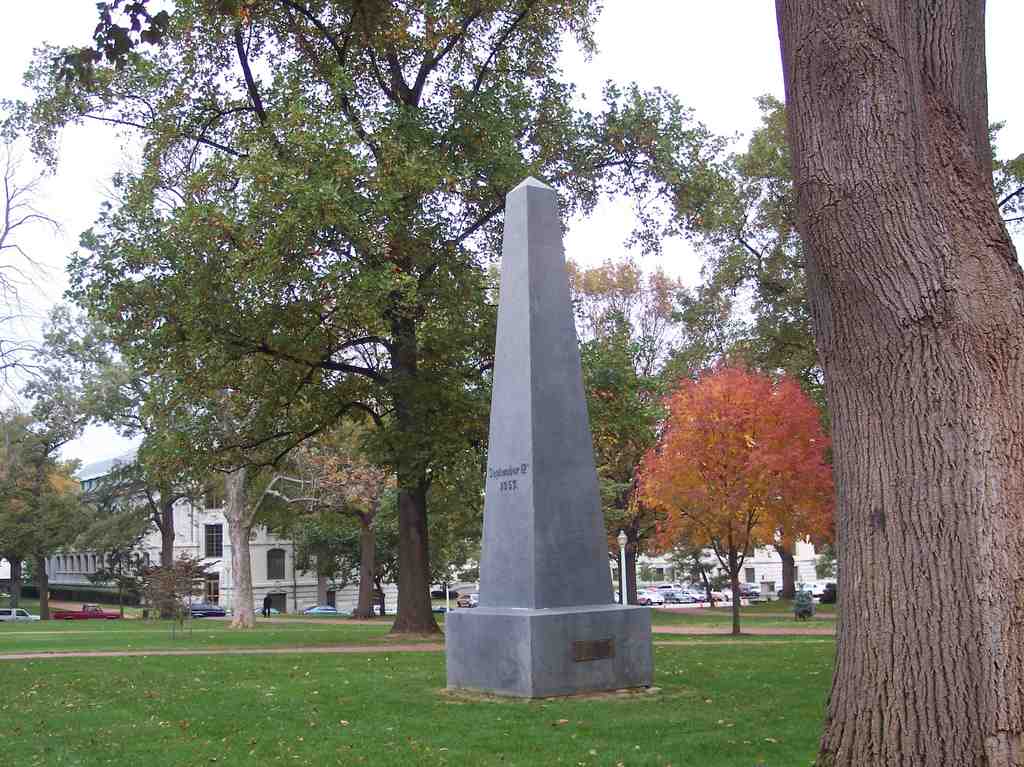
On your left stands a twenty-one-foot obelisk, which is a tall, tapering four-sided pillar, carved from smooth grey granite and resting on a square base marked with raised lettering.
This is the Herndon Monument. It was erected by the class of eighteen sixty in memory of Captain William Lewis Herndon, and it perfectly captures the heavy toll of naval service. On September twelfth, eighteen fifty-seven, Herndon was commanding the S S Central America when a hurricane battered the ship off the coast of North Carolina. As the vessel began to sink, Herndon ordered the lifeboats launched, successfully saving all one hundred and fifty-two women and children on board, along with several men. Knowing his own fate, he handed his watch to a passenger to deliver to his wife, stating he could not leave while a single soul remained aboard. Survivors later reported that as the ship finally slipped beneath the waves, Herndon had put on his full dress uniform and was standing stoically by the wheelhouse.
He went down with his ship, becoming the ultimate Victorian exemplar of duty.
But there is always a gap between a pristine historical memory and the messy reality of how we choose to honor it. You can see this shift by looking at the before and after image in your app. While an eighteen sixty-eight photograph captures a solitary cadet quietly observing the newly erected monument, today this stone pillar is the centerpiece of a chaotic annual tradition.
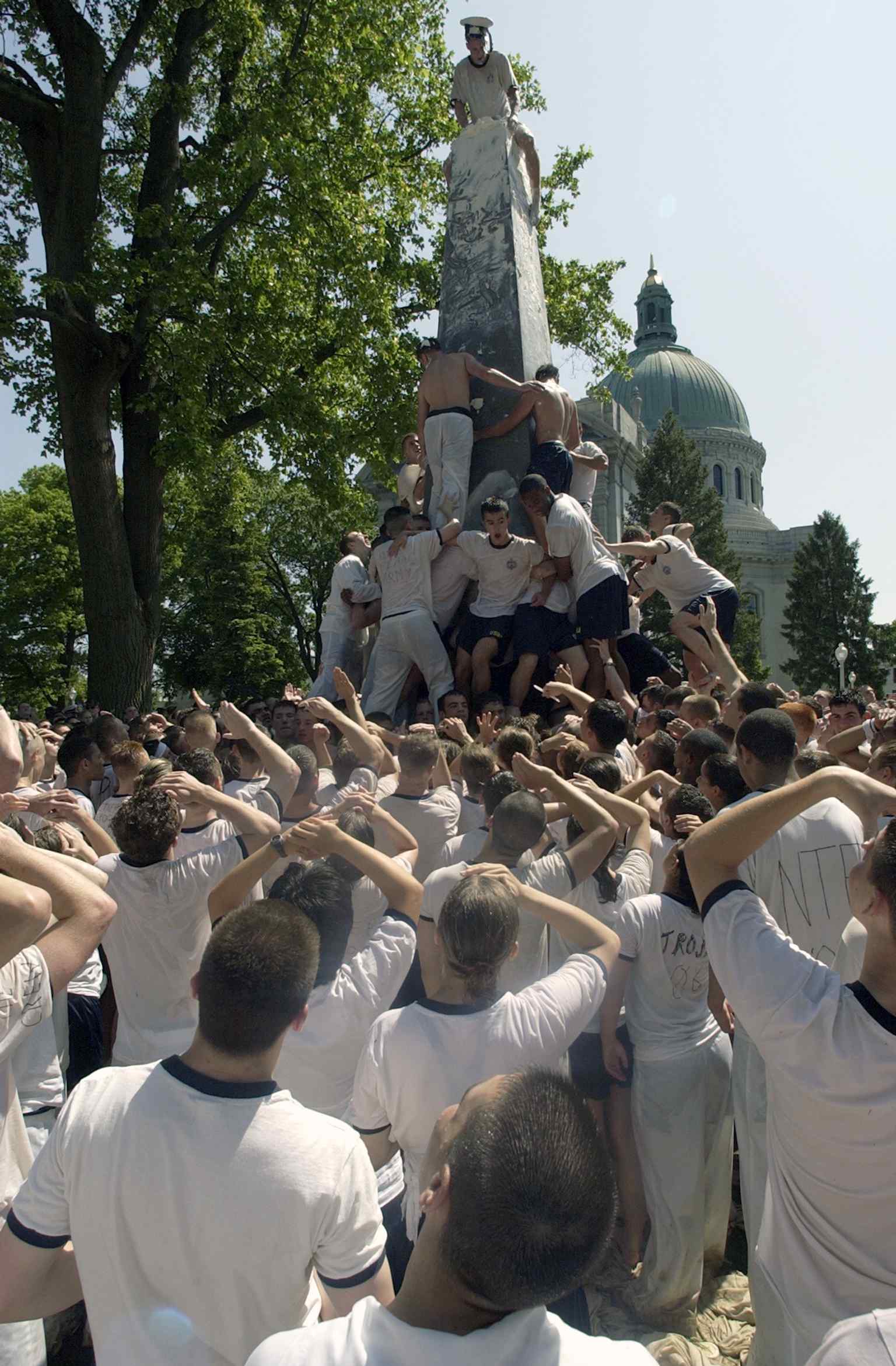
It is called the Herndon Monument Climb. First-year students, known as plebes, must work together to scale the monument and replace a white sailor hat, called a dixie cup, sitting at the very top. In its place, they must secure an upperclassman's combination cover, which is the formal peaked cap worn by naval officers.
There is just one catch. Before the climb, upperclassmen slather the granite obelisk with up to fifty pounds of vegetable shortening. Take a look at your screen to see the midshipmen battling this ridiculous wall of lard. They form massive human pyramids, often sacrificing their own t-shirts to wipe away the grease for the climbers above them.
The academy has occasionally tried to tame the chaos. In twenty ten, a superintendent banned the grease citing safety concerns. The ungreased plebes completed the climb in a mere two minutes and two seconds. Instead of being relieved, the students felt robbed of their rite of passage, printing shirts that demanded to know where the grease went. The lard was quickly reinstated the following year.
Yet beneath the raucous yelling and flying shortening, the monument still commands profound respect. In two thousand eight, just days before the climb, a plebe named Kristen Marie Dickmann died suddenly from a heart condition. In a break with tradition, her classmates voted to place her cap on top of the monument instead of an upperclassman's. In that moment, a chaotic physical challenge transformed back into a solemn tribute for a fallen shipmate.
The naval academy grounds are open twenty-four hours a day, so this granite pillar stands perpetual watch, anchoring generations of tradition. Let us continue to the Peggy Stewart House to see how history is physically remodeled over time.


