
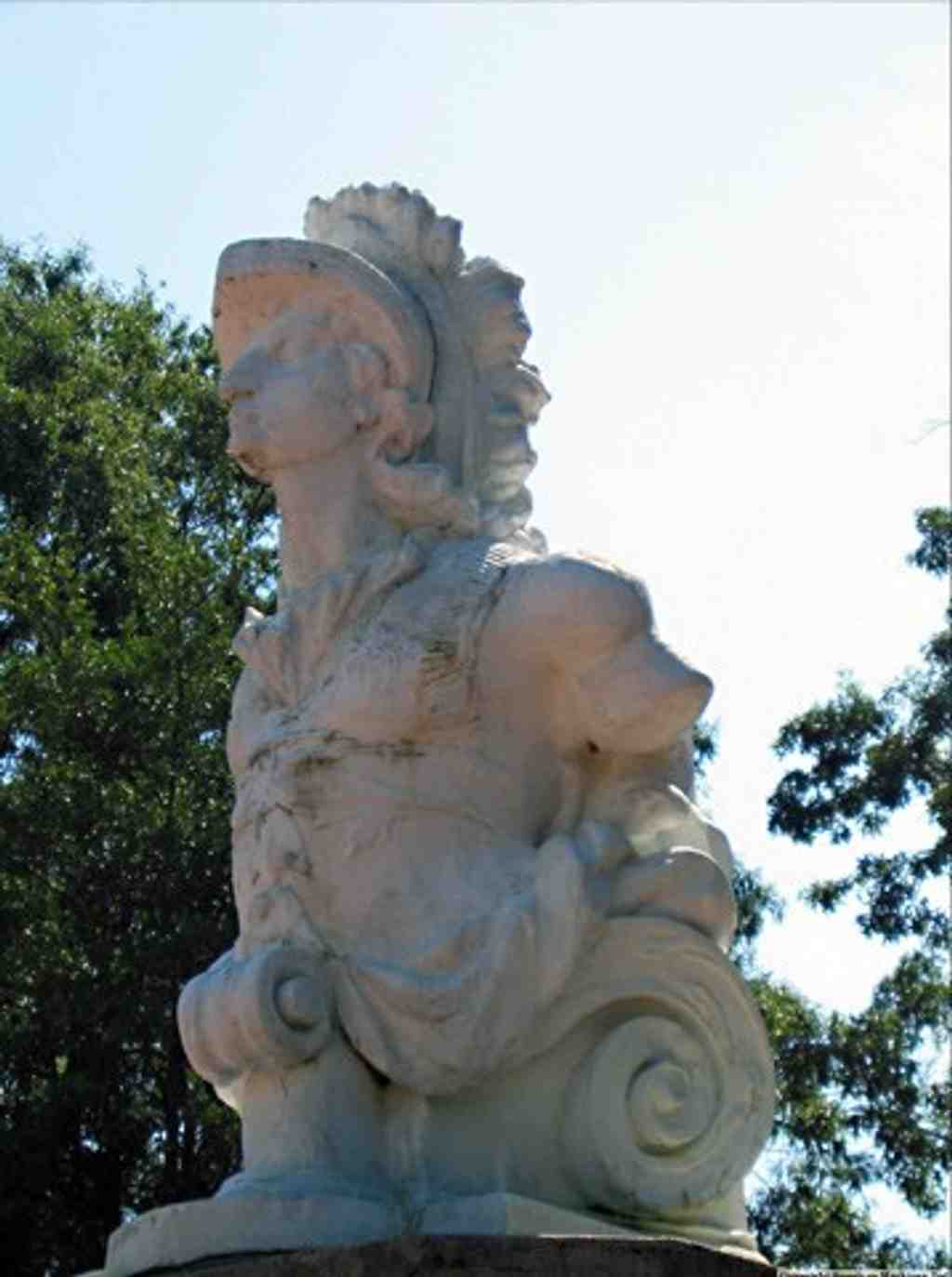
On your left, look for a stark white wooden sculpture of a man wearing a plumed classical helmet and a ruffled shirt, mounted atop a solid stone base. This is the Macedonian Monument, and the man in the helmet is meant to be Alexander the Great. Originally, he was the figurehead, the carved wooden decoration mounted on the front bow, of the British warship HMS Macedonian.
To understand how a piece of British naval pride ended up here, we have to look at Captain Stephen Decatur. Decatur possessed a brilliant tactical mind that made him an American naval legend during the War of 1812, yet his unquenchable thirst for glory ultimately led to his tragic, self inflicted downfall.
The story actually starts with a friendly bet. In 1810, Decatur met British Captain John Surman Carden in Virginia. Carden playfully wagered a beaver hat that his newly built HMS Macedonian could defeat Decatur's USS United States in combat. Two years later, near the Canary Islands, they put that hat to the test.
Take a look at your screen to see Thomas Birch's 1813 painting of the engagement. Decatur executed a ruthless, calculated strategy. He knew his twenty four pound cannons could shoot further than the British eighteen pounders. So, he kept his distance and pounded the British ship with seventy broadsides, meaning the simultaneous firings of all the cannons on one side of his ship. The British could only manage thirty in return. The result was catastrophic. The Macedonian was reduced to a dismasted hulk. A third of the British crew was lost, while Decatur lost only twelve men.
Decatur became a national hero, but heroism is rarely a shield against ego. His outspoken nature and relentless pursuit of honor earned him powerful enemies. He publicly blamed Commodore James Barron for a previous naval disaster, prompting Barron to challenge him to a duel. On March 22, 1820, at the Bladensburg dueling grounds in Maryland, the two men faced off. Both fired. Both struck their targets. Barron survived. Decatur did not. He died at forty one, cutting short the very life this monument celebrates.
As for Alexander the Great here, maintaining a nineteenth century wooden carving is an engineering nightmare. For decades, the wood rotted. Early, misguided attempts to save it involved wrapping the whole thing in lead, and later, encasing it in fiberglass. Naturally, that just trapped the moisture inside and accelerated the decay.
When the Class of 1973 funded a three hundred thousand dollar restoration in 2014, they wanted a weatherproof bronze replacement. The Maryland Historic Preservation Commission said no, demanding historical authenticity with real wood. Forced to pivot, engineers laser scanned the decaying monument to create a digital baseline. They milled a styrofoam replica, had artisans hand sculpt the missing details, and then laser scanned that perfected model to create the precise computer paths needed to carve the pristine mahogany version you see today.
When you are ready, let us shift our focus from the heavy cost of naval warfare to something equally ambitious but far more peaceful. Keep walking ahead toward the Naval Academy Chapel, which is about a two minute walk away.


