
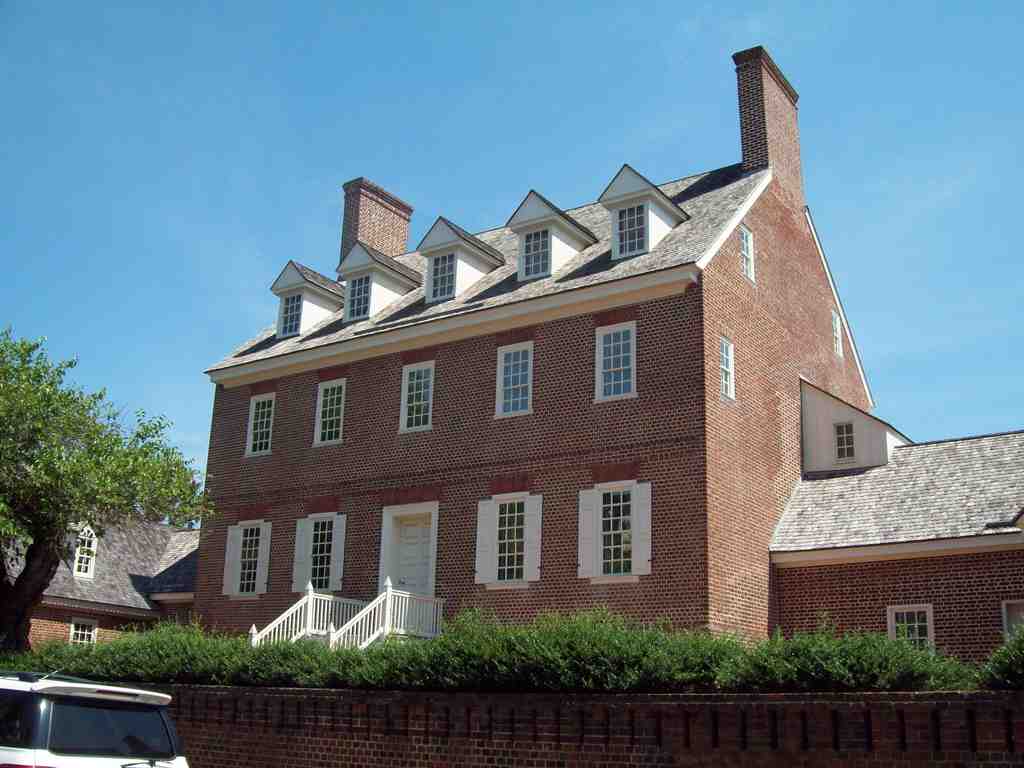
Look at the red brick mansion on your left, built in a strictly symmetrical Georgian architectural style and defined by its steep roof dotted with a row of five white dormer windows.
This is the William Paca House, constructed between 1763 and 1765. William Paca was a Founding Father, a three-term Governor of Maryland, and a man who confidently signed the Declaration of Independence. Like many of his peers, he enjoyed an elite lifestyle funded by immense colonial wealth. Yet, the pristine elegance of this estate was maintained entirely by enslaved individuals whose uncredited, forced labor made the opulent lives of the Annapolis elite possible. While Paca was publicly demanding American liberty, he held six to ten people in bondage right here. Historical records give us a few of their names. Denby, Affey, Poll, Sarah, Bett, and Sall. Unsurprisingly, this house saw active resistance. At least one indentured servant is known to have fled to freedom during Paca's tenure.
How do we reconcile the brilliant minds that birthed American liberty with the stark reality of the enslaved people who served them?
The hypocrisy survived his departure. When Paca sold the house to Thomas Jenings in 1780, the reliance on forced labor continued. Upon Jenings's death, his son freed only one enslaved man, a forty-six-year-old named Jacob, and ruthlessly sold off the rest of the household.
Fast forward to the twentieth century, and the mansion had been swallowed up by a sprawling two-hundred-room hotel called Carvel Hall. If you want to see how drastically the property was altered to fit the hotel before its modern restoration, take a look at the historic image in your app.
The hotel was so famous that a blacksmithing company named their steak knives after it. When the hotel announced its closure in 1965, panicked customers flooded the knife company with calls, terrified their favorite cutlery was doomed. The factory had to issue press releases clarifying they were still happily churning out blades. Through its long hotel era, the true backbone of Carvel Hall's famed hospitality was an African American staff member named Marcellus Hall, who started as a bellboy in 1913 and dedicated fifty-two years to the establishment, rising to Superintendent of Services.
By the nineteen sixties, developers planned to bulldoze this entire block for a motel and bus station. Preservationist Anne St. Clair Wright raised two hundred fifty thousand dollars, roughly two point four million today, to save it. Her team hired overnight guards to protect the site during restoration, but the guards quit after claiming a gentleman in colonial dress was haunting the parlor. Wright eagerly staked out the parlor herself, hoping for a ghost sighting, but the phantom never showed.
The true engineering triumph was resurrecting the two-acre colonial garden out back, which you can see in your app. It was buried under nine feet of landfill and an asphalt parking lot before archaeologists unearthed the original terraces and intricate water systems.
The house and self-guided garden are open to the public daily, closing by late afternoon. Let us move on toward the Historic Inns of Annapolis to explore the everyday life of the city's working class, which is about a four-minute walk from here.


