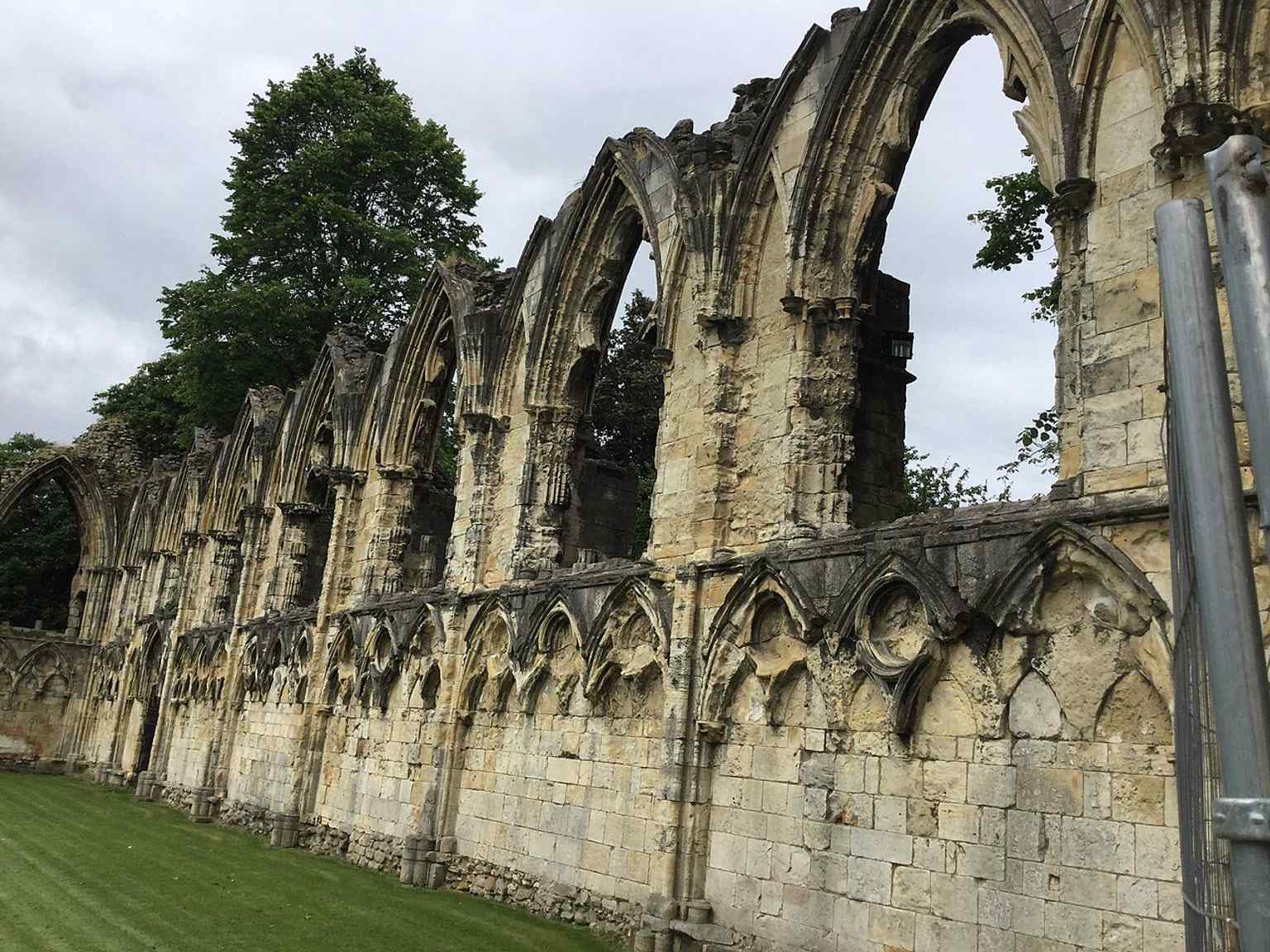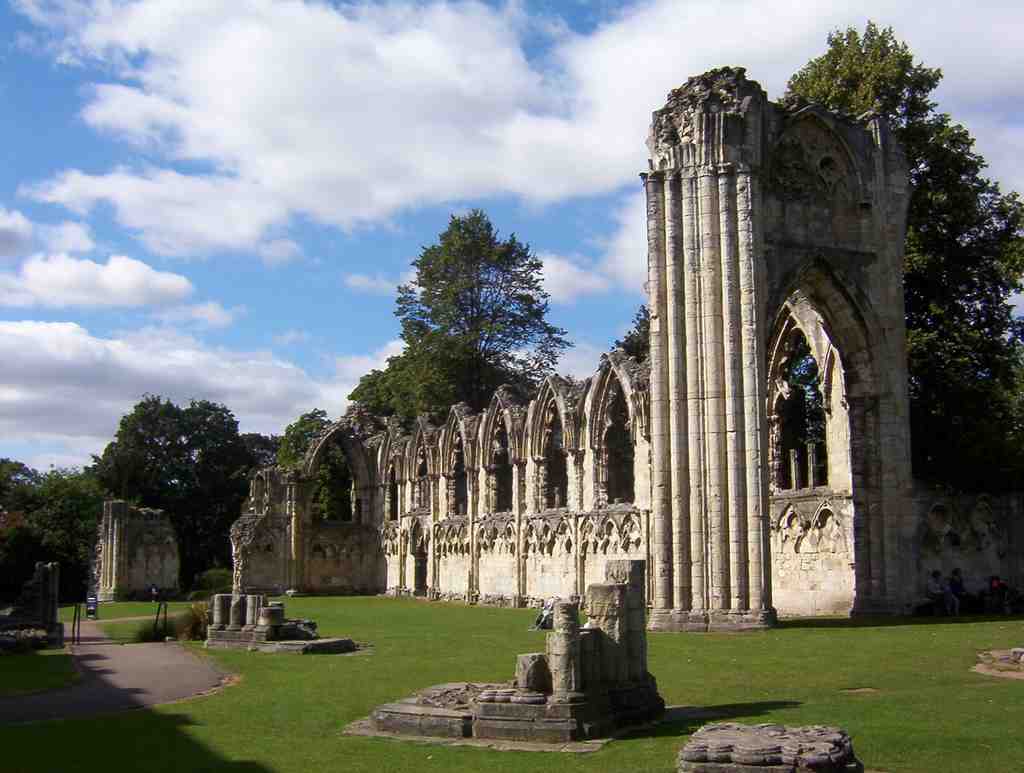
On your right, the abbey shows itself as pale stone ruins: tall broken walls, long pointed window openings, and a jagged line of masonry marking the shell of an enormous church.
What looks peaceful now once belonged to one of the richest Benedictine abbeys in northern England. A church stood here by ten fifty-five, dedicated to Saint Olaf. After the Norman Conquest, Alan Rufus handed the site to Abbot Stephen and monks from Whitby, and in ten eighty-eight King William the Second came to York, gave them more land, and set in motion a grand new abbey dedicated to the Virgin Mary.
And grand really is the word. This was not just a church. It sat inside a huge monastic precinct, almost three-quarters of a mile around, with walls, towers, privileges, its own prison, even its own gallows. A useful reminder that medieval holiness could come with a fairly muscular legal department. The abbots here were so powerful they wore mitres, like bishops, and got summoned to Parliament.
Most of what you see belongs to the great rebuilding begun in twelve seventy-one under Abbot Simon de Warwick, working with a master stonemason also named Simon. They finished the whole campaign by twelve ninety-four, astonishingly fast for a project of this size. The church stretched about three hundred and fifty feet long, with a nave, the great central hall of worship, plus transepts crossing it like arms, side aisles, chapels, library, chapter house, kitchens, infirmary... an entire world ordered around prayer, study, and administration.
Take a moment and look along those surviving walls. From where you're standing, try to measure the ambition of it... and then imagine the nerve it took to challenge the place from within.
Because the surprise here is that one of England's most famous monasteries began with a quarrel at this one. The monastic revolt of eleven thirty-two started when Prior Richard accused Abbot Geoffrey of letting discipline slide. This was not a mild disagreement over hymn selection. Richard and other reform-minded monks wanted a stricter life, closer to the rule they believed they had promised. The dispute turned ugly enough to become a riot, and Archbishop Thurstan stepped in.
Thurstan sheltered the rebels. Then, on the twenty-sixth of December, eleven thirty-two, he took thirteen expelled monks to the valley of the River Skell. There he backed Richard as first abbot of a new house: Fountains Abbey. So one of the greatest Cistercian monasteries in England began as a breakaway from this wealthy Benedictine giant. That changes the mood of these ruins a bit, doesn't it? Calm stone outside... fierce argument underneath.
If you check the app, one image pulls back enough to show the scale of the surviving church walls more clearly. And another shows King’s Manor, the later reuse of the abbot’s house after Henry the Eighth closed the abbey in fifteen thirty-nine, when it was worth more than two thousand pounds a year, roughly several million in modern terms.
So this ruin does not only mark loss. It also marks departure, rebellion, and a new beginning somewhere else entirely. In about a minute, we’ll head into York Museum Gardens, where the abbey’s afterlife keeps unfolding. If you want to explore a little longer later, the grounds are generally open daily from nine in the morning until six in the evening.