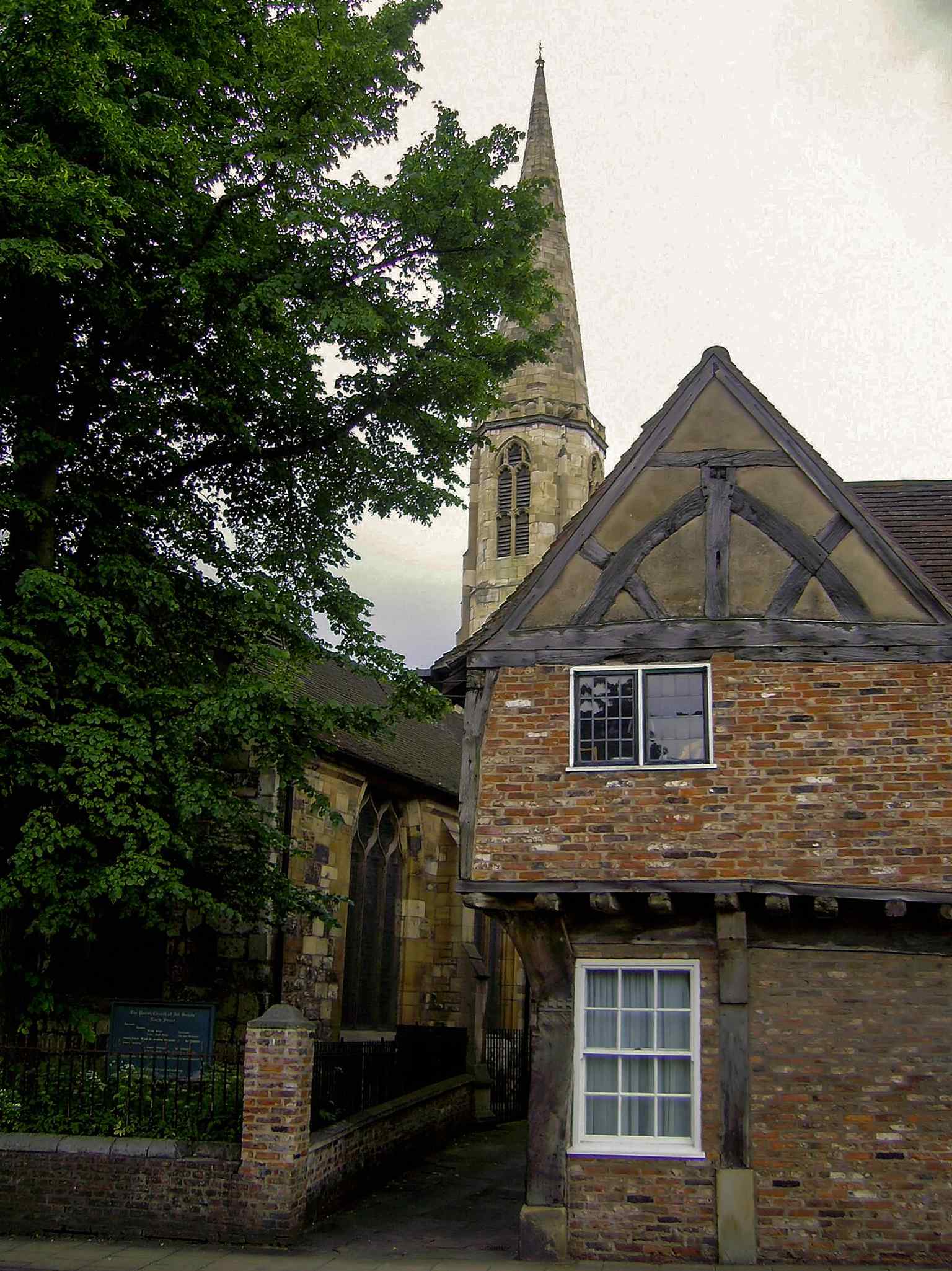
Look for the pale stone church with a squat square tower, a long pitched roof, and tall pointed windows rising just above the line of North Street.
This is a fine place to begin, because York is terrible at starting from scratch... in the best possible way. People have worshipped on this patch of ground for more than a thousand years, and even before this church took shape, this stood within the Roman civilian city of Eboracum, beside the old road that crossed the river toward the military fortress where York Minster now stands. So before you is not one neat medieval building, but a stack of intentions: Roman threshold, parish church, Victorian repair job, modern conservation project.
The building itself keeps the record in stone. Its nave, the central hall of the church, dates back to the twelfth century. The arcades, those rows of arches inside, belong to the thirteenth. Then in the fourteenth century, builders remade the east end and added chapels around the chancel, the space around the altar. If you check the app image of the interior, you can see that layering almost at a glance, as if centuries politely agreed to share the same room.
But the most haunting story here belongs to someone who barely occupied a room at all. In the fifteenth century, the church added an anchorite cell at the west end for Emma Raughton. An anchorite chose a life of enclosure for prayer, sealed away from ordinary society but not cut off from worship. Emma’s tiny connection to the church came through a squint, a little opening in the wall, so she could see the Mass and hear it from her cell. Most people pass this church without ever guessing that one of its most important viewpoints was a slit in the masonry.
And that raises an awkwardly large question for such a small opening: what would it mean to shut yourself away, yet remain deeply tied to the sounds, rhythms, and rituals of the city outside?
Emma did not stay alone in memory. In the twentieth century, Sister Adeline Cashmere worked in a York factory and still lived the contemplative life here for nine years. Then Brother Walter Wilman, once a clothworker, later a lay reader and First World War veteran, lived in the rebuilt cell from the early nineteen thirties until his death in the nineteen seventies. The church even commissioned a modern artwork to remember Emma, so the woman once glimpsed through a crack in the wall now quietly looks back at the city.
Inside, the windows are another kind of witness. All Saints holds York’s finest collection of medieval stained glass after the Minster. One famous window, the Prick of Conscience, shows the fifteen signs before Doomsday with floods and earthquakes vivid enough to unsettle anybody. For centuries, people misread the damaged glass completely, until a sketch from sixteen seventy turned up and restorers reassembled it correctly in nineteen sixty-six. Another set of panels records ordinary medieval life with startling frankness: a man in spectacles, prisoners in stocks, a sick man in bed, bodies and troubles that grand history usually edits out. Take a look at the glass image in the app and you’ll get a sense of how intimate these windows can be.
That feels like York in miniature: a city seen through narrow openings, where side figures refuse to stay on the side. We’ll keep following those lives from odd angles as you head next to St Michael’s Church, Spurriergate, about a six-minute walk away. If you want to return and step inside later, the church usually opens from ten to four most days, and from ten fifteen to six thirty on Sundays.