
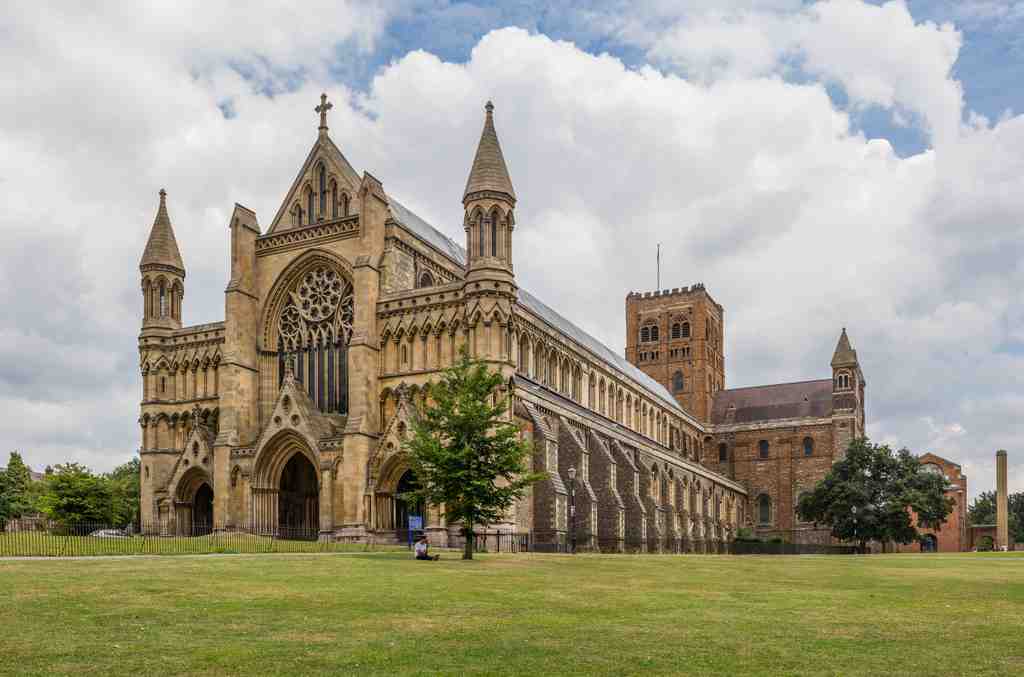
Look ahead and you’ll see a mighty stone church with a pair of pointed towers flanking a grand entrance, a giant rose window above the door, and a long nave stretching back to a tall, square, reddish tower-it’s almost impossible to miss, especially as it looms up over the enormous green lawn in front of you.
Welcome to St Albans Cathedral, a place where history isn’t just behind the walls-sometimes, it feels like it’s hiding in the bricks, waiting to leap out at the unsuspecting visitor! Let’s set the scene: this cathedral, also known as "the Abbey," has a story so epic it could rival your favorite adventure movie, with a little bit of mystery, some drama, and even a sprinkle of comedy.
It all starts with Alban, a kind man living here almost 1,700 years ago, when Romans ruled Britain and Christians were being hunted. One day, Alban met a desperate priest named Amphibalus, running for his life. Alban’s big heart got the better of him, and he hid the priest in his house. After a few days, Alban was so inspired by his guest’s faith that he swapped places with him when soldiers came, wearing the priest’s cloak and bravely stepping forward to be arrested. As Alban was sentenced to death and led up the hill, he grew thirsty-legend says he prayed for a drink and, right on cue, a spring bubbled up at his feet. That’s some VIP treatment from above! When he was finally executed, something truly bizarre happened: the executioner’s eyes supposedly dropped right out of his head. Not exactly a sightseeing tip I’d normally give, but there you have it.
The cathedral was later built to mark the spot where Alban became Britain’s first Christian martyr. Over centuries, the Abbey grew and transformed-founded way back in the 8th century, rebuilt by Normans in the 11th (they liked their buildings as sturdy as their armor), and touched up by pretty much every generation since. Look up at that massive nave-you’re looking down the longest in England, stretching a whopping 85 meters. If you’re feeling brave, try to picture medieval monks bustling around, their footsteps echoing under these arches, chanting prayers, and occasionally ducking as bits of poorly-repaired roof tumbled down!
Much of this stone actually came from the ruins of Roman Verulamium next door-so you’re not just seeing Norman craftsmanship, you’re staring at recycled Roman bricks, once part of a bustling ancient city. The old monks must have been the world’s original upcyclers.
The Abbey itself was the biggest church in England when it was first built, complete with its great tower-still standing today, by the way, and weighing a hefty 5,000 tons. The tower once rang with the sound of five bells, some donated by locals, and now you’ll find 23 bells that ring out over St Albans, including one from the 13th century that still peals as the sanctus bell.
But life here wasn’t always peaceful. The Abbey was raided by Vikings, partially rebuilt, shaken by earthquakes, and even used to hold prisoners of war during the English Civil War (let’s just say there were more than a few rowdy nights). Trouble continued long after-the roof leaked, walls cracked and windows rattled every time a storm rolled through. At one point, the Abbey nearly became rubble, when someone floated the idea of simply knocking it all down and building a smaller, cheaper church. Luckily for us-and you-they stuck it out, patching up holes, re-leading the roof, and eventually transforming the battered church into the cathedral you see today.
Victorian architects left their stamp, mixing styles a bit like kids mixing paint-sometimes beautiful, sometimes a bit odd. There’s even a local saying that if you stand here long enough, you’ll hear three things: the bells ringing, the ghost of a monk still searching for his lost keys, and visitors gasping as they step inside that breath-taking nave.
So as you gaze on St Albans Cathedral, remember, you’re looking at almost two millennia of stories, triumphs, disasters, and-best of all-rebirths. Now, shall we pop inside and see what secrets the next few centuries have left for us to discover?
For a more comprehensive understanding of the britain's first christian martyr, modern times or the dean and chapter, engage with me in the chat section below.


