
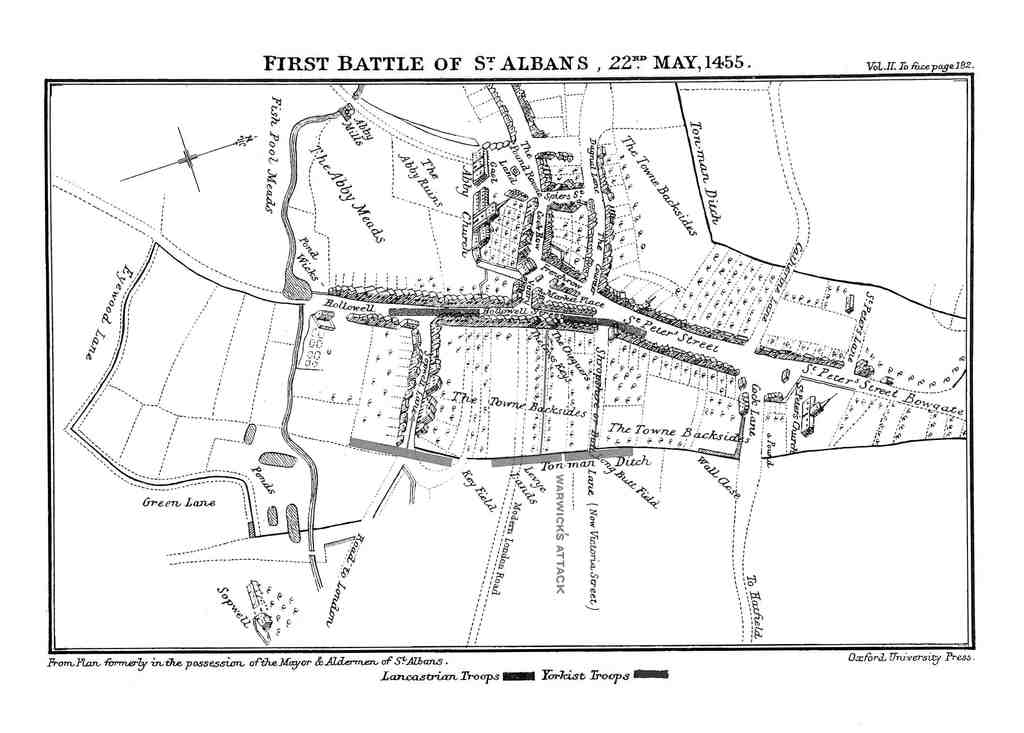
To spot the site of the First Battle of St Albans, look for an area where the streets come together with a sense of open history around you - imagine yourself standing exactly where ancient lanes and alleys would have once echoed with the chaos of battle, right in the heart of St Albans.
Alright, my fellow time explorer, ready your imagination! Let’s turn back the clock to a spring morning in 1455, right here in these very streets. There’s a nervous buzz in the air, not just from the market traders and townsfolk, but from thousands of armed men bracing themselves for the thunder of one of England’s most famous street fights. This wasn’t just any old scuffle-this was the First Battle of St Albans, a clash that kicked off the bloody Wars of the Roses.
Picture it: two mighty rivals circling each other like angry cats. On one side, you’ve got Richard, Duke of York-a man who’d spent years exiled in Ireland and was tired of seeing another, less successful noble, Edmund Beaufort, Duke of Somerset, fumble the kingdom’s fortunes in France. Richard returns, all swagger and purpose, and soon he’s the people’s hero and, for a brief time, the Lord Protector of England, thanks to King Henry VI’s unfortunate case of royal brain fog. But no sooner does Henry recover than York’s chance at command slips away, and Somerset is back in favour... tensions boil hotter than a cauldron in a medieval kitchen.
York and his allies, the hard-nosed Neville family-think of them as the celebrity power-cousins of the age, led by the lively Earls of Salisbury and Warwick-suddenly have a problem. With politics as sharp as any sword, they fear Somerset will drag them into court at Leicester and point the guillotine their way. So here’s the plan: they’re not waiting around. They raise an army-thousands of boots hitting the dusty roads, banners fluttering in the breeze-and head south towards St Albans, ready for a showdown.
Now, turn your gaze around you and imagine what happened right where you stand. Somerset’s men fan out through the narrow lanes, setting up barricades near St Peter’s Church and the Tonman Ditch, hoping to block York’s path. It’s tense. Messengers on horseback dash madly back and forth, carrying letters filled with threats and demands across the lines. Imagine the shouts, the clatter of armour, and the anxious whispers of townspeople peeking out their windows-because this wasn’t just a battle; it happened right in the middle of the town, between shops, homes, and taverns.
After hours of tense negotiation, York-the pushy but popular duke-has had enough. If only peaceful talks could settle these things! Suddenly, Warwick, just twenty-six and already dreaming big, leads a group of Yorkists sneaking through tiny back lanes, splashing through gardens, surprising everyone by bursting out into the heart of the market square. Many of Somerset's men are caught off guard, some even without helmets-sleepy soldiers hoping for peace. That dream shatters fast when Warwick charges. In the blink of an eye, chaos erupts as steel clashes on cobblestone, arrows whizz overhead, and the market that usually sells bread and apples becomes a battleground.
Somerset himself dashes for shelter-imagine him barreling into a tavern called the Castle Inn (yes, they literally used a pub as a fortress). Trapped and desperate, the duke fights bravely, but can’t escape the Yorkist blades waiting outside. With Somerset killed, and King Henry VI found, confused and apparently a bit battered by a stray arrow, York becomes the man in charge once more.
Yet for all this drama, would you believe the whole fight lasted less than half an hour? Out of five thousand warriors, fewer than sixty perished! It was quick and brutal-history in fast-forward. King Henry VI was taken back to London, and if you listened closely that day, you might have even heard the first whispers of the Earl of Warwick’s nickname: "the kingmaker," a title he’d earn in the epic years yet to come.
And here’s a funny thought-imagine the medieval paperwork after all this: the king, recaptured; a duke, defeated; and half the nobles nursing bruised egos! Shakespeare himself thought it so dramatic, he made it the grand finale of Henry VI, Part 2. So, as you stand here, feel the pulse of history where roses, both red and white, first drew blood-a place where the fate of England was decided before lunchtime. Now that’s what I call a memorable morning in St Albans!
If you're curious about the background, prelude or the battle, the chat section below is the perfect place to seek clarification.


