
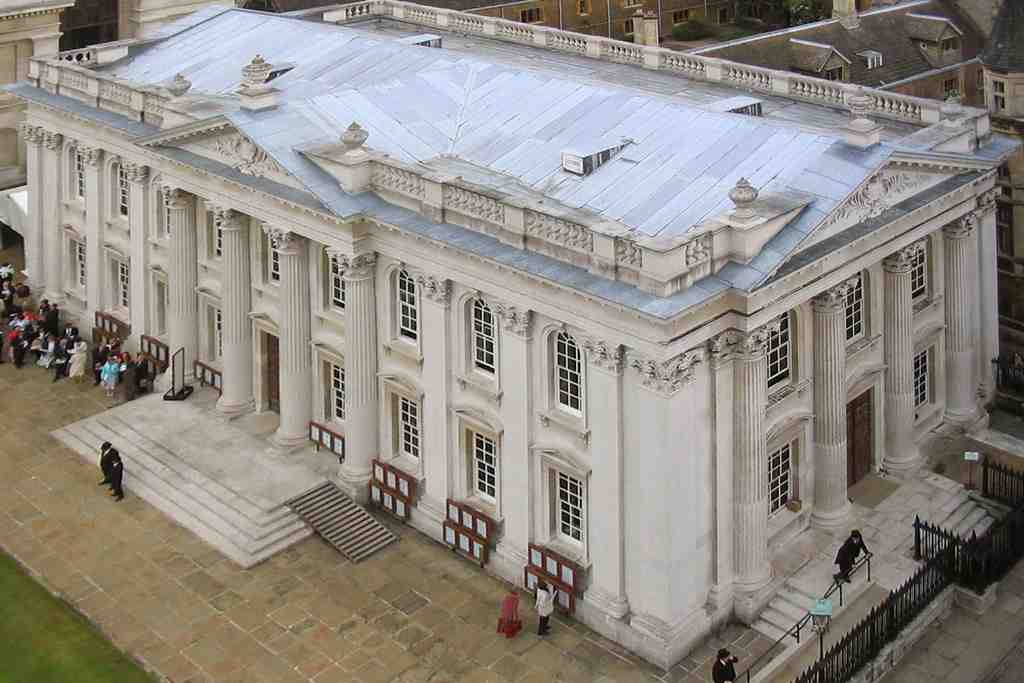
Look to your right and you will spot a grand rectangular building crafted from pale Portland stone, defined by its towering fluted columns and an elegant balustrade running along the edge of the roof. This is the Senate House, the majestic ceremonial centre of the University of Cambridge, built in the seventeen twenties.
It projects an air of absolute authority, doesn't it? But its very creation was born of intense rivalry. In the early eighteenth century, an architectural competition was held to design a grand new meeting space. A gentleman-architect named Sir James Burrough, a fellow of a local college, initially won the commission. However, the university suddenly lost its nerve and hired a professional, James Gibbs, to take over and refine the plans. The result was this striking neoclassical hybrid that architectural scholars still fiercely debate today.
And if you think the building looks a little lonely standing there, you are quite right. The Senate House was originally designed to be just one side of a magnificent quadrangle, a grand four-sided courtyard. But the grand vision was interrupted by a rather academic crisis. The university had just inherited a staggering thirty thousand volumes from the collection of a bishop, and the old rooms where the governing body traditionally met were desperately needed just to house this mountain of books. Construction of this new hall was rushed to completion by seventeen thirty, and the rest of the quadrangle was simply abandoned.
Today, this beautiful hall is primarily used for graduation. Inside, the ceremonies are bound by centuries of strict etiquette. Students are presented to the Vice-Chancellor by their college's Praelector, an officer who leads them forward by the right hand while reciting formal Latin. Yet, the sheer weight of all this stiff solemnity seems to inevitably provoke a wildly defiant response from the student body.
The most famous act of mischief happened right up there on that pristine roof. On the morning of the eighth of June, nineteen fifty-eight, locals awoke to find a battered Austin Seven van sitting squarely on the roof's apex. A brilliant engineering student named Peter Davey had orchestrated the stunt. His team towed a derelict van into town, stripped out its heavy engine, and used stolen scaffolding to winch it up the seventy-foot wall in the dead of night. To keep the police distracted, the students even stationed their girlfriends on the street below with instructions to hitch up their skirts and draw the officers' attention elsewhere!
It took the embarrassed university an entire week and the use of oxy-acetylene blowtorches to cut the van into six pieces just to get it down. The pranksters kept their secret for fifty years. If you glance at your screen, you can see this magnificent building beautifully illuminated for the university's eight hundredth anniversary. I love how that light reveals the architectural details, standing as a testament to both rigid establishment rules and the brilliant, cheeky minds that love to subvert them.
Now, let us move toward the spiritual heart of the university just steps away, a one-minute walk bringing us to the Church of St Mary the Great.




