
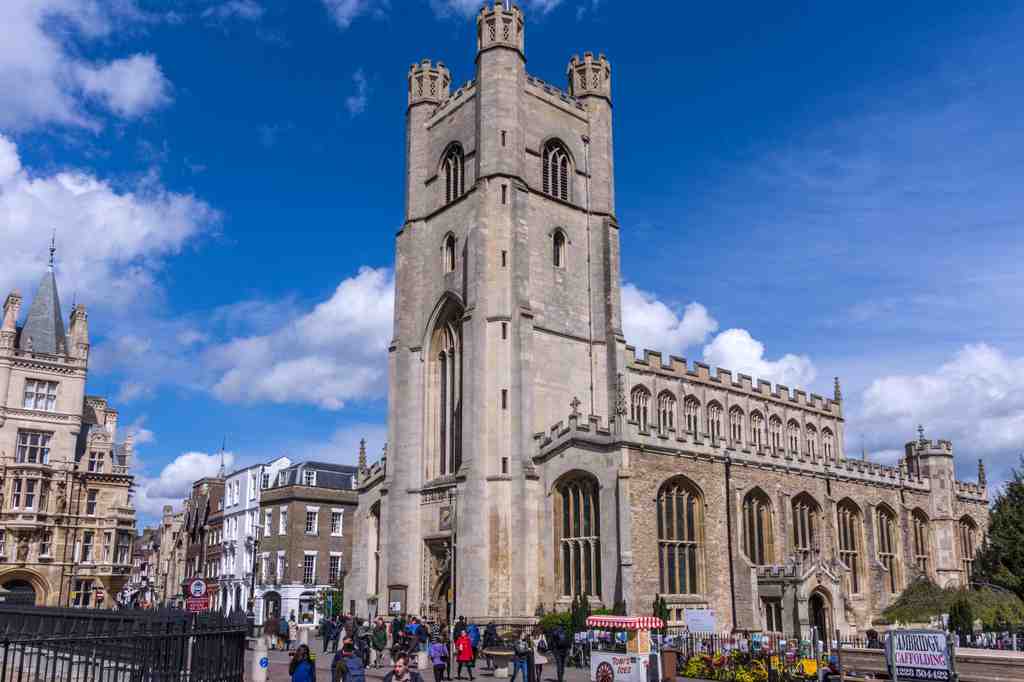
To your right stands the Church of St Mary the Great, a commanding structure of pale stone featuring a tall square tower topped with corner turrets and a long nave lined with prominent arched windows.
Since we just explored the Senate House, where official university business happens today, you should know that before 1730, this church was the absolute heart of Cambridge. In fact, the entire university began with a group of terrified academics on the run.
In 1209, scholars fleeing deadly violence in Oxford sought sanctuary right here. They made this church, then called St Mary by the market, their very first home. Here they delivered lectures, conferred degrees, and hid their earliest records safely within its walls.
But the town that offered refuge soon erupted into its own chaos. During the Peasants Revolt in 1381, the Mayor of Cambridge personally led an angry mob right through these doors. They seized the university chest, a heavy box holding the institution's most vital legal deeds and charters, and dragged it into the market square. They threw the priceless documents into a massive bonfire. Because of that fiery rebellion, Cambridge's historical records remain far more sparse than Oxford's today.
This sacred space constantly witnessed the fierce clash between strict authority and wild human defiance. Take the macabre tale of the Protestant reformer Martin Bucer. When he died in 1551, three thousand grieving mourners crammed inside, completely wrecking the wooden benches. But just a few years later, under the Catholic Queen Mary the First, his corpse was dug up and chained upright to a stake in the market square. The crowd mocked the university authorities for using heavy iron on a rotten carcass, joking there was no fear of a dead man running away. His ashes were eventually swept up and returned to the chancel, the sacred area near the main altar reserved for clergy, when Queen Elizabeth the First took the throne.
You can see how the street around this magnificent survivor has evolved from Victorian times to today if you take a peek at the before and after image on your screen.
If you linger a moment, you might hear the church clock strike. The melody it plays, the Cambridge Quarters, was composed here in 1793 and later adopted by the Palace of Westminster, meaning this very church gave Big Ben its famous voice.
The church is open to visitors daily, generally from ten in the morning to half past five, and Sunday afternoons. Let us continue our journey to an even older, more mysterious religious structure just a five minute walk away, the Church of the Holy Sepulchre.




