
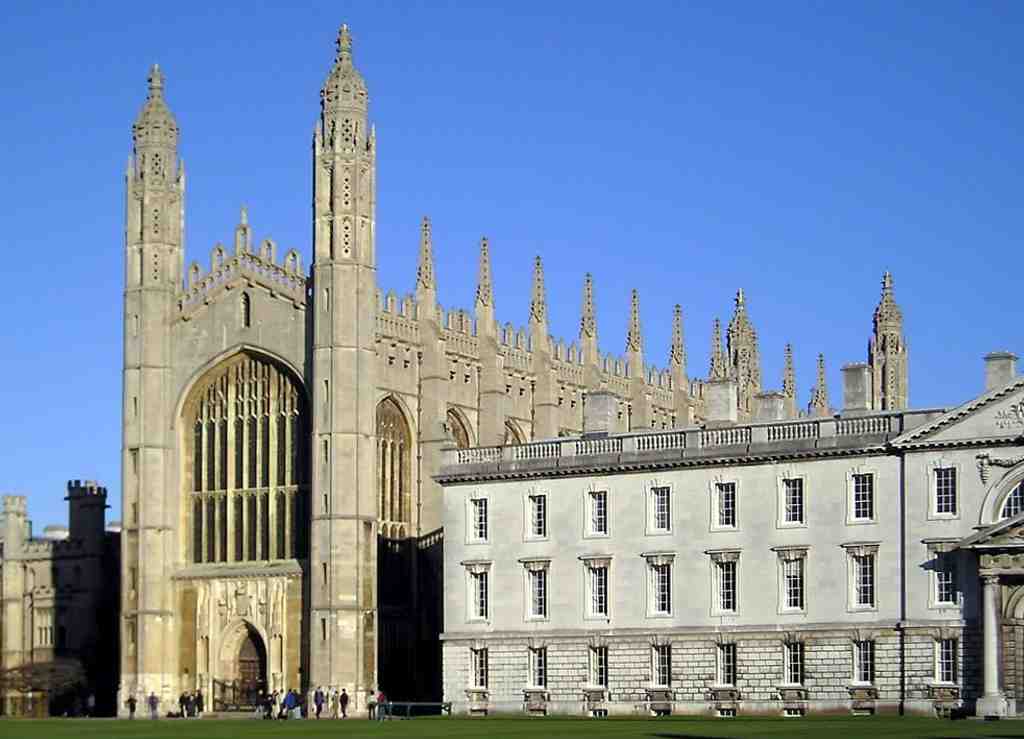
On your left, you will see a colossal pale stone building dominated by an enormous arched window and flanked by two soaring, intricately carved spires. Awe-inspiring, isn't it? But look closely at the walls, because this magnificent structure bears the literal scars of history, the physical growing pains of a kingdom at war with itself.
King Henry the Sixth laid the very first stone of King's College Chapel in 1446. He dreamed of a grand space, and to make room, he ordered a massive clearing of the town centre, demolishing houses, shops, and even a parish church. The early work used a white magnesian limestone, but in 1461, the brutal Wars of the Roses interrupted everything. The king was imprisoned, and construction slammed to a halt. Local legend claims the workmen literally dropped their tools and fled, leaving a half-cut stone where it lay for over two hundred and fifty years.
When you look at the exterior, you can see a distinct line where the crisp white stone of the fifteenth century suddenly gives way to a yellowish limestone. That line represents decades of silence. Work finally resumed under Henry the Seventh, and by 1515, master mason John Wastell and his team achieved the impossible. They spent months perched high up on wooden scaffolding to build the world's largest fan vault, a spectacularly complex stone ceiling decorated with heavy floral carvings that weighs several hundred tons yet appears to float effortlessly above.
Yet, for all its sacred grandeur, these walls have constantly witnessed the clash between rigid authority and human defiance. During the English Civil War, Parliamentarian troops used the chapel as a training ground, carving swords and pentagrams into the walls near the altar. And modern rebellion has been just as spirited. Adventurous students known as Night Climbers have frequently scaled those sheer walls in the dark, sometimes leaving their marks high on the stonework.
Even the interior layout sparked furious clashes. In the 1960s, the college tore up the historic Tudor steps leading to the altar just to fit a magnificent painting by Rubens. This caused a massive rift. The famous novelist E. M. Forster, whose presence we noted earlier, led a furious protest, begging the college to admit its mistake and stop treating a living house of worship like a museum.
If you wish to see that floating ceiling for yourself, the building is open to visitors most days from half past nine to a quarter past three, though it is closed on Sundays. Now, let us leave this ecclesiastical grandeur behind and walk towards the very heart of secular university authority, as we head to the Senate House, just a four minute walk away.




