
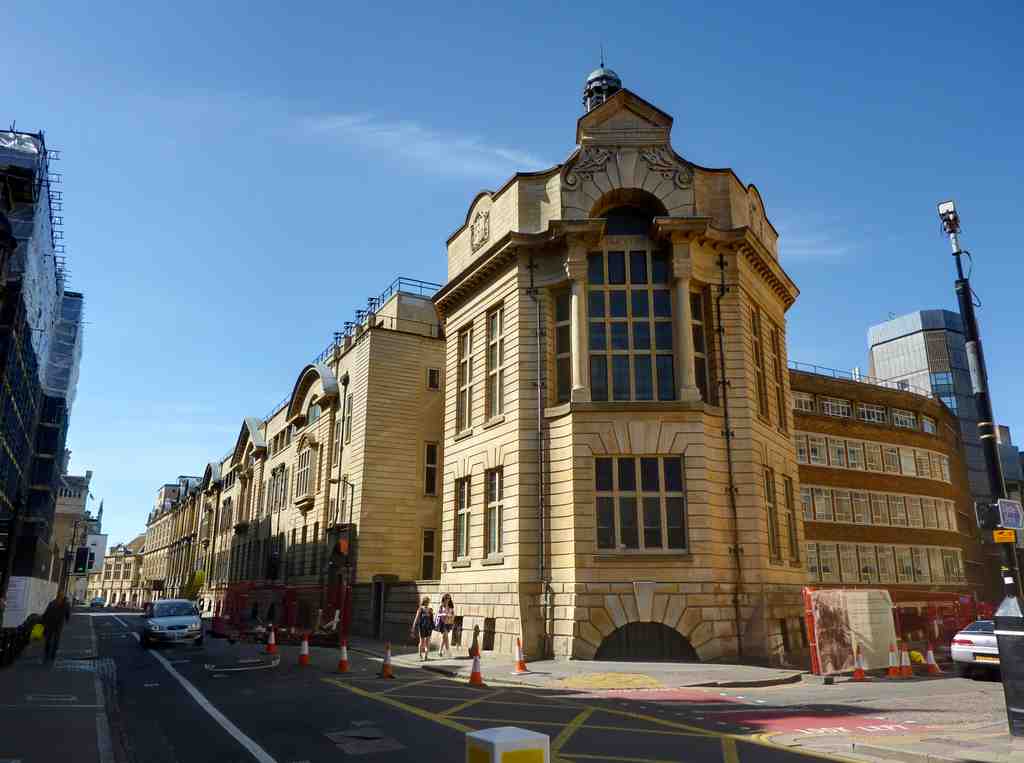
To your right as you approach the corner of Downing Street and Corn Exchange Street, you’ll spot a striking, cream-coloured building, its stonework almost glowing in the sunlight. The structure is strongly L-shaped, hugging both streets. Notice the large bay windows pushing out from the walls, the steep pediments above some of them, and the whole site’s grand, classic stature. Its face is lined with details-the tall, shallow bays, and rows of broad windows capture your eye straight away. Look up and you’ll see a high parapet and, right above the main door, shields carved in stone. Move a bit closer and you might make out delicate carved lilies and Eric Gill’s careful lettering etched along the front.
This is what was once the Cambridge Medical School building. Imagine Cambridge at the turn of the 20th century-horses clattering on these very stones-when doctor and reverend sat on the building committee, determined to make an impression. The architect, Edward Schroeder Prior, was called in. Tall, serious, under the weight of expectation, he met with fierce opinions: his plans swayed and shifted, his ideas reshaped by the committee's insistence-“Make it stone, make it classical, make it grand.”
He did. What stands before you is his largest building, its body inspired by the English Baroque but touched with the creativity of other masters-Belcher, Pite, and Blomfield. The stone façade you see was demanded by the committee, and Prior’s classical flourishes were both homage and clever compromise. If you run your hand along the wall, you’re touching the same stone chosen to leave a stamp on Cambridge for centuries.
Inside, the layout tells tales-corridors running long and straight, rooms that once heard the shuffle of future doctors' shoes, a lecture theatre so hushed and windowless that every lesson must have felt like secret knowledge being unearthed. The libraries inside, named Balfour and Newton, shelter collections that grew as the city did, filled with discoveries from every corner of the world. Even the staircase, designed with curved steps so dust had nowhere to hide, was built with the same care as the scientific works studied under this roof.
It became the Zoological Laboratory in 1933, transformed by architect John Murray Easton. Imagine-specimens arrived, libraries expanded, and up in the old Humphry Museum, marble columns gleamed beneath a hexagonal dome, all silent tribute to Sir George Murray Humphry, Cambridge’s surgeon-pioneer.
But the building never lost its sense of purpose, its sense of drama. Letters and mottos carved by Eric Gill share the stone with the carved lilies of Prior, while somewhere beneath these stories and arches, you might still hear the echo of Prior, with brush or chisel in hand, determined to prove that classicism-carefully built, carefully detailed-would never go out of style, no matter what the committee wanted. Every detail here tells you: this was, and is, a place where tradition and innovation walk side by side.




