
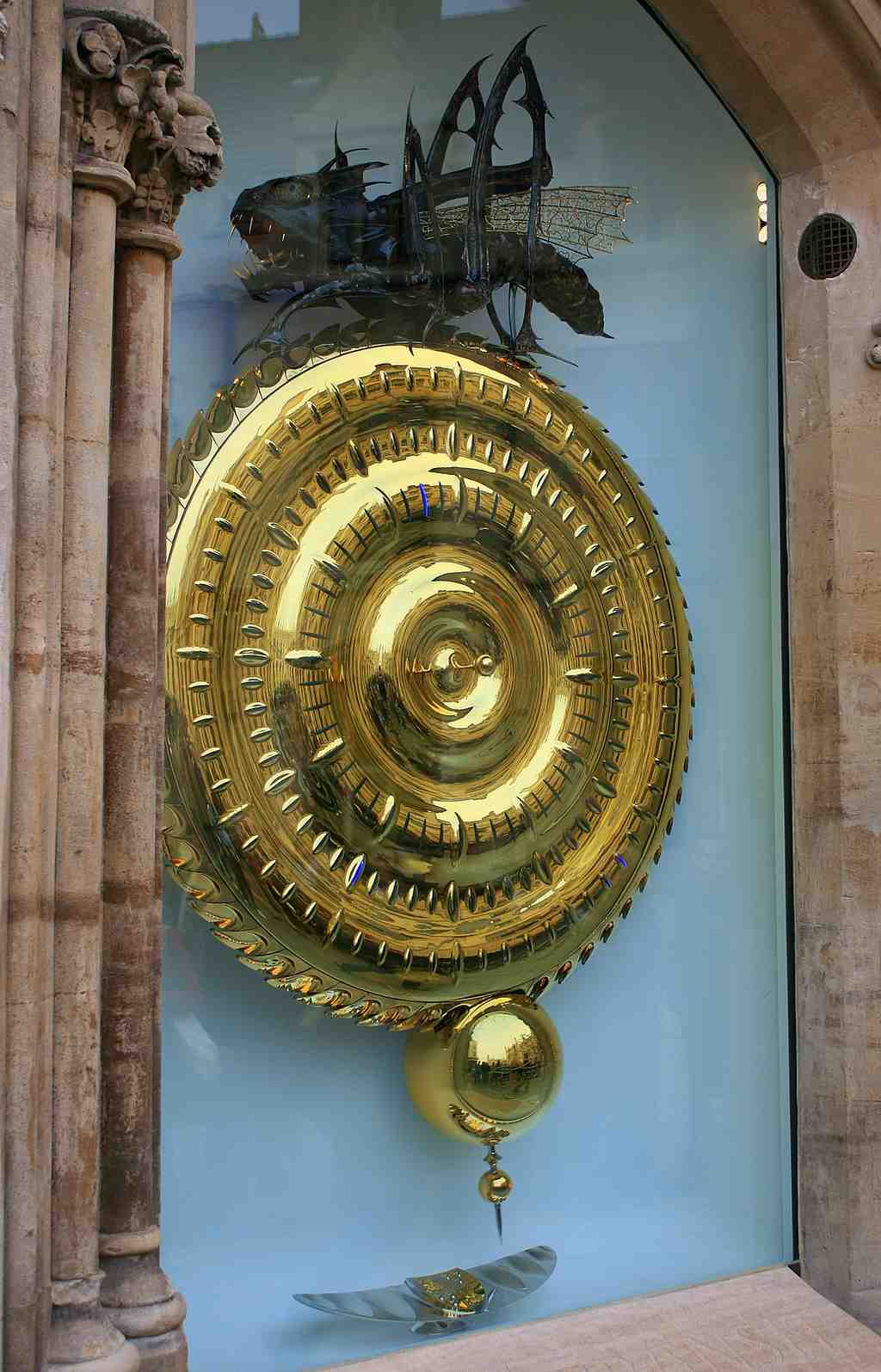
To spot the Corpus Clock, just look ahead at street level where a giant, rippling gold disc almost as wide as a doorway gleams in the glass, crowned by a menacing metal grasshopper perching on top-trust me, you can’t miss that unsettling bug!
Now, as you stand here on the edge of Bene’t Street, with the old stones of Cambridge humming quietly beneath your feet, let me pull you into the extraordinary world of the Corpus Clock-or as it’s more mischievously known, the Chronophage, the time eater! This isn’t your grandmother’s clock with gentle chimes and twirling hands. No, before you is a remarkable creature-a monstrous grasshopper or perhaps an alien locust-peering out over King’s Parade, jaws poised to devour every second of your day. If you listen closely, you might catch its next move: That’s the sound of time slipping away, swallowed bite by bite.
The clock’s face is actually a dazzling 24-carat gold-plated disc, about as round as a small dinner table, and entirely hand-crafted. But you won’t see any numbers or tell-tale hands; instead, blue LED lights mark out the hours, minutes, and seconds by briefly glowing through tiny slits, forming three dancing circles that shift around the disc. It’s as if time here is measured by ripples on a golden pond.
But the real star of the show-the creature looming above-is called the Chronophage. The very word means “time eater,” and you’ll understand why as you watch: its jaws snap and twitch, gulping down seconds, while its eerie eyelids flicker in random, almost sinister blinks. Legend has it, if you stare long enough, you’ll see it blink twice in rapid succession-but miss it, and well, that moment’s gone forever, just as the clock intends.
Invented and funded by John Taylor, a Cambridge alumnus who is clearly no fan of ordinary watches, this clock was unveiled to the world in 2008 with none other than Stephen Hawking himself presiding. Taylor wanted to give life to a message: that time is wild and unpredictable, not neat and regular like in movies. In fact, this clock is only truly accurate every five minutes. In between, it wobbles, stutters, stalls, then suddenly races-just like life itself. Sometimes the lights lag behind, sometimes they leap ahead in a panic, almost as if the clock has a mind of its own.
And let’s not forget-to give the whole enterprise a bit of Victorian drama-every hour is punctuated by the sound of a chain clanking into a hidden wooden coffin just behind the clock. A gentle reminder that our glorious moments tick away-right down to the last gloomy second.
If you look at the inscription below, you’ll see the Latin: “mundus transit et concupiscentia eius.” It means, “the world passeth away, and the lust thereof”-a haunting little note to make you pause and check your own watch!
But how does it work? Well, the magic is all in the mechanics. The Chronophage is powered by the world’s largest grasshopper escapement-a brilliantly clever invention from the eighteenth century, brought roaring-or should I say, chirping?-into the modern day. The grasshopper’s motion, powered by hidden gears and a swinging pendulum, is visible for everyone to see, something John Taylor thought would amaze passersby. And if you think it’s controlled by fancy computers-think again! Everything is mechanical: the gears, the springs, the escapements, all chattering together, with electricity only used to keep the blue LEDs twinkling and the internal motor wound up tight.
The creation of this clock took five years, an investment of one million pounds, and a team of two hundred people-engineers, sculptors, scientists, and artists-all working together like the tiniest cogs in a very big, very beautiful machine. The gold disc? Formed using a secret explosive process from Holland. The grasshopper? Sculpted by hand, right down to its twitching golden eyelids.
There are even other Chronophage clocks! A dragon version scowls from the Isle of Man, and another stands proudly in Douglas. But this one, right here in Cambridge, remains the most famous and possibly the most unsettling. The Corpus Clock has even made appearances in movies and television, from Bollywood to British TV to Chinese dramas, so you might be gazing at a real celebrity!
As you stand here, let the shifting lights and slow, grinding chomps remind you of just how cleverly-and deliciously-time marches on. Just try not to get hypnotized or you might find it’s eaten more time than you planned! Shall we move on before the Chronophage gets hungry again?
Interested in a deeper dive into the appearance, mechanics of the clock or the funding and realisation? Join me in the chat section for an insightful conversation.




