
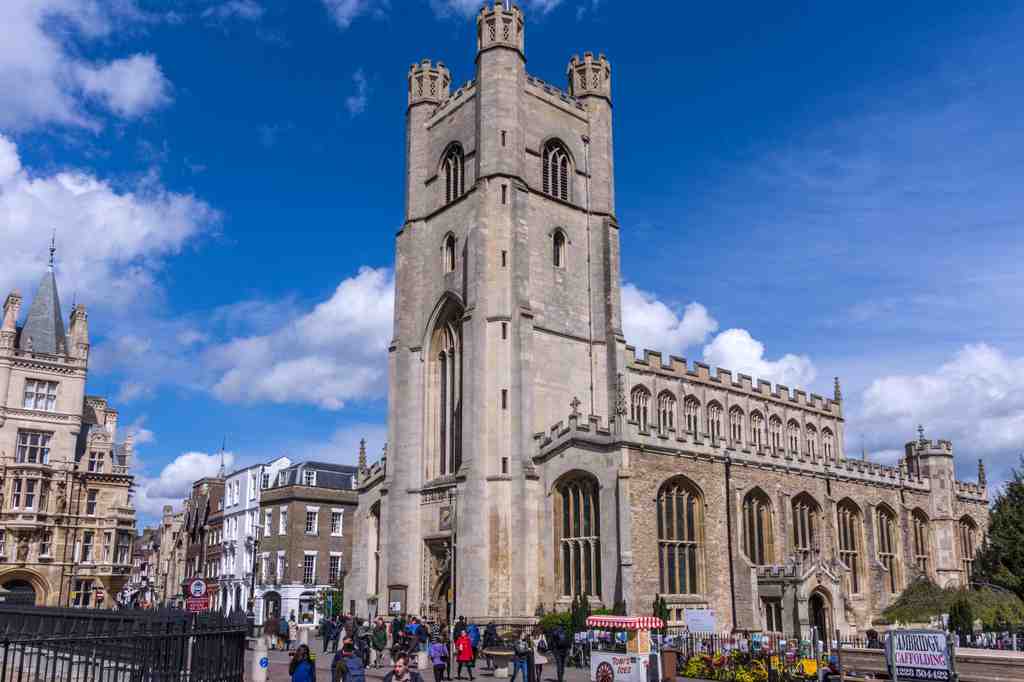
Right in front of you looms a tall, buckskin-colored stone church tower, its corners crowned with little castle-like turrets-just look for the largest, most impressive building on this end of King's Parade!
Welcome to the mighty Church of St Mary the Great, or as the locals like to say with a wink, “GSM”-because who wants to confuse it with Little St Mary’s down the road? Now, let’s step back in time together: picture yourself arriving in medieval Cambridge, the air buzzing with voices and the occasional clang of the market. This wasn’t just a parish church, it was the heartbeat of university life-so vital, in fact, that even today, Cambridge University insists its officers don’t live too far away, lest they miss out on any divine inspiration.
The story begins before the days of big stone walls: some say a church’s foundations were laid here as early as 1010, but in 1290, disaster struck. One hot summer night, a furious fire swept through and left the congregation staring at ashes. Imagine the tension as suspicions flew-locals blamed the city’s Jewish population and, in the angry aftermath, the synagogue was forcibly shut. What was rebuilt wasn’t only a place for prayer, but for power: by 1352 it had its new name, Great St Mary’s, and a new significance as the official gathering spot for university debates and the all-important University Sermons.
Over the years, the church saw more than just worship. Picture a hot-headed mob in 1381, storming the church during the Peasants’ Revolt, tearing up charters, bulls, and deeds-those precious papers fluttering like lost birds. As things calmed, the stone church you see today began taking shape between 1478 and 1519, funded partly by big-name kings like Richard III and Henry VII-probably not out of pure generosity, but hey, every brick tells a story.
The passion for grandeur didn’t stop on the outside. Step inside and your eyes are treated to soaring ceilings, stained glass windows by Hardman glowing in the sun, and walls thick with history. Here, even the furniture’s special: there’s a rare moveable pulpit and a font from 1632. Behind the altar, a gleaming sculpture of Christ in Majesty radiates calm-it’s actually quite new, added in 1960.
University tradition runs deep in these walls. For centuries, undergraduates crammed in for compulsory sermons, lining the galleries added in 1735. And if your ears are sharp, you’ll know this is where the famous “Cambridge Quarters” ring out from the tower-a tune so catchy, Parliament stole it for “Big Ben.” Those bells aren’t just for show, either: in 1724, a bunch of locals got together to form the Society of Cambridge Youths, now Britain’s oldest bell-ringing society. There’s such pride in the bells that in 2009, a shiny new set was installed thanks to a generous donation, but some originals stayed-so every time you hear that chime, you’re listening to centuries of history overlapping.
Music lovers rejoice: the church houses not just one, but two mighty pipe organs. The “University Organ” is the crown jewel-originally built way back in 1698 by the master organ builder everyone called “Father” Smith, then lovingly upgraded and restored over the years, becoming a living museum of British organ pipes. There’s even a second, lighter “Parish Organ,” keeping the parishioners singing sweetly since 1991.
The walls here have seen everything-fiery reformers like Erasmus and Martin Bucer preaching up a storm, and centuries later, sombre funerals for the likes of legendary physicist Stephen Hawking. In fact, beneath the south chancel, lie the ashes of Martin Bucer, once dragged out and burned in the marketplace, later reinterred when cooler heads prevailed. If ever there was a spot stacked high with drama, debate, and dignity, this is it.
So, the next time someone tells you Cambridge is just brains and books, remind them it’s also bells and bravery, flames and forgiveness-and all under the watchful gaze of St Mary the Great. Now, how about we head to our next stop before the bells start ringing again? Don’t worry, I promise not to make you do any compulsory sermons… or at least, not yet!
Seeking more information about the architecture and features, list of vicars or the burials and funerals? Ask away in the chat section and I'll fill you in.




