
Carlisle Audio Tour: An Acoustic Journey Through History
Beneath the ancient skyline of Carlisle, hidden stories linger in every red-brick shadow and echo off cathedral spires. This self-guided audio tour turns your walk through Caldewgate into a vivid adventure, unwrapping secrets and scandals most travelers never glimpse. What was the spark behind dramatic student protests at St Martin’s College that drew MPs to the streets? Which forgotten rituals once unfolded under the blue clock tower of Our Lady and St Joseph’s Church? Why did hospital corridors here see both heartbreak and hope before transforming into university lecture halls? Stride from military barracks to sacred towers, across academic battlegrounds and spiritual refuges. Each step reveals layers of rebellion, reinvention, and unlikely heroes who forever shaped Carlisle’s heart. Ready to discover the hidden city where history marches beside you and every stone tells a tale? Press play and let Carlisle unveil its secrets.
Tour preview
About this tour
- scheduleDuration 90–110 minsGo at your own pace
- straighten3.3 km walking routeFollow the guided path
- location_onLocationCarlisle, United Kingdom
- wifi_offWorks offlineDownload once, use anywhere
- all_inclusiveLifetime accessReplay anytime, forever
- location_onStarts at St Martin's College
Stops on this tour
lock_open 3 free previews · 12 unlock with purchase
But the story gets brighter! After World War II, this spot transformed from a workhouse to the Carlisle City General Hospital. You’d hear doctors and nurses bustling, stretchers…Read moreShow less
But the story gets brighter! After World War II, this spot transformed from a workhouse to the Carlisle City General Hospital. You’d hear doctors and nurses bustling, stretchers rolling down corridors, and the ever-reassuring beeps and pings that only hospitals seem to have. Between 1948 and 1999, this was where Carlisle’s little ones came into the world and where many wounds-big and small-were healed. Step forward into the sunshine of 2007, and voila! The University of Cumbria is born, but, like any great origin story, there were plenty of twists and turns to get here. The university is kind of like a superhero made of three powerful parts: St Martin’s College in Lancaster, the Cumbria Institute of the Arts right here in Carlisle, and the Cumbrian campuses of the University of Central Lancashire. Together, they merged into one, but not before St Martin’s College had to pass the ultimate academic test-the Quality Assurance Agency’s scrutiny, a nine-month grilling that would make anyone sweat. They passed! Independent degree powers were theirs in 2006. Not long after, the Privy Council, sounding grand as always, officially declared university status in 2007. Uni life here is far from ordinary. The Brampton Road campus, now alive with vibrant arts students, actually traces its roots back to a group called the Society for the Encouragement of Fine Arts, set up in 1822. Imagine paint brushes clinking, canvas rustling, and galleries filled with murmurs and laughter-arts and creativity have always been part of this community’s heartbeat. Let’s not forget Ambleside! That campus snapped into life from the dreams of Charlotte Mason, the 19th-century education pioneer, who believed in inspiring young minds in a beautiful setting (who wouldn’t?). Her “House of Education” grew into a lively teacher training college and, despite some dramatic closures and student protests in 2009-imagine the chanting and banners waving-the place was revived, and students returned in 2014, much to everyone’s relief. Lancaster’s campus sits atop the old Bowerham Barracks, where soldiers once drilled and marched. Later, it taught the teachers, then nurses, radiographers, health professionals, and even sports coaches. If the walls could talk, you’d probably hear echoes of marching boots, giggles over test tubes in science labs, and the thud-thud of basketballs in the sports centre. Innovation hasn’t stopped with history. There’s even a new Pears Cumbria School of Medicine, opening soon in partnership with Imperial College London. Medical degrees from Carlisle awarded by one of the world’s top universities? Sounds pretty cutting-edge, doesn’t it? Now, before you think it was all smooth sailing, let’s sprinkle in some drama-the university faced some tricky times and a mountain of debt, about £13 million at one point. Let’s just say their bank account looked a bit like a student’s after Freshers’ Week-empty! But with a bit of luck and a lot of hard work, they’re back in the black now. Today, the University of Cumbria is proud of its “distributed learning network,” a clever way of saying students can study in lots of locations-Carlisle, Lancaster, Ambleside, the Energus Centre in Lillyhall, and formerly, even London and Penrith. Let’s not forget the sports-cricket balls flying, rugby tackles, cheers at the hockey pitch, and the persistent squeak of sneakers on netball courts every Wednesday afternoon. So, whether you’re here for the arts, sciences, health, business, leadership, or those all-important Wednesday matches, you’re walking through a place filled with stories-of hope, reinvention, resilience, a little controversy, and a lot of creativity. And if you listen carefully, you might just hear the whisper of an old artist’s brush or a nurse’s gentle goodnight echoing across the years. Let’s keep walking-who knows what stories we’ll stumble on next? Interested in a deeper dive into the campuses, organisation and structure or the academic profile? Join me in the chat section for an insightful conversation.
Open dedicated page →

Show 12 more stopsShow fewer stopsexpand_moreexpand_less
Look ahead for a grand, reddish-brown stone structure with a large square tower rising above it-it’s hard to miss the slate roofs and the unusual blackened patches on its mighty…Read moreShow less
Look ahead for a grand, reddish-brown stone structure with a large square tower rising above it-it’s hard to miss the slate roofs and the unusual blackened patches on its mighty walls. Welcome to Carlisle Cathedral! If you feel the air tingle with history, don't be surprised-this is one of England’s oldest and most storied cathedrals. Imagine you're standing where monks and kings have both walked, surrounded by stones that have soaked up nearly 900 years of bustling whispers, holy chants, and the occasional snoozing monk. Speaking of snoozes, rumor has it those choir stalls inside have little flip-up seats-misericords-meant to keep monks from falling asleep during marathon prayers. But let’s head back to the beginning. The story starts in 1122, when Carlisle’s church was founded as an Augustinian priory. Back then, this land was wild and windswept, and even the sheep needed prayers. It was Prior Athelwold, a determined Englishman, who led the first brothers on a strict, nearly Cistercian life. By 1133, this church earned a big promotion, becoming the Cathedral Church of the Holy and Undivided Trinity-quite a name, and quite a job! Athelwold himself found out, becoming the first Bishop of Carlisle. Unlike most grand English cathedrals, which were founded by the Benedictines, this one kept its Augustinian roots. That made it special-a rare survivor of just four such conversions across England. Stroll by the south transept and nave, and you’ll spot the thick Norman stonework with columns tilting at strange angles. That’s not just creative design; the ground’s been shifting here for centuries. The original stone is local red sandstone; in some places, it’s weathered so much it’s nearly black. The cathedral didn’t escape fire or war, either. In 1292, a mighty fire tore through the building, leaving a smoky mess behind. The choir, that splendid east end, had to be rebuilt in shining new Gothic style-wider and grander than before, topped with a barrel ceiling painted with stars and colors. The cathedral’s most striking feature is the massive East Window. If sunlight pours through, you’ll see its rainbow glow flood the interior. This is the biggest window in the “Flowing Decorated Gothic” style in all of England: 51 feet high and 26 feet wide. The stone tracery is so complex, people have counted over 260 different points in its design! Some of the stained glass is original medieval art; the rest, a Victorian patch-up job. Either way, it’s a kaleidoscope you can’t miss. Ever wonder why the nave is so short? Well, in the English Civil War, Scottish soldiers knocked down much of it to fortify Carlisle Castle with the stones. War really does take a toll on your local architecture! What remains now is just two bays in length, used as the Chapel of the Border Regiment-a reminder that faith and conflict sat side-by-side in this border city. This place is alive with stories. The 15th-century carved choir stalls, for example, feature everything from half-angel, half-creature monsters to scenes from the lives of saints and, for a bit of mischief, a woman beating a man-a medieval joke every good cathedral needed. If only those seats could talk! And the monks, it seems, sometimes dozed off and singed the canopies overhead with their candles. Now that’s what I call a fire hazard. Even the deanery has a tale-a 15th-century tower with a painted ceiling, and the Fratry, once the monks’ dining hall, now buzzes with new life, thanks to a modern extension. The quiet cloisters and old priory fragments are Grade I listed treasures, while the grounds hint at vanished storerooms and wrecked dormitories, casualties of civil war and time’s patient hand. Music wafts through these halls, too. Since 1133, boys and men have sung here, with today’s choir including both girls and boys from local schools-though I’m told the parents are grateful the rehearsals don’t run all night! The cathedral boasts an organ with a story nearly as long as the building, its pipes echoing every era-from Victorian times to the present day. So gaze up at the weathered stones, the mighty window, and picture centuries of faith, conflict, laughter, and music all packed into these walls. Carlisle Cathedral: living proof that even history has a sense of humor and a beautiful song. Want to explore the architecture, dean and chapter or the burials in more depth? Join me in the chat section for a detailed discussion.
Open dedicated page →It all started back on a chilly November day in 1973, when BBC Radio Carlisle first hit the airwaves. Back then, Cumbria as a county didn’t even exist yet. The station was so…Read moreShow less
It all started back on a chilly November day in 1973, when BBC Radio Carlisle first hit the airwaves. Back then, Cumbria as a county didn’t even exist yet. The station was so ahead of its time, it was broadcasting before the county it’s named after was created! They must have had a crystal ball-or at least a good sense of timing. Their first listeners tuned in across what was then Cumberland, probably adjusting their radio dials while eating buttered toast. Fast-forward to 1982, almost ten years later-someone had the bright idea to change the name to BBC Radio Cumbria, just as the station’s coverage ballooned to wrap around the whole, newly created county. That meant not only the rolling landscapes of Cumberland and Westmorland, but even a patch that used to be part of Yorkshire and an exclave of Lancashire called “North of the Sands.” With all those shifting borders, I think even the maps needed a cup of tea and a lie down. But the station didn’t stop expanding. For nearly a decade, in the south, you could catch an alternate broadcast, BBC Radio Furness, which focused more on southern voices and stories and even used their own little Barrow-in-Furness studio. Just imagine-while breakfast was sizzling in kitchens up north, someone down south was grumbling about the rain with their own special broadcast. You could pick up the signal all the way along the sparkling edges of Morecambe Bay to the west coast as far as Millom. It’s like Cumbria was the original home of the “split screen” experience. Sadly, by the 1990s, BBC budget cutbacks meant fewer unique broadcasts for the south, but by now, BBC Radio Cumbria had already made its mark. In fact, the old Hartington Street studio where much of this happened is now the local HQ for the Labour Party. From airwaves to politics-a real career move! Now, here’s a fun fact: BBC Radio Cumbria is famous for its “Lamb Bank” segment, where local farmers announce daily livestock exchanges. Now, I don’t know if you’ve ever heard live radio sheep-trading, but trust me, it’s utterly unique-imagine a morning commute interrupted by a farmer announcing, “I’ve got three gimmers for swap. Any takers?” Radio gold! With Cumbria’s massive hills, wild weather, and lots of sheep (about six for every person), keeping the county connected was no easy feat. The station beams out on FM from Sandale or Morecambe Bay, with more little transmitters than you can count on your fingers-Kendal, Whitehaven, Windermere, and even Brisco, here in Carlisle, on good-old-fashioned medium wave. Some listeners even used to tune in through medium wave on 756 kHz right here in the city. And who am I to argue with tradition? It took until 2021 for BBC Radio Cumbria to join the digital party with DAB+. That’s right, it was the last local BBC station in England to go digital, dragging its feet like a teenager on a Saturday morning. If you’re more of a screen person, you can also find them on Freeview TV. And if you prefer streaming, there’s always BBC Sounds. Local shows are broadcast from this very studio every weekday morning till early afternoon, and if you’re a sports fan, they’ve even bagged an award-winning Saturday Sport show, with exclusive coverage of Carlisle United and their legendary debates-imagine the tension: two passionate fans, one microphone, a referee in the middle. So, as you stand here, picture the voices that have filled these studios-farmers with their lambs, football commentators calling last-minute goals, and presenters connecting one-third of Cumbria’s people. It’s all happening right inside this building. Next time you hear a sheep on the radio, you’ll know exactly where it came from! Fascinated by the bbc radio furness opt-out, background or the technical? Let's chat about it
Open dedicated page →In front of you, you’ll spot a long and weathered brick and stone wall, overgrown in places with patches of greenery, with tall, sloping sides and a sturdy barred doorway at its…Read moreShow less
In front of you, you’ll spot a long and weathered brick and stone wall, overgrown in places with patches of greenery, with tall, sloping sides and a sturdy barred doorway at its center-just keep your eyes on the grassy area ahead and look for the thick, fortress-like barrier stretching across. Alright, picture this: It’s the late 1100s. Imagine yourself dressed in woolly layers, boots squelching in the mud of medieval Carlisle, the air smoky from home fires and thick with the sound of clanging iron. You’re standing in the shadow of the mighty city walls-the last line of defense between you and whatever trouble might be brewing just beyond, whether it’s rampaging Scots, mischievous livestock, or, if you believe the older folk, the odd ghostly Roman legionnaire. These walls once wrapped snugly around the heart of Carlisle, keeping it safe from invaders and, let’s be honest, from some of the town’s rowdier neighbors, too. Stretching out for just over 2 kilometers, the walls connected Carlisle Castle in the northwest with the Citadel in the southeast, like a great stone belt holding the city together. But don’t go thinking these are just any old walls-oh no! The very stones you see went up in the 12th century, replacing rickety timber barricades left behind by the Romans. Imagine a stern medieval builder with a bit of a grudge against draughty houses. Over the centuries, these walls saw sieges, battles, and more stormy politics than you receive in your inbox. At one end stood the Citadel, originally a mighty gate designed by a chap named Stefan von Haschenperg-try saying that three times fast! Eventually, the southern gate was blocked, and folks had to detour through Englishgate, which probably made for a few grumpy mornings. Now, as time marched on, Carlisle’s walls had plenty of bad hair days-neglect, wars, even a near-demolition by the Scots. By the late 1700s, folks decided it was more important to let traffic and fresh air through, so out came the demolition crews. The stones got recycled into fancy new court buildings and the grand Eden Bridge, all with help from legendary engineers Thomas Telford and Robert Smirke. But this chunk of wall remained, stubborn as ever, holding back the old river cliff. The houses that once clung to the wall’s side are mostly gone now, leaving the ancient stones exposed to sun, rain, and the occasional gawking tourist. Today, as you stand here, just close your eyes and listen-the wind might carry echoes of hooves, laughter, or the grumbling of masons from centuries past. See, even in a city that never sits still, history has a way of hanging on, stone by stone.
Open dedicated page →In front of you, you’ll see a mighty red sandstone fortress with thick walls and a sturdy tower rising above the grassy earthwork-just look for the tall flag fluttering at the top…Read moreShow less
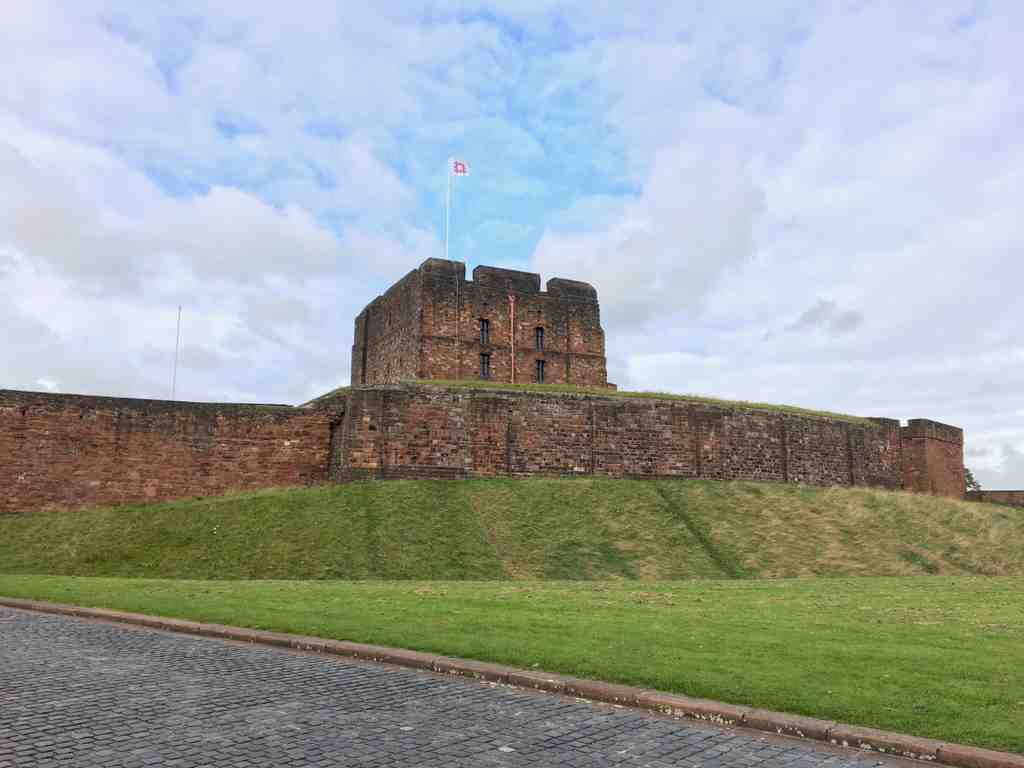
In front of you, you’ll see a mighty red sandstone fortress with thick walls and a sturdy tower rising above the grassy earthwork-just look for the tall flag fluttering at the top and you’ll know you’ve arrived at Carlisle Castle. Now, take a moment to soak it all in-the wind whipping around these ancient walls, the echoes of battles and whispers of forgotten kings. Carlisle Castle has stood here for over 930 years, watching over the northern borderlands of England like a never-blinking sentry. But don’t let its sleepy modern looks fool you-this place is packed with more drama than a whole season of your favourite TV show! Imagine it: the year is 1092, and William II, the son of William the Conqueror, has just marched his army into what was then the edge of Scotland. On the ruins of a battered old Roman fort, he commands the building of a wooden motte and bailey castle-the beginning of Carlisle’s transformation from muddy outpost to mighty fortress. You can still almost hear the sound of hammers and axes as they carve the first shapes into history. A few decades later, Henry I decided to prove that castles, like cheese, just get better with age if you fortify them-and replaced the wooden structure with the thick stone keep you see now. From then on, this castle was at the absolute heart of every squabble, skirmish, and siege between England and Scotland. Hungry for drama? In 1138-after the Battle of the Standard-David I of Scotland came knocking with an army and rebuilt much of the place. Just imagine his soldiers’ boots crunching over the stones, all hoping not to be the next unlucky ghost to wander these halls. Throughout the centuries, Carlisle Castle has played both hero and villain. At one point, it was the headquarters for the Western March-a kind of medieval border patrol zone, where “making friends with the neighbours” meant fending off raiders and putting out fires. The most stubborn of those neighbours? Well, who else but Scotland! The castle changed hands many times in these border wars, and its long list of governors reads almost like a who’s who of medieval power players-barons, knights, even bishops, all passing through these echoing corridors. If you listen very closely, maybe you’ll sense a faint hint of bagpipes or the thunder of hooves from the days Scottish armies pounded on the gates. In fact, Mary, Queen of Scots herself was imprisoned here for a few months in 1568, gazing out from the Warden’s Tower. They say she watched football matches from her window-proof that even queens get bored behind bars. Sir Gawain, one of King Arthur’s legendary knights (and a bit of a troublemaker himself), is rumoured to have stayed at Carlisle Castle too. Legend has it he hunted in the haunted Inglewood Forest nearby, charmed the lord’s wife, and did things we won’t repeat in polite company. Some even whisper that this could be Camelot itself. Watch out for knights in slightly rusty armour-if you see a round table, you know you’ve wandered into the wrong century! The castle became a fortress not just of stone, but of memory. The last great battle was during the Jacobite Rising in 1745. “Bonnie Prince Charlie” and his supporters seized Carlisle and shored up its defences, only to lose it again to the redcoats of Duke Cumberland-who then locked up the Jacobites in their own stronghold. After that, the wars died away, and the castle traded catapults for clipboards, becoming an army HQ and depot all the way up through the 20th century. If walls could talk, these ones would recite tales of prisoner carvings, secret tunnels, and the strange graffiti discovered only recently. Inside today, you’ll find Cumbria’s Museum of Military Life, packed with regimental stories, uniforms, and medals. The spirits of ancient soldiers probably shake their heads when they see modern visitors-no swords, no armor, just smartphones and umbrellas. So, as you stand here in the shadow of this grand and battered keep, remember: you’re sharing ground with Roman legionaries, Norman knights, Scottish kings, bold border reivers, trapped queens, and mischievous poets. Carlisle Castle may look peaceful now, but under your feet, the ghosts are still busy, and the stones are just bursting to tell another story. And if you suddenly hear footsteps behind you... don’t be alarmed-it’s probably just me, your trusty guide, making sure you made it to the final stop!
Open dedicated page →

Frequently asked questions
How do I start the tour?
After purchase, download the AudaTours app and enter your redemption code. The tour will be ready to start immediately - just tap play and follow the GPS-guided route.
Do I need internet during the tour?
No! Download the tour before you start and enjoy it fully offline. Only the chat feature requires internet. We recommend downloading on WiFi to save mobile data.
Is this a guided group tour?
No - this is a self-guided audio tour. You explore independently at your own pace, with audio narration playing through your phone. No tour guide, no group, no schedule.
How long does the tour take?
Most tours take 60–90 minutes to complete, but you control the pace entirely. Pause, skip stops, or take breaks whenever you want.
What if I can't finish the tour today?
No problem! Tours have lifetime access. Pause and resume whenever you like - tomorrow, next week, or next year. Your progress is saved.
What languages are available?
All tours are available in 50+ languages. Select your preferred language when redeeming your code. Note: language cannot be changed after tour generation.
Where do I access the tour after purchase?
Download the free AudaTours app from the App Store or Google Play. Enter your redemption code (sent via email) and the tour will appear in your library, ready to download and start.
If you don't enjoy the tour, we'll refund your purchase. Contact us at [email protected]
Checkout securely with 




