
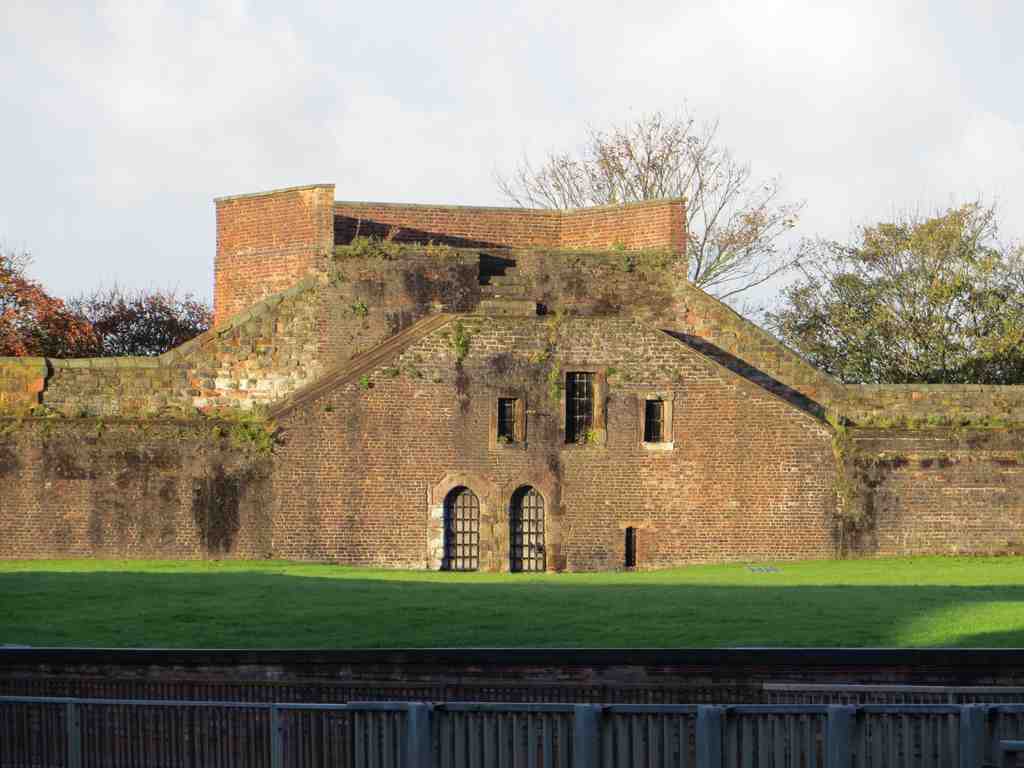
In front of you, you’ll spot a long and weathered brick and stone wall, overgrown in places with patches of greenery, with tall, sloping sides and a sturdy barred doorway at its center-just keep your eyes on the grassy area ahead and look for the thick, fortress-like barrier stretching across.
Alright, picture this: It’s the late 1100s. Imagine yourself dressed in woolly layers, boots squelching in the mud of medieval Carlisle, the air smoky from home fires and thick with the sound of clanging iron. You’re standing in the shadow of the mighty city walls-the last line of defense between you and whatever trouble might be brewing just beyond, whether it’s rampaging Scots, mischievous livestock, or, if you believe the older folk, the odd ghostly Roman legionnaire.
These walls once wrapped snugly around the heart of Carlisle, keeping it safe from invaders and, let’s be honest, from some of the town’s rowdier neighbors, too. Stretching out for just over 2 kilometers, the walls connected Carlisle Castle in the northwest with the Citadel in the southeast, like a great stone belt holding the city together.
But don’t go thinking these are just any old walls-oh no! The very stones you see went up in the 12th century, replacing rickety timber barricades left behind by the Romans. Imagine a stern medieval builder with a bit of a grudge against draughty houses. Over the centuries, these walls saw sieges, battles, and more stormy politics than you receive in your inbox. At one end stood the Citadel, originally a mighty gate designed by a chap named Stefan von Haschenperg-try saying that three times fast! Eventually, the southern gate was blocked, and folks had to detour through Englishgate, which probably made for a few grumpy mornings.
Now, as time marched on, Carlisle’s walls had plenty of bad hair days-neglect, wars, even a near-demolition by the Scots. By the late 1700s, folks decided it was more important to let traffic and fresh air through, so out came the demolition crews. The stones got recycled into fancy new court buildings and the grand Eden Bridge, all with help from legendary engineers Thomas Telford and Robert Smirke. But this chunk of wall remained, stubborn as ever, holding back the old river cliff.
The houses that once clung to the wall’s side are mostly gone now, leaving the ancient stones exposed to sun, rain, and the occasional gawking tourist. Today, as you stand here, just close your eyes and listen-the wind might carry echoes of hooves, laughter, or the grumbling of masons from centuries past. See, even in a city that never sits still, history has a way of hanging on, stone by stone.




