
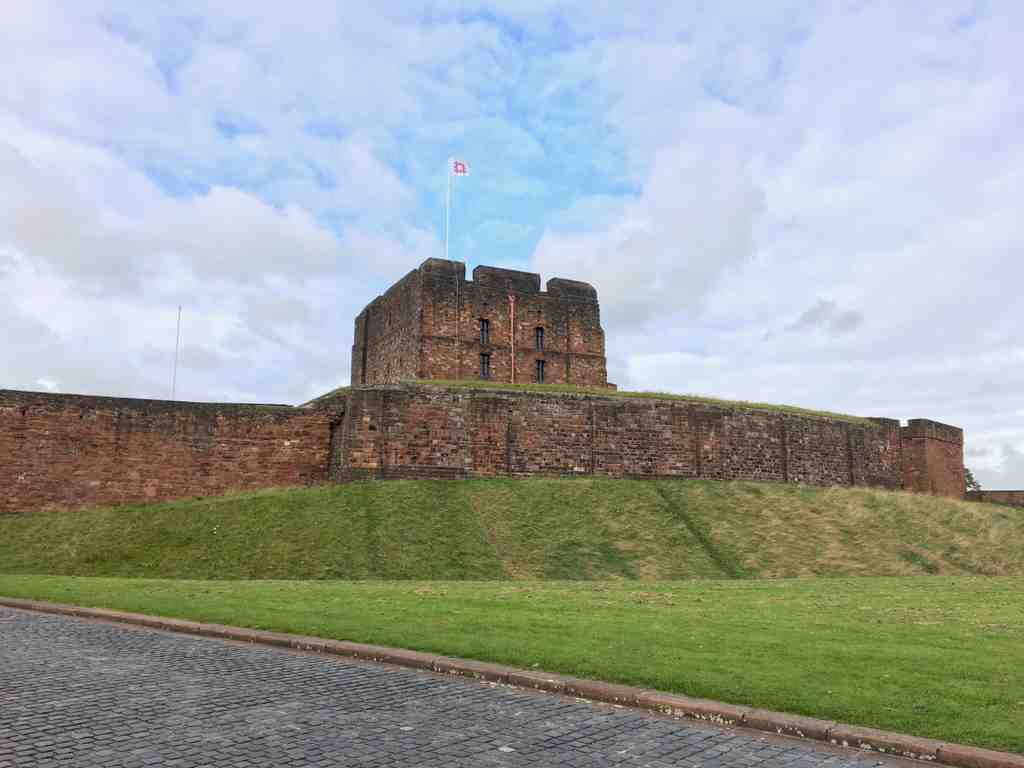
In front of you, you’ll see a mighty red sandstone fortress with thick walls and a sturdy tower rising above the grassy earthwork-just look for the tall flag fluttering at the top and you’ll know you’ve arrived at Carlisle Castle.
Now, take a moment to soak it all in-the wind whipping around these ancient walls, the echoes of battles and whispers of forgotten kings. Carlisle Castle has stood here for over 930 years, watching over the northern borderlands of England like a never-blinking sentry. But don’t let its sleepy modern looks fool you-this place is packed with more drama than a whole season of your favourite TV show!
Imagine it: the year is 1092, and William II, the son of William the Conqueror, has just marched his army into what was then the edge of Scotland. On the ruins of a battered old Roman fort, he commands the building of a wooden motte and bailey castle-the beginning of Carlisle’s transformation from muddy outpost to mighty fortress. You can still almost hear the sound of hammers and axes as they carve the first shapes into history.
A few decades later, Henry I decided to prove that castles, like cheese, just get better with age if you fortify them-and replaced the wooden structure with the thick stone keep you see now. From then on, this castle was at the absolute heart of every squabble, skirmish, and siege between England and Scotland. Hungry for drama? In 1138-after the Battle of the Standard-David I of Scotland came knocking with an army and rebuilt much of the place. Just imagine his soldiers’ boots crunching over the stones, all hoping not to be the next unlucky ghost to wander these halls.
Throughout the centuries, Carlisle Castle has played both hero and villain. At one point, it was the headquarters for the Western March-a kind of medieval border patrol zone, where “making friends with the neighbours” meant fending off raiders and putting out fires. The most stubborn of those neighbours? Well, who else but Scotland! The castle changed hands many times in these border wars, and its long list of governors reads almost like a who’s who of medieval power players-barons, knights, even bishops, all passing through these echoing corridors.
If you listen very closely, maybe you’ll sense a faint hint of bagpipes or the thunder of hooves from the days Scottish armies pounded on the gates. In fact, Mary, Queen of Scots herself was imprisoned here for a few months in 1568, gazing out from the Warden’s Tower. They say she watched football matches from her window-proof that even queens get bored behind bars.
Sir Gawain, one of King Arthur’s legendary knights (and a bit of a troublemaker himself), is rumoured to have stayed at Carlisle Castle too. Legend has it he hunted in the haunted Inglewood Forest nearby, charmed the lord’s wife, and did things we won’t repeat in polite company. Some even whisper that this could be Camelot itself. Watch out for knights in slightly rusty armour-if you see a round table, you know you’ve wandered into the wrong century!
The castle became a fortress not just of stone, but of memory. The last great battle was during the Jacobite Rising in 1745. “Bonnie Prince Charlie” and his supporters seized Carlisle and shored up its defences, only to lose it again to the redcoats of Duke Cumberland-who then locked up the Jacobites in their own stronghold. After that, the wars died away, and the castle traded catapults for clipboards, becoming an army HQ and depot all the way up through the 20th century.
If walls could talk, these ones would recite tales of prisoner carvings, secret tunnels, and the strange graffiti discovered only recently. Inside today, you’ll find Cumbria’s Museum of Military Life, packed with regimental stories, uniforms, and medals. The spirits of ancient soldiers probably shake their heads when they see modern visitors-no swords, no armor, just smartphones and umbrellas.
So, as you stand here in the shadow of this grand and battered keep, remember: you’re sharing ground with Roman legionaries, Norman knights, Scottish kings, bold border reivers, trapped queens, and mischievous poets. Carlisle Castle may look peaceful now, but under your feet, the ghosts are still busy, and the stones are just bursting to tell another story. And if you suddenly hear footsteps behind you... don’t be alarmed-it’s probably just me, your trusty guide, making sure you made it to the final stop!




