
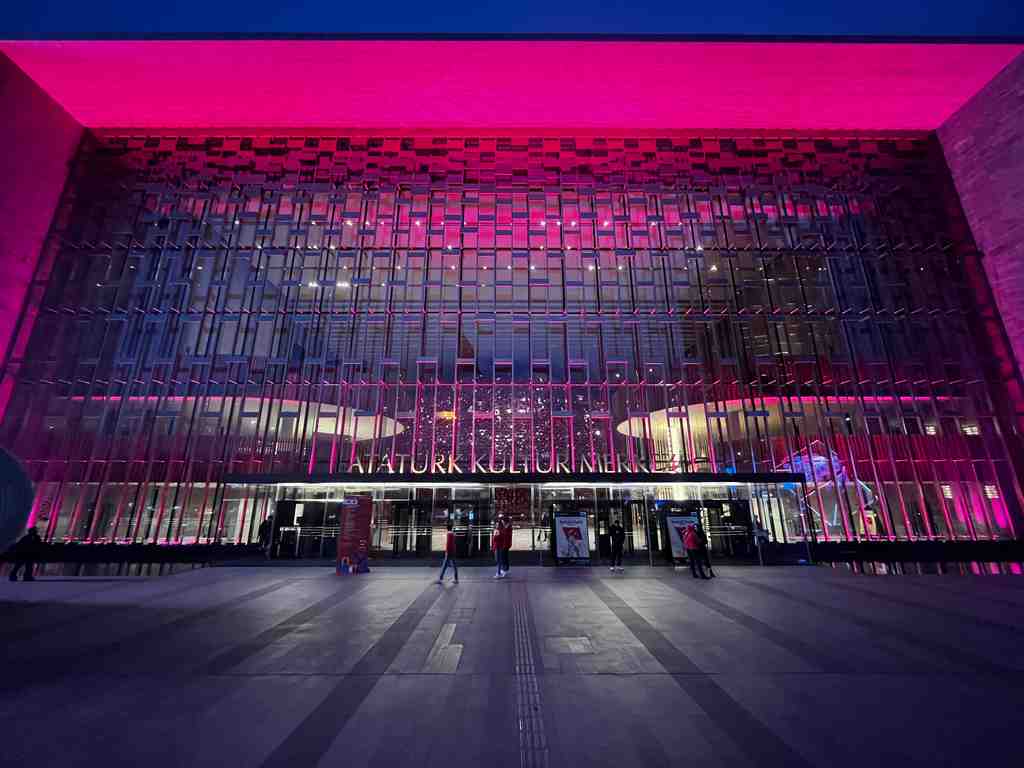
On your left, look for the big, modern glass-fronted building with a grid-like metal screen glowing in pink and purple light-that’s the Atatürk Cultural Center, or AKM.
AKM sits right on Taksim Square like Istanbul’s living room for the performing arts: opera, ballet, theater, concerts, even big congress-style events-plus exhibition spaces and a cinema. The city has a thousand places to buy a simit, but only a few that can swallow an opera production whole, orchestra and all.
The story starts with ambition and patience. The first version of this building began in 1946, but like so many big public projects, it ran into the classic obstacle: no money. Work stalled, the project changed hands, and eventually architect Hayati Tabanlıoğlu took over and pushed it forward. After 23 years-yes, twenty-three-it finally opened in 1969, originally called the Istanbul Cultural Palace. For the debut, the program went big: a ballet by Ferit Tüzün and Verdi’s Aida. Not exactly a “soft launch.”
Then came the plot twist. In 1970, during a performance of Arthur Miller’s play The Crucible, a fire ripped through the building and left it badly damaged. No one died, but the loss was still brutal: along with the hall itself, items brought from Topkapı Palace for an upcoming production-objects linked to Sultan Murad the Fourth, including a robe, a valuable Quran, and a painting-were destroyed. The cause of the fire was never pinned down, which only adds to the unease. A modern cultural temple, burned mid-performance, for reasons nobody could confidently name.
Tabanlıoğlu restored it, and in 1978 AKM reopened-stubbornly-continuing for decades as the home base for Istanbul’s state theater, opera and ballet, and symphony. Architecturally, the original AKM wore the clean, practical lines of the 1950s: less ornament, more purpose. Inside, it was a serious machine for stagecraft, built with a big hall, deep stage, and the kind of backstage mechanics that let productions transform fast.
But buildings age, and AKM became a national argument as much as a venue. It was closed from 2008 to 2018, pulled into lawsuits, restoration debates, and the political turbulence around Taksim. Eventually the old structure was demolished in 2018, and the new AKM rose from the same spot-opened in 2021, on October 29, Turkey’s Republic Day. Fitting date, considering AKM has always been as symbolic as it is practical.
Today’s complex is larger and more multipurpose: a major opera hall, a sizable theater, and the extras that keep a cultural center alive between showtimes-galleries, a library, cafes, and more.
When you’re set, Galatasaray Museum is a 12-minute walk heading north.




