
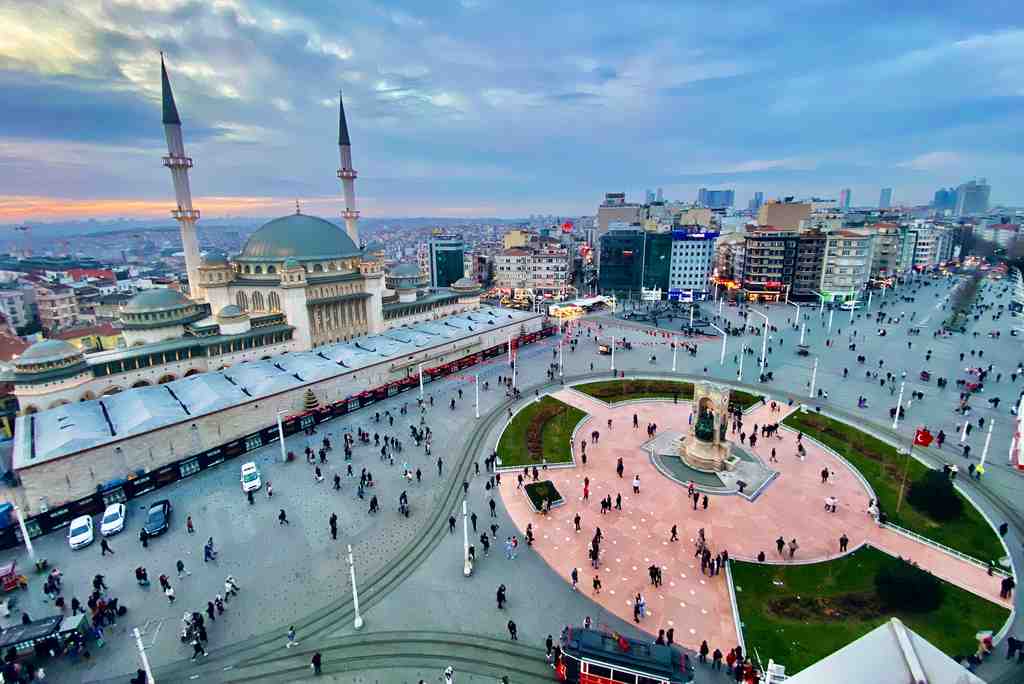
Ahead of you is a wide, open plaza with the Republic Monument set in the middle, and if you glance left you’ll spot a big domed mosque with two tall minarets watching over the square.
Welcome to Taksim Square-part meeting point, part transit hub, and part open-air stage where Istanbul keeps rewriting its own script. Today it feels like a giant shared living room: people cutting across the paving stones, the occasional nostalgic red tram gliding nearby, and an endless hum from buses, taxis, shops, cafés, and hotels radiating out in every direction.
But the square’s name gives away its oldest job, and it’s wonderfully practical. “Taksim” means “distribution.” In the Ottoman era, this area wasn’t a famous plaza at all-it was where water got managed. A reservoir and a small stone distribution building, a maksem, sat here to “divide up” water brought from the forests up north. In the early 1730s, Sultan Mahmud the First pushed a water system from the Belgrad Forest through a network of channels and structures, ending right here-then the water was sent out toward the surrounding neighborhoods. Istanbul may be a city wrapped in water, but fresh drinking water was always the hard part. So yes: one of the most iconic squares in Turkey is, at its origin, basically a municipal plumbing triumph. Try working that into a postcard.
For a long time, this still wasn’t really a “square.” If you could time-travel back to when the main street of Pera-today’s İstiklal Avenue-reached this point, the urban world would more or less stop, and beyond it you’d hit open ground with few trees and not much structure. Over the 1800s, the area took on a distinctly state-and-military vibe with barracks and training grounds. The place even gave its name to Talimhane-“training house”-a reminder that soldiers drilling here was once normal background noise.
The big transformation into a true city square came with the Republic era. The Republic Monument-right there at the center-arrived in 1928 and suddenly Taksim wasn’t just a junction or a blank space; it became a symbolic front yard for the new Turkey. Ceremonies, parades, grandstand seating, lights, and choreographed public life turned this into a national stage.
And like any stage, it has seen drama. From the 1960s onward, the square became a focal point for mass politics-sometimes hopeful, sometimes grim. In 1969, clashes during protests against the visiting U.S. Sixth Fleet led to deaths in an event remembered as “Bloody Sunday.” The worst tragedy came on 1 May 1977, when gunfire and panic during a massive Labor Day rally caused 34 deaths and many injuries-an open wound in the square’s memory.
Taksim also keeps physically reinventing itself. Parts of the traffic were pushed underground with pedestrianization work largely completed in 2013, and the square’s redesign has continued to be debated, voted on, and reshaped-because Istanbul never met a public space it couldn’t argue about passionately.
When you’re set, Atatürk Cultural Center is a 3-minute walk heading east.




