
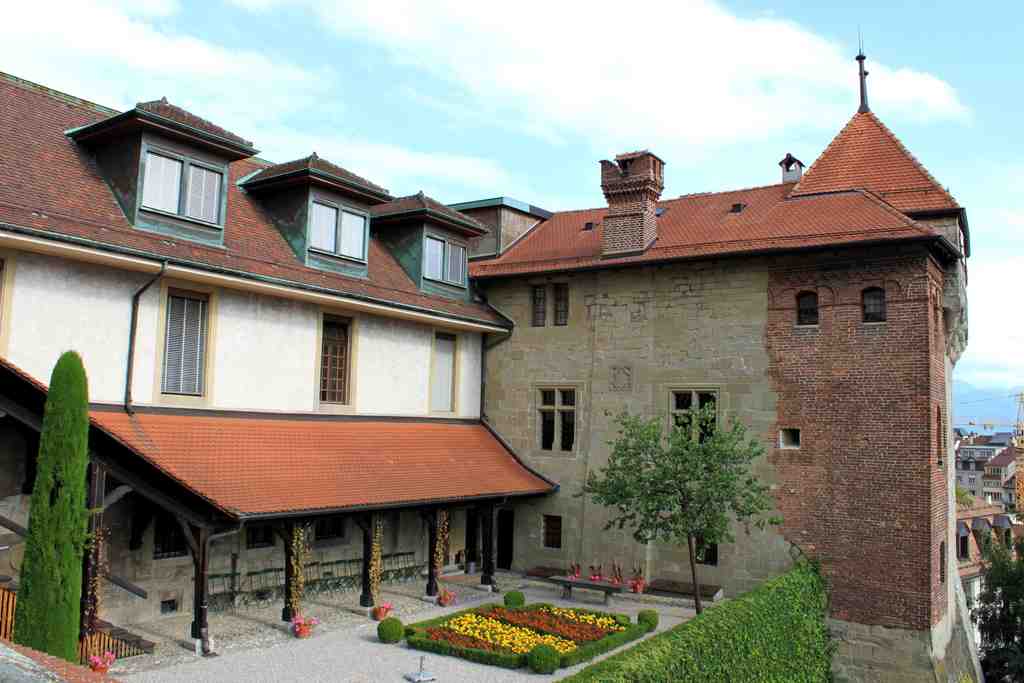
On your right, look for a pale stone building with a steep tiled roof, irregular medieval lines, and a modern glass entrance set into the old bishop’s palace.
This is the Musée historique Lausanne, but the first thing to know is that it survived by argument, not by accident. Long before it became a city museum, this building served as the bishop’s residence, part of the old machinery of religious power. Later, when Lausanne modernized at full speed, people began tearing away chunks of the old city as if history were clutter. Cities do love calling demolition “improvement.”
One of the first people to push back was Pastor Paul Vionnet. Starting in eighteen forty-seven, he gathered engravings, plans, and photographs to resist the disappearance of old Lausanne. He understood something crucial: if a city loses its buildings and also loses the images that prove they mattered, memory gets erased twice. His Collection iconographique vaudoise, created in eighteen ninety-six and later handed to the state, entered the museum in nineteen oh-three. After Paul died in nineteen fourteen, his daughter Esther Vionnet stepped in as interim curator, which gives this story a welcome human detail: the rescue of a city’s memory passed from one pair of hands to another.
The people around him became the guardians of old Lausanne. They were not dreamy nostalgics; they used documents, pictures, public exhibitions, and stubborn civic pressure to fight the vanishing of the historic city. They used documents, pictures, public exhibitions, and stubborn civic pressure to fight the vanishing of the historic city.
That fight became very real here. Around nineteen hundred, this former bishop’s residence already had some protection, yet certain elected officials still wanted part of it demolished. So, on the sixth of February, nineteen oh-two, Berthold van Muyden and others founded the Association du Vieux-Lausanne. That same year, they staged a major exhibition at the Grenette, and the public response brought in a flood of donations. In nineteen oh-eight, the city finally agreed to fund the conversion of former prison rooms inside this old bishop’s palace to house the collections. So the museum began not simply as a cultural project, but as a rescue operation with display cases.
If you glance at the image in the app, you can see that mix of old authority and later adaptation in the building itself: the medieval mass of the palace, then the cleaner intervention of the entrance added much later. Between nineteen oh-nine and nineteen seventeen, the architect Schmid de Veytaux carried out major restoration work to prepare the place for museum life. The museum opened here on the twenty-seventh of December, nineteen eighteen. Much later, between nineteen eighty-six and nineteen ninety, Wolfgang Freienberg added the glass entrance hall facing the cathedral square, a new staircase, and even a two-level shelter for cultural treasures under the west garden. Quite practical, really: save memory, then build a bunker for it.
Inside, the museum now holds more than five hundred fifty thousand objects, and since the reopening in twenty eighteen, its exhibition “Lausanne, l’Exposition” tells the city’s story in twelve thematic stations, including the twentieth and twenty-first centuries. The old bishop’s palace no longer governs souls; now it guards evidence.
And that turns the story. Once authority here wore a mitre. Then it wore a curator’s gloves. Next, we head toward another kind of trust altogether: Banque Cantonale Vaudoise, where confidence moves from relics and records into money, credit, and the paper promises that keep a modern city standing. If you want to return inside later, the museum is closed on Monday and open from eleven to six the rest of the week.




