
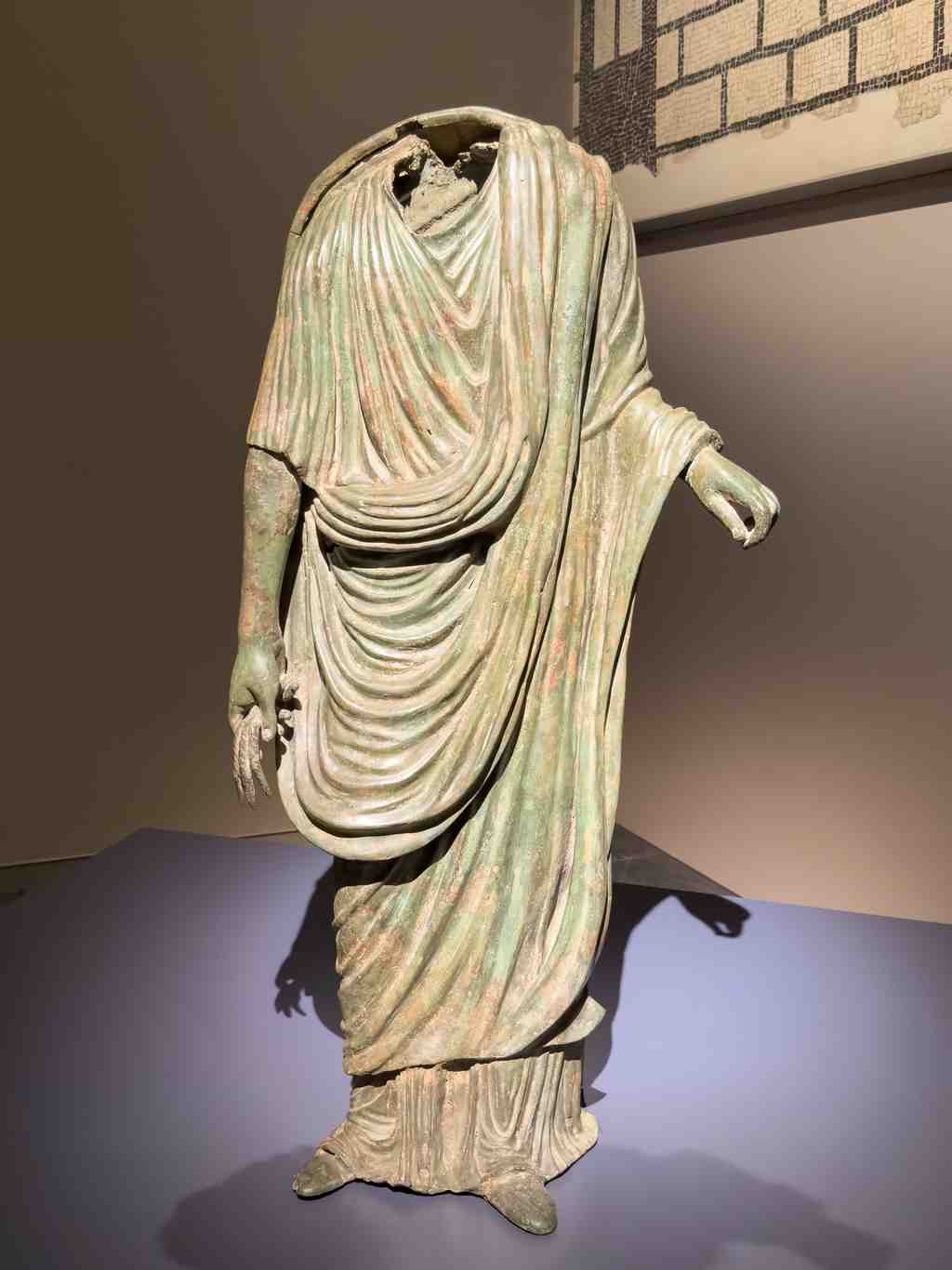
Look just ahead of you-you’ll spot a life-sized bronze figure clad in elegant, flowing robes. This headless statue stands tall and proud, even after all these centuries. The drapes look heavy, almost ready to rustle in a Roman breeze, and the statue’s hand once gestured, holding authority or perhaps greeting a friend-though you’ll notice the left hand and head are missing, giving it a mysterious air. This Togado stands almost eerily lifelike, with folds and textures so realistic you might expect him to step down and join you on your stroll. His bronze surface glimmers under the light in shades of green and brown, a gift from centuries of waiting for you to find him.
Let me take you back-not just a hundred years, but almost two thousand! We’re standing in front of one of the most important Roman statues ever discovered in Spain, known as the Togado of Pompelo. Imagine Pamplona, not with cafés and pintxos, but with the clang and chatter of Roman traders, all moving under the shadow of the Empire. Back then, this was Pompelo, a bustling Roman city, and this statue once watched over its citizens.
The story of this statue is an adventure worthy of Indiana Jones. It was made in the middle of the second century-think about that for a moment, that’s before chocolate, before the internet, even before pizza delivery! It was discovered by accident, buried deep in the earth right here in Pamplona in 1895. And then? Like a magician’s trick, it vanished! For over a hundred years, its whereabouts were a complete mystery. It traveled through secret collections in France and the United States. At one point, people thought it came from France, not Pompelo. It even went to an auction, but-believe it or not-nobody bought it! Eventually, a sharp-eyed specialist spotted the statue in a private collection, and Pamplona’s ancient secret was finally revealed again.
Why is this statue special? It’s the first bronze Roman toga’d figure found in Spain, and only thirteen like it survive across the whole world! Can you imagine? Five are from Pompeii and Herculaneum, where dust and lava have saved their secrets. Here is our own survivor, weathered by time and mystery, but still majestic. He’s a bridge to a past where Latin was spoken in the streets and togas were the fashion of the day. I guess you could say he was the trendsetter of ancient Pompelo-too bad he lost his head from all the excitement!
As you stand here, close your eyes for a second and imagine the Roman city teeming around you. Feel the thrill of discovery-because here you’re standing in the presence of a legend that not even centuries of secrets could keep hidden. Now, let’s head on to our next stop-the Pamplona Cathedral! I promise, no missing heads there.
Intrigued by the description, archaeological context or the open debate: male or female figure? Explore further by joining me in the chat section below.




