
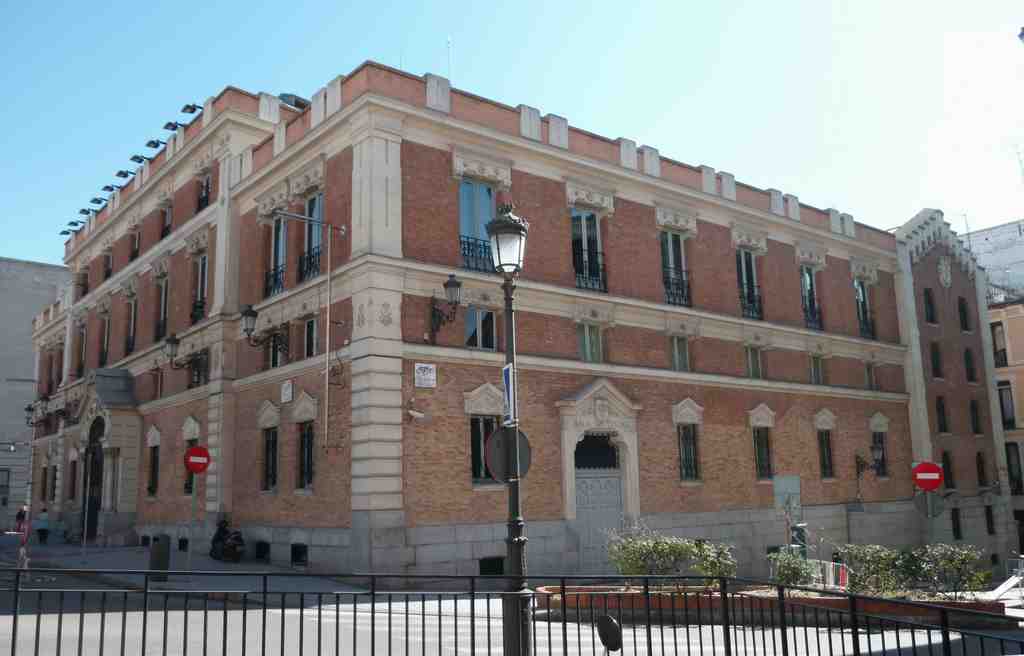
You’re looking for a large, elegant brick-and-stone building with tall windows, metal railings, and sturdy stone corners-just look across the plaza and you’ll spot its solid, angular facade and decorative entryway with the words “Sala de Ventas” above the door.
Welcome to the House of Jewels, or as the locals call it, La Casa de las Alhajas! Just imagine yourself in this very spot over a century ago, when this block-sized beauty was the stronghold of Madrid’s most precious treasures-not jewels you’d wear to a royal ball, but the ones pawned for a slice of hope and a handful of coins. The House of Jewels sits in the historic San Martín square, where you can practically hear the echoes of bustling passersby and horse-drawn carts from the days when this neighborhood was the old arrabal, or suburb, of San Martín.
Now, get ready for a twisty tale! This area once held the ancient Convent of San Martín, dating all the way back to 1126-the very first convent in Madrid! It survived centuries and changes, from a spiritual haven to a vital parish church, until one day, King Joseph Bonaparte (Napoleon’s brother, no less) came along with a sledgehammer’s dream and ordered its demolition. Poof! Up went a bigger plaza and a suitcase full of drama-because almost instantly, these hallowed grounds became everything from government offices to a guardhouse, even housing a provincial courthouse for a spell.
Then came the real surprise: buried under revolutions, reforms, and the constant shuffle of history, a charitable spirit was born. In 1702, a kind-hearted priest named Francisco Piquer had an idea-why not help Madrid’s poor with small, low-interest loans, taken against the jewels and belongings they held dearest? So the Monte de Piedad was founded. Over time, this little operation grew big, moved around a bit, then merged with the city’s newly formed Savings Bank-kind of like Madrid’s financial Batman and Robin, looking out for everyday people.
And so, in 1870, after the site’s tangled past and a competitive design contest (think: 19th-century “Madrid’s Got Talent”), construction began on this new headquarters. The building you see today is the result: a marvel of brickwork and limestone, with a layout wrapped around a bright, square patio, crowned by a glass skylight and ringed by slender iron columns. Imagine sunlight pouring into the central hall, illuminating crowds who gathered to redeem their keepsakes or bid in lively auctions. The architecture combined Italianate medieval details and bold modern technology-check out those iron beams and stylish balconies! Arbós and Aguilar, the architects, wanted every detail to serve a function. Rumor has it they even designed the furniture!
Inside, there were once grand murals and a cleverly ventilated strongroom where people’s precious items could breathe easy and stay safe, and a chapel for prayers-a full-service “lost-and-found” for both property and the soul. To make things even quirkier, the building housed not only staff but also the director and the chaplain. Imagine Sunday mornings: a cup of coffee, a quick blessing, and maybe inventorying a few watches and tiaras!
Through the decades, La Casa de las Alhajas stubbornly resisted demolition-sometimes by little more than luck-and instead found new life as a cultural space. Today, you might stumble on an art exhibit where fortunes were once stashed and auctioned. All the while, the old bones of the place remain: the grand stairs, the ironwork, and even the tombstone of the very priest who started it all, quietly tucked inside.
So, as you stand outside those thick, patterned doors, pause and listen-can you hear it? The quiet clink of coins hitting a tin bank, the quiet hope of someone’s treasure, waiting for a new beginning. And don’t worry, you don’t have to pawn your headphones to keep enjoying this tour!
For a more comprehensive understanding of the identification and location, property description or the use, engage with me in the chat section below.




