
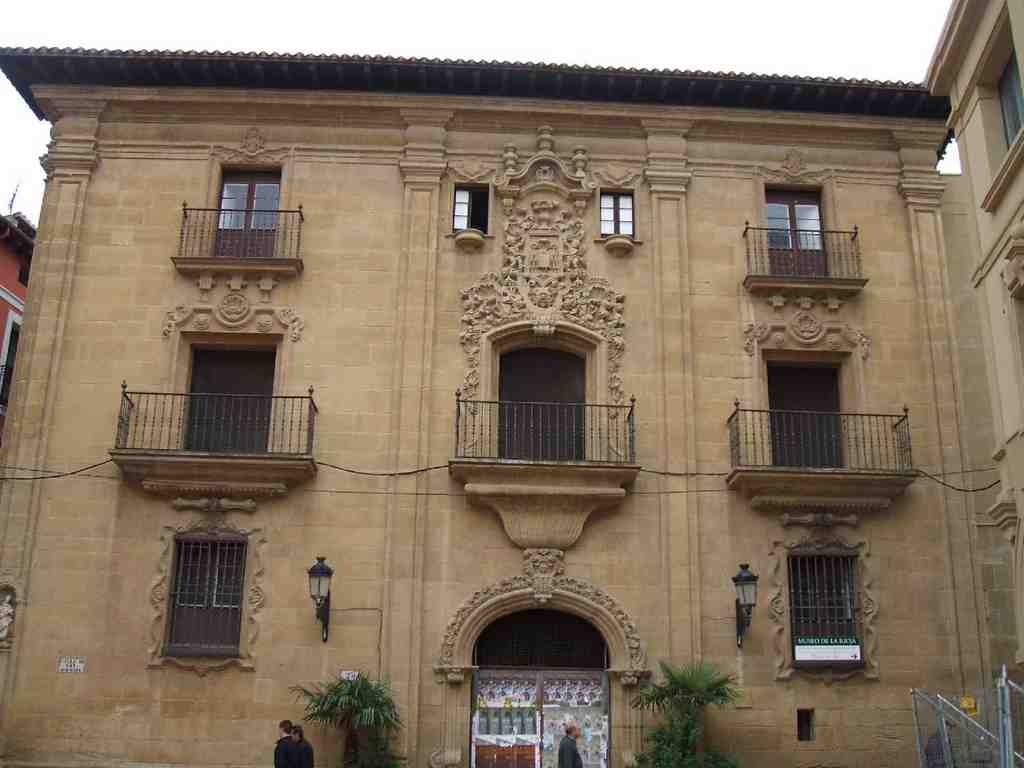
Look for a grand neoclassical stone palace with three floors, ornate balconies, an impressive central shield above the main entrance, and iron lamps flanking the doorway-it’s right in front of you!
Welcome to the Museum of La Rioja! If you're wondering how to spot it, just look for that majestic baroque building that seems to say, “I’ve seen it all!” This palace has more stories than your average wine barrel (and that’s saying something in La Rioja). Built in 1752 by Pedro Ruiz de la Porta, who fancied a bit of extra grandeur in his retirement, its centuries-old walls are buzzing with history.
Now, picture yourself in the late 1700s-wig-wearing nobles stroll in and out, and the air smells of fresh stone and ink from important documents. Over the years, the building changed hands almost as often as Logroño changes weather. When Pedro Ruiz de la Porta shuffled off this mortal coil, the palace passed to the Martínez de Sicilia family, and later it would become famous as the residence of none other than General Baldomero Espartero. Espartero was a well-known Spanish general, who, after finally waving goodbye to the world of politics, decided this was the perfect retirement pad. Maybe he liked the high ceilings; maybe he just wanted the best view in town!
He settled here with his beloved wife, Jacinta Martínez de Sicilia. Although they lived royally, they had no children. When both eventually passed on, the palace went to Vicenta Martínez de Sicilia y Fernánde de Luco, better known as the Marquesa de La Habana-a woman with a title as long as her to-do list. She rented the palace to the state, and from that point, the building transformed more times than a magician’s hat.
After a spell as the Government Military headquarters, it was almost turned into the bishop’s official residence. Imagine bishops walking down these storied halls, but alas, it wasn’t meant to be-the bishop never actually moved in! So, the palace did what empty palaces do: become a revolving door for new tenants. Over the next decades, the building played host to a children’s shelter, a savings bank, a business chamber, and even a group of artists-all before anyone realized, “Hey! This place might just be a treasure in itself.”
Fast-forward to the swinging 1960s. The place was named a Historic-Artistic Monument, and finally, in 1971, it officially became the Museum of La Rioja. But the adventure wasn’t over! Fasten your seatbelt-here comes the renovation rollercoaster. The museum saw closures, debates, near-empty halls, and even a construction standoff worthy of a spaghetti western. Regional and central government argued about whether to hollow out the historic walls and start anew or simply give it a careful facelift. Let’s just say, those walls have probably heard more dramatic arguments than a family dinner at Christmas.
In 2013, after nearly a decade (yes, a decade!) of stops and starts, repairs, and architectural wizardry, the museum reopened-bigger, brighter, and ready to dazzle everyone who walks in. Now, inside, you’ll discover rooms filled with treasures from the 12th to the 19th centuries. Glance around and you’ll see gothic wooden carvings, flamboyant paintings, and ancient archaeological finds-each with their own tantalizing secrets.
Don’t miss the museum’s true showstopper: the Tables of San Millán, original panels from a 14th-century altarpiece that once stood in the distant monastery of San Millán de Suso. Pictured on both sides are scenes from the lives of the Virgin Mary, Jesus, and San Millán-imagine all the stories hidden behind those quiet, painted faces.
And there’s plenty more-the museum houses everything from contemporary art to the nuts and bolts of La Rioja’s agricultural and domestic life. Every exhibit, whether it’s an ancient Roman artifact, a mysterious medieval sculpture, or a lovingly carved piece of furniture, is part of the region’s rich tapestry. Thanks to the museum’s own expansion, you can now get lost (not literally, don’t worry!) in extra galleries, a library, and an exhibition hall, all humming with the life and times of La Rioja.
So, as you stand beneath the palace’s rococo crest and gaze at its stately balconies, remember: this building isn’t just a museum. It’s a living, breathing storyteller full of twists, turns, and enough drama for a whole season of historical soap operas. Ready to step through those doors? Your adventure is just beginning!




