
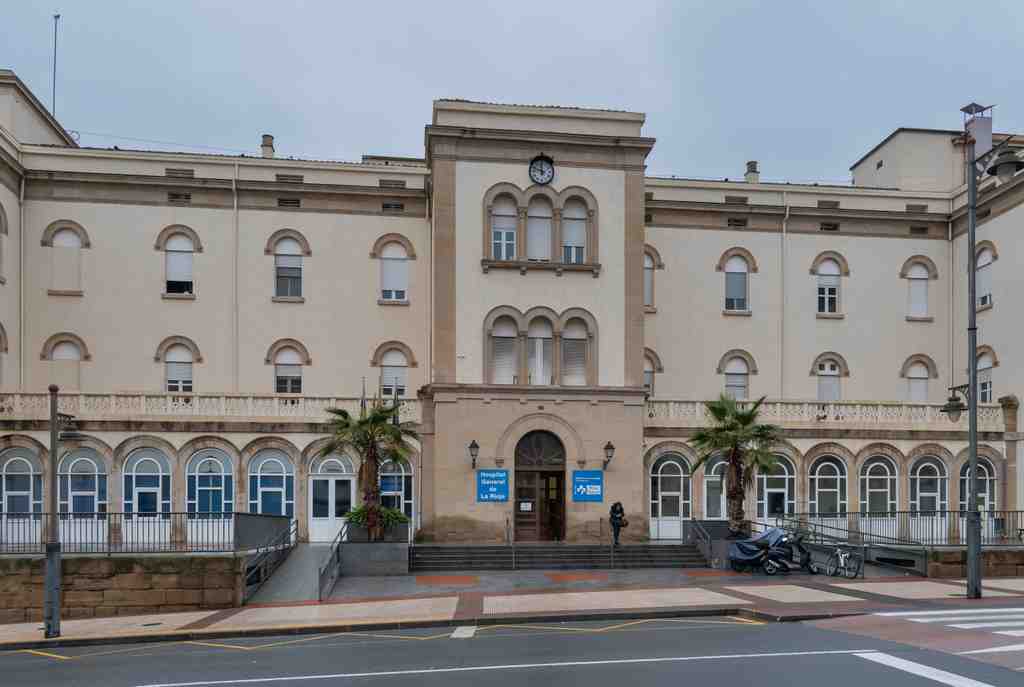
To spot the General Hospital of La Rioja, just look for a large, sand-colored building with a central clock above its arched entryway, standing grandly across the street-impossible to miss with its neat rows of windows and touches of palm trees out front.
Now, standing right here, can you feel the echoes of history in the air? The General Hospital of La Rioja isn’t just a place of healing-it’s a living storyteller, whispering centuries-old secrets into the wind. If these walls could talk, they’d tell tales of both hardship and hope, dedication and drama, and maybe even a few unexpected animal sounds-yes, there was once a farm in back, but let’s not get ahead of ourselves!
Back in medieval Logroño, being admitted to a hospital wasn’t exactly a badge of luxury. Quite the opposite-those lucky enough to afford care were treated at home, while hospitals like the ones here were a last refuge for the poor, the sick, and the outsiders. You might have stumbled upon a collection of small, impoverished hospitals scattered around the city-Rocamador, San Juan, San Gil, San Blas, and the infamous lazareto of San Lázaro, where contagious patients were sent for treatment. Imagine the isolation out there in the southwestern wilds, until the lazareto was demolished in 1747 after years of abandonment.
A city’s fate often hinges on the decisions of kings, and so it was at the end of the fifteenth century when Ferdinand and Isabella, Spain’s Catholic Monarchs, decided to merge these scattered hospitals into one grand institution-the Hospital de la Misericordia. It was built near the San Francisco convent and the city’s bullring, because nothing says “get well soon” like the sound of cheering toro fans in the background. The hospital earned a heroic reputation during the plague outbreak in 1599 and again during the cholera epidemic of 1834. It wasn’t all grim, though; can you picture the shuffling of busy nurses, the clang of soup pots, the whispered prayers, and the hope that somehow-although resources were always scarce-someone might recover?
Plagues and fires go hand in hand with grand stories, and in 1869, a devastating blaze destroyed the old convent-turned-barracks, clearing the way for what would become the modern-day hospital right here. Commissioned by the provincial government and designed by Jacinto Arregui, the new “Casa de Beneficencia y Hospital Provincial” took shape in the 1860s in this very spot, up north in the city near Plaza del Coso. The H-shaped floor plan, completed in 1866, was like a pair of welcoming arms. A royal stamp of approval came in 1871 when King Amadeo I of Savoy himself inaugurated the almost-finished hospital-though, as is tradition with big projects, there were still some finishing touches left.
You can almost hear the bustle of the original hospital team: a chief physician, a military doctor, oculists (not the most popular at parties, I hear), a surgeon, a pharmacist, and three brave nurses from the “sisters of charity.” Then there were the six traditional nurses, ten male attendants, the gardener, the porter, the man responsible for chopping wood, and even someone to care for abandoned children-and yes, at the back, a barn where cows were milked right on hospital grounds. That’s right, it wasn’t just the patients saying “moo”!
Fast forward to the horrors of 1918-the Spanish flu pandemic-when the number of beds simply couldn’t keep up. As Logroño’s population doubled between 1900 and 1930, the constant search for more space led to the creation of the Casa de Socorro for emergencies in the 1920s, a precursor to what we think of today as an emergency room.
Decades rolled by, and medicine kept changing. By the 1960s, this wasn’t just any hospital: there were consultations for ear, nose, and throat troubles, ophthalmology, specialized rooms for treating prisoners, and a space where the nuns who cared for the sick lived and worked. Over the years, the hospital survived the end of charity-run care and pivoted to serve alongside San Millán-which eventually closed, leaving this grand old building to shine once again.
Today, the Hospital General de La Rioja serves nearly 320,000 local residents, specializing in short-term stays for chronic patients, mental health day care, and even a center for reproductive and sexual health. But if you listen closely, you’ll still sense the echoes of centuries past-of pandemics, royal visits, cows in the backyard, and everyday heroes working tirelessly within these thick old walls. And just imagine: if old ghosts do walk the halls, they’re probably arguing about whose turn it is on milking duty. Welcome to the beating, breathing heart of Logroño’s history-one story at a time.




