
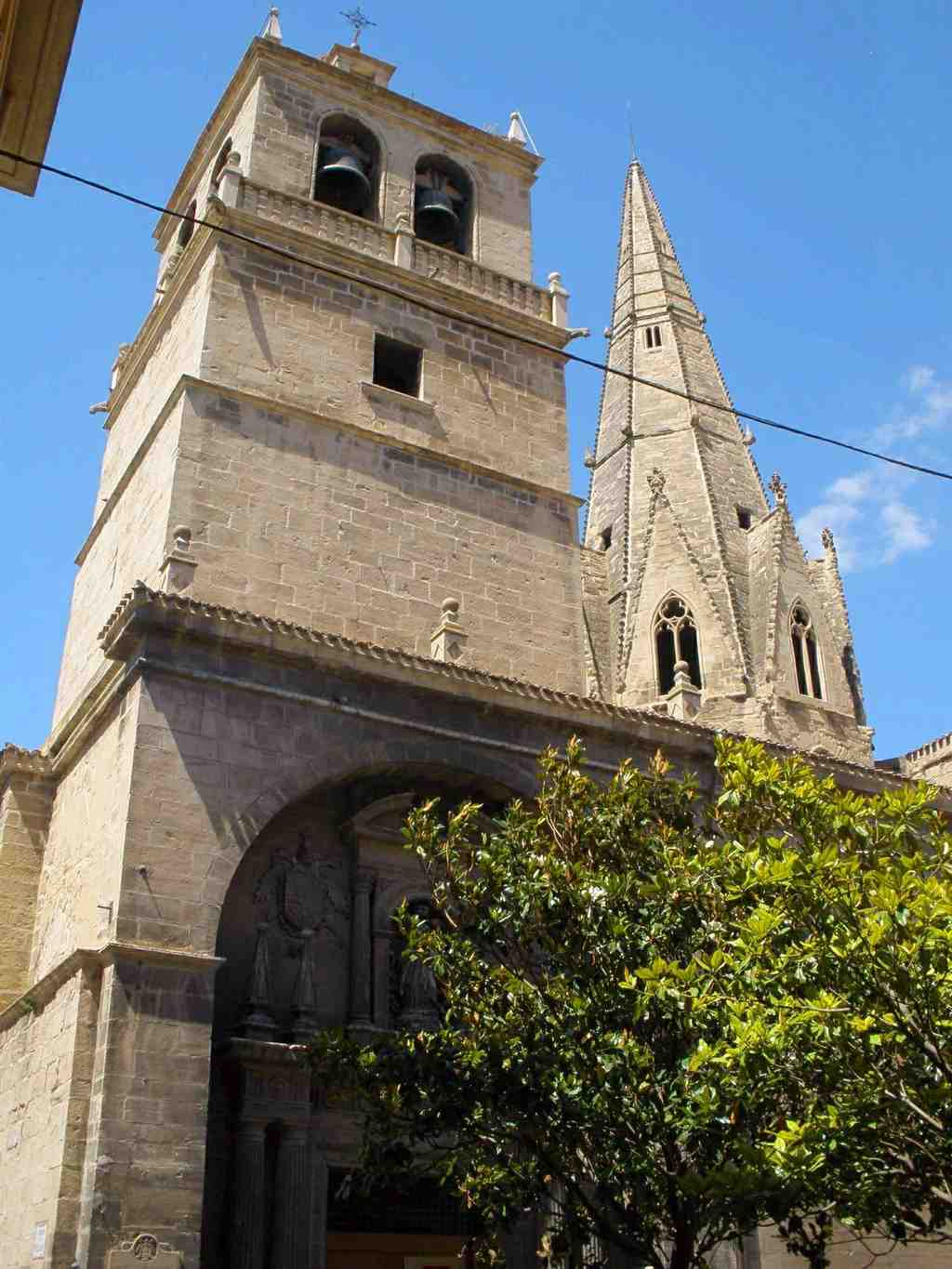
To spot the Church of Santa María de Palacio, look ahead for a stone church with a towering square bell tower on your left and a striking, steep octagonal spire shooting toward the sky on your right.
Take a deep breath and imagine you’re wandering into medieval Logroño-dust swirling, merchants calling out their wares, and pilgrims hurrying along the Camino de Santiago. Right here stands the Church of Santa María de Palacio, a place that’s seen everything from royal donations to near disasters! Now, why “Palacio”? Well, in 1130, King Alfonso VII was feeling particularly generous and decided to gift his very own palace-not exactly something you’d find lying around! With that, the first outpost of the Order of the Holy Sepulcher was born in Castile. And because it came straight from a king, the church even gets to flaunt the grand title “imperial”-move over, humble parish churches!
The oldest stones beneath your feet date back to the 1200s, and if those stones could talk, they’d whisper stories of knights and monks reshaping half the church over the centuries. And look high above-the iconic crown-shaped spire! That’s no ordinary steeple; it’s an eight-sided, gothic, pointy hat so impressive it’s become the calling card of Logroño. But don’t let that elegant facade fool you; in the 1600s, that spire was so wobbly, city officials nearly tore it down. Picture horses and carts detoured away from the street for fear the whole thing might tumble down at the slightest.
Inside, the church is a feast for your senses. Rows of columns rise up, holding beautiful vaults of gothic stonework over three naves and absidal chapels. But brace yourself-because the main altarpiece is absolutely spectacular! Crafted by the master Arnao de Bruselas, it was actually meant for Logroño’s concatedral, but was turned away due to a little too much donor pride… So it found a forever home in this church, and lucky for us! The altarpiece is like a storybook in wood and gold: scenes from Christ’s life, the mysterious figures of the prophets, a whole cast of saints swirling around a family tree known as the Tree of Jesse (think of it as the medieval version of “Who’s Who” of biblical ancestry). At the top, you’ll spot Saint Jerome with a ferocious lion and Saint James the pilgrim-the original travelers!
And then there are the treasures: The oldest of all is the sculpture of the Virgin of la Antigua, a sweet-faced figure with an echo of Byzantium in her style, nestled in a gorgeous baroque chapel. And for the locals, nothing is more important than the figures honoring San Bernabé, the city’s patron (to whom locals owe some of their noisiest fiestas), and San Mateo, beloved during the riotous wine harvest festival. It’s as if the very heart of Logroño beats inside these walls.
Now, don’t miss that organ! There’s more mystery to it than an unsolved detective novel. No one really knows its original date, and after being zapped with all sorts of modern electrics, it’s more Frankenstein than Bach. Some of the sounds are gone for good, but every Sunday at noon, echoes drift out, filling this imperial nave with music.
Even the door has a story: you’ll see the Baroque southern entrance built in 1627, marked by imperial shields and an image of the Assumption. And if you wander around to Rúa Vieja, there’s another entrance, this one celebrating Saint John-a quiet nod to the many ways of entering this spiritual haven.
So as the sunlight shines through those gothic points and the ancient stones seem to hum with secrets, imagine centuries of footsteps echoing around you-kings, monks, townsfolk, and travelers-making this church not just a monument, but a living piece of Logroño’s soul. And hey, if you listen closely, maybe you’ll catch the ghostly clink of a king’s keys or the laughter of an organist trying to squeeze a tune out of his cantankerous keyboard.
Fascinated by the origin, temple architecture or the altarpiece? Let's chat about it




