
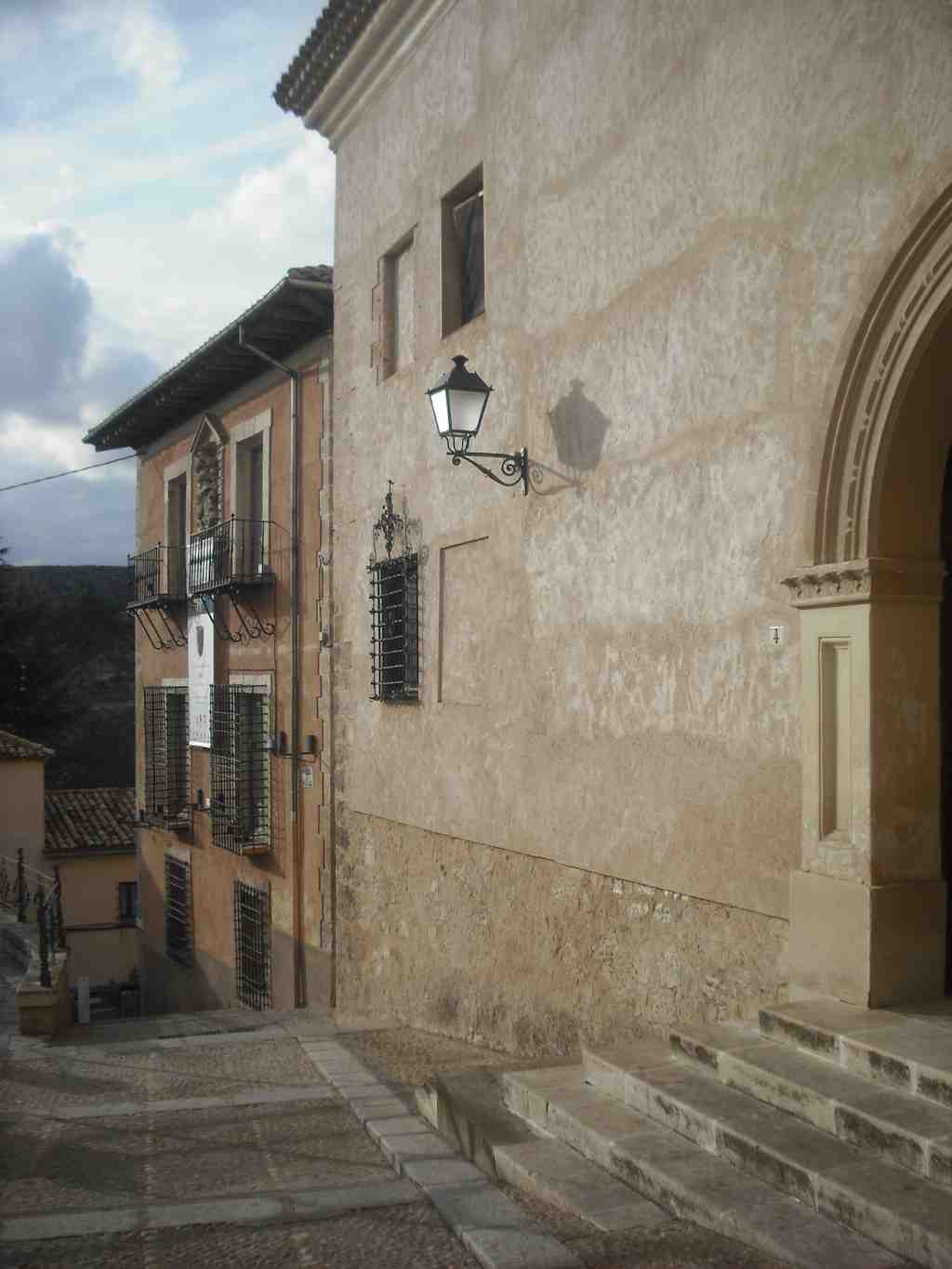
On your right is the Iglesia de San Nicolás de Bari, recognizable by its plain beige stone facade, the elegant pointed archway of its main entrance, and the short flight of stone steps leading up to the doors.
If you look closely at the building, you will notice something peculiar about its layout. It does not stand alone. In a brilliant act of architectural self preservation, this church survived the centuries by physically merging with the city around it. To one side, it connects directly to the grand Casa Museo Zavala, and to the other, it is bound to a former convent that now serves as an art school. The church gave up its isolation to become an inseparable part of the neighborhood's daily life, letting the flow of the city run right into its very walls. Even its original stone apse, the semi circular back end of the church, was eventually swallowed up and buried beneath the adjoining residential houses.
It is a wonderfully practical kind of devotion. The building is constructed of simple masonry, meaning rough, unshaped stones held together by mortar, though its corners are reinforced with ashlar, which are carefully cut and squared blocks of stone. Despite its later origins, its south facing entrance and single rectangular nave, or main central hall, owe more to the heavy, grounded style of early Romanesque architecture than the airy Renaissance designs of its time.
But the real life of this building happens on Mondays. That is the only day the church opens for mass, keeping alive an iron clad local tradition known as the Caminatas de San Nicolás. According to custom, if a person attends mass for three consecutive Mondays and walks to and from the church in absolute silence, they can ask the saint for three wishes. The saint, as the deal goes, will grant exactly one.
This silent devotion stems from centuries of local miracles. The earliest tells of a young farmer left paralyzed after a brutal beating by bandits. His mother completed the three silent walks, and weeks later, her son walked again. But my favorite story involves a woman named Petra in the late nineteenth century. During a harsh winter of famine, Petra joined three friends on the silent walk to pray for her daughter, who had caught smallpox. On the way home, Petra broke the single, most important rule. She opened her mouth and started talking loudly in the street. Her friends waved their hands frantically, terrified she had ruined the plea for divine help. Miraculously, the saint healed Petra's daughter anyway. The unexpected grace profoundly changed Petra, who spent the rest of her life keeping the peace instead of making noise.
Before we move on, take a moment to walk toward the church and look closely at its structure, noticing how tightly it clings to the buildings beside it, almost as if the city itself flows right through the walls. Enjoy the tranquility of the Plaza de San Nicolás here, perhaps admiring the delicate bronze statue of the water bearer in the central fountain, before we head to a site that was not quite so lucky in its survival. Our next stop, the Iglesia de San Pantaleón, is just a one minute walk away.




