
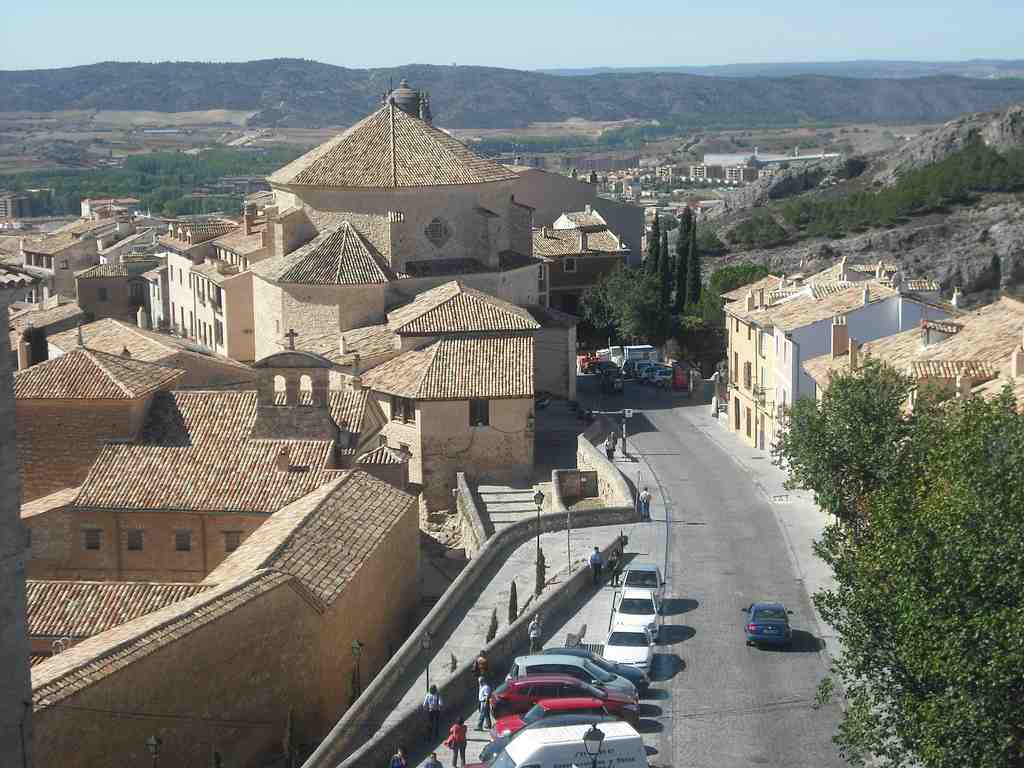
You will spot the Church of San Pedro right away by its massive octagonal tiled roof topping pale stone walls, crowned by a small central cupola. Because it sits at the absolute highest point in Cuenca, right near the edge of the Júcar river gorge, this site has always been more than just a place of worship. It was a fortress. And in the fifteenth century, that strategic high ground turned this parish into a very dangerous place to be.
In 1449, Diego Hurtado de Mendoza and his troops were trying to surrender the city to the Kingdom of Aragon. The loyalists, backed by Bishop Lope de Barrientos, refused to yield and barricaded themselves right here inside the church. To break the stalemate, Mendoza did the unthinkable. He hauled a lombard, a massive primitive cannon, out from the nearby Cuenca Castle, and aimed it directly at these walls. The devastating artillery attack unleashed absolute hell on the sanctuary, sparking five simultaneous fires that reduced the original twelfth-century building to ash.
It is hard to picture standing in this sacred space in 1449, hearing the deafening roar of a cannonball shattering the stone walls. How does a community recover from its own protectors turning weapons against a church?
They rebuilt, of course. First in a Gothic style, and then in the eighteenth century, the architect José Martín de Aldehuela gave it the striking octagonal shape you see today, complete with a beautifully complex vaulted ceiling inside. Along the way, they also had to rebuild the bell tower in 1661 after it threatened to collapse entirely. The winning bid was 3,300 reales, which might equal a few thousand dollars today, representing a monumental sacrifice for a parish still picking up the pieces.
For centuries, the physical memory of that violent bombardment was buried under the floorboards. It was the ultimate architectural cover-up. But during a deep restoration in 1999, experts finally uncovered the scorched earth. They decided to leave an archaeological window open beneath the altar, allowing visitors to look through a glass floor. Down there, you can see three distinct color-coded layers of history, plus ancient tombs, proving this place was used as an active cemetery straight through to the nineteenth century.
It takes a lot to keep a church standing when half the town wants to blow it off the cliff. As you picture the smoke and cannon fire that once engulfed this stone, know that the church is open every day from ten in the morning until five thirty in the evening if you want to inspect those centuries of survival for yourself. Next, we will head toward a modern foundation born from exile, the Antonio Pérez Foundation, which is just a one-minute walk away.




