
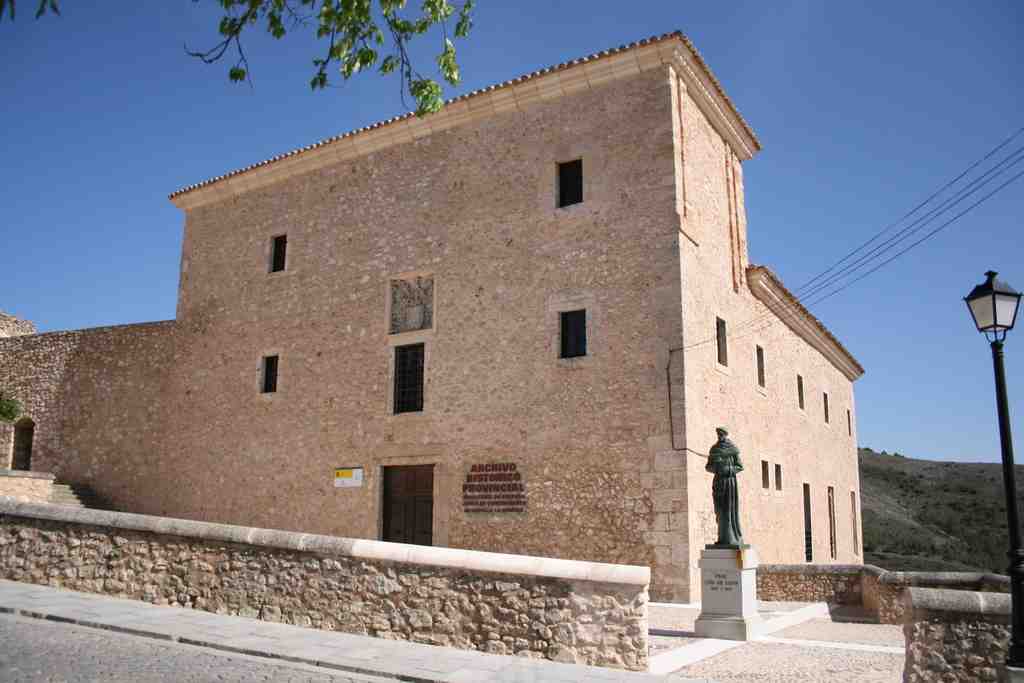
On your right stands a massive, blocky structure built of light-colored rough stone, marked by a faded stone coat of arms set just above a dark grated window.
This high point was once the site of Cuenca's original, nearly impenetrable castle. It took months for Alfonso VIII of Castile to finally break through and conquer this fortress, establishing it as a crucial stronghold. And if you recall the cannon fire that struck the Church of San Pedro we talked about earlier... well, this was the very castle that launched that 1449 bombardment.
But cannons were far from the darkest things housed on this hill. In 1574, King Philip II handed these grounds over to the Spanish Inquisition. They did not just use the old fortress, they built a custom headquarters from the ground up to serve as a prison and tribunal. This drive for legacy turned a military defense into a house of profound terror.
Within these thick walls, prisoners faced strict isolation. The desperation was absolute. One prisoner, a poet named Manuel de Castro, meticulously scratched a sonnet into his cell wall, begging the inquisitors to see he had been framed by false witnesses. Others fashioned pens out of wicker food baskets just to leave a trace of their existence. The sheer will to endure was carved quite literally into the stone.
The building's dominance was finally shattered in 1812. Retreating Napoleonic troops purposefully left a massive stockpile of gunpowder in the main offices and blew the center of the complex sky-high.
It sat as a ruined civil prison until the nineteen seventies. When architects finally came to rescue the site, they found the lower floors still choked with rubble from that French explosion over a century and a half prior. Instead of leaving it as a bleak monument to ruin, they chose a brilliant architectural reinvention. They healed the building's scars, transforming it into a bright, open space. Now, the prison of the Inquisition is the Provincial Historical Archive, dedicated to preserving the truth rather than suppressing it.
The stones of Cuenca have seen empires rise, cannons fire, and terrified whispers shared through cracks in a cell door. They remember everything.
If you would like to look inside, the archive is open Monday through Friday from 9 AM to 2 PM, though it is closed on weekends.




