
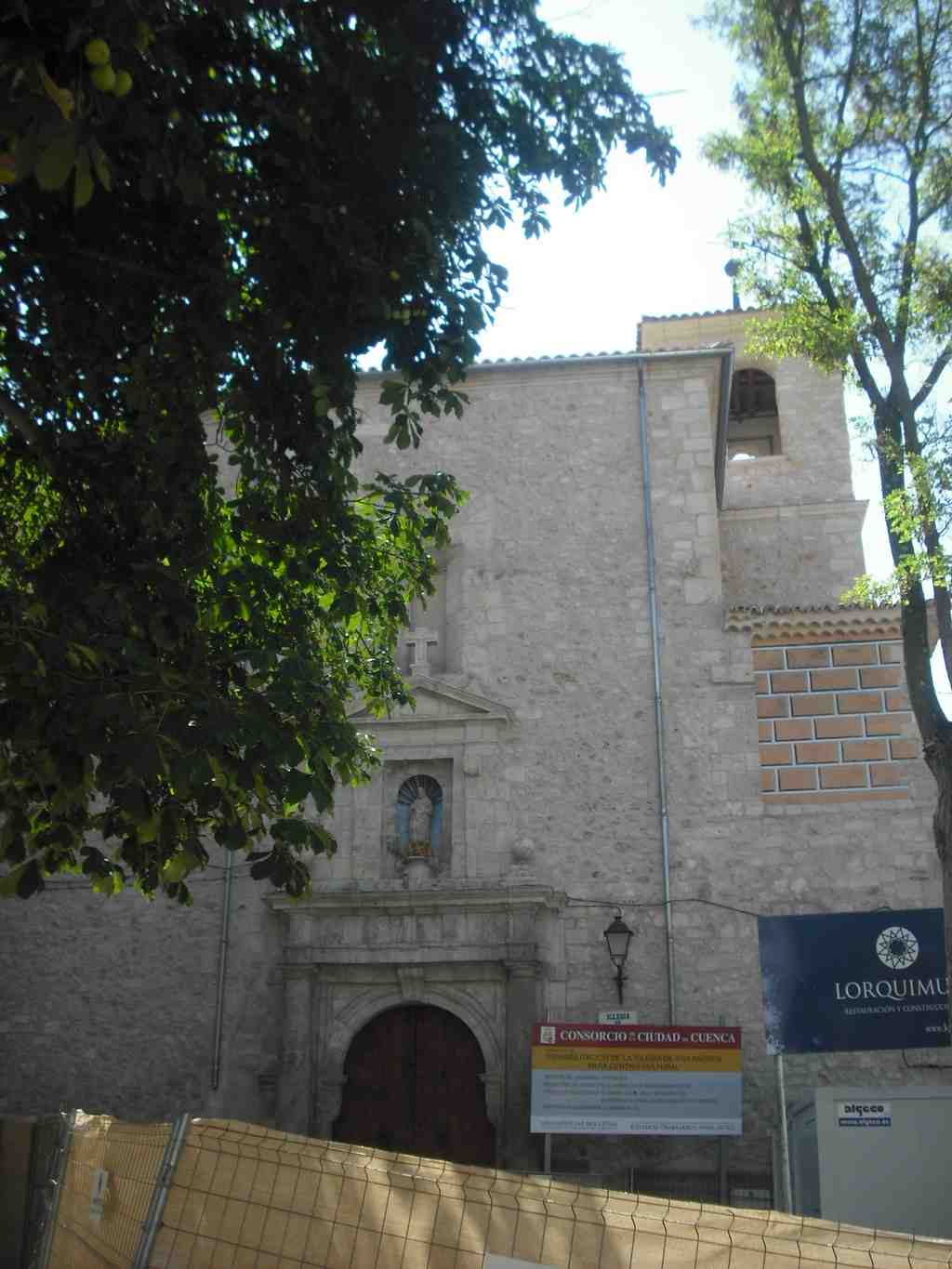
You’ll spot the Iglesia de San Andrés right in front of you by its sturdy pale stone facade, arched wooden door, and a statue of Saint Andrew peeking out from a small niche just above the entrance-look past the tree branches and you’ll see the simple tower rising up behind the wall.
Imagine yourself back in the 1500s, standing on this very spot. The air is thick with the sound of chisels and hammers--because a determined architect named Pedro de Alviz, along with the talented stonemason Sebastián de Arnani, have just started work on a brand-new church. But nothing is simple in Cuenca! After all that excitement, the construction grinds to a halt, almost as if time itself took a siesta, and the site falls quiet for years.
It wasn’t until much later, thanks to Juanes de Mendizábal and his son-in-law Pedro de Aguirre, that work finally picks up again. I’d like to imagine them walking up to the half-finished shell of the church, rolling up their sleeves, and saying, “Let’s get this show on the road!” Yet the ground beneath their feet had other plans-it was so damp you could almost feel the squelching with every step. The walls and arches were rapidly wearing out, and it seemed like even the very foundation might throw in the towel.
Fast-forward, and a man named Domingo Ruiz is now the hero of the day, arriving with ambitious new blueprints in hand to rescue the struggling building. If you listen closely, you might just hear the echo of hammers as he calls out instructions--battling leaks, swelling walls, and endless repairs.
The church has a rather quirky shape, almost like it’s squeezed into place by invisible hands-look down and imagine a trapezoid instead of a neat rectangle. Space was tight, so everything was built to fit a tricky little plot of land, and the sacristy was tucked behind the altar-a daring twist that left some craftsmen scratching their heads. Pedro de Alviz, used to more traditional buildings, must have felt a bit like a chef who suddenly has to make a feast with just a frying pan and a teaspoon.
Take a look at the windows, cut high above those elegant columns. Originally, the builders didn’t even have a roof to close them off! And the grand vault overhead? That wasn’t added until many, many years later, after a few more chapters of waiting and worry. Even now, you can see the difference-the first part of the nave stands out from the last, as they were finished decades apart.
Now, look at the entrance: above you, two sturdy Tuscan columns rise from their pedestals, with decorative balls popping up like surprised eyes between the layers of the portal. There’s a sense of playfulness here, as if the builders wanted to show just how clever post-Herrerian architecture could be. And right in the center is Saint Andrew himself, peeking from his tiny niche while two slender supports, called estipites, keep him company on either side. At the very top, a proud triangular fronton laughs in the face of gravity-and it has the balls (literally) to prove it.
This church, though, has not only survived tough times, but also tough crowds. In the 1930s, during the Spanish Civil War, it was seriously damaged. When the dust settled< sfx>heavy wooden door creaking open</sfx>, its fate changed once again-it was handed over to Cuenca’s brotherhoods. No longer a sacred church, it became a home for the Easter processional floats, holding some of the city’s most treasured religious traditions.
Today, Iglesia de San Andrés stands as a survivor’s story written in stone, a place that’s been rebuilt, repurposed, and restored more than once. Its windows are still locked behind sturdy iron grilles, hand-forged by Cuenca’s legendary smiths back in the 1500s. And every spring, with the coming of Easter, this church bursts back into life, holding the secrets and splendours of a city that never gives up-even if its churches do like to take the occasional nap!




