
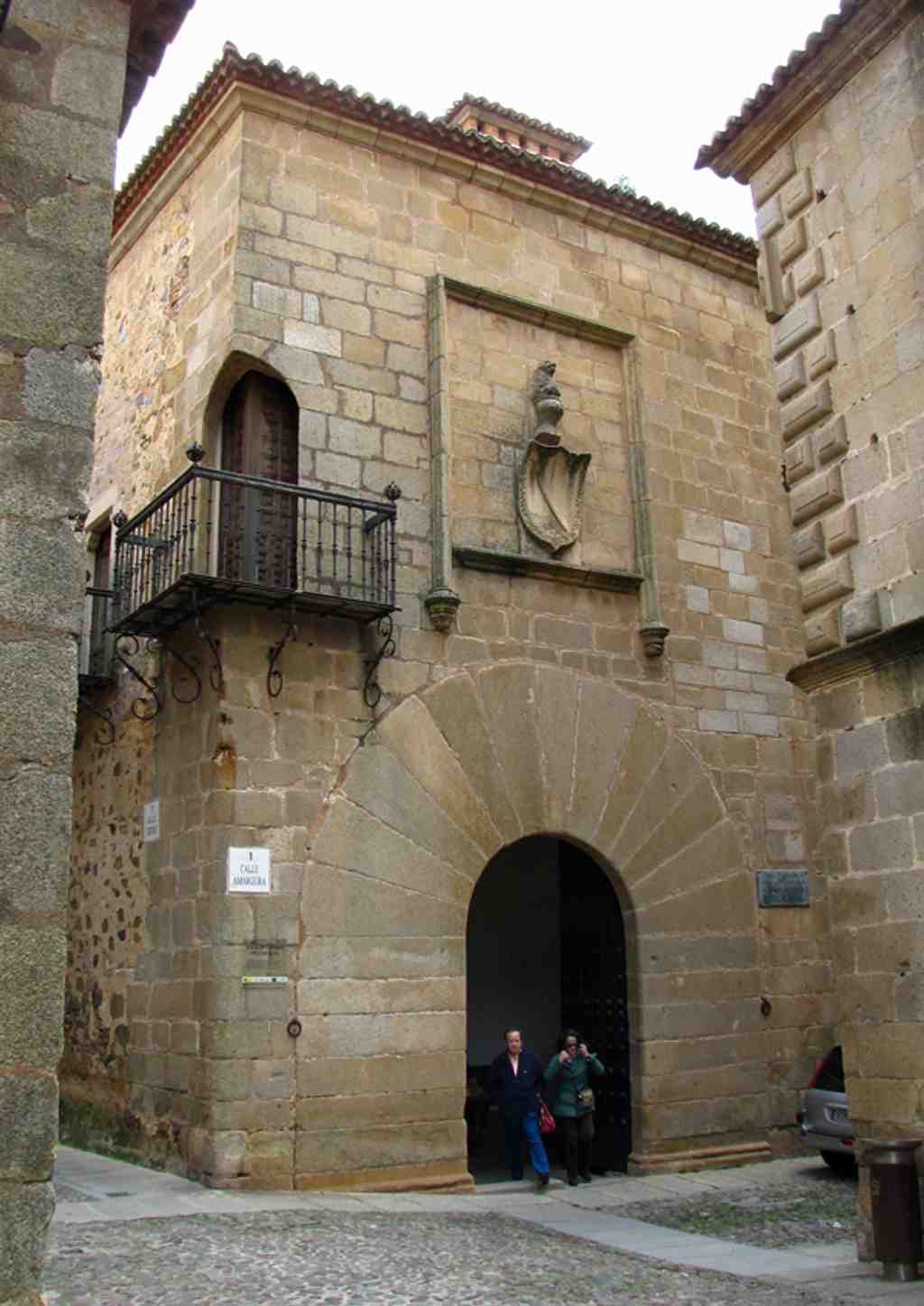
To spot Carvajal Palace, look for a sturdy stone building with a grand arched entrance, a simple balcony jutting from the corner, and a big family crest on the facade, all made from solid granite blocks right in front of you.
Now, take a moment and imagine the creak of heavy wooden doors as you stand before the Carvajal Palace. This sturdy, almost fortress-like building has guarded the stories of one of Cáceres’ oldest noble lineages for centuries-yes, the Carvajals were the kind of folks who had more drama in their lives than most TV shows! The first thing that’ll strike you is the massive, rounded granite arch over the entrance-go ahead, run your hand over the stone, and picture the countless boots that have passed through, from knights to nobles to the odd nosy neighbor.
The family crest, boldly carved in relief, sits right above you, squeezed into a rectangular frame and perched on ornate brackets. It’s basically medieval bragging in stone-“We are the Carvajals, and this is our spot!” Off to the right, you’ll spot a lonely little balcony with an arch, simple, no frills-perhaps perfect for Romeo-style serenades or some good old-fashioned gossip watching the street below.
But the real twist in the story is the round tower attached to the side. Rumor has it, this tower could be even older than the palace itself, maybe even with Arab roots, and some say the mysterious warrior monks-called the Fratres-used it back in the days of battle during the Reconquista, when Christian knights fought to reclaim the city from Moorish rule. The tower still shows off its ancient arches, one shaped like a horseshoe, echoing centuries of echoes.
And now, let’s talk about palatial life-more than just stone! Imagine scurrying inside on a rainy medieval evening and stepping into the airy patio, where chunky granite columns topped with decorative “ball” capitals hold up the arches, showing off a style typical of late Gothic mansions. But the real showstopper is in the garden, where a giant fig tree spreads its tangled limbs, rumored to be anywhere from 300 to 400 years old. That’s one wise old tree; if only it could tell us what it’s heard over the centuries!
Tucked beneath the tower is the private chapel-a secret little jewel adorned with gorgeous Renaissance-era frescoes by an Italian painter named Juan Bautista Pachi. One moment you’re gazing at the Carvajal coat of arms, the next you’re swept into stories painted on the walls: the Annunciation, Mary visiting Saint Elizabeth, the Nativity, even young Jesus dazzling the teachers-artful glimpses into family faith and Renaissance flair.
But don’t let all this grandeur fool you-there’s a thrilling legend to this family, worthy of a blockbuster! Back in the 1300s, the two Carvajal brothers were accused of a nasty crime: the murder of a nobleman. Condemned by King Fernando IV of Castile, they insisted on their innocence and demanded “a judgment from God.” Well, believe it or not, just 30 days after he sentenced them, King Fernando dropped dead! The city was abuzz. The Carvajals were cleared, and the shadow of scandal became a point of mysterious pride for the family forevermore.
The Carvajals loved their city, but like all good soap operas, they took sides-sometimes joining the powerful upper families, sometimes the lower, always finding ways to thrive, outwit rivals, and support the church. They were builders, renovators, art patrons, and politicians, and their most famous offspring, Don José de Carvajal, was a top minister and secretary of the state in the 18th century.
Traders, conquerors, and even flames have touched this palace’s history. After the family sold it, a huge fire in the 19th century gutted the interiors. Locals called it the “burned house” for decades until a determined descendant restored it in the 1960s, building those broad stone stairs you’d climb today to reach the upper floor.
Now, the palace is home to the tourist board-so the hustle and bustle continues, just minus the horses and swords. Even today, if you listen closely, you might catch the whisper of old secrets swirling in the peaceful patio or hear the garden fig tree sighing in the breeze. Quite a place to stand, isn't it?




