
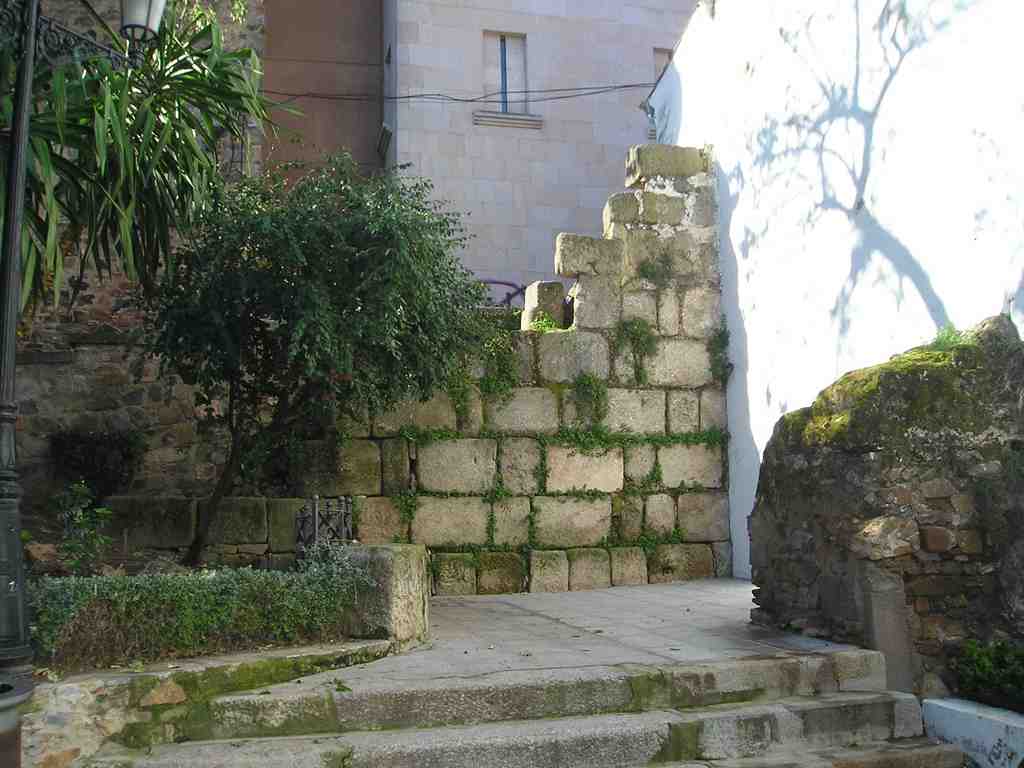
To spot the Puerta de Coria, look ahead for a small, mossy section of ancient stone wall rising up beside the plants at the edge of the steps-it looks like an old, rough puzzle pieced together, standing quietly where the past meets the present.
Now, let’s step with me into the echoing footsteps of centuries, right here at what was once the proud northern gate of Roman Cáceres, the Puerta de Coria, also affectionately called the Arco del Socorro. If you close your eyes and take in the crisp air, you might just imagine the clang of soldiers’ sandals and merchants’ cart wheels thumping over the stones as they streamed in from the great Roman road, the Via de la Plata, winding just east of town.
Picture this: it’s the bustling days of Norba Caesarina-the original Roman name for Cáceres-and the city is wrapped in sturdy walls that guard its four cardinal points. The Puerta de Coria is the city’s northern guardian. Its mighty stone arch, shaped in a graceful half-circle, is crowned with a small niche-a special nook that, in later centuries, would hold a statue of the Virgin of Socorro, gently watching over everyone who passed beneath.
But the Puerta de Coria was more than just stones and archways. Two strong towers flanked this gate, giving it the air of a silent sentinel. Imagine those towers: one rooted where the shops buzz today on Zapatería street, the other tucked into the stately Casa de los Condes de Trespalacios. Overhead, the walls and arches must have felt endless, heavy with the memories of a thousand comings and goings-trades, reunions, bittersweet goodbyes.
Through this very gate nearly 800 years ago, the fate of Cáceres changed forever. In the year 1229, during the heat of the Christian reconquest, Alfonso IX of León’s troops entered through the Puerta de Coria, securing the city and forever stitching it into the great tapestry of Spanish history. Can you feel the tension, the nerves, the hope, and maybe a dash of fear, as armored knights squeezed through that arch, swords clinking and banners fluttering in the wind? History is not always peaceful, and this old gate has seen its share.
But time is a trickster, and the centuries rolled on. By the 1700s, the once-majestic gate had turned, in the eyes of its neighbors, into a gloomy, shadowy nook-one that might give even the bravest city dweller the heebie-jeebies. Local aristocrats and townsfolk petitioned, “Can’t we just get rid of this old thing? It’s a health hazard, a trap for dirt and mischief, and it blocks the coaches and carriages.” The city council scratched their heads; after all, nobody likes a bottleneck-especially not one stuffed with medieval cobwebs!
The final blow came from a gentleman named Joaquín Muñoz Chaves, a notable from the local Liberal Party, whose house stood nearby. By 1879, he’d had enough of the “piles of dirt incompatible with the hygiene of modern Cáceres.” With the blessing of the city’s Committee of Ornato (what a name!), he began to dismantle the old stonework. If only WhatsApp or Twitter had existed then, maybe the Real Academy of Fine Arts’ desperate plea to stop the demolition would have arrived in time! But alas, by February 1880, the Puerta de Coria was no more-swept aside in the name of progress and tidiness.
Yet the story doesn’t end there. For decades after, the statue of the Virgin of Socorro that once watched over travelers was cherished, tucked behind an iron grate in a nearby noble house. And though her image vanished in the storm of a new century, her spirit still haunts these stones and this tiny, peaceful plaza.
So, as you stand among the small garden and the rough, forgotten stones, surrounded by the green moss of centuries and the everyday life of Cáceres, remember: great arches may crumble, but the memories-of Roman legions, medieval conquerors, and modern city folk alike-linger ever on. And if you listen closely, this silent spot just might tell you another secret from the old stone puzzle of Cáceres.




