
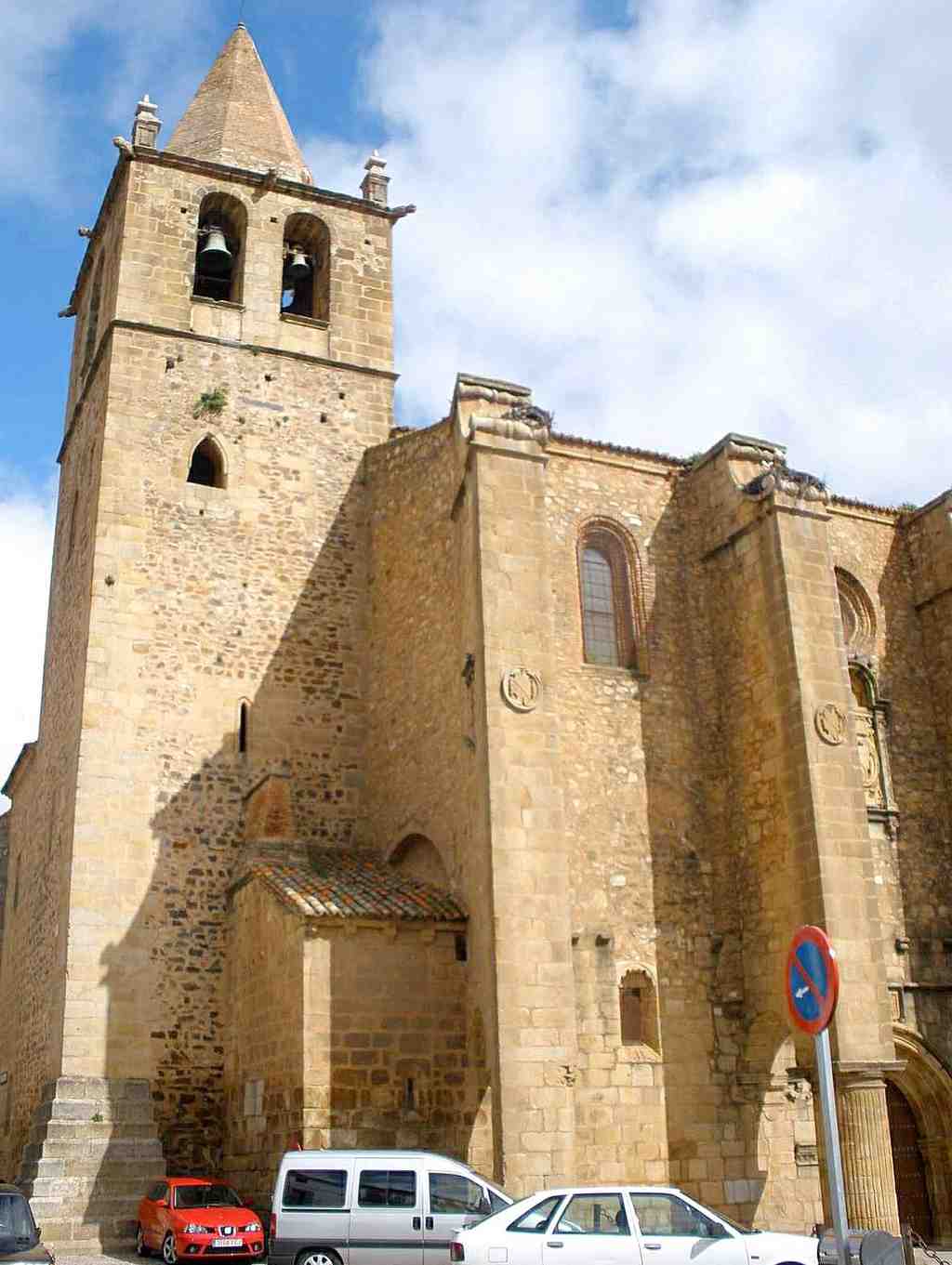
To spot the Church of Santiago, look for a striking, sand-colored stone building with colossal buttresses, pointed arches, and a tall bell tower topped by a pyramid-shaped roof-impossible to miss, especially when you spot the medallions on those impressive supports.
Picture yourself standing here, the sounds of Cáceres behind you, and before you rises the ancient Church of Santiago de los Caballeros. The bell tower stretches skyward, and enormous buttresses jut out from the walls, each decorated with carved medallions-some resting on thick, fluted columns that look sturdy enough to keep out all of history’s storms. These guards of stone have withstood centuries, and if these walls could talk, I’m sure they’d whisper tales of knights, artists, and the odd clumsy stone mason or two.
Let’s wind back the clock to the late Middle Ages. It’s the 1300s, and on the outskirts of the walled town of Cáceres, a hearty band of townsfolk and knights gather in what was then just a humble church. You might catch the smell of woodsmoke and hear the clop of horses outside, for this parish belonged to a community of soldiers-Santiago’s Knights. Some ancient scrolls say the church’s first stones were laid even earlier, in the 12th century. But don’t believe everything you read; the oldest bits you see today are most likely from the 14th century.
Now, as you run your eyes along the building, notice those entrances-two grand pointed arches, opposite each other, just begging for a medieval procession to march through. If you stepped in centuries ago, the echo of your footsteps would meet the soaring vaults above-listen, perhaps you can imagine the sound now.
It wasn’t always this grand, though. Fast forward to the 1500s, the renaissance is in full bloom, and along comes Rodrigo Gil de Hontañón-one of Spain’s master builders. He rolled up his sleeves and, with a twinkle of innovation, gave Santiago its sweeping main chapel and elegant sacristy. Some of the church’s best features sprang to life under his watch, although, amusingly, he had a bit of a clash with the folks paying him, and left the job unfinished! Don’t worry-the ever-resourceful locals brought in another architect, Sancho Cabrera, to wrap up the job.
Inside, the treasures grow richer. Look up and imagine vaulted ceilings crisscrossed with stone ribs. There’s a wide choir loft at the back where deep voices would ring out each Sunday. But the star of the show is the main altarpiece-a staggering, colorful masterpiece carved from wood in the 1500s by Alonso Berruguete, a man famous for making statues that almost walk and talk. The church must have buzzed with excitement when Berruguete’s retablo finally arrived from Valladolid in 1570, but it wasn’t smooth sailing. Rain poured in during transport, soaking the delicate wood, and it arrived battered and nearly ruined. It took a small army of artisans to set things right, but today the retablo stands gleaming, crowned with images of the Virgin and Child surrounded by angels, and none other than Santiago astride a horse, charging valiantly into battle.
You might spot other beautiful sculptures, too: a serene figure of Our Lady from the 1400s, and the Cristo de los Milagros-another centuries-old wonder, whose presence might just send a shiver down your spine if you catch its gaze in the candlelight.
Let’s not forget-the Church of Santiago isn’t just a museum. It’s still a living parish, part of the old city’s pulse. It hosts lively brotherhoods, especially during Easter Week, when processions wind through the streets and sacred statues are carried out-often at a frankly heroic hour. There’s a famous one: the statue of Jesús Nazareno, carved in 1609, with a cross inlaid with silver and decorated flowers, marching out as bells peal and crowds gasp with devotion.
Standing here, you’re at a crossroads of history-where knights sharpened their swords, artists dreamed in wood and stone, and even rainstorms couldn’t dampen the town’s spirit. Be sure to take a deep breath and look closely; every stone is a piece of Cáceres’s centuries-old story! If you’re ready, let’s march on to our next stop.




