
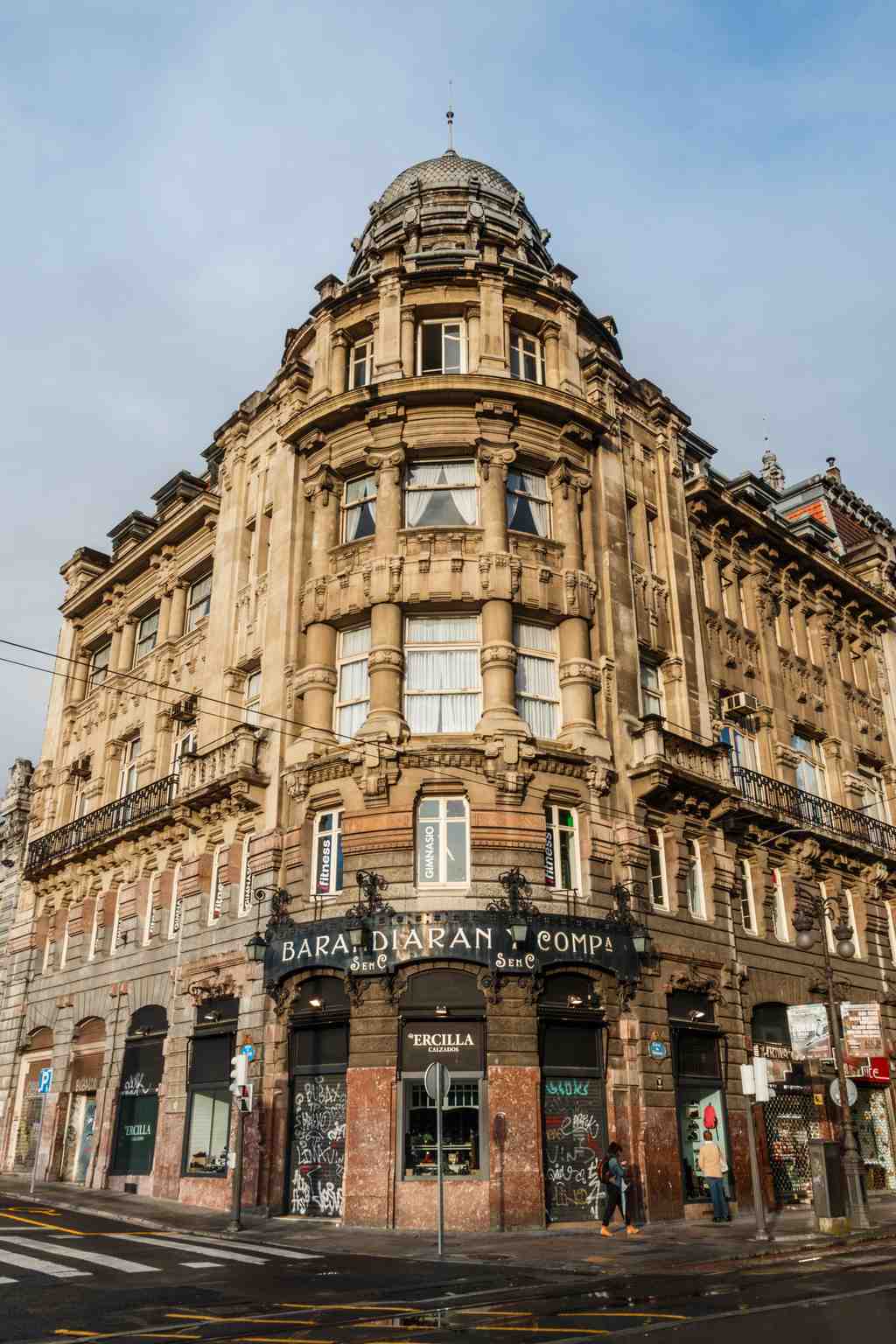
Look for the pale stone facade with strong horizontal bands, a rounded corner topped by a circular dome, and a grand arched entrance framed by deep red Ereño marble columns.
This is the Building of the Bilbaina Society, opened on the twenty-fifth of January, nineteen thirteen, and it reads almost like a self-portrait of the people who paid for it. The Sociedad Bilbaína had spent seventy-five years in a first-floor home on Plaza Nueva. Then Bilbao expanded, fortunes grew, and the club decided it needed an address that matched the city’s new ambitions.
The industrial and financial bourgeoisie shaped that decision. By that, I mean the class of mine owners, shipbuilders, bankers, and merchants who wanted modern Bilbao to look polished as well as prosperous. They did not only fund industry; they also built networks, habits, and polished interiors where alliances could form over coffee, billiards, and dinner. Money likes privacy, but it also enjoys a handsome facade.
From where you stand, the building makes that point very clearly. The main front on Calle Navarra stretches wide and symmetrical, almost calm, then gathers drama at the cut-off corner where the streets meet, crowned by that dome. The big entrance arch is deliberately monumental. Above it, a stone balcony ties the central windows together, and higher up, columns and carved details pull your eye upward. Even the word chaflán matters here: it means that clipped corner of a city block, turned into a showpiece instead of a leftover edge.
In nineteen oh nine, the board turned the commission into a proper local contest. Twelve architects entered. Emiliano Amann won first prize, but here is the part locals enjoy: the committee did not quietly pick one drawing and call it a day. It publicly ranked several entries, turning the project into a visible rivalry among Bilbao architects. Then it kept adjusting Amann’s design, opening more windows for light and adding the corner tower element that gives the building extra swagger.
One man helps anchor that change: Pablo García Ogara, the society’s president. Between nineteen oh eight and nineteen oh nine, he led the move toward this site at La Concordia, near the Nervión, on land the society had acquired from local banking interests. At the inauguration banquet, he spoke as if he were closing one chapter of club life and opening another. And they did not celebrate modestly. Two days later came dancing, with rigodons and waltzes, and then a concert to round out the festivities. Very Bilbao: serious business, then very serious socializing.
Inside, the club followed the English model for private societies: a grand spiral staircase under a skylight, an English bar at ground level, a double-height library with an upper gallery, reading rooms, billiard rooms with original tables, dining rooms, dance rooms, even bedrooms with hotel-style services for members. Private comfort became a kind of urban performance.
The story did not stay elegant forever. In nineteen twenty-four, dictatorship banned gaming rooms and hurt the club’s finances. On the twentieth of July, nineteen thirty-six, anarcho-syndicalist brigadists took the street, set a machine gun at the doorway, searched the building top to bottom, and looted art, furniture, and the bar stocks. Later, members rebuilt. By nineteen forty-two, the library already held more than thirty-four thousand volumes, and later the building earned protected status as a cultural monument.
That is the trick of a city like this: a private club commissions a monument for itself, and before long the whole street inherits the view. When you are ready, head on to the Bilbao Stock Exchange, about two minutes away, where prestige steps out of the club and into the marketplace. If you are curious later, the society keeps long daily hours, roughly nine in the morning to eleven at night.




