
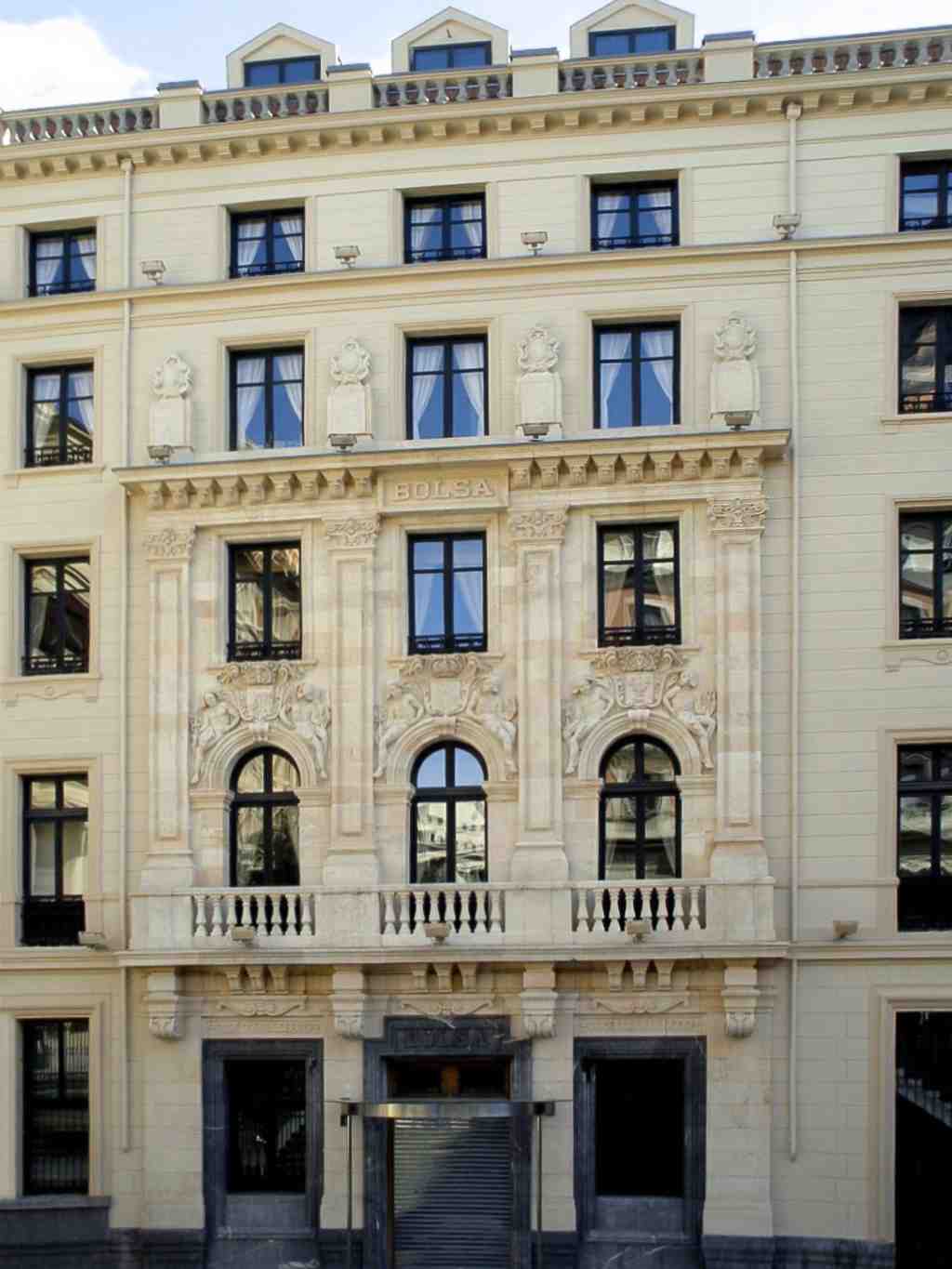
In front of you stands a sober pale-stone building with a symmetrical rectangular façade, tall evenly spaced windows, and a formal central entrance that looks determined to be taken seriously.
That seriousness mattered. Bilbao’s stock exchange did not begin with swagger... it began with nerve. In eighteen eighty-nine, a small circle of local financiers signed the founding deed with a share capital of fifty thousand pesetas, spread across twenty-nine shareholders and two hundred bearer shares - roughly the buying power of a few hundred thousand euros today. Not huge money for a grand institution. More like a bold local wager.
And for a while, this market had no proper home at all. Its first trading session took place on the fifth of February, eighteen ninety-one, in the lobby of the Arriaga Theatre. Then it shifted to Plaza Nueva, then to a room lent by Banco de Bilbao in nineteen oh one, then back again to the Arriaga. Not exactly the picture of eternal stability. It was ambitious, useful, and growing fast... but still looking for an address that could make people believe in it.
That is the trick with finance. It does not only move money; it reshapes streets. Traders need speed, reputation, and proximity, so stations, banks, offices, and plazas begin clustering around them. Give capital a permanent doorway, and the city starts tailoring itself like a good suit around that doorway.
By the end of eighteen ninety-one, the exchange already listed forty official securities - public funds, bonds, and shares. The first six brokers multiplied to thirty-two by nineteen hundred, and a law in nineteen ten capped the number at forty. So in nineteen oh three, the brokers made their decisive move: they voted to build a headquarters of their own here on the Concordia lands, beside the railway station and near the rising banking axis of the ensanche, the planned expansion district. Location, as ever, was half the argument.
The architect Enrique Epalza gave them the other half. Epalza knew how to design with flair, but here he chose restraint. He dressed the exchange in what he called a purified eclectic style - formal, balanced, and businesslike. Inside, the key room was the sala del corro, the trading ring where deals happened face to face, with voices, glances, and quick judgments. Before screens took over, markets ran on human theater.
There is a nice irony in its early exile at the Arriaga. That theater had already hosted Bilbao’s first electric telegraph in eighteen fifty-four, so from the beginning, information and speculation shared an address. A city learns its habits early.
Since two thousand and two, Bilbao’s exchange has belonged to Bolsas y Mercados Españoles, B-M-E, the group that brings together Spain’s four stock exchanges. It still operates, though the old trading-floor roar has mostly given way to digital silence. Ahead, the architecture of money grows larger and more corporate along the Gran Vía; Bizkaia Tower is about a three-minute walk from here. If you want to come inside another time, the building generally opens on weekdays from eight in the morning to five thirty in the afternoon.




