
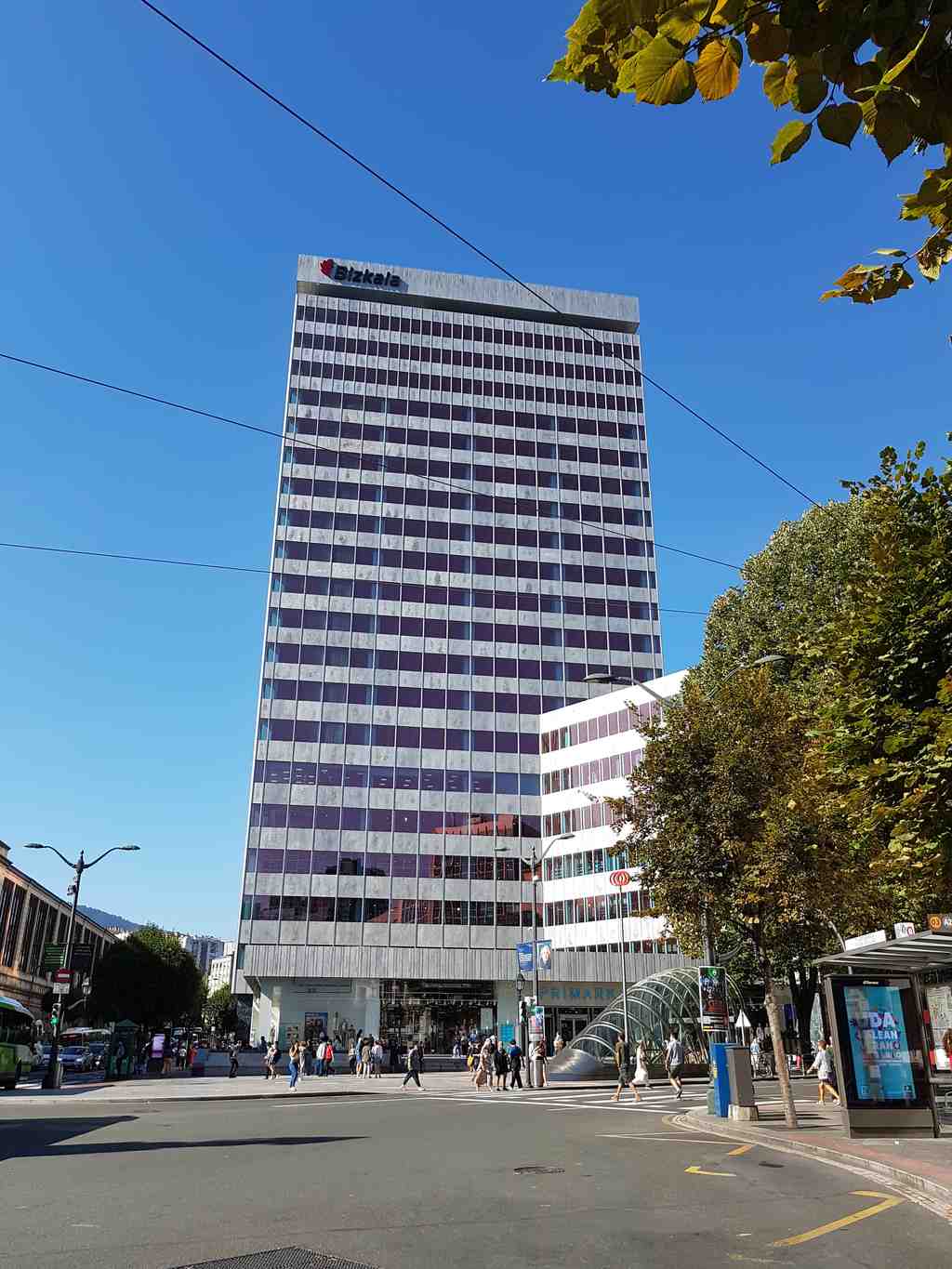
On your left, look for a tall rectangular tower wrapped in a glass curtain wall, with tinted window panels and a strong vertical rhythm that sets it apart from the lower stone buildings around it.
This is Torre Bizkaia, once the Banco de Vizcaya tower, later the B-B-V-A tower, and now also known as B-A-T, short for B Accelerator Tower. If Gran Vía is Bilbao’s ceremonial spine, this is one of the moments where that spine straightens its back and says, very plainly, “We mean business.”
The bank wanted exactly that effect. In the nineteen sixties, Banco de Vizcaya decided its old headquarters no longer matched its ambitions. It wanted modernity in built form, not as a slogan, but as a skyline. So architects Enrique Casanueva, Jaime Torres, and José María Chapa designed this tower, and when it opened on the twenty-second of April, nineteen sixty-nine, it climbed to twenty-one floors and eighty-eight meters. For years, it stood as the tallest building in Bilbao... the city’s vertical exclamation point.
And the bank knew the language it was speaking. Its leaders looked to the Seagram Building in New York, the S-A-S tower in Copenhagen by Arne Jacobsen, and the Banco Popular building in Madrid. That helps explain the curtain wall here - a facade that hangs like a skin rather than bearing the weight itself - and the colored glass that breaks up what could have been a stern corporate face. Serious, yes... but not entirely humorless. Even bankers occasionally loosen the tie.
There is an older ghost under this address too. Before this tower rose, the Banco de Vizcaya had occupied a nineteen-oh-three headquarters here designed by José María de Basterra. So this spot didn’t just change buildings; it changed vocabulary, from stone authority to glass ambition.
At the base once stood Eduardo Chillida’s Elogio del hierro tres, “Praise of Iron Three.” It later moved away during remodeling, then returned to Bilbao in a new setting: today it stands by the Fine Arts Museum in the new Plaza Chillida. That little journey tells you something useful about Bilbao. Objects move, meanings move with them, and the city keeps rewriting the same story in a new location.
There’s also a harder human story here. During asbestos removal - asbestos being a fireproofing material once used widely, then discovered to be dangerous - workers later became part of a court case over exposure, and the ruling noted that environmental measurements were taken in the building rather than directly on the workers themselves. Towers advertise power from a distance; up close, somebody always pays the cost of keeping the image clean.
In recent years, the facade underwent a major restoration to recover its original visual language, even down to that pinkish tone and the replacement of one thousand one hundred sixteen windows. Inside, the building shifted again: big retail below, entrepreneurship and offices above. Finance built the monument; reinvention kept it alive.
Before we move on, tilt your gaze upward and compare this tower to the street around it. Does it feel like Bilbao growing naturally... or Bilbao making a deliberate interruption? Either way, no skyline statement stays final for long. In about two minutes, we’ll head to the B-B-V-A Building and watch that story continue. For practical purposes, the building generally keeps weekday hours from eight in the morning to six in the evening, and it closes on weekends.




