
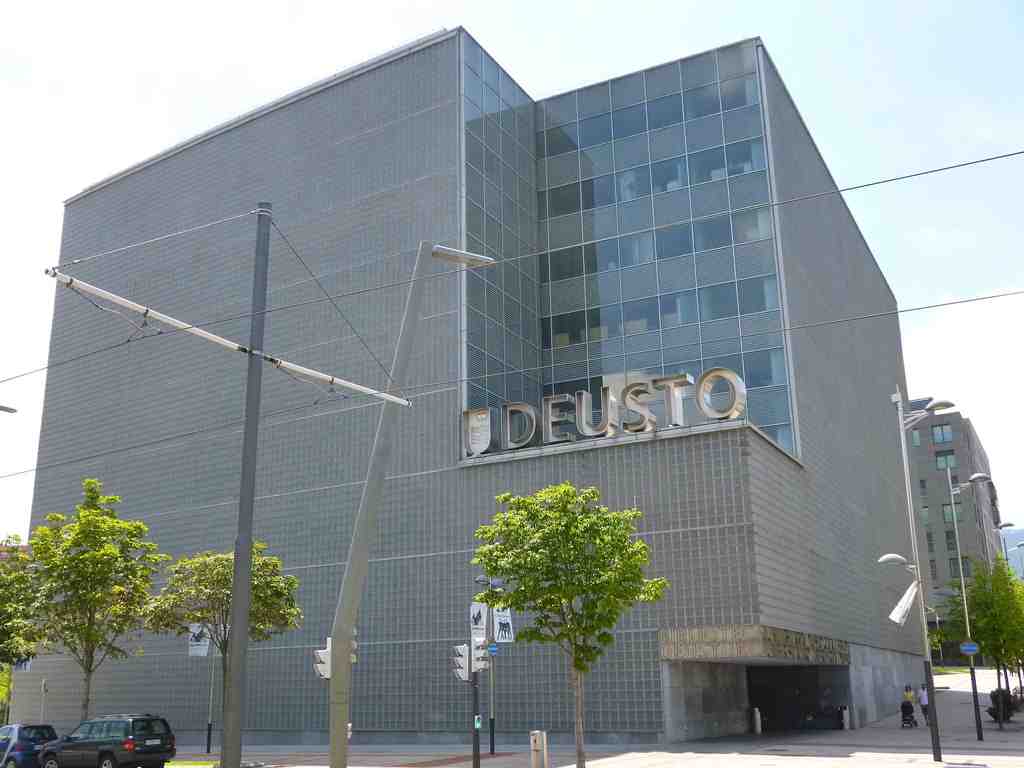
On your left stands a pale glass-and-stone block, broad and rectangular, with a gridded facade and a deep entrance carved into its smooth face.
This is the Deusto University Library, formally the Center for Learning and Research Resources... though around here, people sensibly stick with “the library.” And that matters, because Rafael Moneo did not design this place as a fancy box to stack books in. He wanted a meeting point between readers and knowledge, filled with natural light, open space, and a public spirit. In other words, less dusty warehouse, more thinking machine.
That idea fits this stretch of Abandoibarra perfectly. Nearby, the riverfront shows off with titanium curves and corporate glass. This building answers in a quieter voice. It says a city does not only renew itself with spectacle or skyline... it also renews itself by making room for study, research, and the long patient work of learning.
The library opened on the twenty-seventh of January, two thousand and nine, replacing the university’s older library. But its story started before the doors opened. Bilbao City Hall and the University of Deusto struck a funding agreement: the city contributed one million euros, and in return received the title of Distinguished Sponsor. That is a very Bilbao sort of arrangement, if you ask me... civic pride, practical money, and a little ceremony all at the same table.
Moneo anchors the human side of the story here. On opening day, he stood with rector Jaime Oraá while the new building was being blessed. Then the polished ceremony got interrupted by a flood-risk warning, and one witness had to rush off to collect his children. That tiny moment tells you a lot about the place: even at a grand inauguration, local life barges in, sleeves rolled up, asking who is picking up the kids.
Inside, this is far more than shelves. Students, alumni, and professors use group study rooms, research spaces, laptop loans, and even a dining service. The collections stretch from nearly one million printed volumes to electronic resources, and from current course books to incunables - books printed before fifteen-oh-one - plus older historical holdings and a digital repository called Loyola. The university founded the library collection back in eighteen eighty-six, so this modern shell carries a very old memory.
And people came. In its first year here, the building drew more than forty-three thousand users and hosted four hundred fifty-eight organized visits. The whole campus rhythm changed. Students crossed the Pedro Arrupe footbridge instead of lingering in older cloisters and gardens, and the new library filled up with life. It even became a cultural venue, with welcome sessions in Spanish, Basque, and English, and exhibitions on biblical texts, Egypt, and the university’s own bibliographic treasures.
There is one more local wrinkle. In two thousand sixteen, two glass facade tiles, each weighing seven and a half kilos, came loose. The university removed fifty-eight more as a precaution, and in two thousand eighteen it renewed all four facades. Even landmark buildings, bless them, still have to behave in the real world.
Keep that in mind as you head toward the Guggenheim, about five minutes from here. The famous image ahead makes more sense once you have seen this place first: not just a city showing off, but a city making room for memory, money, ideas, and the public together. If you want to return, the library generally opens Monday through Friday from eight in the morning to nine thirty at night, Saturday until two forty-five in the afternoon, and closes on Sunday.




