
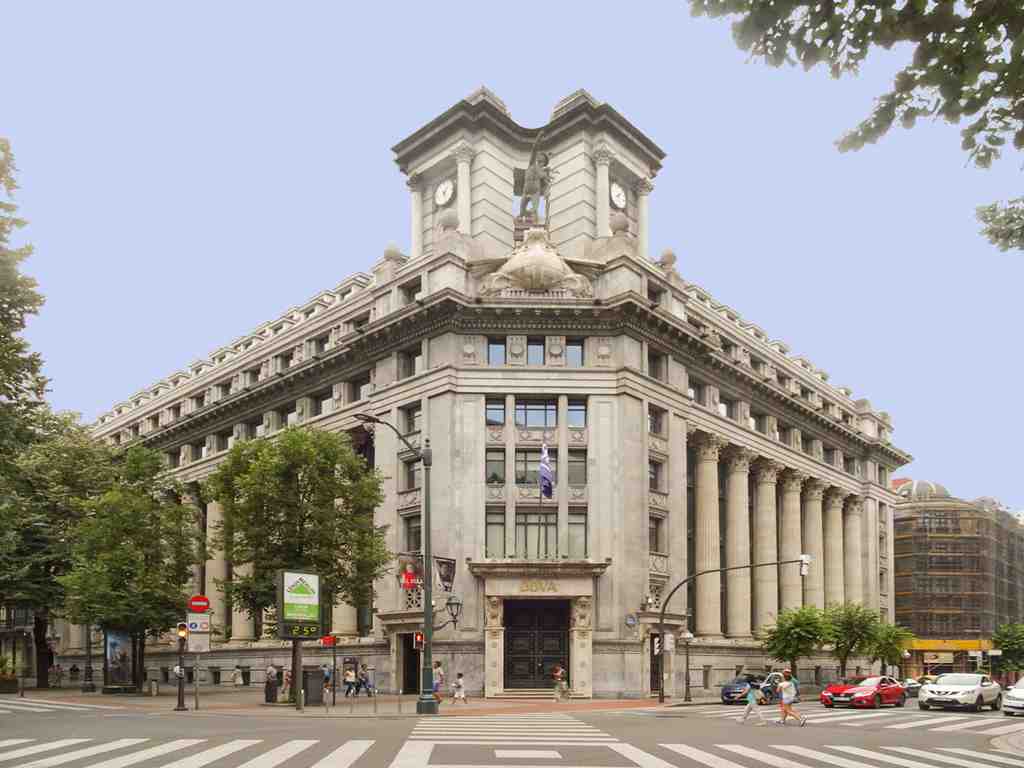
On your right, look for the pale stone corner building with tall Corinthian columns, a broad curved façade on Gran Vía, and a small temple-like top crowned by Mercury, the Roman god of trade.
This is the B-B-V-A Building, but its story began far less grandly... with a simple desk on the old Calle de la Estufa. Banco de Bilbao grew so fast that the desk was overwhelmed within months, and the bank started gathering property around San Nicolás. That early scramble matters, because it shows something Bilbao repeats again and again: institutions here rarely stay small for long.
And they rarely grow alone. In this city, mergers and alliances did not just change balance sheets; they redrew the map. The fusion of Banco de Bilbao and Banco del Comercio in nineteen oh one helped create a kind of banking triangle: the San Nicolás palace across the river, and Gran Vía numbers one and twelve here in the expansion district.
This particular building carries that layered history in its bones. Pedro Guimón drew the first project in nineteen twelve. Then Ricardo de Bastida reworked it, and after Bastida died, Francisco Hurtado de Saracho finished the job. Most visitors miss the little argument hidden in the dates: some references insist the project belongs to nineteen twelve, while local architectural guides place the real making of it between nineteen nineteen and nineteen twenty-three. Around here, that usually means a building took its time growing into itself.
Look up again at that rooftop Mercury by sculptor Moisés de Huerta. He is a neat little clue: this was once the headquarters of Banco del Comercio, and the message is not subtle. Trade lives here. In nineteen fifty-seven, Banco de Bilbao moved its operations into Gran Vía twelve and turned this into a banking center of the new ensanche, the planned expansion of the city. In nineteen seventy-four, Hurtado de Saracho added another floor and roofed over the inner courtyard, giving the building the silhouette you see now.
Even its memory was carefully banked. In nineteen seventy-one, Banco de Bilbao began gathering its historical archive in San Nicolás, one of Spain’s earliest private banking archives. Up ahead, Kutxabank widens this tale from one powerful house to a broader Basque pattern... and it is only about four minutes away.




