
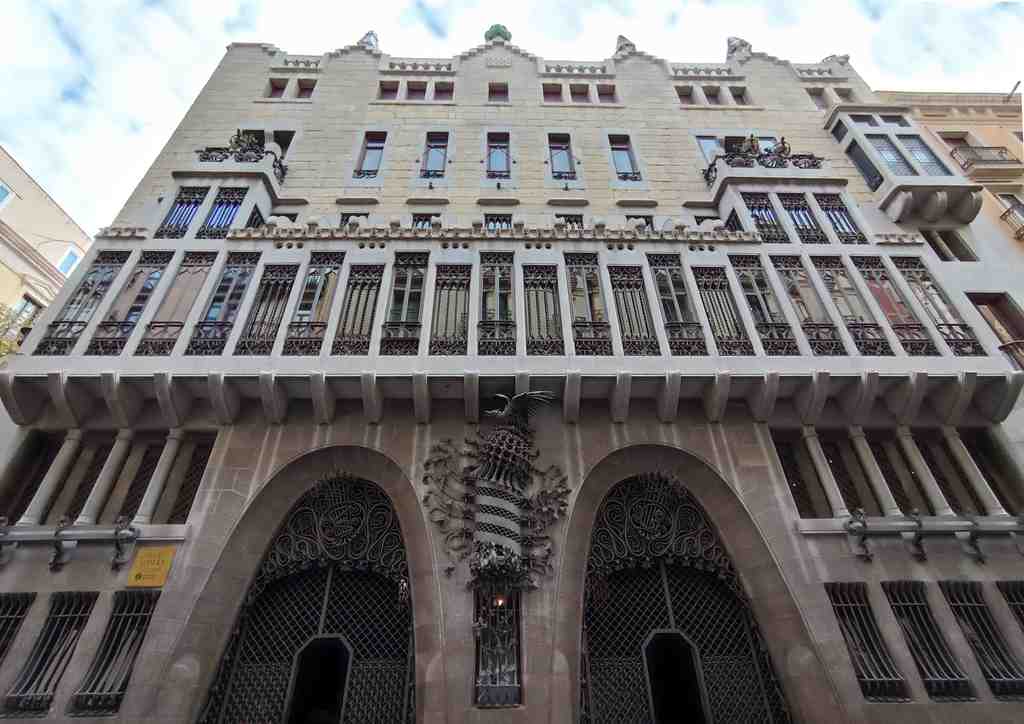
Notice the imposing pale stone facade dominated by two massive, steeply curved archways, separated by a striking spiked iron bird crest. Welcome to Palau Güell, one of Antoni Gaudí's earliest masterpieces. It was commissioned in the late 1880s by Eusebio Güell, a prominent member of the industrial bourgeoisie. This is exactly the same wealthy elite class that built the Liceu theater we just walked past. Eusebio wanted a home that screamed power and modern ambition, and Gaudí delivered a palace that completely defied the standard architectural rules of the day.
But to really understand this building, we have to talk about the shadows of colonial wealth. Behind the stunning ironwork and intricate stone lies an uncomfortable truth: much of the immense wealth that funded Barcelona's modernist marvels was built directly on exploitative colonial enterprises. Eusebio's father, Joan Güell, went to Cuba and amassed a fortune by monopolizing the market in Havana through the illegal transatlantic slave trade. Even after international treaties strictly banned the buying and selling of human beings, ships financed by businessmen like him continued to supply enslaved workers to Caribbean plantations. That blood money eventually sailed back to Barcelona. It was poured into the booming textile industry, and a generation later, it paid for this spectacular palace. It is a striking contradiction.
The building itself mirrors Barcelona's endless habit of tearing its own heart out and building something new from the wreckage. What began as a symbol of ultimate luxury later descended into a site of profound suffering. During the Spanish Civil War in the 1930s, the palace was seized and used as a checa, which was a clandestine, secret prison. Those magnificent underground stables, where Gaudí had designed an elegant spiral ramp for the family's horses, were converted into dismal holding cells. Today, you can still see nearly two hundred pencil messages scratched into the walls by desperate prisoners of war.
After the war, the palace faced another bizarre threat. An eccentric American millionaire offered to buy the entire building just so he could dismantle it block by block and rebuild it in the United States. Thankfully, Eusebio's daughter Mercè stepped in. She handed the property over to the local government on the strict condition that it remain exactly where it is, preserved exclusively for culture. If you want to look inside, the palace is open to the public from Tuesday through Sunday between 10:00 AM and 5:30 PM, though it remains completely closed on Mondays. I think we have spent enough time in the heavy shadows of history for one stop. Let us keep moving and step back out into a bit of open space. Our next destination is Plaça Reial, a beautiful neoclassical square just a short two minute walk away.




