
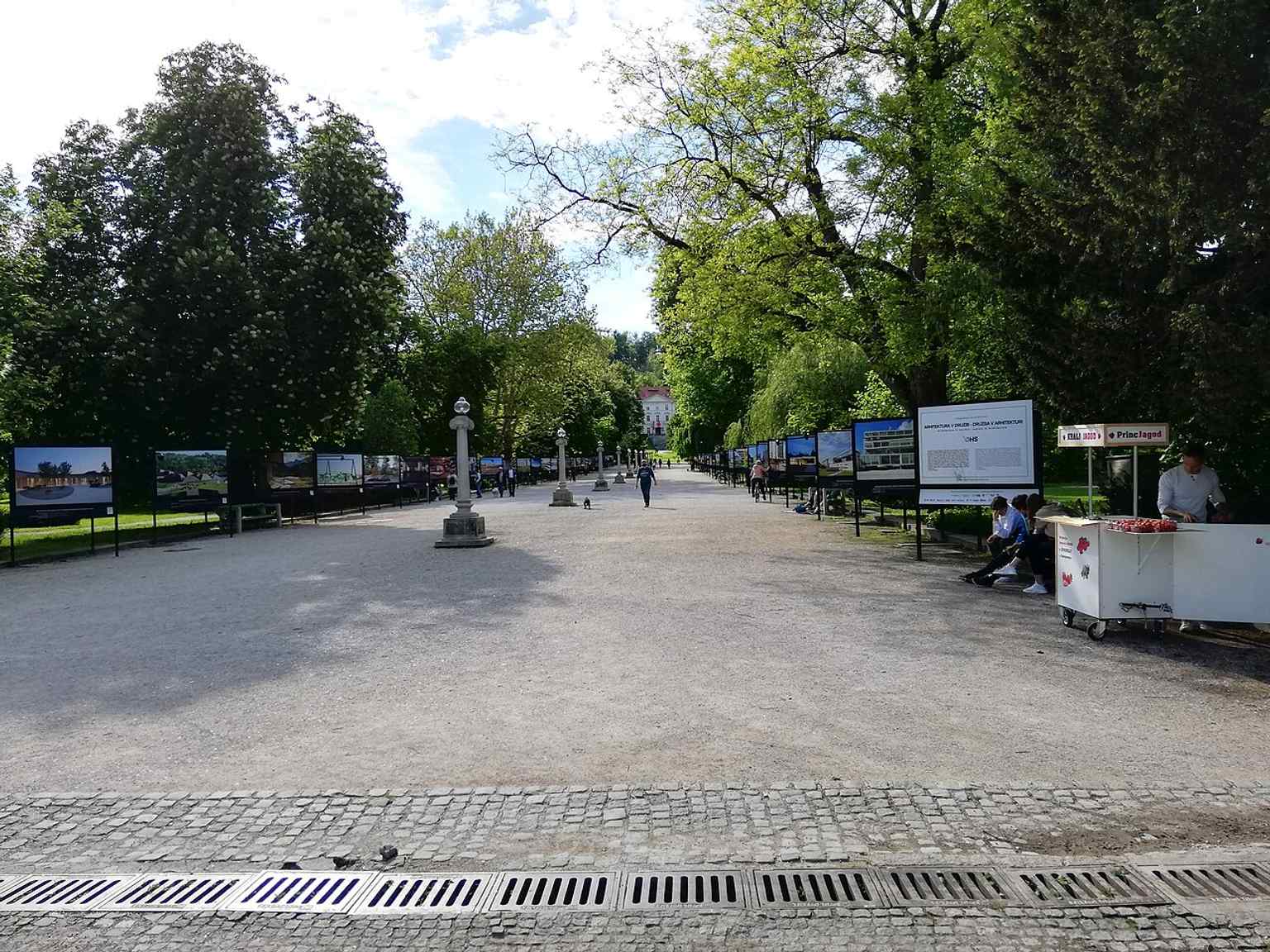
Looking to your left, you will find the sprawling entrance to Tivoli City Park, marked by a wide gravel path, sculpted white stone planters, and a curving black wrought-iron railing that frames the descent into the greenery.
Take a look at the historical engraving on your screen to see how this space looked around 1855, when an Austrian governor planted grand rows of poplars and chestnuts. These pathways became the stage where the high society of the Austro-Hungarian Empire would parade their fashion and status. This world of aristocratic leisure stands in sharp contrast to the fierce, grassroots cultural movements we explored earlier in the city. The park, much like the streets of Ljubljana, was a space where local identity had to be carved out over time.
At the end of the promenade sits Tivoli Castle, an elegant mansion guarded by four massive cast-iron dogs. For over a century, a dark urban legend has haunted these hounds. If you check the photo on your app, you might notice a strange flaw in their design. The dogs do not have tongues. The story goes that their creator, Austrian sculptor Anton Dominik Fernkorn, was so devastated by this mistake that he took his own life. The truth, however, is equally tragic but far less theatrical. Fernkorn did not shoot himself over the missing tongues. He actually suffered a severe mental collapse shortly after finishing the dogs and vanished into an asylum. The citizens of Ljubljana, unable to explain his sudden disappearance from public life, crafted the myth of the perfectionist's suicide to make sense of the eerie, silent gaze of his creations.
Over the decades, this park transitioned from a playground for the elite into a vibrant, bohemian sanctuary. Just behind the castle is an alpine-style building called the Švicarija. Originally a luxury hotel, it evolved into a creative haven that the famous Slovenian writer Ivan Cankar affectionately dubbed a refuge for sinners. It became the ultimate gathering place for local intellectuals. Later, in the 1930s, it served as a sanctuary for Russian war refugees who converted the hotel rooms into modest apartments, filling the halls with the sound of chisels as they lived alongside a burgeoning community of post-war sculptors.
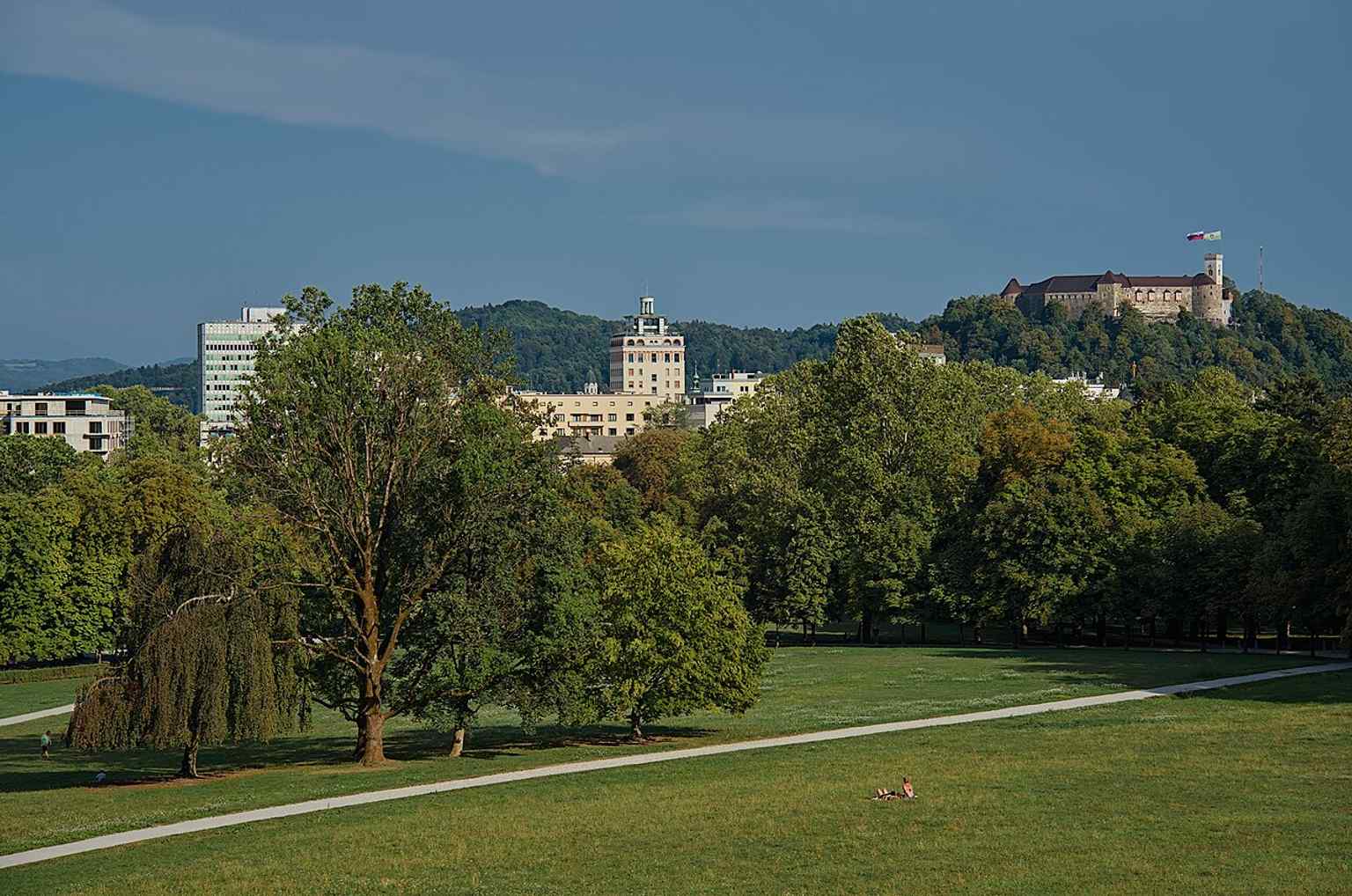
Even the wide walking path stretching before you was initially a site of cultural friction. When local architect Jože Plečnik redesigned this promenade to create a direct visual line straight to Ljubljana Castle, locals resisted the change. They mockingly called the wide, treeless path the Sahara. It took years of growth for the townspeople to finally embrace it as the visionary link between nature and the city it is today.
This beautiful green space is completely open twenty four hours a day, every day of the week. Go ahead and follow the promenade deeper into the park toward the hilltop castle, and we will pick up the trail at our next stop, Tivoli Castle, just a four minute walk away.





.jpg)
![This Photo was taken by Miha Peče. Feel free to use my photos, but please mention me as the author. I would much appreciate if you send me an email [email protected] or write on my talk page, for my information. Please do not upload an edited image here without consulting me. I would like to make corrections only at my own source to ensure that the changes improve the image and are preserved.Otherwise you may upload an edited image with a new name. Please use one of the templates derivative or extract.](https://upload.wikimedia.org/wikipedia/commons/d/d5/Tivoli_park_in_Ljubljan.jpg)
