
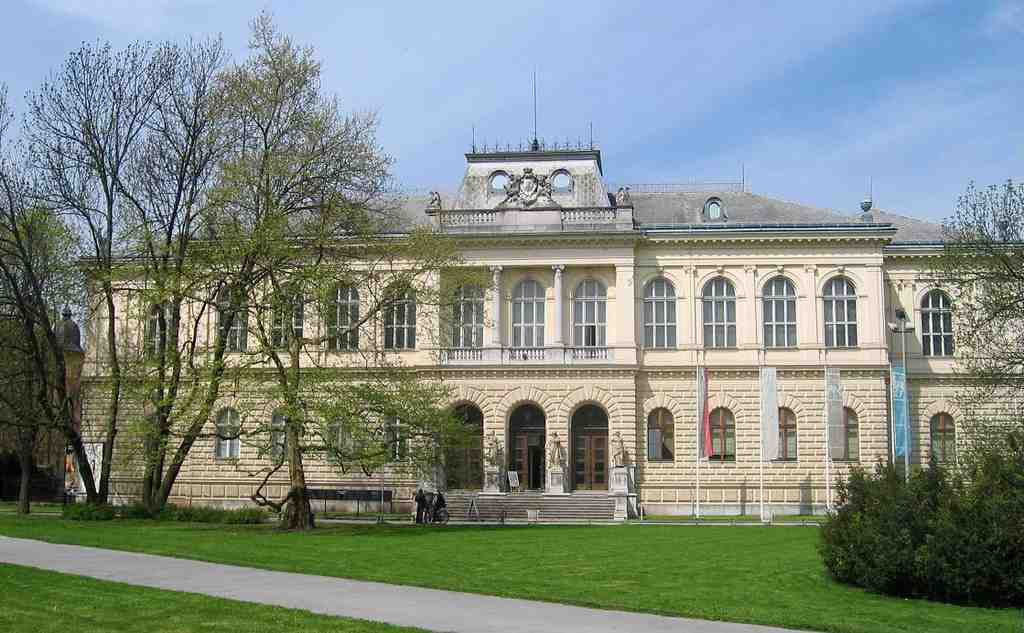
On your left, look for a pale stone Neo-Renaissance block with a long, symmetrical facade, arched windows, and a central pediment that reads as a formal civic “front door” to culture.
This is the National Museum of Slovenia, and it began as an act of national preservation before the nation-state even existed. In 1821, local leaders founded it as the “Estate Museum of Carniola,” trying to keep Carniolan heritage from being scattered, sold off, or simply forgotten. Five years later, Emperor Francis I stepped in as sponsor and renamed it the “Provincial Museum of Carniola,” a reminder that even preservation can come with a label attached. What gets protected… and what story it serves… often depends on who pays.
The building itself makes that argument in stone. The cornerstone was laid on July 14, 1883, for what would become the first purpose-built cultural building in the Slovene Lands. There was pride in that, and tension too: master builder Wilhelm Treo led the work, but the aesthetic vision leaned heavily on plans by Viennese architect Wilhelm Rezori. The Carniolan Building Company, dominant in its era, pushed to turn this whole zone near parliament into a grand cultural quarter-architecture as a kind of public curriculum. If you glance at the photo in the app, you can see how confidently the facade presents itself: orderly, official, and built to last.
Inside, the museum is also a museum of choices. One pillar is numismatics-coins and currency-down on the ground floor. And that collection owes a great deal to a merchant, Jože Repežič, who in 1831 donated more than 2,000 coins, including a rare core of 367 Roman Republican silver coins. A merchant’s private passion became a public inheritance. But the story isn’t tidy. For decades, the museum had no dedicated numismatic curator, so the coins sat under archaeology’s care, poorly documented, and in some cases damaged by mismanagement. Even when a society decides something matters… it still has to do the daily work of caring for it.
If you want a glimpse of how the museum tried to elevate local identity into something formal, pull up the ceiling image. Those medallions were painted in 1885 by Janez and Jurij Šubic: an allegory of Carniola as protector of arts and sciences, and portraits of famous Carniolans like Valvasor and Vodnik-history turned into a kind of civic sky.
Out front, since 1903, a bronze Valvasor stands watch-Alojz Gangl’s monument to a polymath whose curiosity helped define what “our knowledge” could mean.
When you’re ready, turn your attention across the square toward the opera house-where culture stops being archived and starts projecting itself aloud. The museum is generally open daily 10 to 6, with a later closing at 8 on Thursdays.




