
On your left stands the Tomb of National Heroes. You can see the monument above ground, a granite base supporting a sarcophagus. Take a glance at your app to see a closer view of the bronze reliefs covering its eastern and western faces, which depict scenes from the Second World War. Created in 1949 by architect Edo Mihevc and sculptor Boris Kalin, this marker commands a quiet reverence.
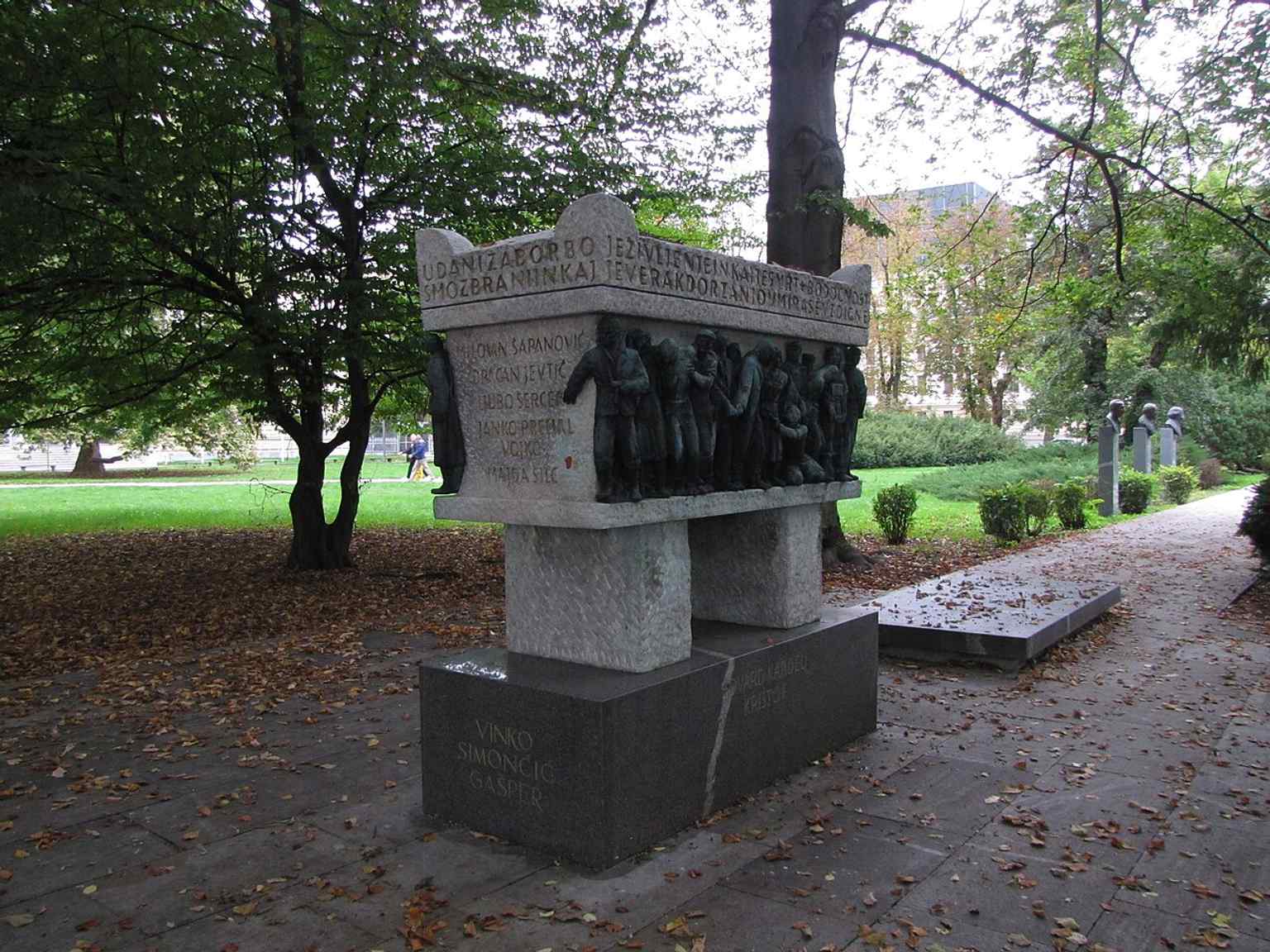
But what you see is only part of the story. The true resting place lies in the hidden layers of an underground tomb built directly into the earth. Transferred here in a solemn ceremony were the remains of legendary partisan commanders. Among them is Franc Rozman, who died tragically when a newly arrived British anti tank weapon exploded during testing. Also resting here is Majda Šilc. A former clerk and nurse who became a resolute partisan soldier, she was killed in battle at just twenty one, becoming the first Slovenian woman proclaimed a National Hero. The tomb later received powerful political figures like Edvard Kardelj in 1979, whose state funeral was so significant that Yugoslav President Josip Broz Tito cut short a diplomatic tour of the Middle East to attend.
Running along the top edge of the sarcophagus is a patriotic epitaph. This was written by Oton Župančič, a deeply revered Slovenian poet. In December 1948, the architect visited the ailing poet to request a verse that could serve as a moral anchor for the new monument. Despite his failing health, Župančič penned the lines specifically for the tomb, marking one of his very last literary contributions. His opening line translates to, One homeland is assigned to us all.
For decades, those words served as a simple tribute to the fallen. Yet, the meaning of public memory rarely stays still. In 2017, that exact line by Župančič was inscribed on a new Monument to All War Victims nearby, intended for national reconciliation. This reuse sparked sharp backlash. Right wing politicians and victims of communist persecution argued that lifting a quote originally written for a partisan tomb was inappropriate, claiming it forced old partisan ideology onto a monument meant to heal historical divides. It became a profound struggle, fought with words and memory instead of weapons.
Today, the monument exists in a state of political irony. Originally a communist shrine integrated into the post war leaderships daily environment, it now stands right next to the modern National Assembly. During recent years, protests have frequently been held within meters of the sarcophagus, often by groups standing in direct ideological opposition to those buried below.
As you stand before the tomb, consider how an epitaph meant for unity became a source of sharp political debate. How does history change when we re read it decades later? You can return to reflect on this space anytime, as it remains open twenty four hours a day, all week long. Let the weight of those words linger as we move toward a space of deep historical preservation. The National Museum of Slovenia is just a two minute walk away.





