
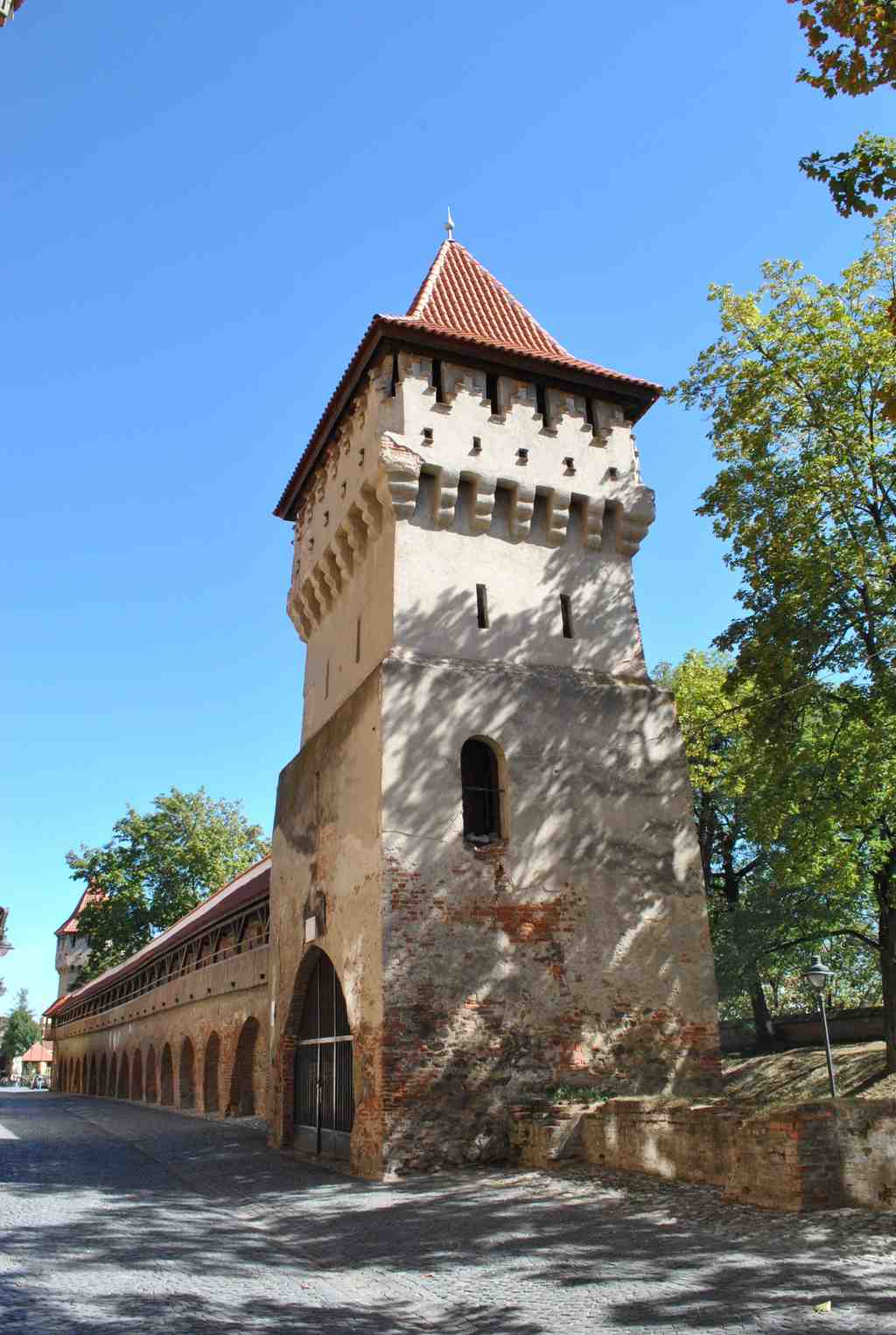
Look ahead at this towering rectangular structure made of faded plaster and exposed brick, featuring a sharply projecting upper section supported by heavy stone brackets beneath a steep tiled roof. You are standing in front of the Potters Tower, built by the Saxon potters guild back in the fifteenth century as part of the citys third fortification ring.
If you look closely at the exterior, you might spot the guilds signature carved right into the stone, an actual potters wheel and ceramic vessels. They wanted everyone to know exactly whose money built this impressive defense.
Notice that the wall connecting this to the tower we just left is made of two entirely different materials. The bottom half is rough stone, while the top half is brick. That is called a curtain wall, a defensive barrier connecting two towers. The defenders doubled its height later on to adapt to a terrifying new invention on the battlefield... artillery. Brick absorbed cannonball impacts much better than rigid stone, which tended to shatter. Up at the top of that wall, there is a covered corridor resting on arches, designed so defenders could quietly rush supplies back and forth during night attacks.
The tower itself is another masterpiece of lethal engineering. Just like the Carpenters' Tower, it features keyhole-shaped loopholes on the lower levels for heavy firearms, and an overhanging top section with pitch holes to drop burning debris directly onto the heads of anyone trying to scale the masonry.
But the threats to Sibiu did not always come from outside. In fifteen fifty-six, a massive fire destroyed nearly six hundred homes and killed over thirty people. The surviving citizens were convinced the blaze was set intentionally to force the city to submit to the Prince of Transylvania. A furious mob blamed the royal judge, Johann Roth. They dragged the old man out of his house, paraded him through the smoldering ruins of the city, and then killed him with an axe right in front of his own front door.
A few decades later, in sixteen ten, things got worse. Prince Gabriel Báthory, known by the citizens as the crazy prince, took the city by trickery. He confiscated all the weapons from the guilds, including the potters, and turned these defensive towers into lookout posts for his own occupying army. His rule was brutal. According to local legend, Báthory tortured a man to death in prison, then tried to court the mans beautiful widow. Preferring death to losing her honor to a tyrant, she tragically took her own life in her home near the Large Square.
Thankfully, the tower sees much more peaceful days now, and you can actually explore the inside from Tuesday through Sunday between eleven A-M and seven P-M by entering through the Carpenters Tower.
Pause here to appreciate the potters' formidable handiwork before continuing along the wall.


