
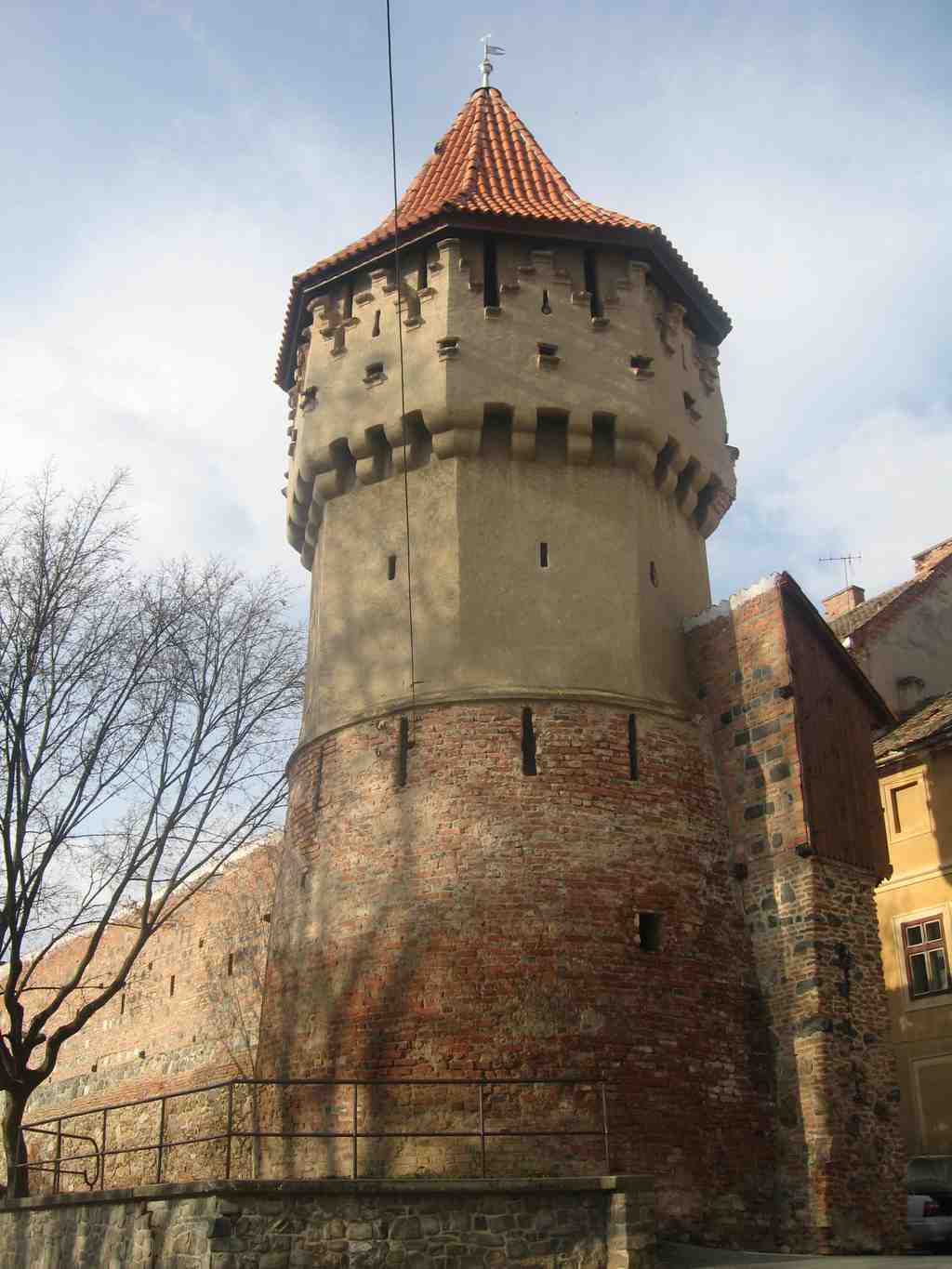
Right in front of you stands a robust defense structure featuring a cylindrical base of exposed red brick that transitions into an octagonal, plastered upper level, all crowned by a steep, red-tiled roof with a metal weather vane at its peak.
This is the Carpenters' Tower, built between thirteen fifty-seven and thirteen sixty-six by the Saxon carpenters' guild. It is the northernmost of three surviving towers along this defensive wall. Back then, this formidable brick network earned Sibiu the nickname the Red City, famous for its ability to withstand sieges.
If you look at the architecture, the base is circular, but above the protruding horizontal molding, known as a cornice, it shifts into an octagonal prism. From certain angles down the street, that robust shape actually resembles the prow of a medieval ship.
Now, let us talk about defense. On the lower level, you will notice slits shaped like keyholes. Those were specifically designed for firing arquebuses, an early type of heavy matchlock gun. But if the attackers somehow survived the gunfire and reached the base of the tower, things got much worse for them. Look up just beneath the overhanging roof section. Those gaps between the supporting arches are called pitch holes. Defenders used those functional channels to pour boiling water, hot oil, or melted pitch directly onto the heads of anyone trying to scale the brickwork.
During peacetime, the carpenters used the tower to hoard supplies, as guild members were required to stock enough provisions to survive months of blockade. If you look at the very tip of the roof, the metal weather vane proudly displays two crossed broadaxes, the traditional emblem of their trade.
The street we are standing near carries its own dramatic story. For centuries, it was named after Johann Sachs von Harteneck, a visionary mayor who commissioned the very first topographic maps of Sibiu to better understand its defenses. But his political career met a violent end. In seventeen zero two, he proposed taxing the nobility to ease the financial burden on the working class. The nobility retaliated swiftly, and Harteneck was convicted and publicly beheaded in the city square in seventeen zero three.
In more recent times, this sixteenth-century architecture proved authentic enough to serve as a backdrop for the nineteen seventy historical film Mihai Viteazul. However, it also survived a rather undignified modern era when it was abandoned and used as an electrical transformer station. Thankfully, it was fully restored and finally reopened to visitors in twenty twenty. If you want to explore the inside and walk the connecting gallery, the tower is open Tuesday through Sunday from eleven A-M to six P-M.
It is a brilliant piece of medieval engineering. Whenever you are ready, we can make our way to the next stop.


