
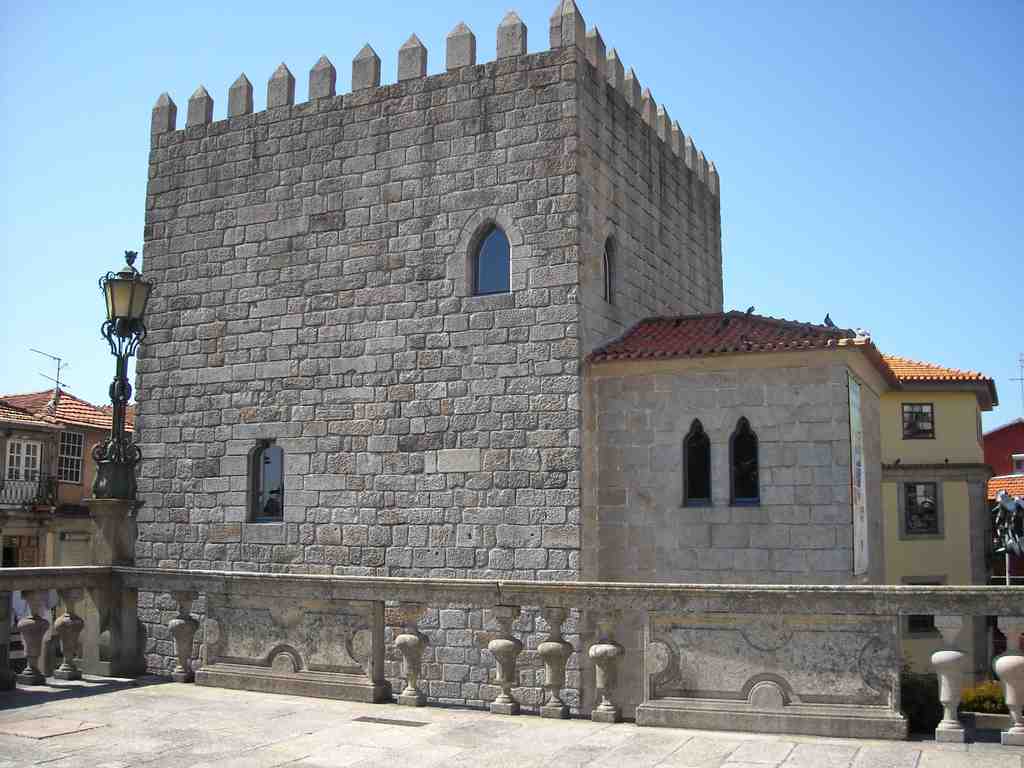
On your right, look for a compact granite tower made of two joined rectangular blocks, topped with red roof tiles and marked by tooth-like triangular battlements on the taller side.
It looks like a clean survivor from the Middle Ages, but Porto has played a subtler game here. This tower carries the name of D. Pedro Pitões, a twelfth-century archdeacon of Porto remembered for his part in the Reconquista, the long Christian campaign to retake Iberian territory, and for supporting the First Crusade. The name gives the place a stern medieval pedigree. Yet the odd thing is this: nobody can say for certain what the original tower actually was. A fortification, perhaps. Or the home of a wealthy burgher, meaning a prosperous town resident, built to look secure in unsettled times.
That uncertainty suits it. Even from here, you can see how the building hesitates between house and stronghold. Above the entrance, the twin trilobe windows, openings shaped like three rounded leaves, feel almost domestic. Then your eye climbs to the battlements, and the place hardens again.
Most visitors miss the real twist. This “survivor” survives because Porto nearly erased it. In nineteen forty, during demolitions around the cathedral hill to open up the new Terreiro da Sé, workers uncovered the tower in the old Largo do Açougue. Medieval Porto has a habit of returning like that, not in triumph, but in fragments exposed by a falling wall. The city made a late rescue decision and shifted the tower roughly fifteen meters instead of clearing it away. So the monument in front of you is both old and relocated, rescued and rearranged. Locals know that this is not simply a relic; it is a relic that moved.
Architect Rogério de Azevedo led the reconstruction and gave the tower some of the silhouette you see now, including the stone balcony with its distinctly Gothic flavour. If you glance at the image on your screen, the tower’s compact, almost theatrical outline becomes clearer, tucked into the slope beside the cathedral quarter. It is medieval in spirit, certainly, but also a twentieth-century act of interpretation.
Then the building changed roles again. Between nineteen forty and nineteen sixty, Porto installed the Gabinete de História da Cidade, the City History Cabinet, inside, and people called it the Torre da Cidade, the City Tower. After the Carnation Revolution on the twenty-fifth of April, nineteen seventy-four, residents occupied it and created the Centro Social e Cultural da Sé. In nineteen ninety-seven, Manuel Magalhães rehabilitated it, and by nineteen ninety-eight it had become a tourist post. Today it serves as the official tourist office of the Sé, which is rather marvellous when you think about it: a place once uncertain in purpose now hands out certainty to strangers.
Soon, power changes its language again. At the Church of Misericórdia do Porto, about eight minutes away, influence will work not through defense or civic record, but through organised charity. And if you ever wish to linger, this stop is listed as open twenty-four hours a day.




