
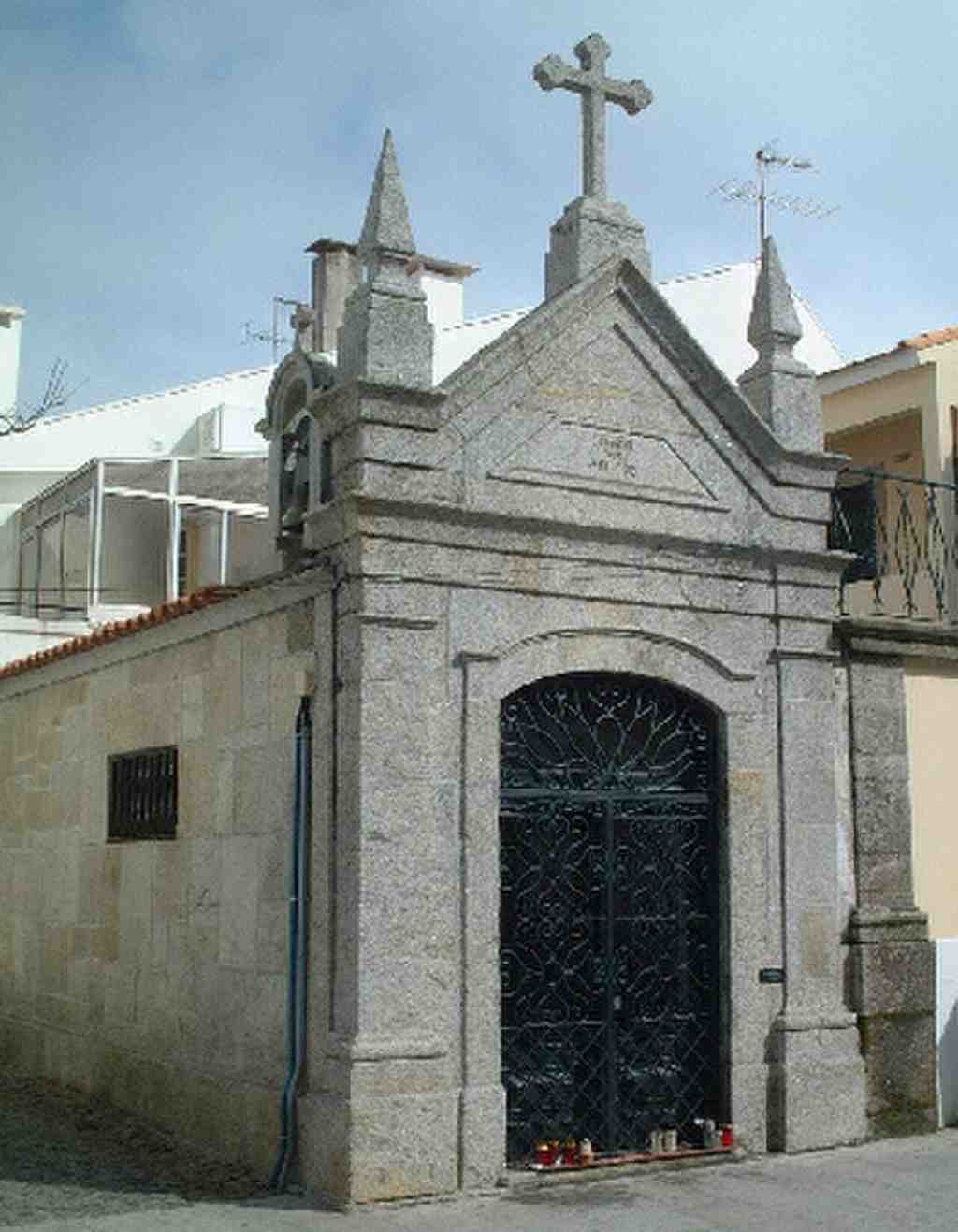
Ahead of you stands a small whitewashed chapel with a rectangular body, a low arched doorway behind wrought-iron gates, and a triangular gable crowned by a three-lobed stone cross.
This little building carries the anxieties of the waterfront. Here in Esposende, river and sea never kept politely to their own corners. They fed the town, guided trade, and sent men out to work, but they also brought sudden danger, changing channels, and the plain possibility that a boat might not come back. That is the world that gave birth to this devotion.
The story begins not with a chapel at all, but with a stone cross raised by fishermen and mareantes, the seafaring boatmen who lived by tides and risk. On that cross they painted an image of Christ, and people quickly called it the Senhor dos Aflitos, the Lord of the Afflicted. Local memory says the devotion may reach back to the sixteenth century, when the cross stood out in the Ribeira as a vow made against the perils of the water. At first, some remembered the image as Senhor do Outeiro, the Lord of the Hillock, before the name Senhor dos Aflitos took hold.
Pause a moment and study the chapel’s front. The doorway, the triangular top, the stone cross above it: now imagine an earlier sacred image exposed out in the open, facing river traffic, salt, and constant wear. You begin to see why devotion here needed shelter.
Most visitors assume the chapel simply grew naturally around the old cross. The truth is much more human, and much more bureaucratic. Municipal papers show expropriations, signed terms, and strict conditions for moving the old niche, that recessed little shrine holding the image. Workers had to dismantle it stone by stone, number the pieces on the outside, and set each one back in its proper place. The instructions even warned them not to chip the corners. And one man steps clearly out of those papers: Manuel Rodrigues Viana, who declared that he would pay for the work needed to reinstall the image and the contents of the old chapel.
Even that careful plan moved slowly. The council approved the transfer in eighteen eighty-two, but the work only went to auction in eighteen eighty-nine, probably because money was short. Then, in nineteen sixty-nine, restoration proved more drastic than it looks. According to the local heritage record, builders kept only the main façade and the cross of Senhor dos Aflitos. Much of what you see beyond that is a later remaking.
So this chapel offers a rather Esposende lesson: faith survived here, yes, but it survived through contracts, delays, measurements, and negotiation, not prayer alone. When you are ready, we’ll walk about four minutes to the Statue of Dom Sebastião, where memory takes a rather different form.




