
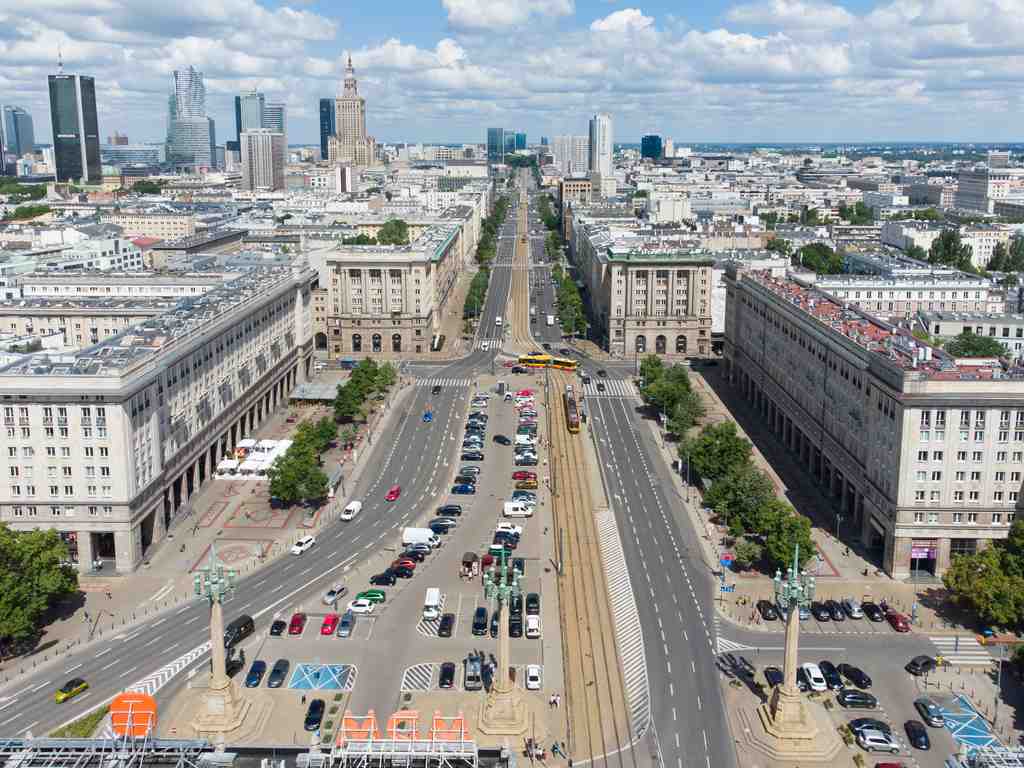
Warsaw Audio Tour: Stories of Squares, Streets, and Silent Symbols
Beneath the polished marble of Warsaw lies a city built on the ashes of rebellion and the whispers of spies. You are walking over the ghosts of kings and the secret meeting points of world-altering political battles. Unlock this self-guided audio tour to navigate the silent narratives hidden behind the grand facades of Three Crosses Square and the stoic walls of the U.S. Embassy. Discover the forgotten scandals and buried tragedies that the typical tourist guidebook ignores. Why did the Swiss Valley become a graveyard for vanished secrets? How close did this district come to total annihilation during the height of the Cold War? And which specific street lamp was the primary signal for an underground courier? Traverse through layers of history where every corner pulses with tension. Experience the city as a living archive. Plug in, press play, and start your descent into Warsaw’s dark, beating heart.
Tour preview
About this tour
- scheduleDuration 100–120 minsGo at your own pace
- straighten4.6 km walking routeFollow the guided path
- location_on
- wifi_offWorks offlineDownload once, use anywhere
- all_inclusiveLifetime accessReplay anytime, forever
- location_onStarts at Greetings from Aleje Jerozolimskie
Stops on this tour
lock_open 3 free previews · 11 unlock with purchase
On your right, a tall brown artificial trunk rises from the roundabout into a wide spray of green fronds - a lone date palm made of plastic and natural materials, standing where…Read moreShow less
Open dedicated page →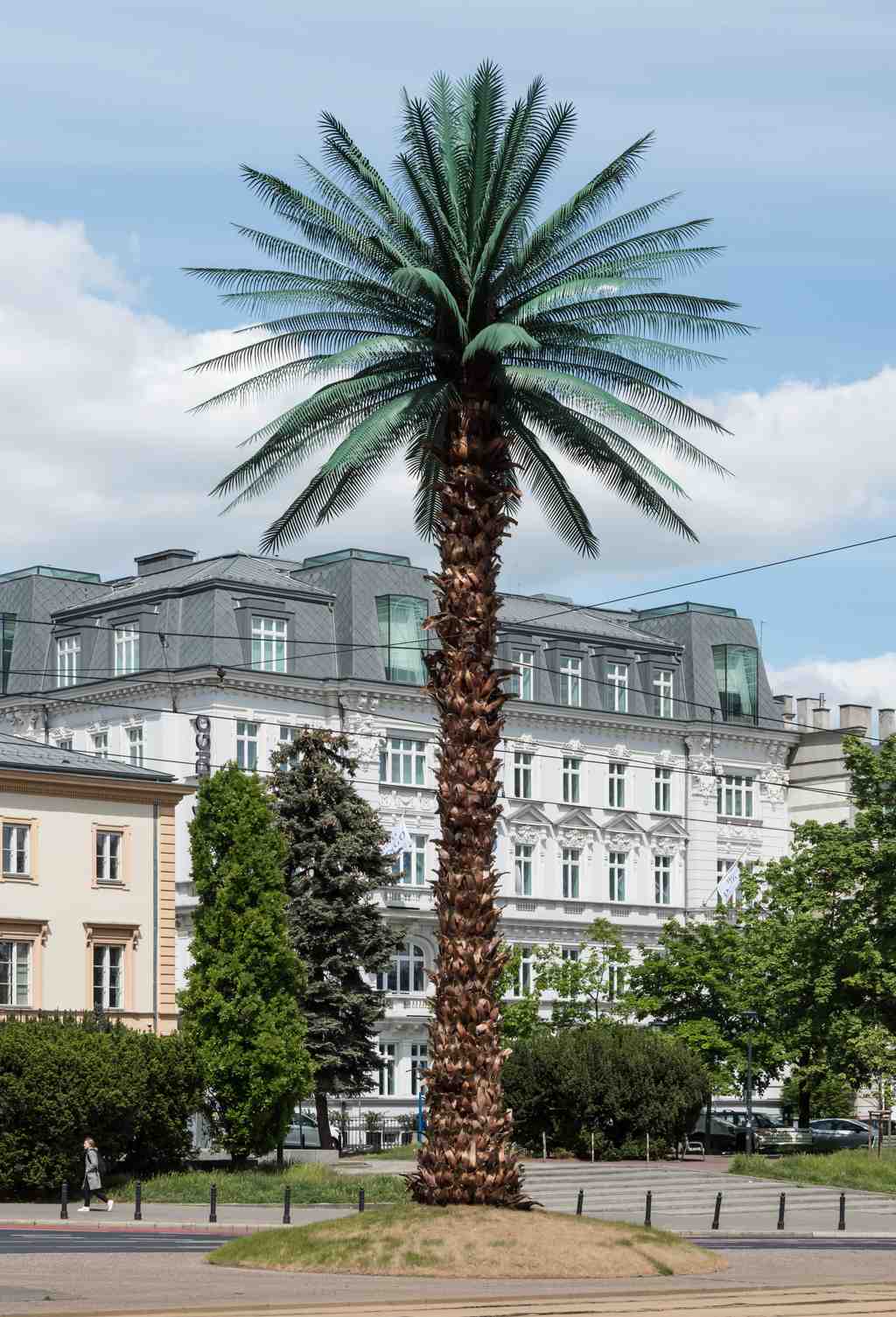
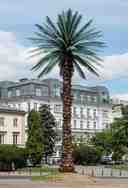
Greetings from Aleje JerozolimskiePhoto: Adrian Grycuk, Wikimedia Commons, CC BY 3.0 PL. Cropped & resized. On your right, a tall brown artificial trunk rises from the roundabout into a wide spray of green fronds - a lone date palm made of plastic and natural materials, standing where Warsaw absolutely does not need one.
This is Joanna Rajkowska’s Palm, officially Greetings from Jerusalem Avenue. It is part sculpture, part prank, part civic stress test. Foreign, local, ironic, and somehow beloved... it turned a traffic circle into a stage and gave Warsaw a symbol that behaves less like a monument and more like a question.
Rajkowska got the idea after a trip to Israel in two thousand one with Artur Żmijewski. At first she imagined a whole row of palms. Then she found an old postcard from Hebron showing a bare hill and one scraggly palm, with the kind of awkward charm familiar from Polish postcards of the nineteen eighties. That changed everything. One strange tree would do more damage to normal expectations than a whole tropical boulevard.
The palm appeared here on the twelfth of December, two thousand two. It stands about fifteen meters high, waterproof, fixed to a metal structure weighted with concrete. If you check the close-up in the app, you can see the handmade artificiality up close - bark, joints, engineering, and the whole beautiful fake.
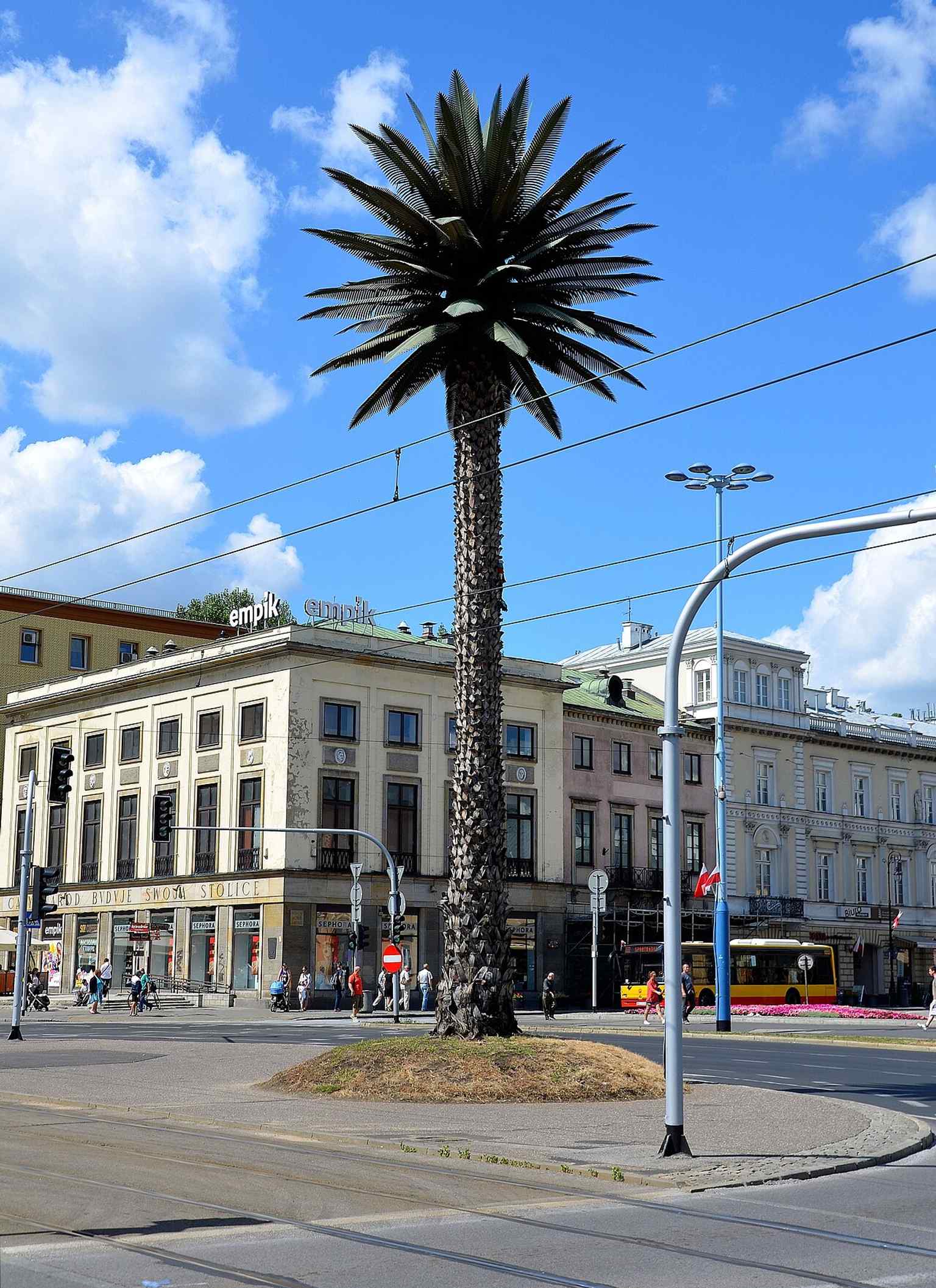
A close-up of the palm’s trunk and crown, useful for showing the handmade, artificial construction of the artwork.Photo: Adrian Grycuk, Wikimedia Commons, CC BY-SA 3.0 pl. Cropped & resized. And yes, the location matters. Aleje Jerozolimskie means Jerusalem Avenue. So Rajkowska planted a palm in the middle of it and let people reveal themselves. Some tram passengers reportedly muttered that Jews had put it here because it was “their avenue.” Which is not a great review of public memory, but it was exactly the point. She wanted the work to test tolerance, prejudice, and the way history lingers in ordinary street names.
The city argued over everything: how long it should stay, who should pay for repairs, who controlled its image, whether it was art or nonsense. It had a permit for only one year. But Warsaw adopted it with suspicious enthusiasm. A poll in two thousand three found that seventy-five percent of residents wanted it to stay. A citizens’ Committee for the Defense of the Palm even staged a protest in swimwear and Hawaiian shirts. Police at the roundabout earned the nickname “Miami cops.” Very dignified.
After that, the palm became a public noticeboard for serious things: a giant nurse’s cap during the nurses’ protest in two thousand seven, a Palestinian scarf in two thousand eleven, a Ukrainian flag in two thousand fourteen, and “Constitution” banners during protests in two thousand twenty. This is not really a tree. It is a public question mark.
In two thousand nineteen, the green fronds were replaced with dead real leaves to warn about ecological collapse. If you want, compare the before and after image in the app - the same joke suddenly looks like a funeral.
In two thousand twenty-four, Rajkowska donated the work to Warsaw’s Museum of Modern Art, and engineers helped restore it with seventy-four new leaves cut by high-pressure water jet for better durability. Even absurdity needs maintenance.
When you’re ready, continue two minutes to the Free Word Memorial, where public space asks a different, and sharper, question. The museum connected to this work generally opens from late morning into early evening, shortens hours on Saturday, and closes on Sunday.
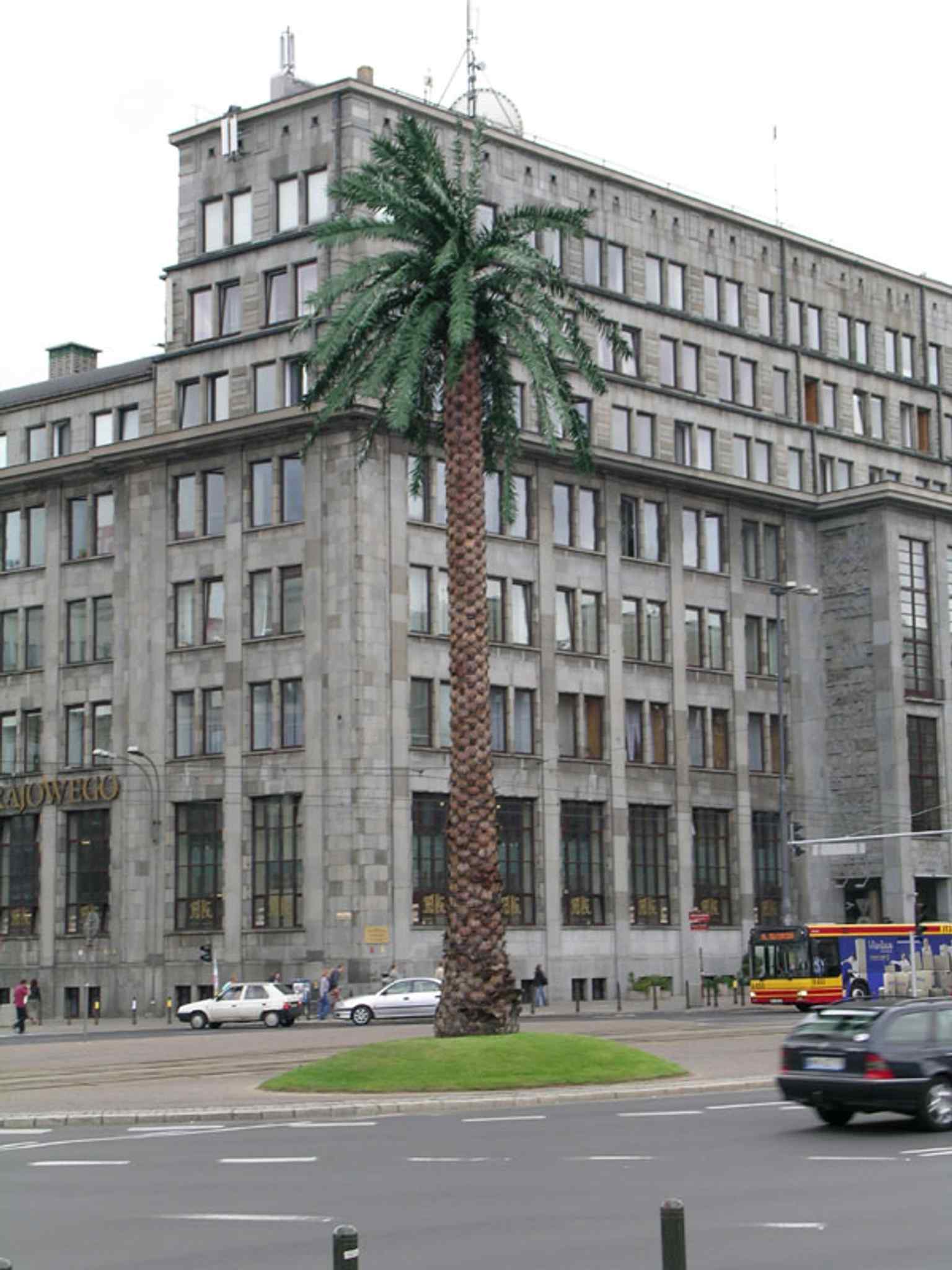
An early view from 2005, showing the artwork in its first years after the 2002 unveiling.Photo: Pjm at Polish Wikipedia, Wikimedia Commons, CC BY-SA 3.0. Cropped & resized. 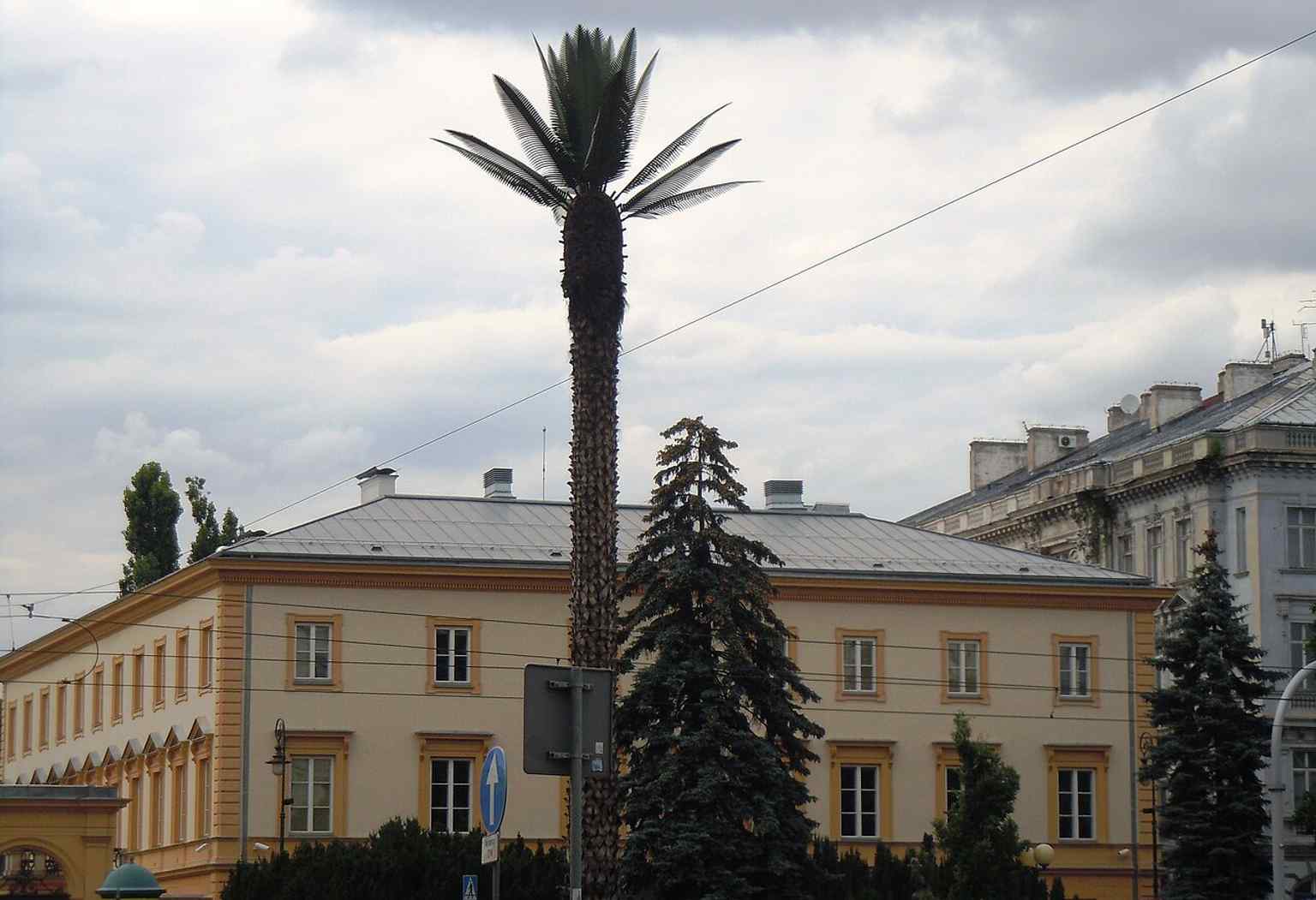
A clear, full-height view of the 15-meter artificial palm, built from plastic and natural materials.Photo: Tony Castle, Wikimedia Commons, CC BY-SA 3.0. Cropped & resized. 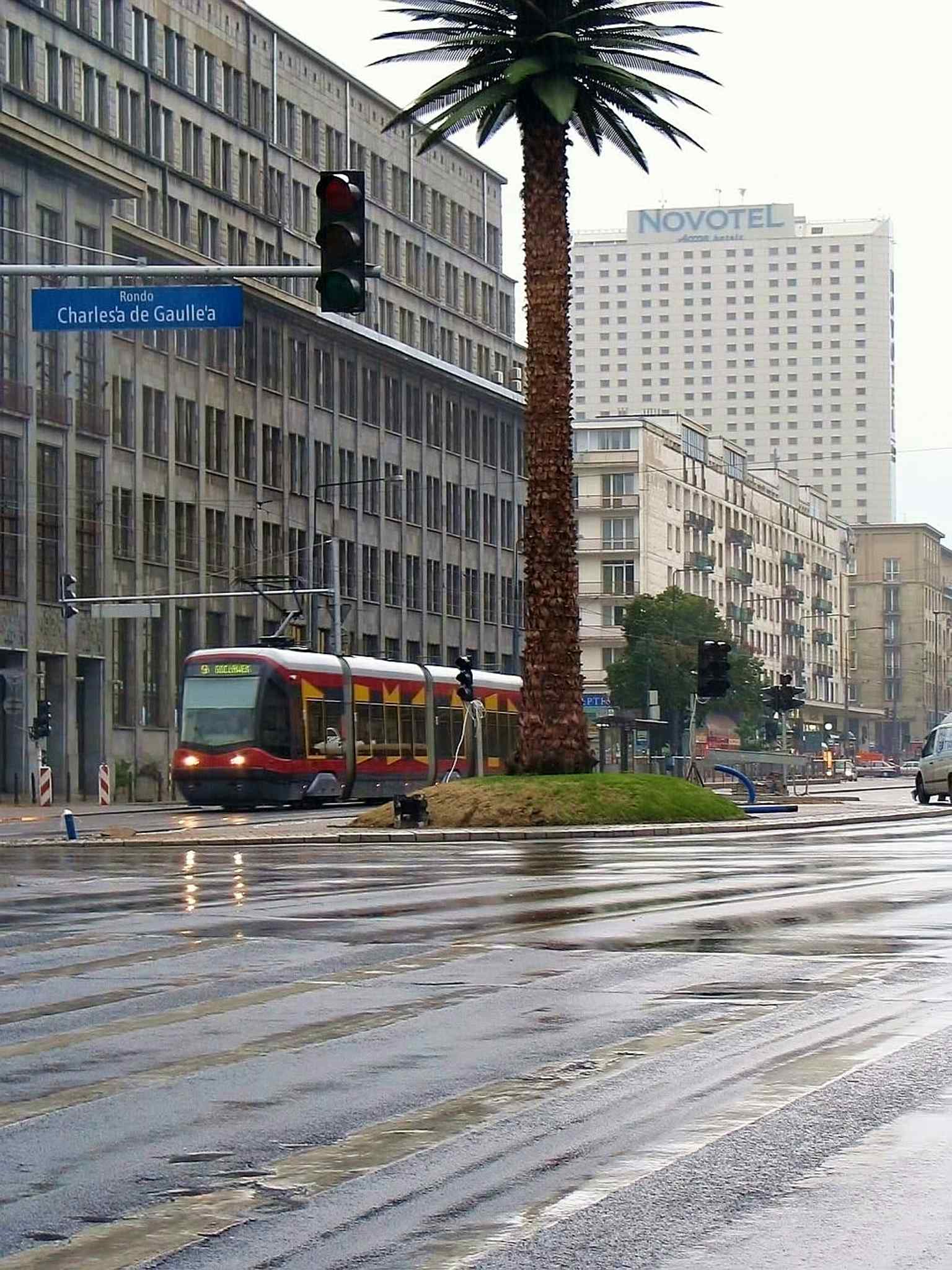
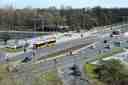
The roundabout seen with tram infrastructure nearby, echoing how the palm became a familiar point of orientation for locals.Photo: Tadeusz Dąbrowski, Wikimedia Commons, CC BY-SA 3.0. Cropped & resized. 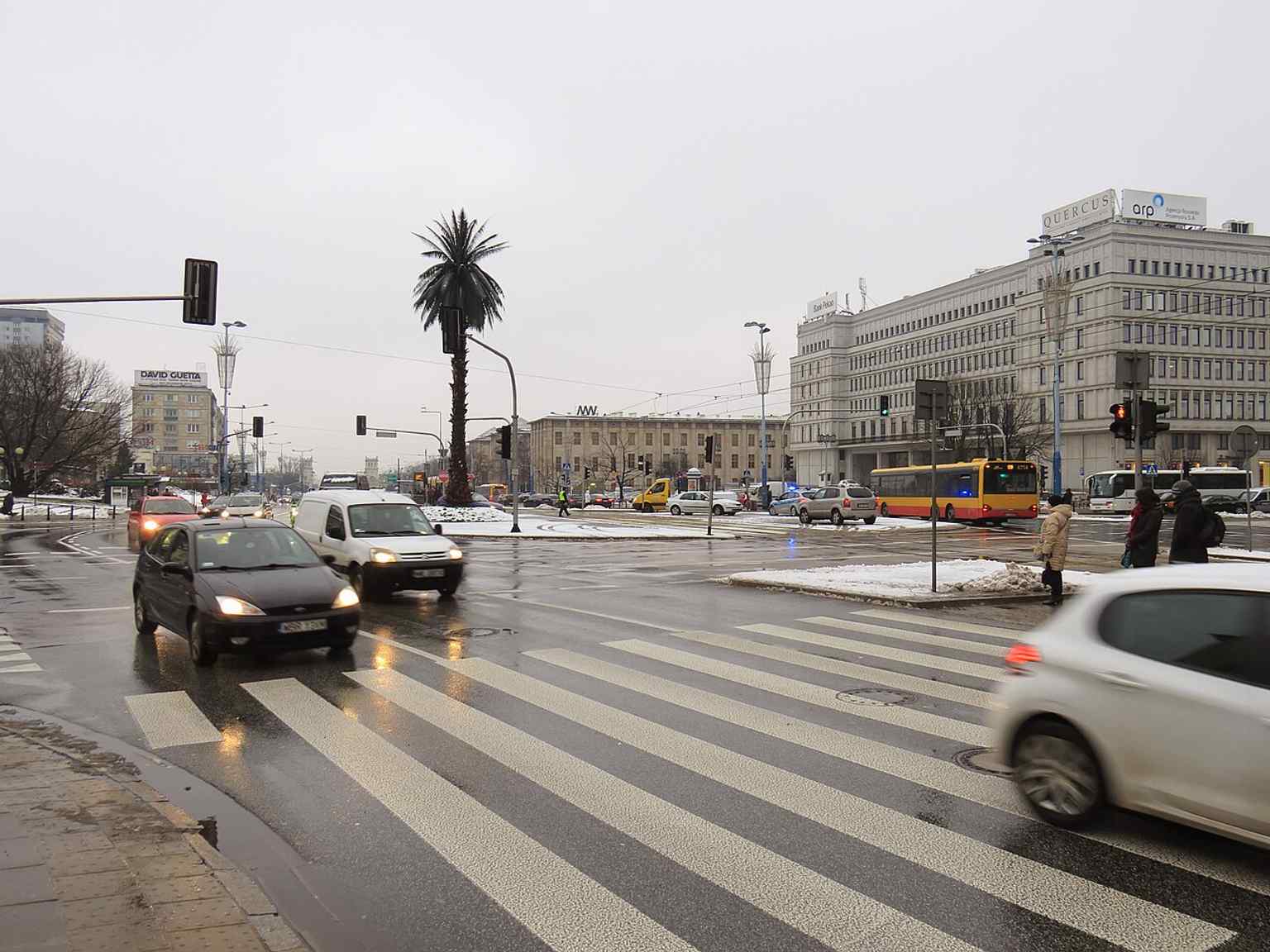
A broad overhead-style city view of the roundabout, showing how the palm anchors this busy central Warsaw junction.Photo: Аимаина хикари, Wikimedia Commons, CC0. Cropped & resized. 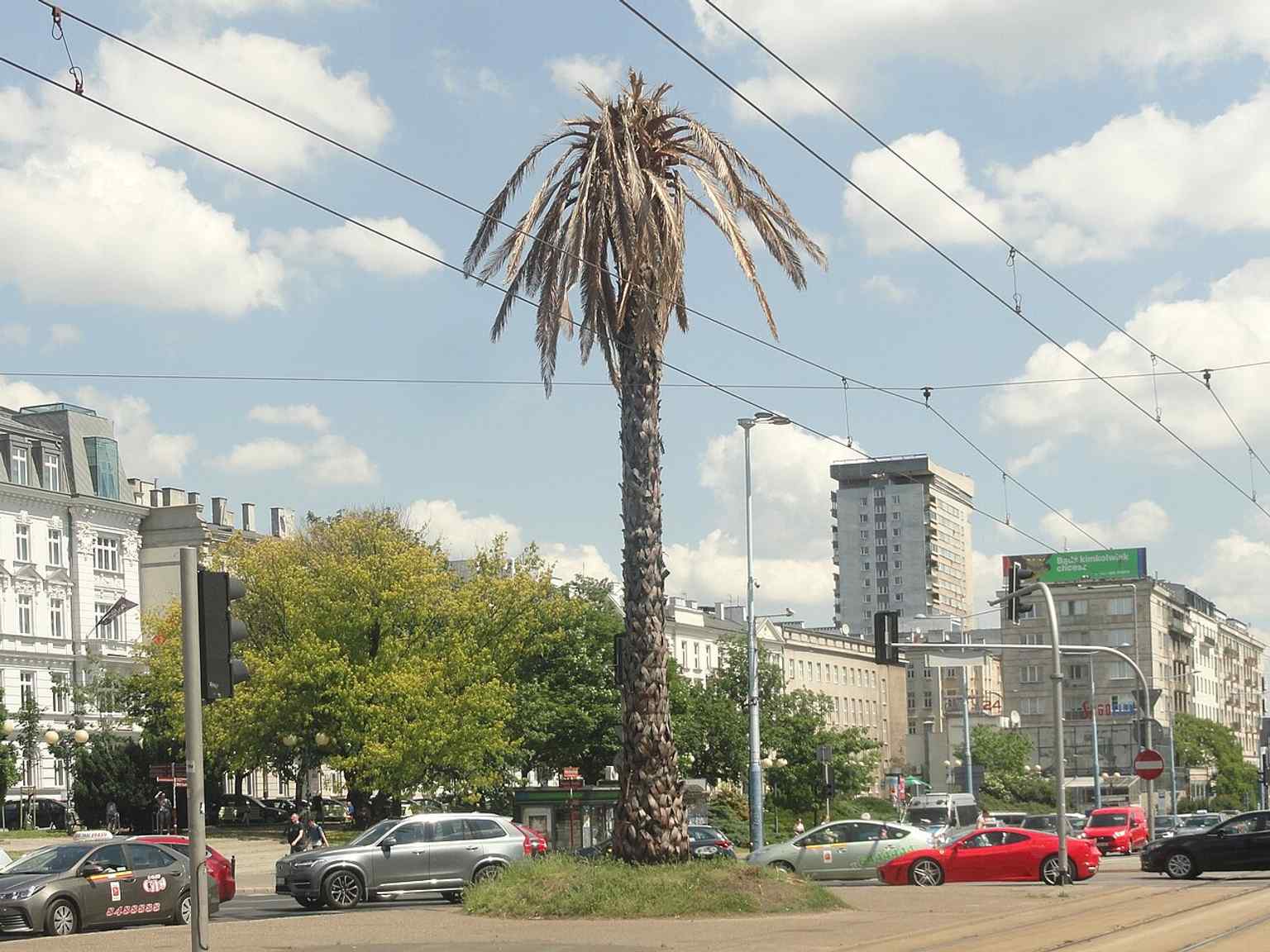
The 2019 climate action version with withered leaves, created to draw attention to ecological collapse on World Environment Day.Photo: Cybularny, Wikimedia Commons, CC0. Cropped & resized. 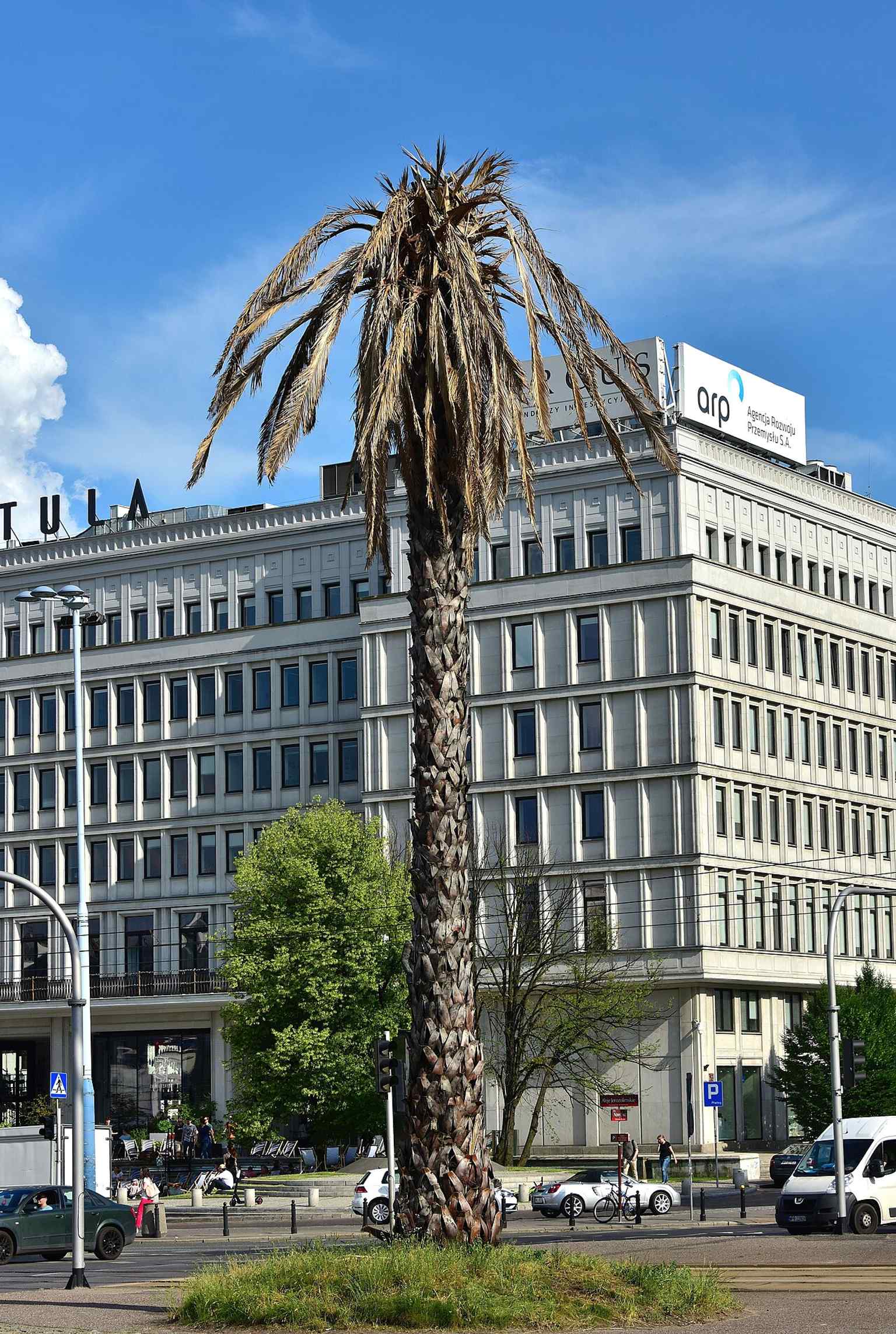
Another 2019 view of the climate-themed installation, when the palm was temporarily dressed with dead leaves as a protest image.Photo: Adrian Grycuk, Wikimedia Commons, CC BY-SA 3.0 pl. Cropped & resized. 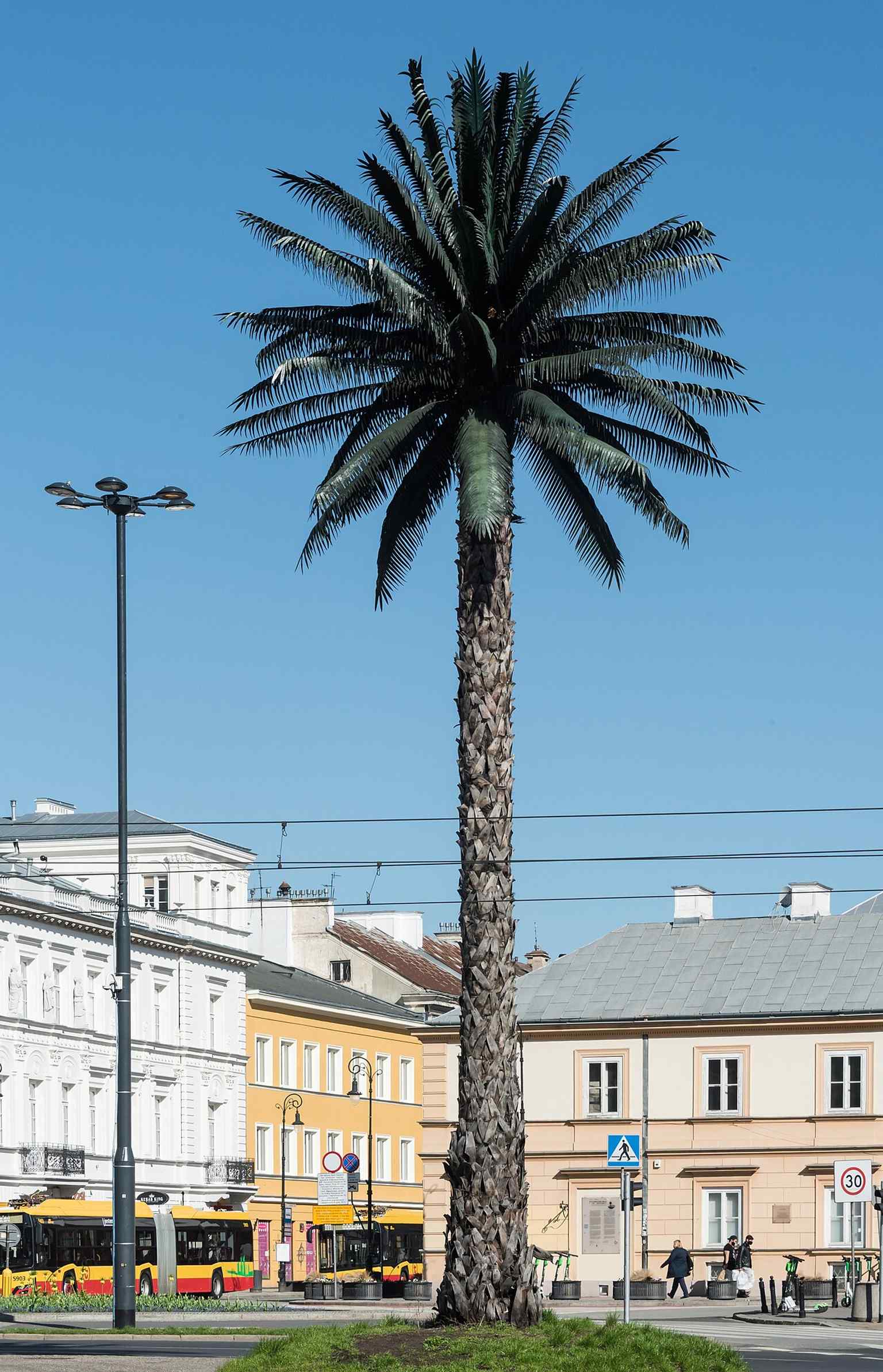
A recent view of the palm, reflecting its continued life after major restoration and its status as an official city artwork.Photo: Adrian Grycuk, Wikimedia Commons, CC BY-SA 3.0 pl. Cropped & resized. 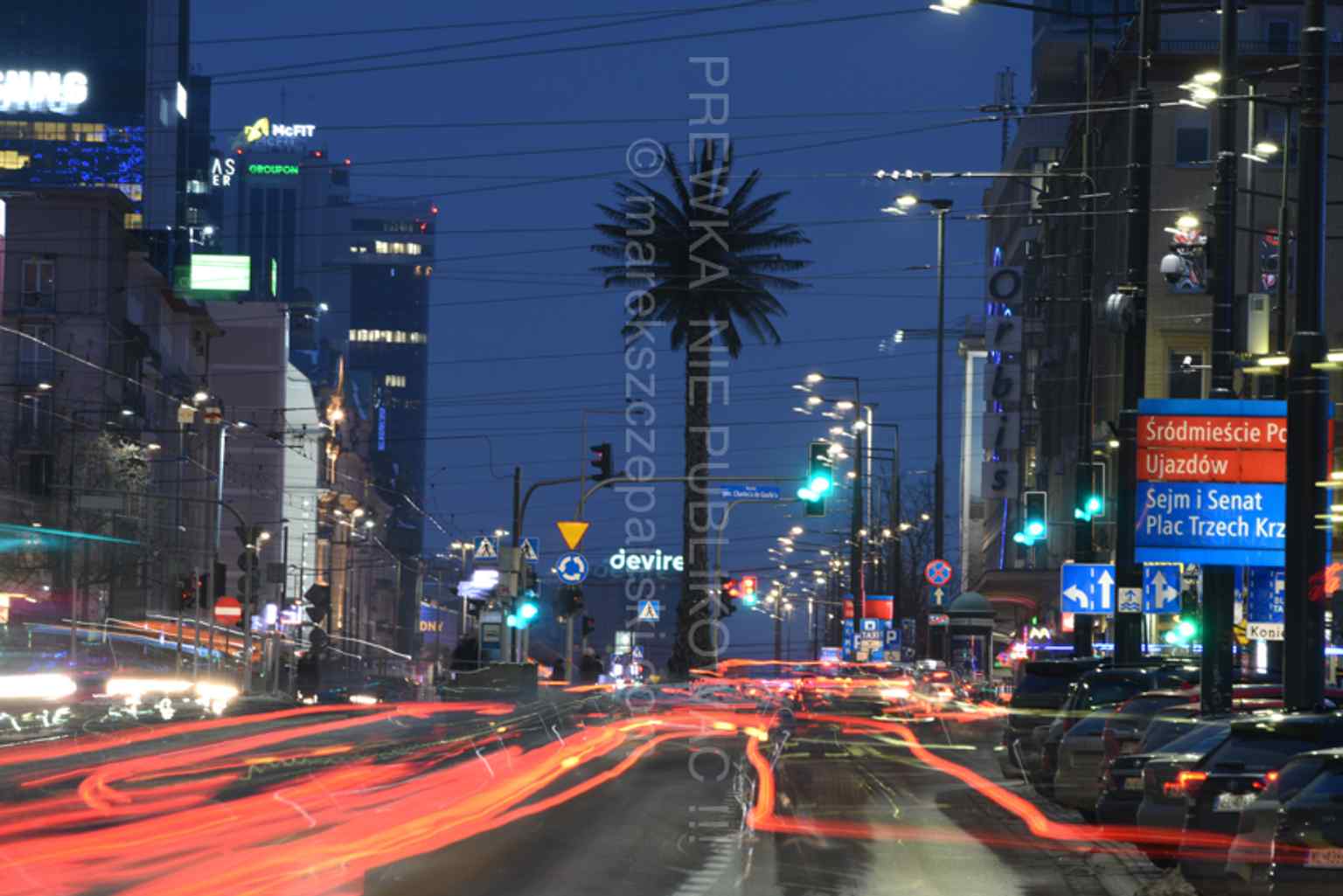
A presentation image that identifies the installation as ‘Greetings from Jerusalem Avenue’ by Joanna Rajkowska.Photo: Malick78, Wikimedia Commons, CC BY-SA 4.0. Cropped & resized. 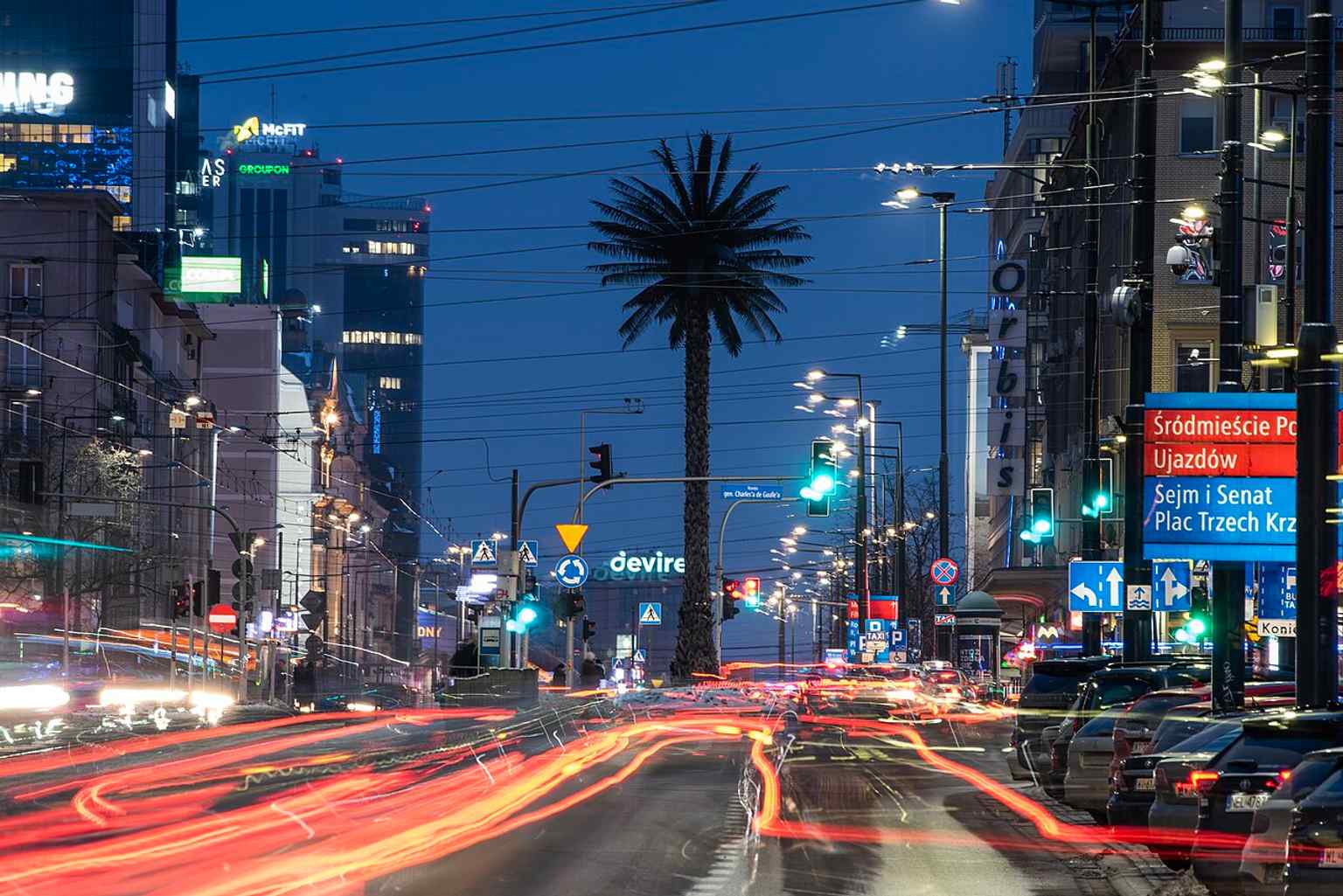
A high-quality main image of the artwork, useful as a clean hero shot for the tour.Photo: Malick78, Wikimedia Commons, CC BY-SA 4.0. Cropped & resized. Look for the broad asphalt street lined with stone and concrete façades, with a sharp wedge-shaped corner building marking the split where Krucza meets Mokotowska and…Read moreShow less
Open dedicated page →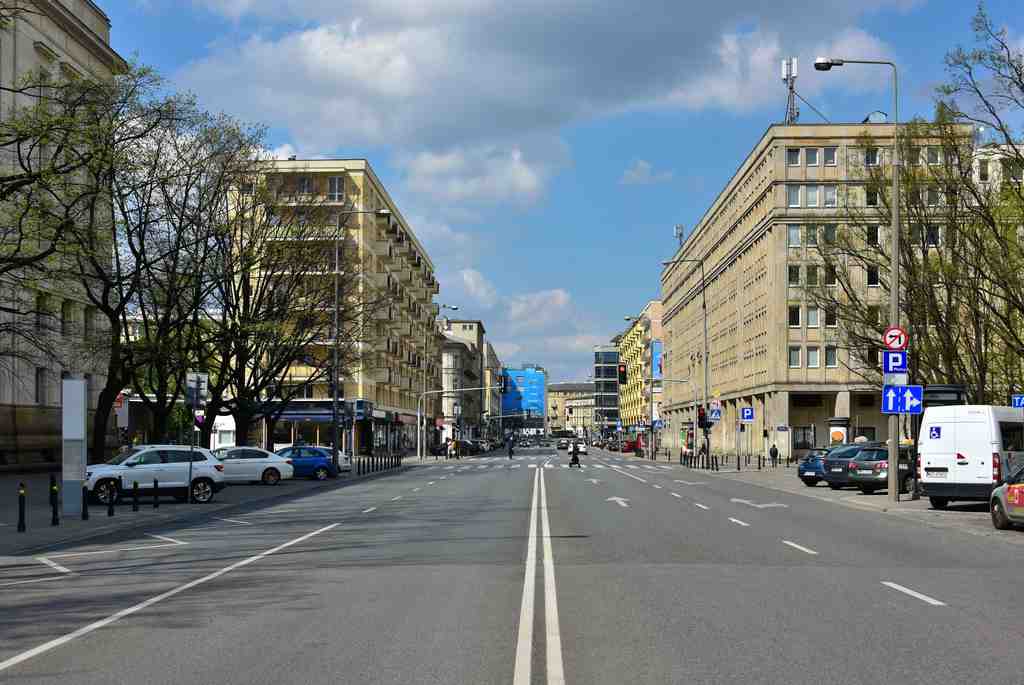
Krucza Street in WarsawPhoto: Adrian Grycuk, Wikimedia Commons, CC BY-SA 3.0 PL. Cropped & resized. Look for the broad asphalt street lined with stone and concrete façades, with a sharp wedge-shaped corner building marking the split where Krucza meets Mokotowska and Piękna.
Krucza began, very appropriately, as a practical problem. Around seventeen seventy, the street started here and ran only as far as beyond Nowogrodzka, then stopped. The city wanted to push it farther, but the ground ahead was wet and troublesome, and that difficult patch helped give the street its name. Not every urban legend gets such muddy credentials.
This is where Warsaw’s ordinary metabolism mattered. Krucza grew through errands, rent, fabric, hats, and shop windows... not through ceremony. After eighteen seventy, builders packed both sides with rental tenements. Before the First World War, people came here for cheap women’s clothing. Later, Krucza became known for women’s hat shops too. The street stayed narrow, busy, and full of ground-floor trade. If the palm on Aleje Jerozolimskie plays the diva, Krucza handled the receipts.
In eighteen twenty-three, the street finally connected to the newly laid Droga Jerozolimska, today’s Aleje Jerozolimskie, and that turned it from a stub into a working city artery. By the late nineteenth and early twentieth century, it had the kind of urban texture cities rarely plan well: crowded sidewalks, small commerce, and buildings that earned their keep floor by floor.
Then war tore through that texture. Some buildings burned in September nineteen thirty-nine, and the Second World War destroyed almost all of Krucza. At the start of the Warsaw Uprising, soldiers from the Bełt and Kiliński battalions raised a barricade between numbers seventeen, now twenty-three, and twenty-two. So even this shopping street became a front line.
After the war, planners widened Krucza to thirty-four meters in nineteen forty-nine. They cleared the ruined eastern frontage entirely and kept only a few prewar tenements on the west side. Ministries and central offices moved in. At Krucza thirty-six and Wspólna six, architect Zbigniew Karpiński finished a major office building in nineteen fifty-one. Then came Metalexport in nineteen fifty-six, right at this end of the street. The idea was a ministry district. It looked efficient on paper and lifeless after five o’clock, so the city eventually added housing and, in nineteen fifty-seven, the Orbis Grand Hotel.
If you check the image in the app, you can see that assertive corner development here. During construction nearby, workers even uncovered a tobruk - a small reinforced-concrete bunker from nineteen forty-four - and sent it to the Warsaw Uprising Museum.
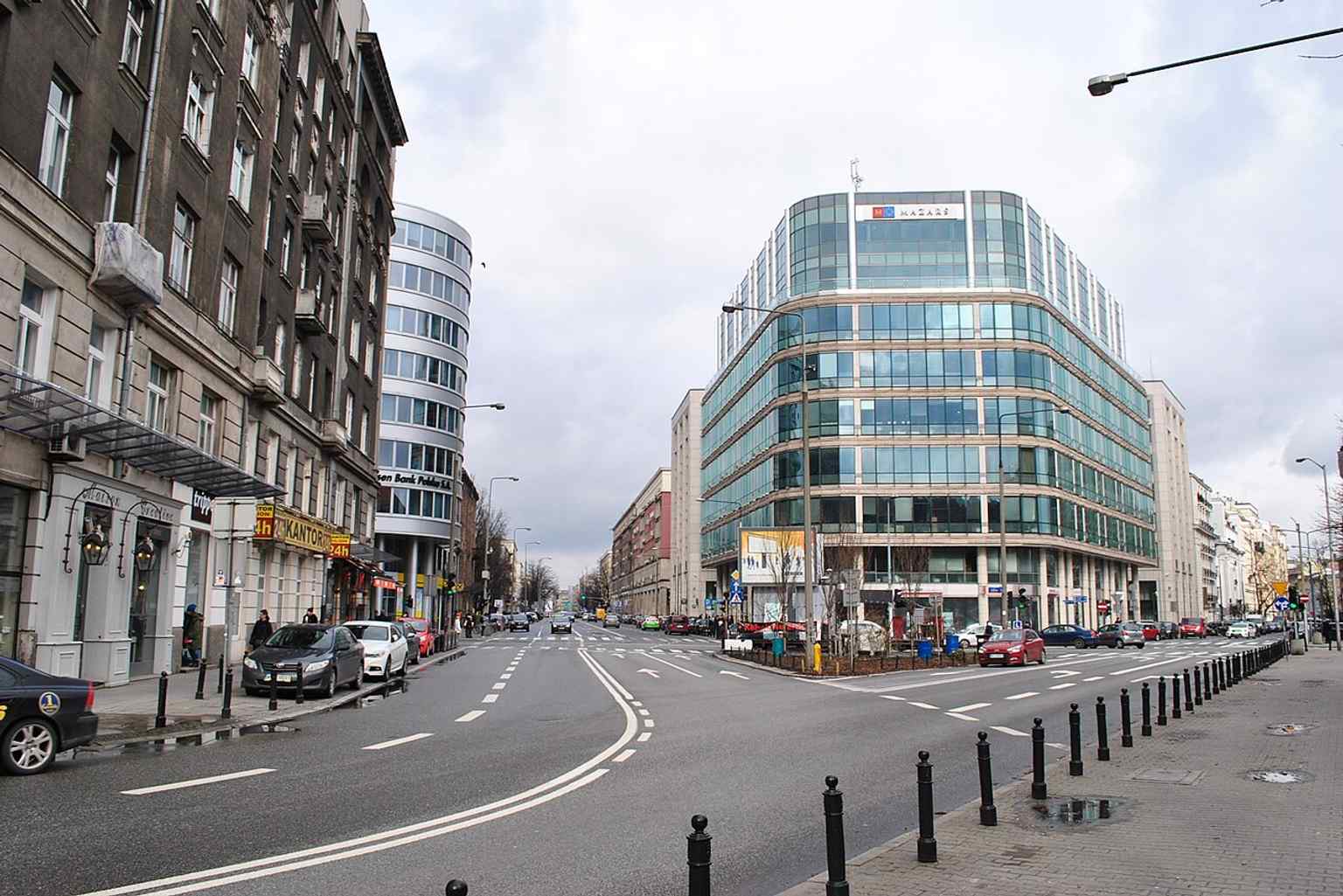
Krucza Street at the Mokotowska junction, with the Zaułek Piękna office building between them — the very corner where the street’s northern end and postwar office development meet.Photo: Marek Mróz, Wikimedia Commons, CC BY 4.0. Cropped & resized. Krucza later glowed with neon too: a pink rooster for Polskie Nagrania, a record label, and a yellow-gowned lady advertising chocolates at Bombonierka. That is the point of this street. To understand Warsaw, you have to read shopfront habits and street plans as carefully as monuments. From here, Piękna Street waits about eight minutes away.
Look for a long black concrete strip cutting across the paving, then lifting off the ground on a steel frame near the former censorship building, with a clear upright panel…Read moreShow less
Open dedicated page →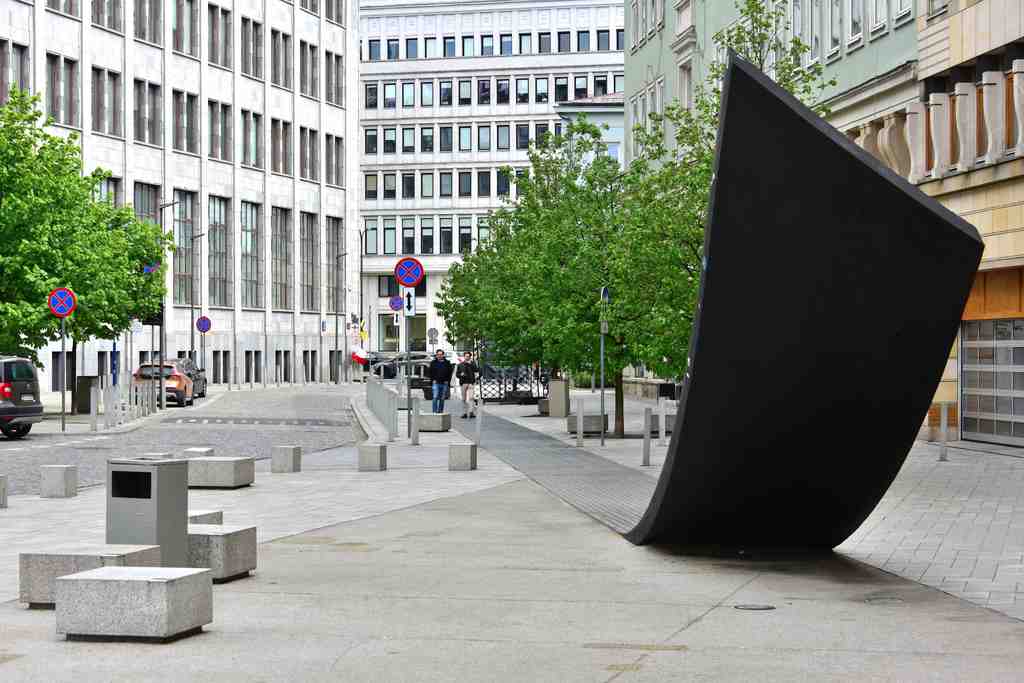
Free Word MemorialPhoto: Adrian Grycuk, Wikimedia Commons, CC BY-SA 3.0 PL. Cropped & resized. Look for a long black concrete strip cutting across the paving, then lifting off the ground on a steel frame near the former censorship building, with a clear upright panel standing beside it.
Public space is never neutral... it is where power speaks in public, and where people answer back. Governments like official language because it marches in straight lines. Citizens, inconveniently, tend to write in the margins.
This is the Free Word Memorial on Skwer Wolnego Słowa, the Square of Free Speech, on Mysia Street. In communist Poland, “Mysia” became shorthand for censorship, because at Mysia five, from nineteen forty-six to nineteen ninety, officials at the Main Office for the Control of Press, Publications and Performances decided what could be printed, staged, or shown. Nearby, the former headquarters of the Polish United Workers’ Party directed the larger machine. Here, language did not just meet editors. It met the state.
That is why this memorial is so sharp in its logic. The black band you see is a giant censor’s line, the kind once used to blot out forbidden text. It runs for about ninety meters, aiming from the old party center toward the former censorship office. Then, near the end, it peels up from the pavement, as if the ground itself has started refusing orders. The break in the line marks the moment when suppressed words push through.
The memorial honors the underground publishing movement of nineteen seventy-seven to nineteen eighty-nine, when Poles built an entire parallel world of print. More than three thousand independent magazines appeared, some in runs of up to one hundred thousand copies. More than seven thousand books circulated, along with audio and video cassettes. The biggest underground publisher, Niezależna Oficyna Wydawnicza, issued nearly four hundred titles. Editors, printers, and couriers risked house searches, confiscations, beatings, arrest, prison, and the loss of their jobs... all for paper, ink, and the radical idea that adults might read without permission.
If every printed sentence had to pass through the state, what would you have risked to read one honest page... or to hand it to someone else?
At least one in four people in Poland encountered this “second circulation” at some point. On that scale, it was unusual even by international standards, and it became one of the forces that helped bring about a peaceful end to communism. Not bad for material so often hidden in basements, attics, and under coats.
A committee launched the project in two thousand ten, and young architects Katarzyna Brońska, Mikołaj Iwańczuk, and Michał Kempiński won the design competition. Smartly, they dropped plans for extra sound effects and digital displays. Technology ages badly. Memory usually waits it out.
The city named this square in two thousand twelve, and people argued over that too. Some worried younger visitors would miss the irony of placing “free speech” beside the old censorship office. But that irony is the point. On the fifth of June, twenty fourteen, during the anniversary of the partly free elections of nineteen eighty-nine, the memorial opened as a place not just for a monument, but for people.
So here is the reversal: a site once known for silencing now asks you to read, think, and remember out loud. When you are ready, continue to Krucza Street in Warsaw... about a seven-minute walk from here.
Show 11 more stopsShow fewer stopsexpand_moreexpand_less
Look for the pale stone corner tenement with a rounded roofline, a steep dark roof, and griffin statues perched high above the decorated façade. This house is a useful first…Read moreShow less
Open dedicated page →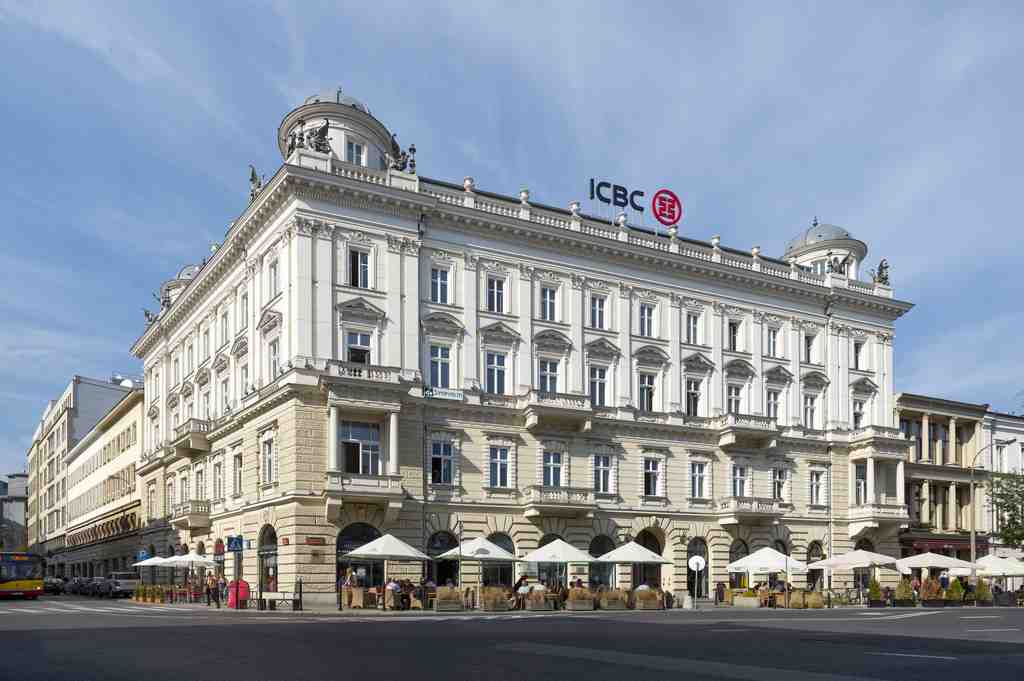
Tenement of the GriffinsPhoto: Sempoo, Wikimedia Commons, CC BY-SA 3.0 PL. Cropped & resized. Look for the pale stone corner tenement with a rounded roofline, a steep dark roof, and griffin statues perched high above the decorated façade.
This house is a useful first lesson in symbols in plain sight. The griffins, the corner domes, the borrowed Renaissance swagger... none of it is just decoration. In Warsaw, surfaces often work like coded messages, and this building is practically shouting in silk gloves.
Julian Fuchs, the confectioner who commissioned it for his family, did not want an ordinary rental house. He wanted a showpiece at Three Crosses Square: luxury apartments for the family on the first floor, tenants above, and a façade that announced success before anyone even rang the bell. A man who sold sweets clearly understood display.
The designer, Józef Huss, made that display unusually clever. He borrowed the domed corner form from Królikarnia, the Rabbit House, which he had restored elsewhere in Warsaw. And those griffins? Locals tend to notice them as ornaments, but they quietly echo the griffins of the demolished Reichsbank building in Berlin. So even in the eighteen eighties, this façade already carried an afterimage of something lost.
Take a second and study the upper corner... which details feel merely fancy, and which start to look like deliberate statements of identity, ambition, maybe even memory?
The building kept changing roles. In nineteen eighteen, Anna Jakubowska opened a private girls' middle and high school here. After the war displaced it for good, the city later marked her work with a plaque on the front. In nineteen forty-four, fire tore through the house and stripped away much of Huss's rooftop drama. For decades it stood simplified, with only a couple of griffins surviving. If you want a quick sense of that transformation, have a look at the before-and-after image in the app.
Then came the comeback: restoration in two thousand five and two thousand six, the domes and griffins rebuilt, and an extra office floor tucked into the roof. So this building teaches you how Warsaw works: the costume changes, the message lingers. Next, walk about four minutes into Three Crosses Square, where those messages stop being private and start becoming public.
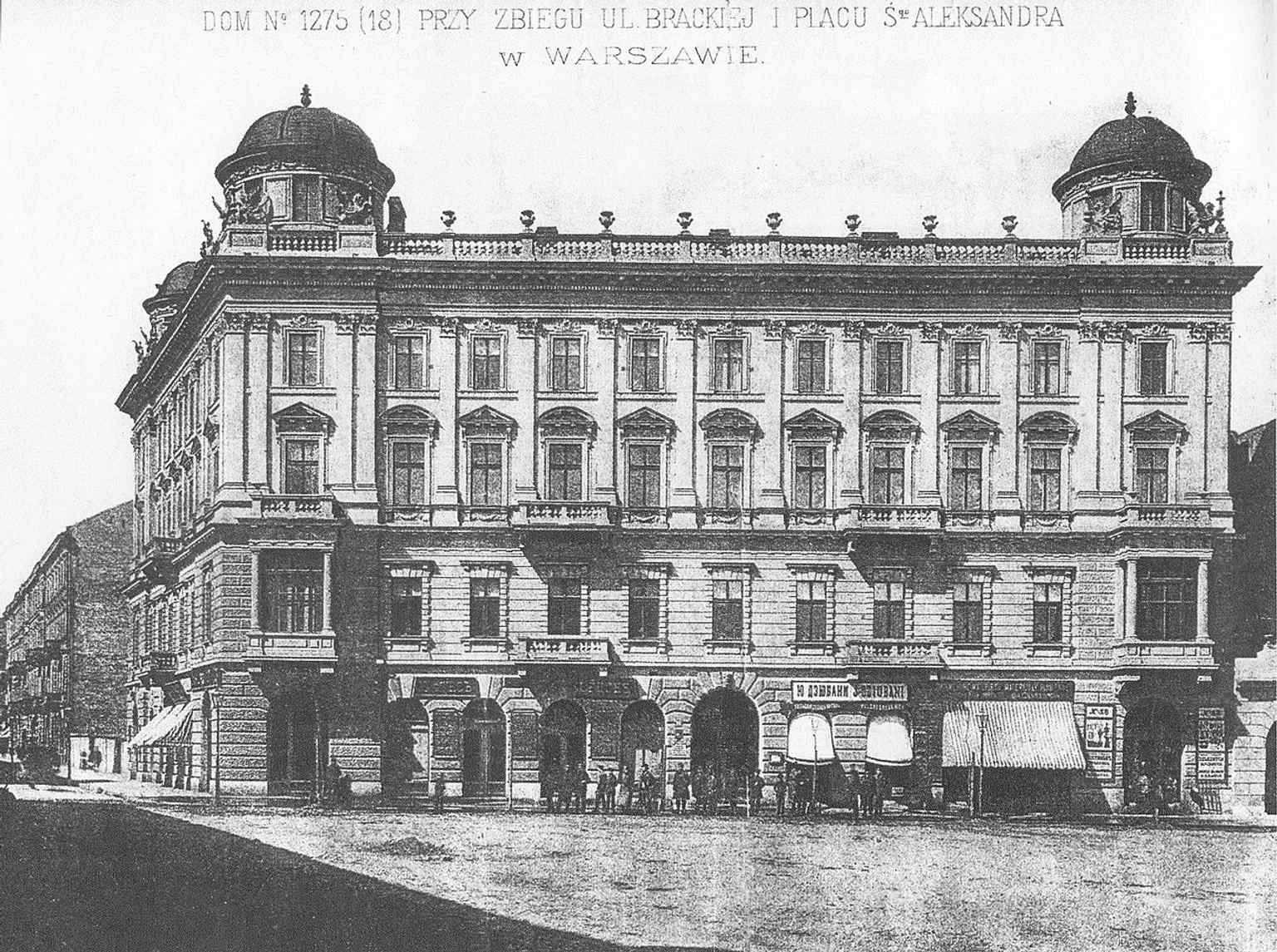
The tenement soon after opening in 1886, when Józef Huss designed its lavish Renaissance Revival façade for the Fuchs family.Photo: nieznany/unknown, Wikimedia Commons, Public domain. Cropped & resized. 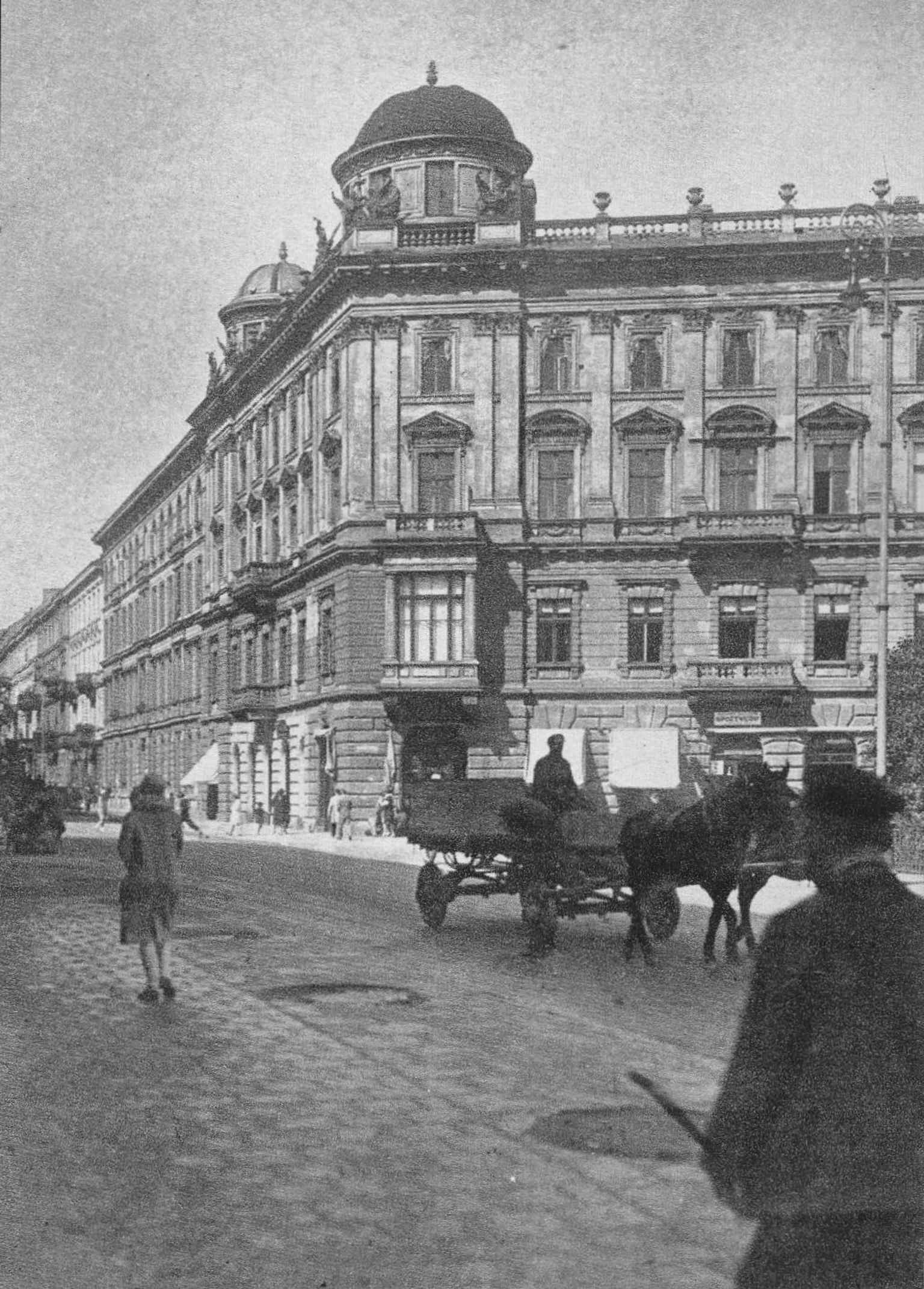
A prewar view of the house before wartime damage erased much of the original rooftop ornament.Photo: nieznany/unknown, Wikimedia Commons, Public domain. Cropped & resized. 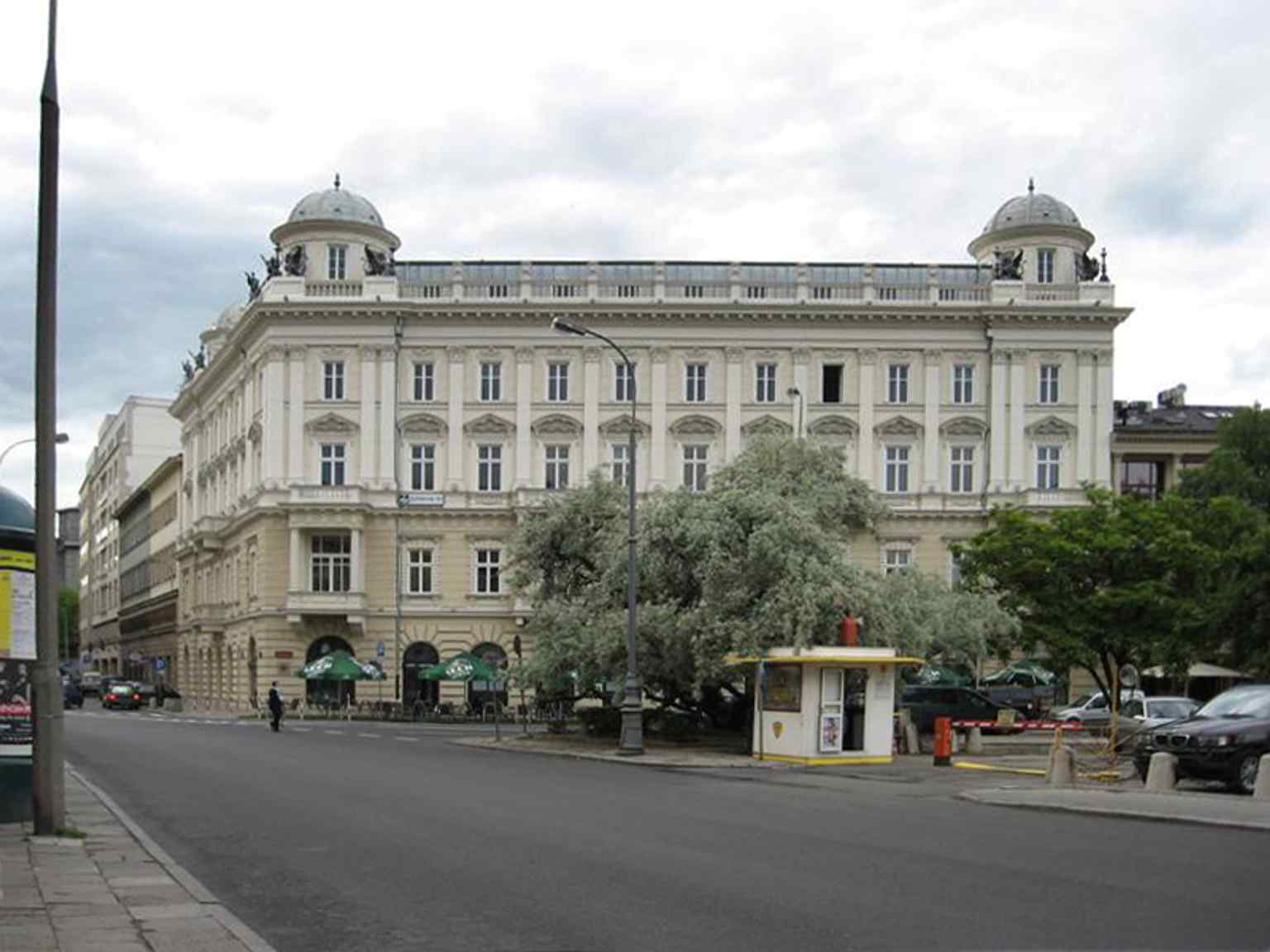
The restored corner tenement in 2006, showing how the lost domes and griffins returned to the skyline.Photo: DocentX, Wikimedia Commons, CC BY-SA 3.0. Cropped & resized. 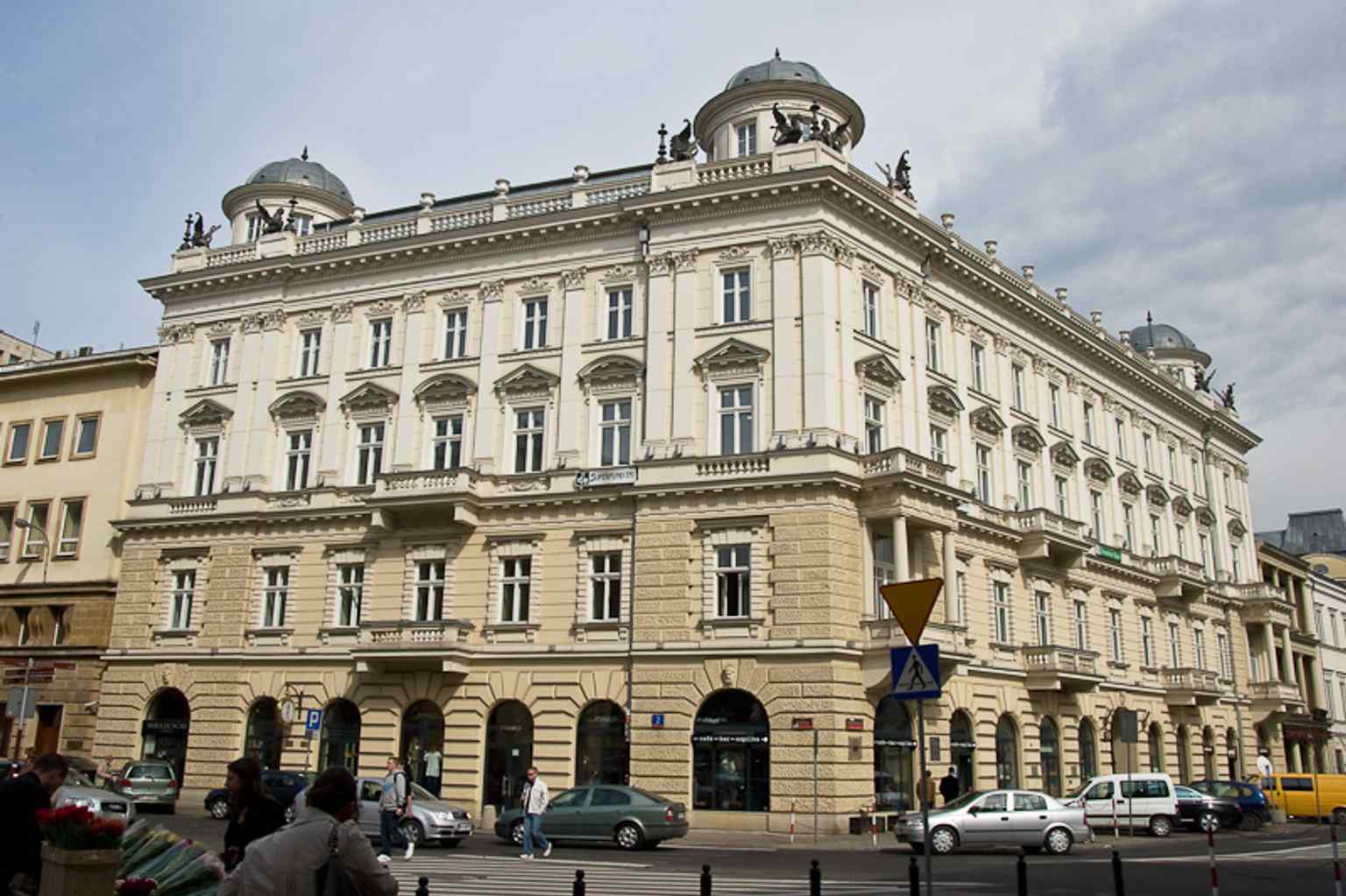
A straight-on façade view that shows the building’s rich Renaissance Revival decoration at Three Crosses Square.Photo: Konrad Kamiński, Wikimedia Commons, CC BY-SA 4.0. Cropped & resized. 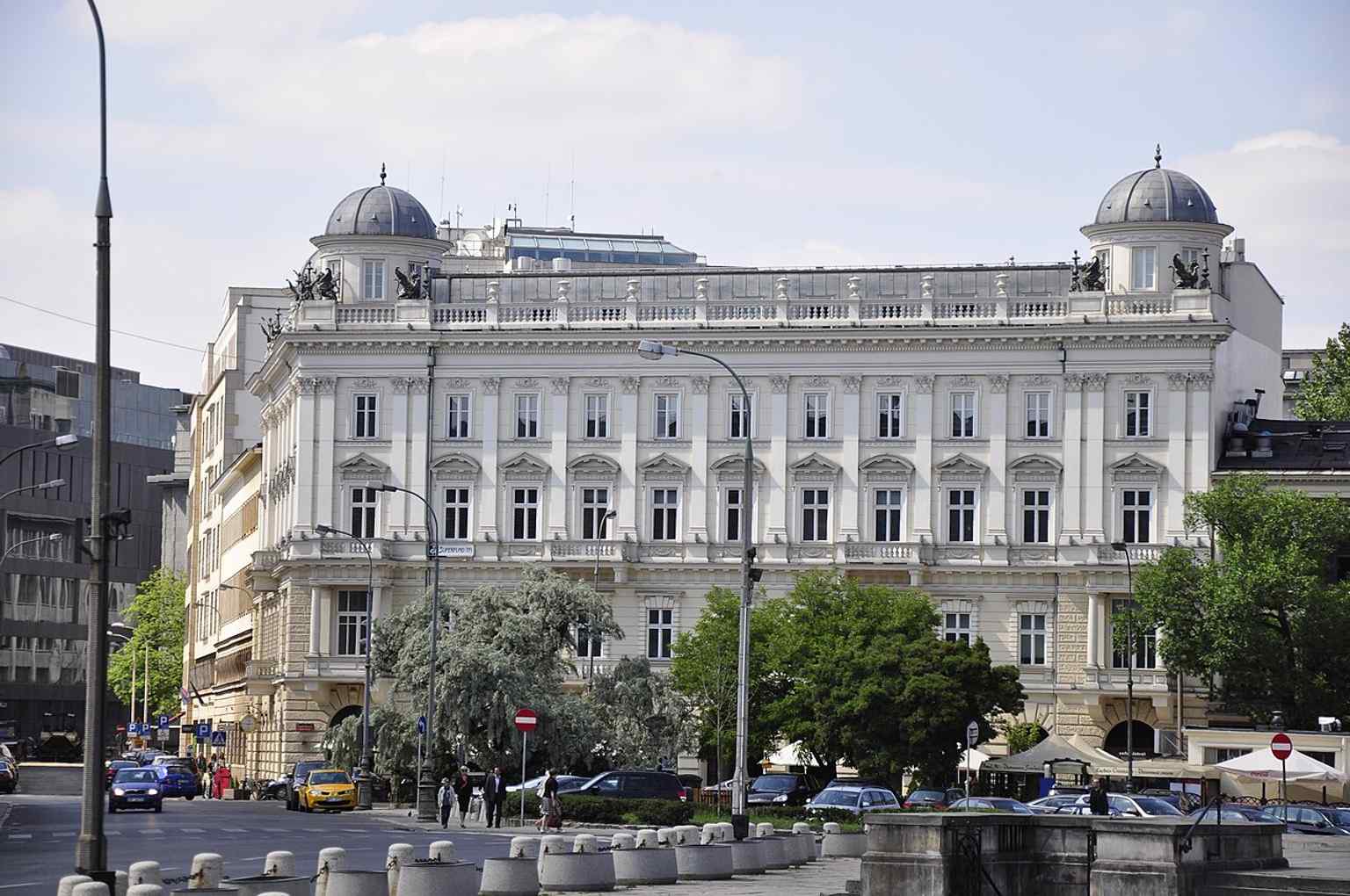
A full-height view of Pod Gryfami on Plac Trzech Krzyży 18, useful for seeing the 5-storey massing and mansard roof.Photo: Wistula, Wikimedia Commons, CC BY 3.0. Cropped & resized. 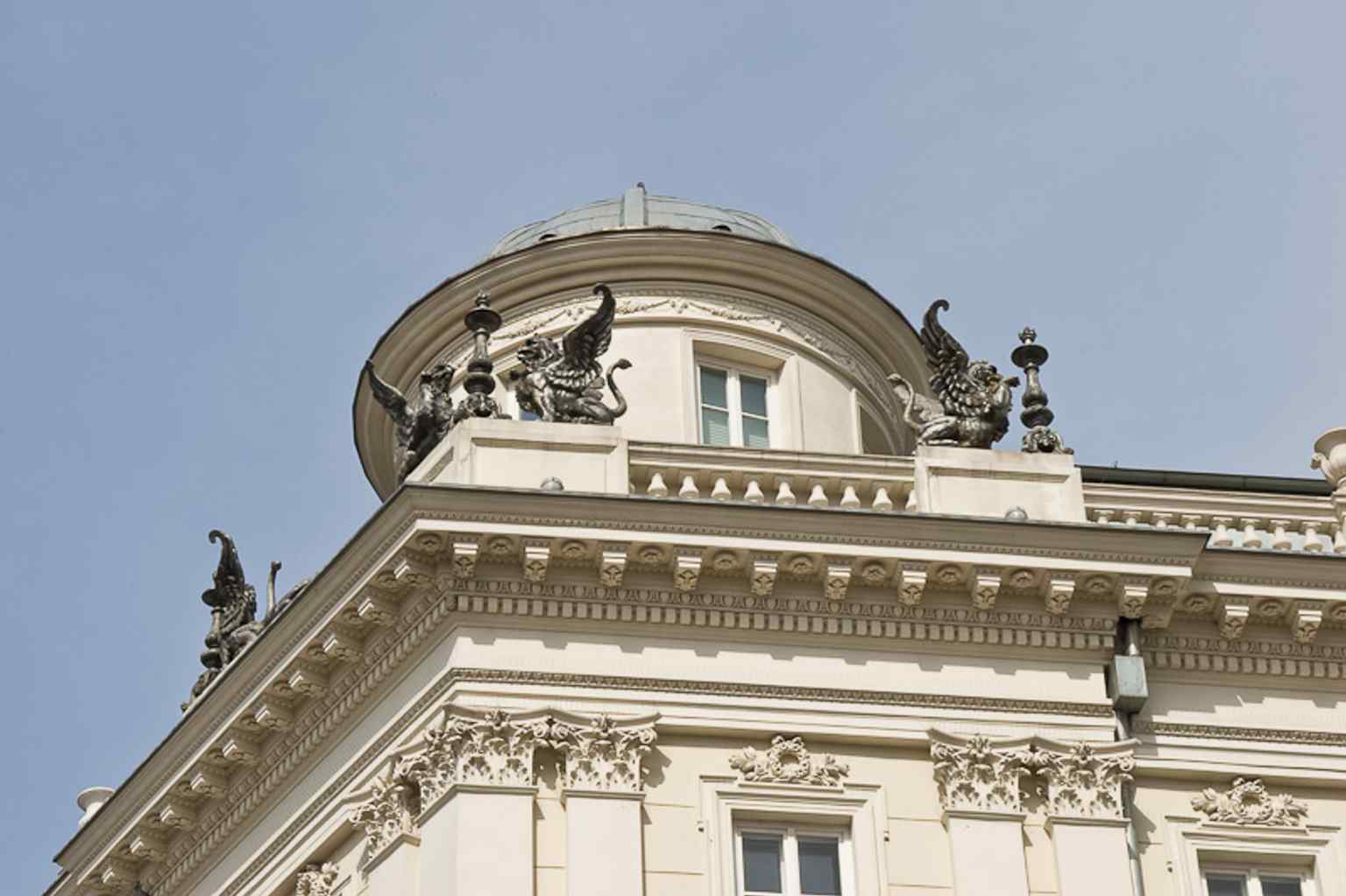
A close-up of the griffins that gave the house its name — a deliberate reference in Huss’s decorative design.Photo: KamilKaminski, Wikimedia Commons, CC BY-SA 4.0. Cropped & resized. 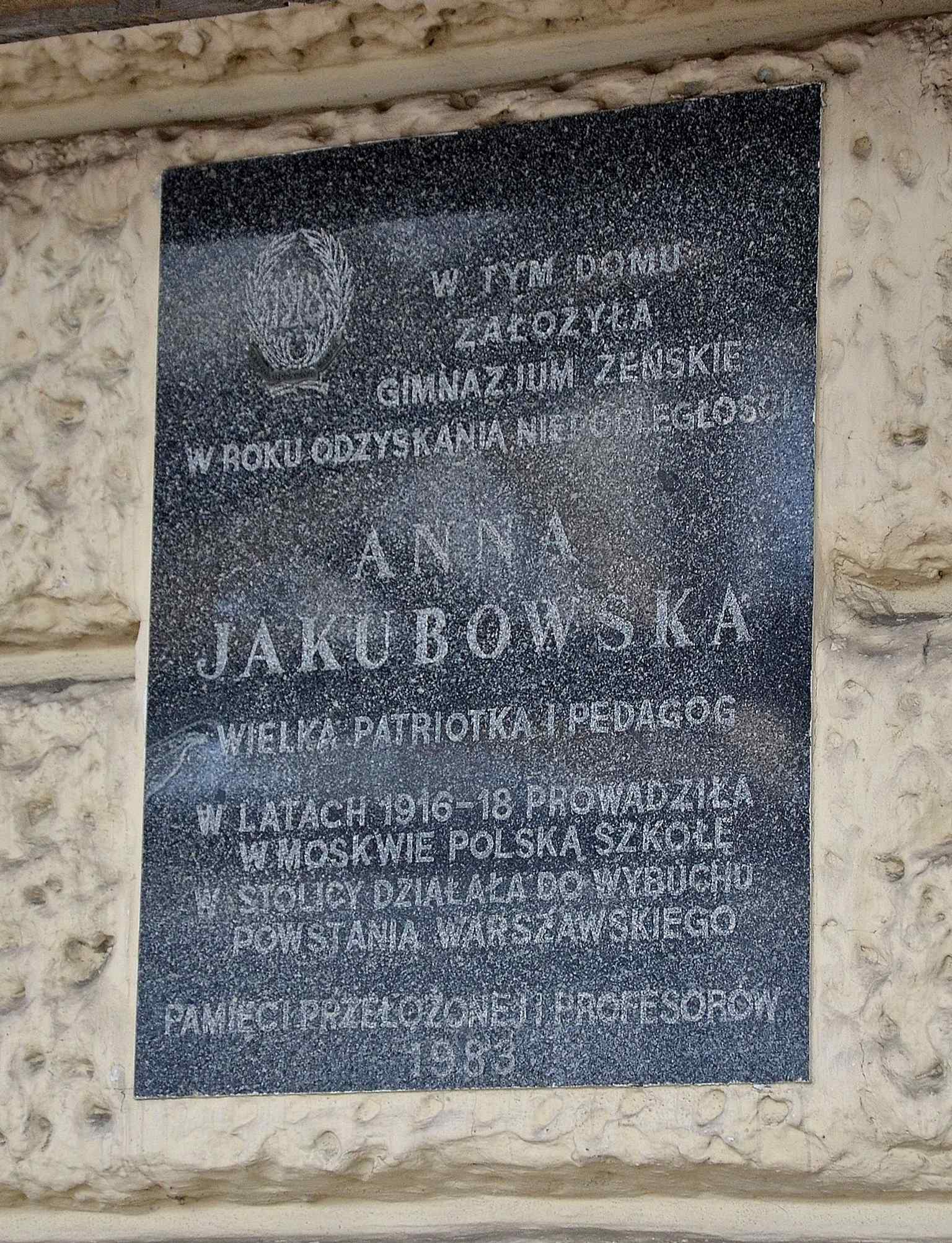
The Anna Jakubowska commemorative plaque on the façade, marking the school director remembered here since 1983.Photo: Adrian Grycuk, Wikimedia Commons, CC BY-SA 3.0 pl. Cropped & resized. 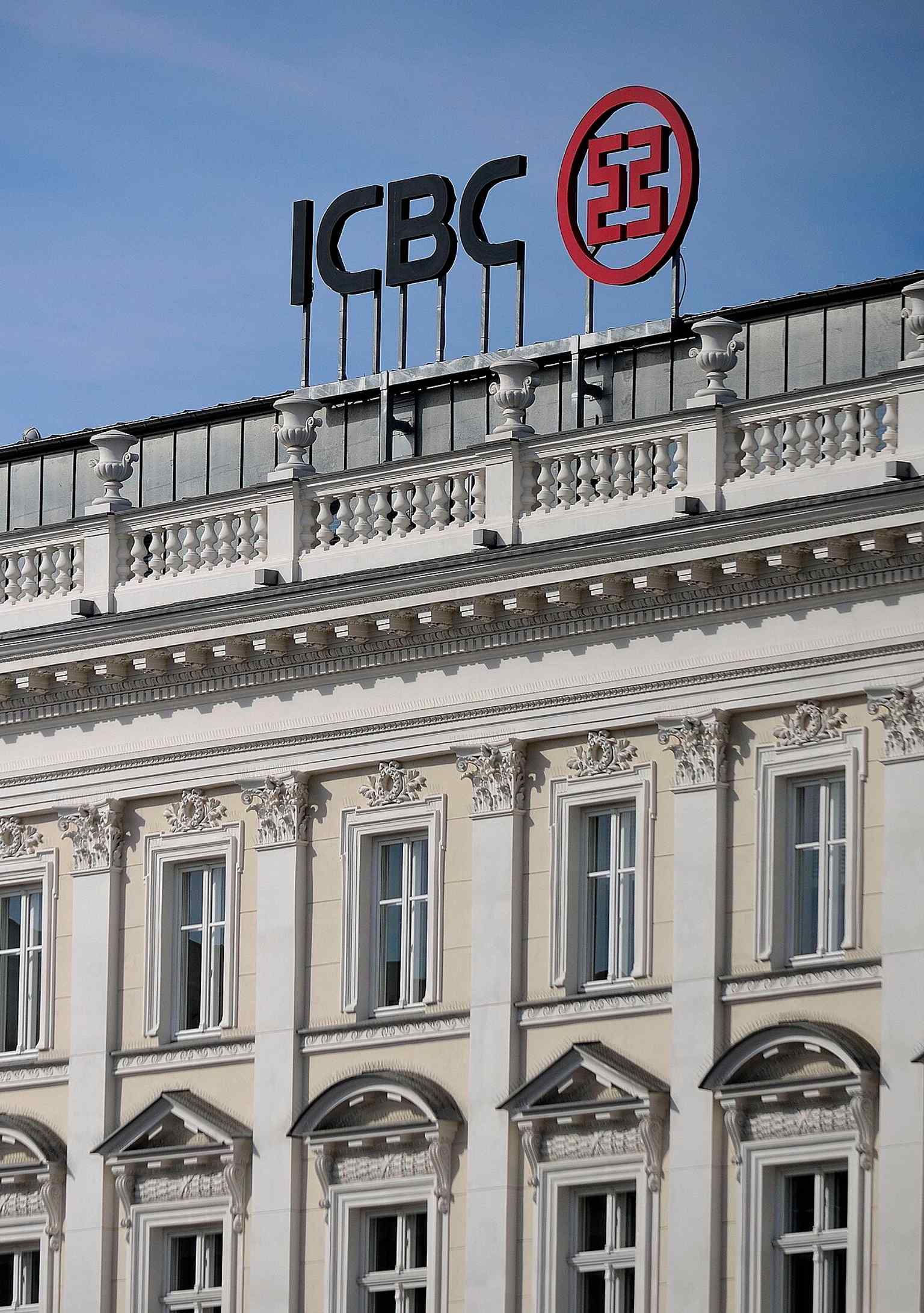
The ICBC sign on the façade shows the building’s modern office use after restoration.Photo: Adrian Grycuk, Wikimedia Commons, CC BY-SA 3.0 pl. Cropped & resized. 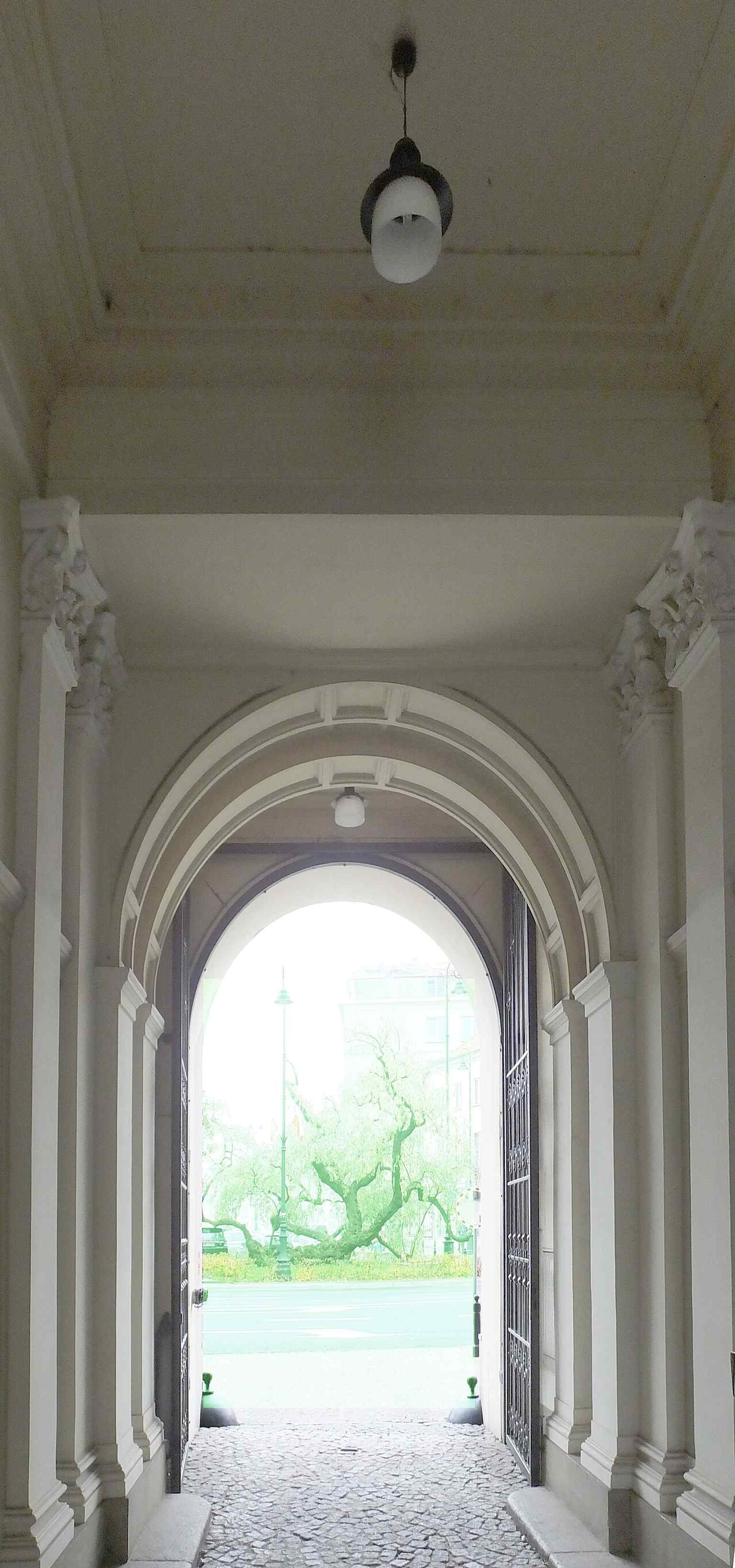
The passageway and façade details give a sense of the building as lived-in urban fabric, not just a monument.Photo: Panek, Wikimedia Commons, CC BY-SA 4.0. Cropped & resized. 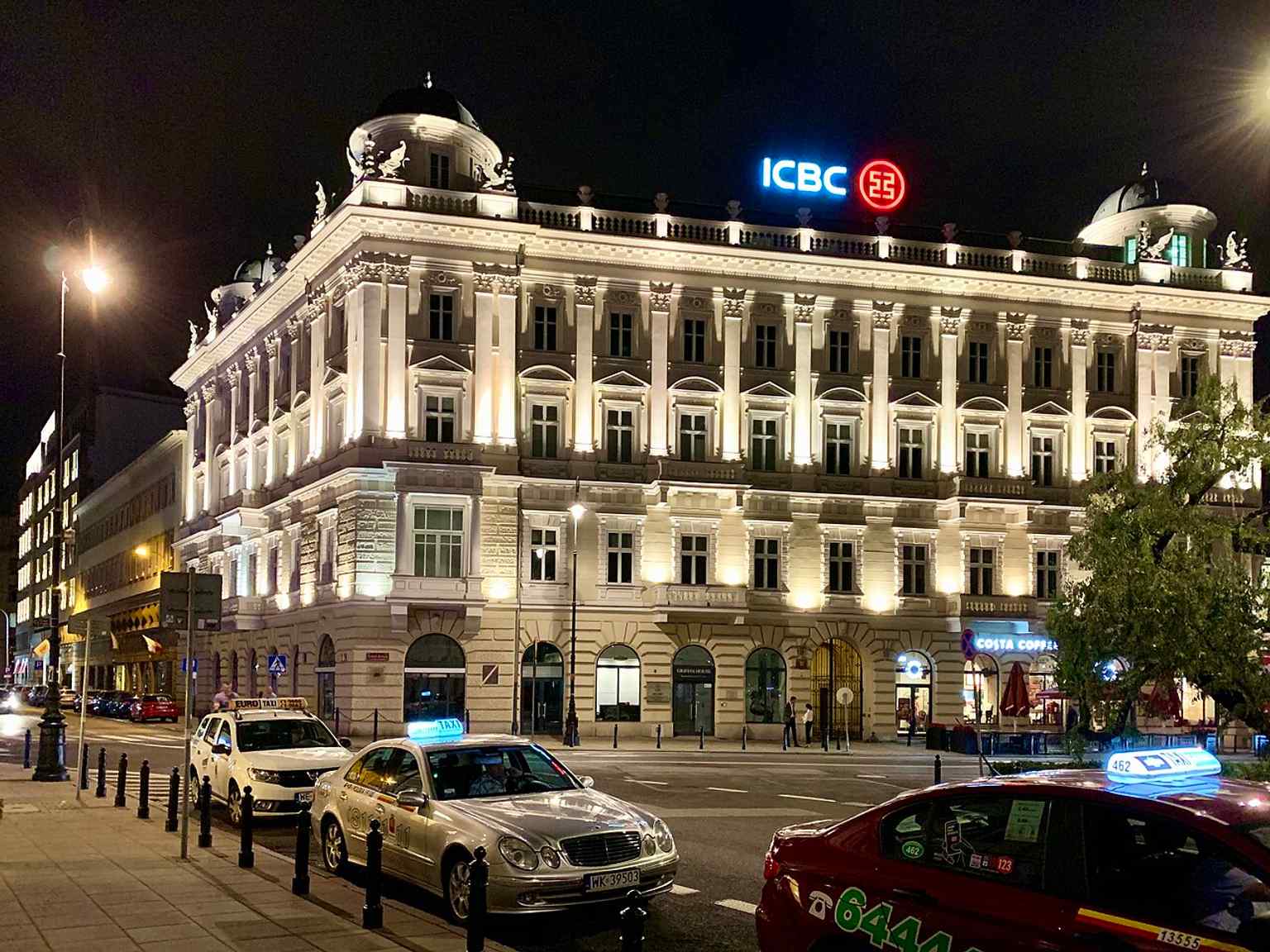
A recent full view of the restored tenement, showing its present-day office-building role in central Warsaw.Photo: Kgbo, Wikimedia Commons, CC BY-SA 4.0. Cropped & resized. 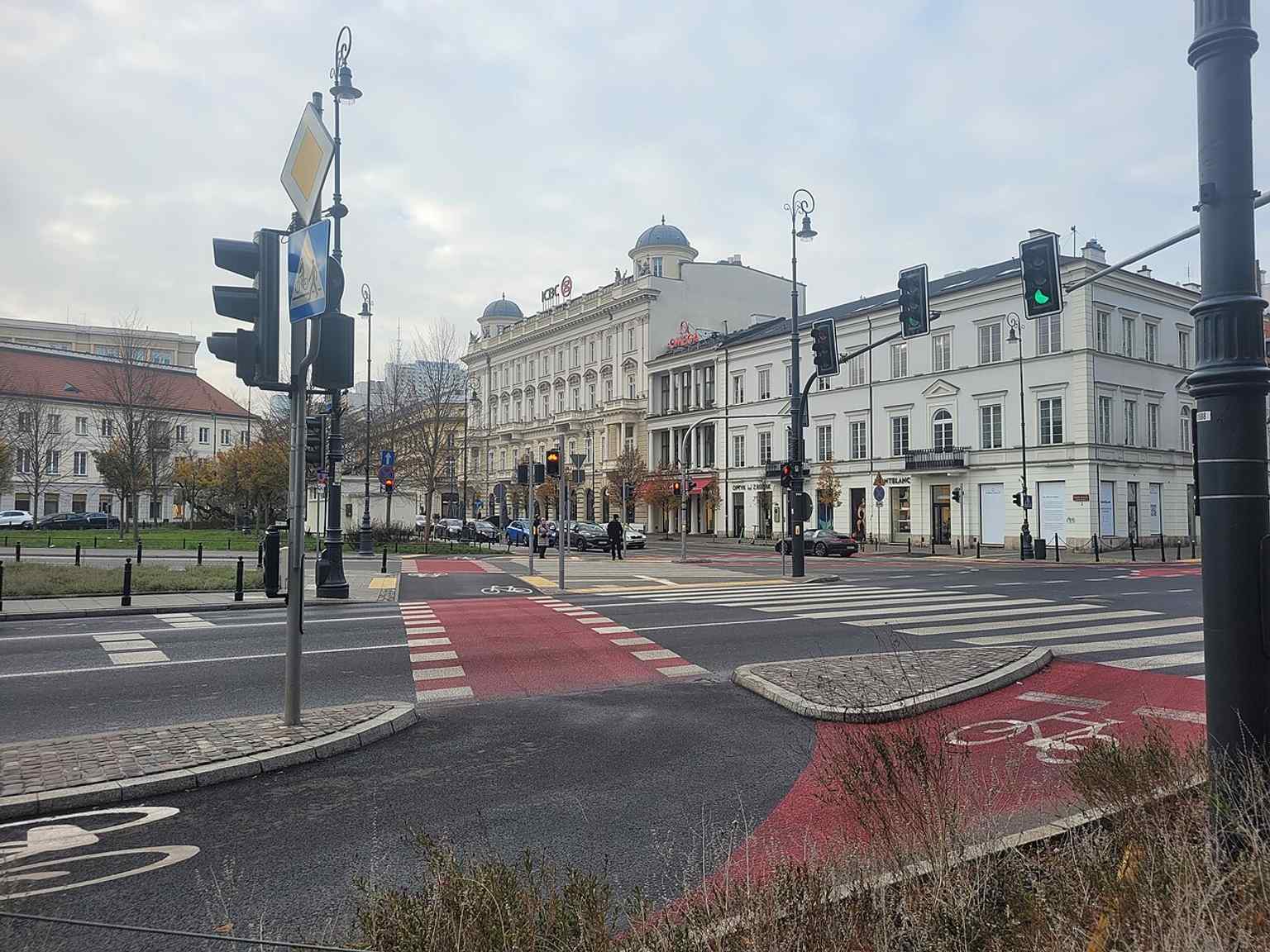
A wider context view of Plac Trzech Krzyży and the corner parcel that makes the building stand out in the streetscape.Photo: Wistula, Wikimedia Commons, CC BY-SA 4.0. Cropped & resized. Ahead of you is a broad stone-and-plaster square framed by six- and seven-story blocky façades, with the Hotel M-D-M anchoring one edge and three tall candelabra-like lamp pillars…Read moreShow less
Open dedicated page →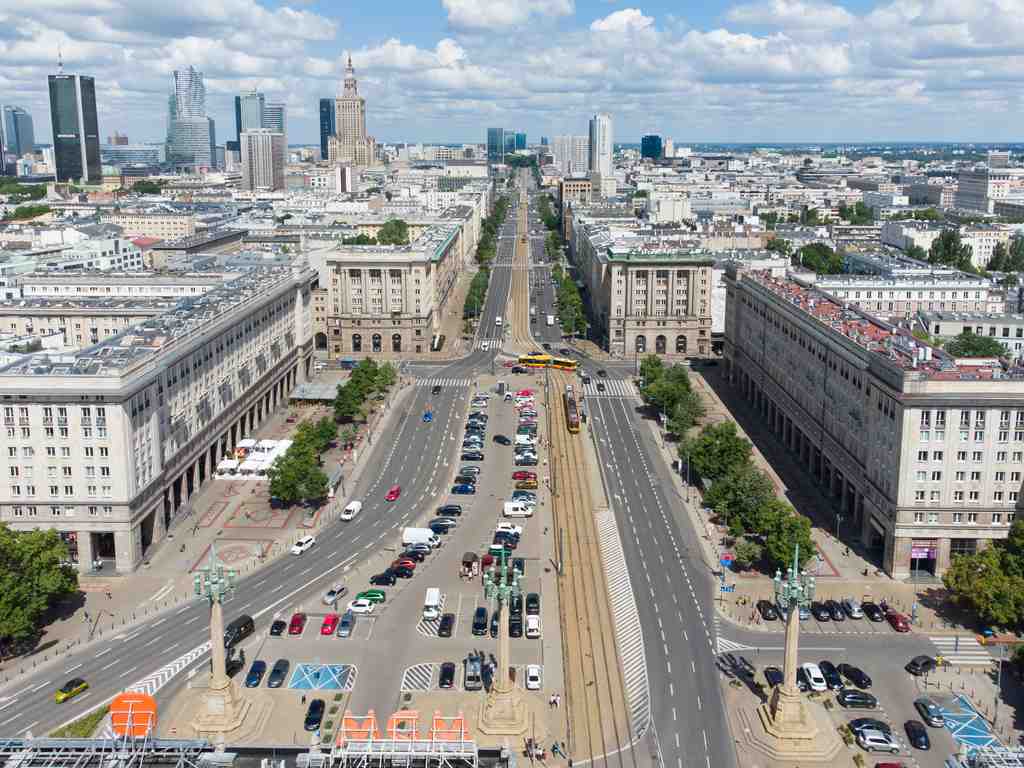
Constitution Square, WarsawPhoto: Emptywords, Wikimedia Commons, CC BY-SA 4.0. Cropped & resized. Ahead of you is a broad stone-and-plaster square framed by six- and seven-story blocky façades, with the Hotel M-D-M anchoring one edge and three tall candelabra-like lamp pillars marking the open space.
Constitution Square is socialist realism at urban scale: not just housing, but choreography. The whole M-D-M ensemble, the Marszałkowska Residential District, opened in nineteen fifty-two to organize how people lived, moved, shopped, and looked in public. In other words, it was a neighborhood designed to perform certainty... which is a very ambitious job for masonry.
Planners cut this square into the axis of Marszałkowska Street after the war, sweeping away the older street grid and even demolishing surviving buildings to remake the area from scratch. They shifted Piękna and Koszykowa Streets, added Waryńskiego, and turned this junction into a giant ideological hinge. Contemporary plans imagined housing for about forty-five thousand workers and their families, with shops, cafés, restaurants, travel agencies, and Orbis tourist offices at ground level, so the district could function almost like a self-contained city.
The style mattered. Socialist realism meant symmetry, heavy façades, and heroic decoration that made the state look permanent. But the architects also borrowed from the earlier work of Jan Heurich Junior, so the square nodded to older Warsaw while advertising a new political order. Rewritten space, very literally.
Its name came first from politics, too. Authorities named the square on the nineteenth of July, nineteen fifty-two, after the Constitution of the Polish People’s Republic, which they ratified three days later, on the very day the square opened. The ceremony was pure stagecraft: delegations from China and the Soviet Union marched here with Polish children before party leader Bolesław Bierut, and the route led down Marszałkowska toward the great parade grounds farther north. If you want the official mood, have a quick look at the opening-day photo in the app.
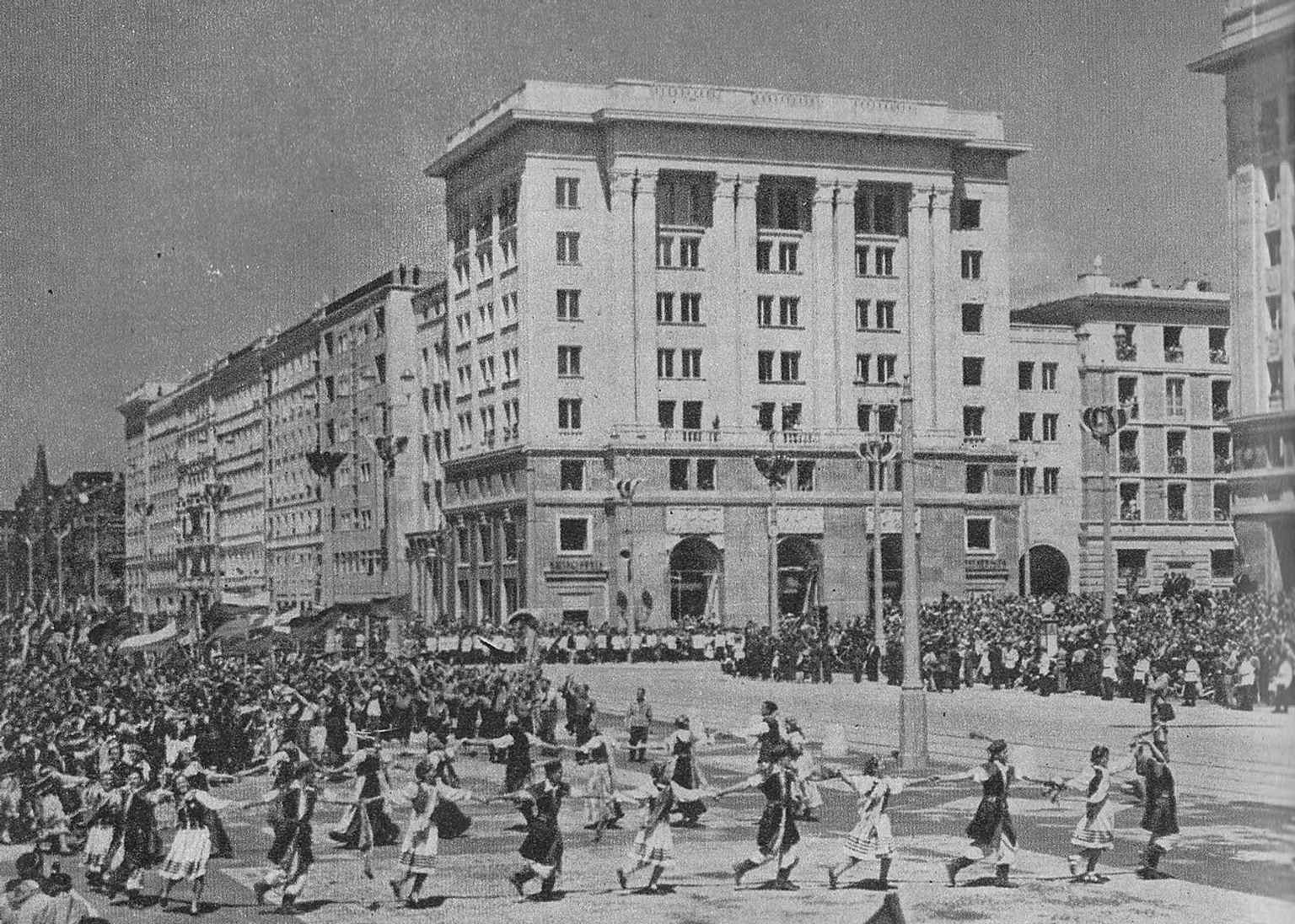
The square’s official opening in 1952, staged as a grand socialist spectacle for the new Marshal Residential District.Photo: nieznany/unknown, Wikimedia Commons, Public domain. Cropped & resized. Yet daily life kept spoiling the script. The square’s center was supposed to hold a grand fountain; instead it became a car park. One corner later took the name Pakulski Brothers Alley, recalling prewar grocers whose shop once stood here. At number six, the café Niespodzianka served as headquarters for Warsaw’s Solidarity Citizens’ Committee during the nineteen eighty-nine election campaign. A former communist showpiece helping organize democracy... Warsaw does enjoy irony.
In nineteen ninety-nine, officials even tried to rename the square after Ronald Reagan. The campaign failed, so the old communist-era name stayed put, one of the last of its kind in the city. Meanwhile, the planned metro station began in the nineteen eighties, stalled in nineteen eighty-nine, and only much later crawled back to life. Grand plans, interrupted by reality. Again.
If you check the before-and-after view, you’ll see the traffic thicken and the city speed up, while the postwar geometry barely blinks.
So this place lives a double life: a fossil of propaganda, and a working city room full of errands, trams, memories, and stubborn reuse. Stay right here... next we’ll look even closer at Constitution Square in Warsaw.
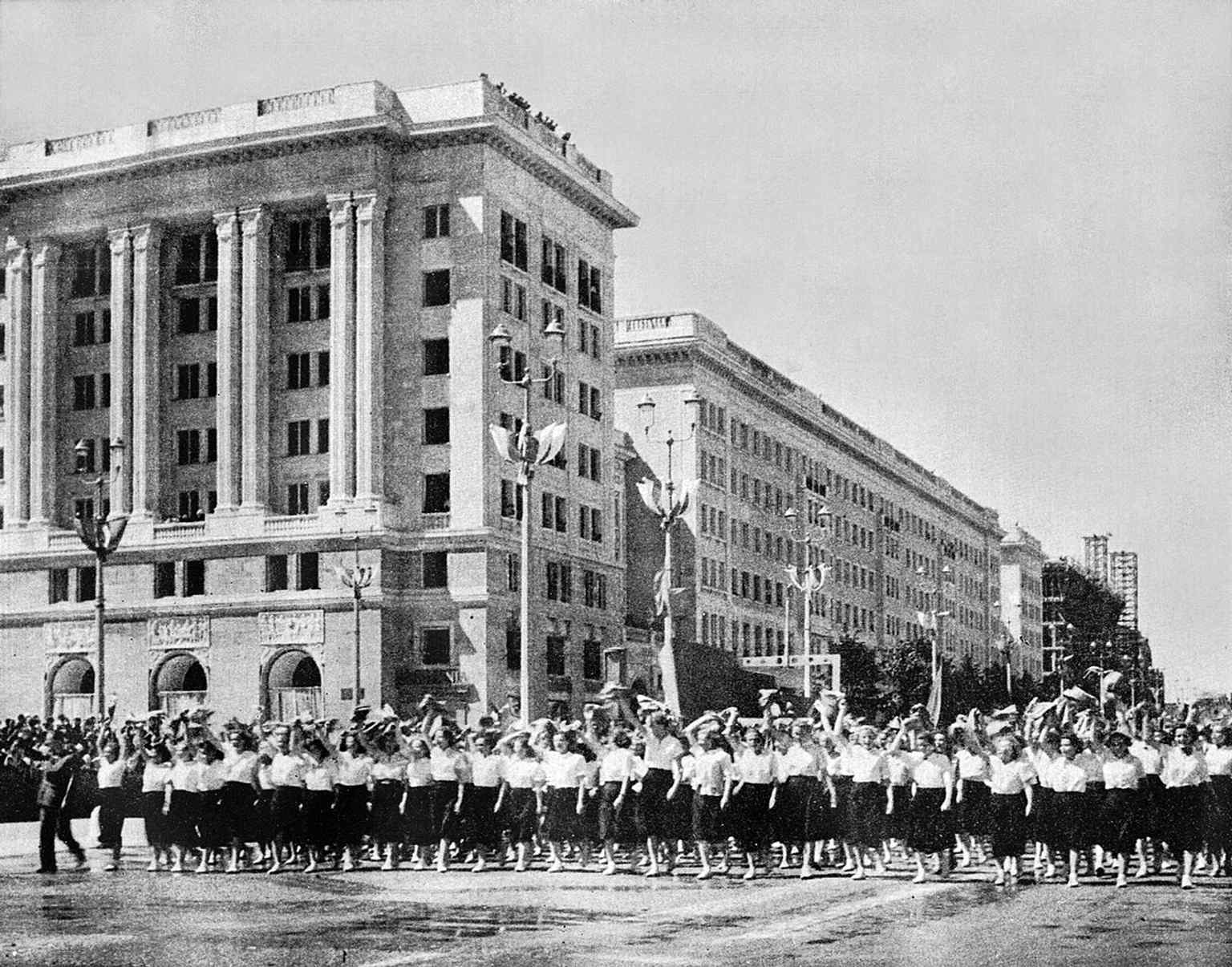
Youth marching on 22 July 1952, echoing the political theater that marked Constitution Square’s opening day.Photo: W. Sławny, Wikimedia Commons, Public domain. Cropped & resized. 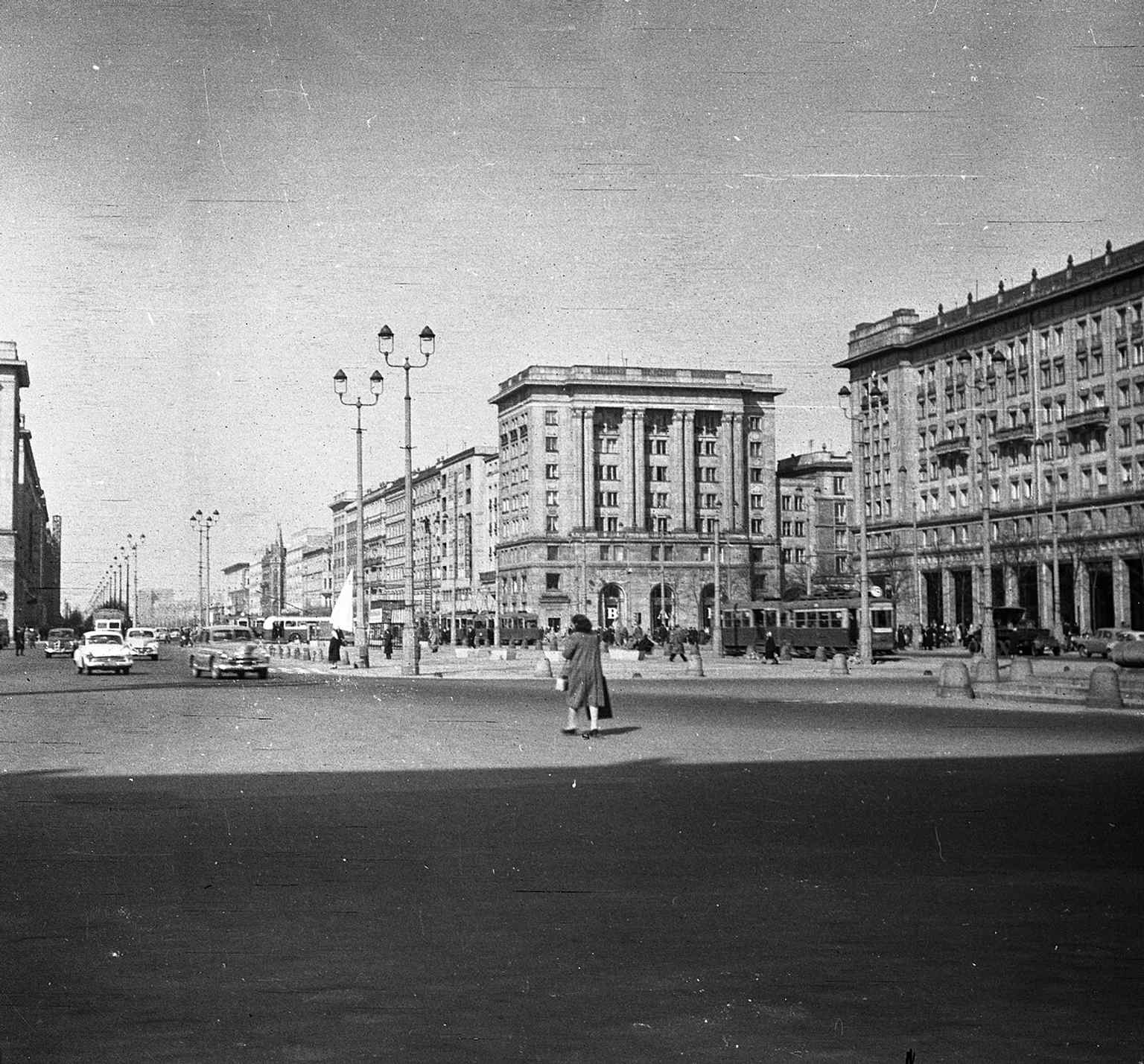
A 1960 view toward Marszałkowska Street, showing the square as a tram-lined socialist-realist boulevard.Photo: FOTO:Fortepan — ID 75021: Adományozó/Donor: Romák Éva., Wikimedia Commons, CC BY-SA 3.0. Cropped & resized. 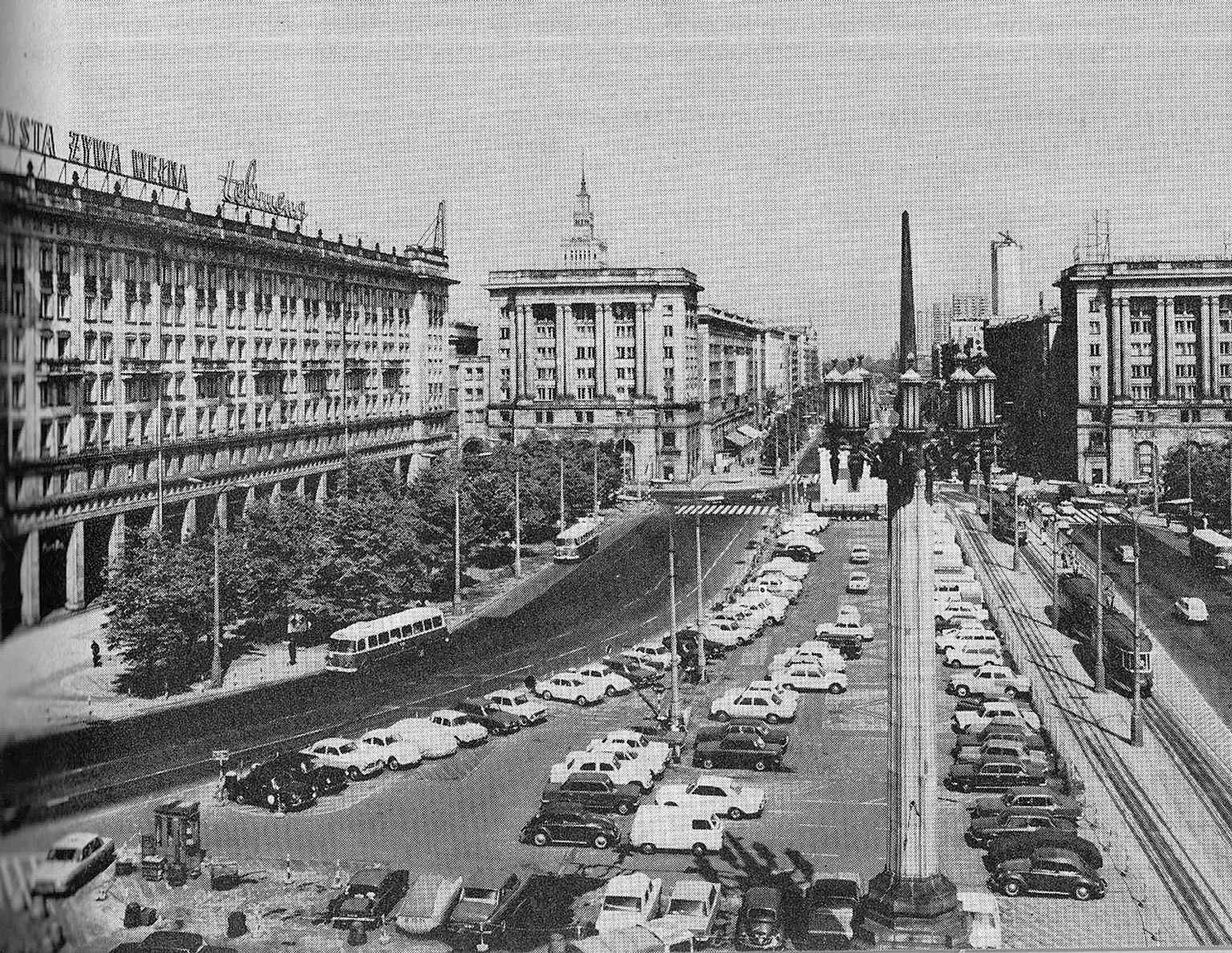
A 1975 view from Hotel MDM, when the square’s central space was still dominated by traffic and parking.Photo: T. Hermańczyk, Wikimedia Commons, Public domain. Cropped & resized. 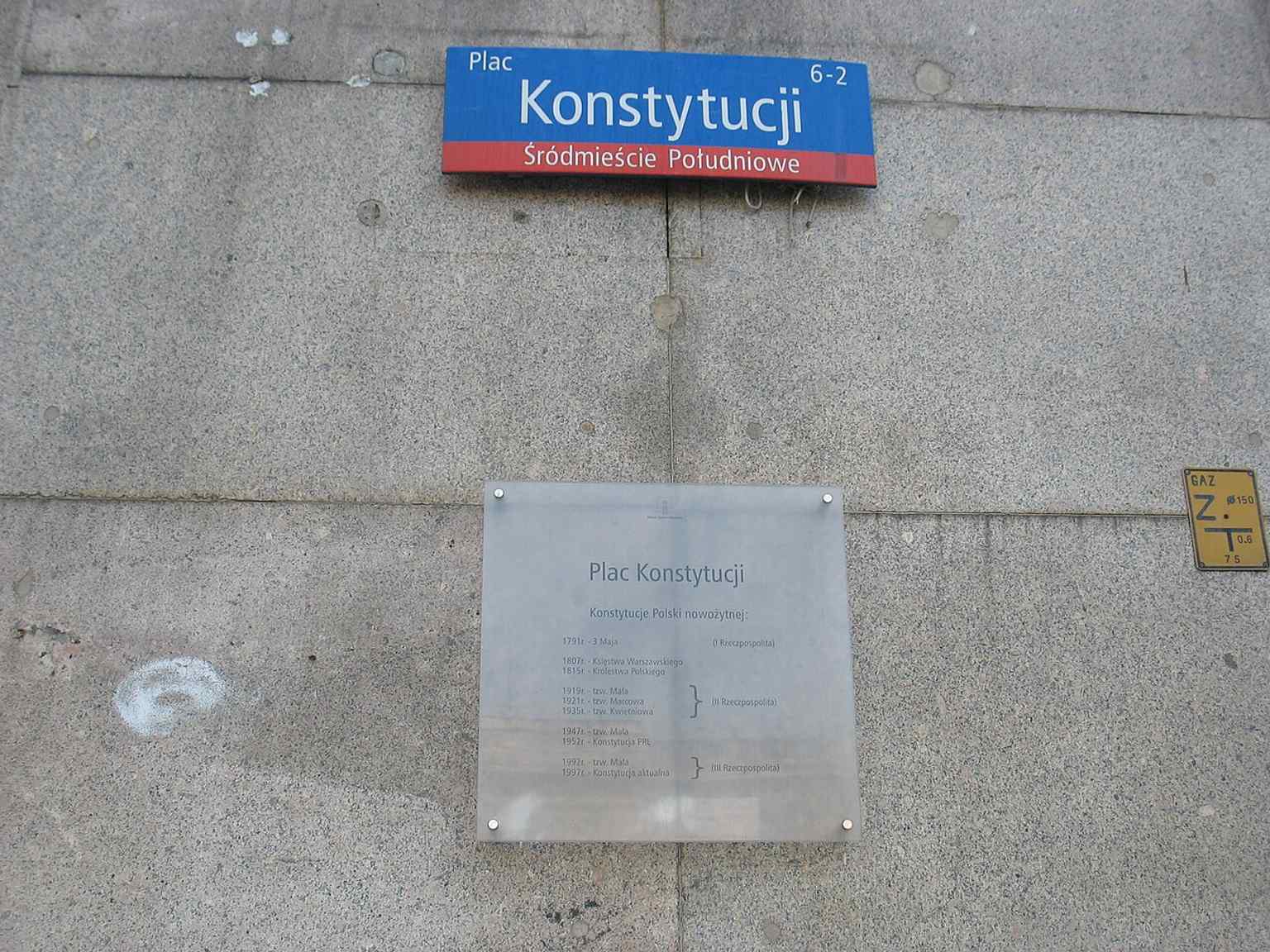
An information board on the square, useful for orienting visitors amid the MDM street plan and its later history.Photo: Gophi, Wikimedia Commons, CC BY-SA 3.0. Cropped & resized. 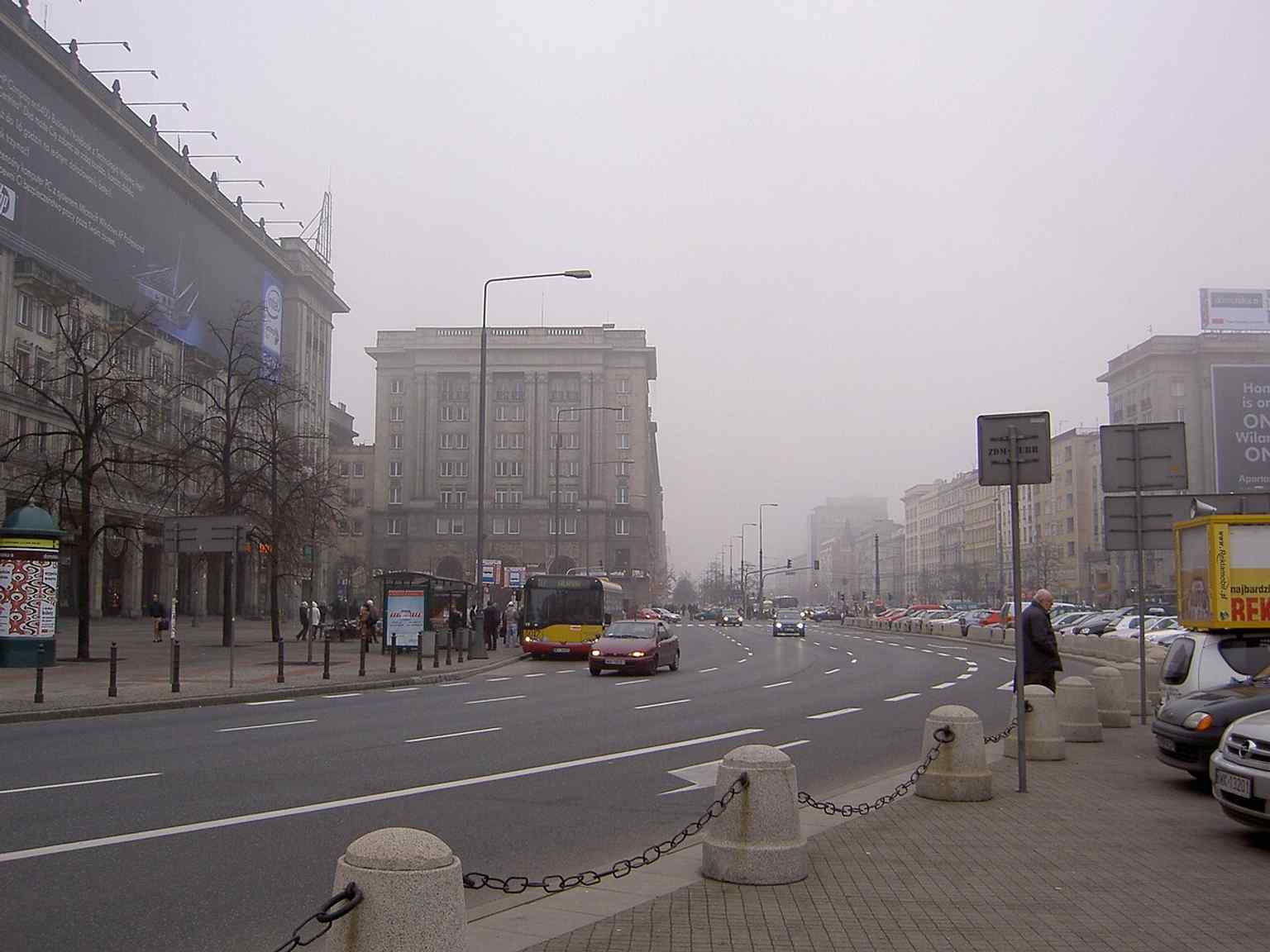
A wide view of Constitution Square’s monumental façades and open roadway, typical of the socialist-realist design.Photo: Raf24~commonswiki, Wikimedia Commons, CC BY-SA 3.0. Cropped & resized. 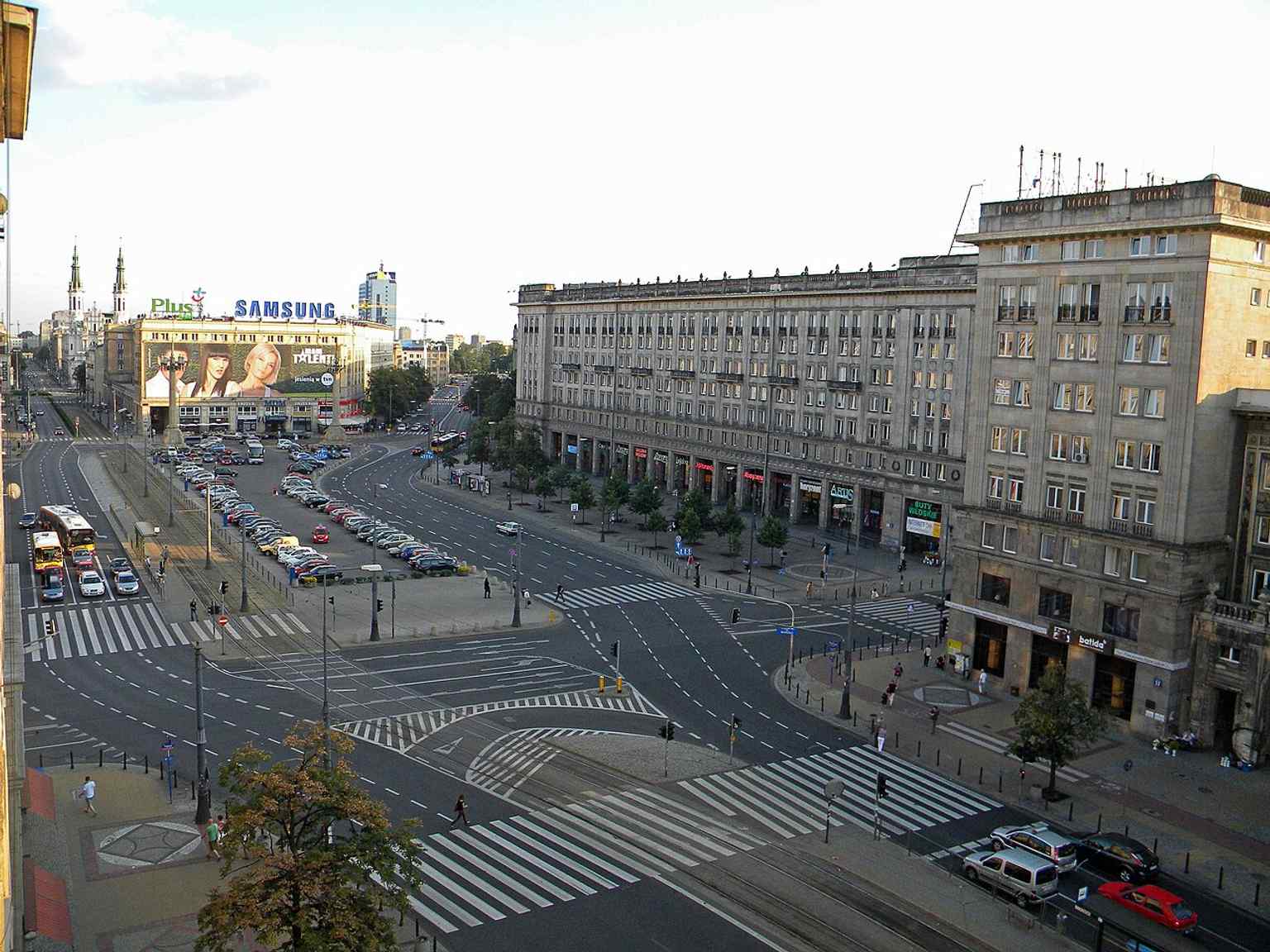
A broad panorama that reveals the square’s full scale and its position on Marszałkowska Street’s axis.Photo: Foma, Wikimedia Commons, CC BY-SA 4.0. Cropped & resized. 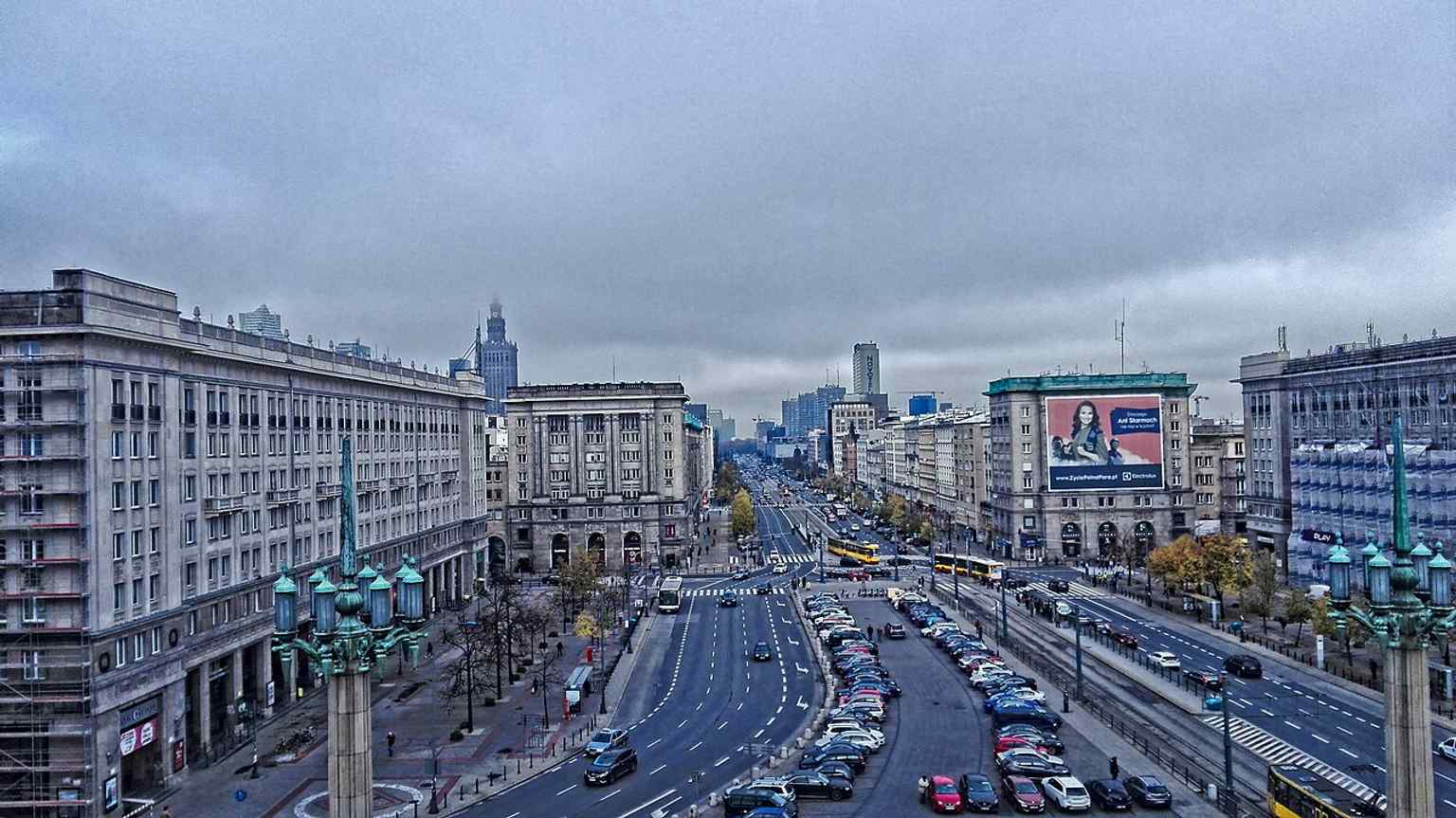
Looking over the square from Hotel MDM, with the surrounding housing blocks and the road intersection clearly laid out.Photo: Halibutt, Wikimedia Commons, CC BY 3.0. Cropped & resized. 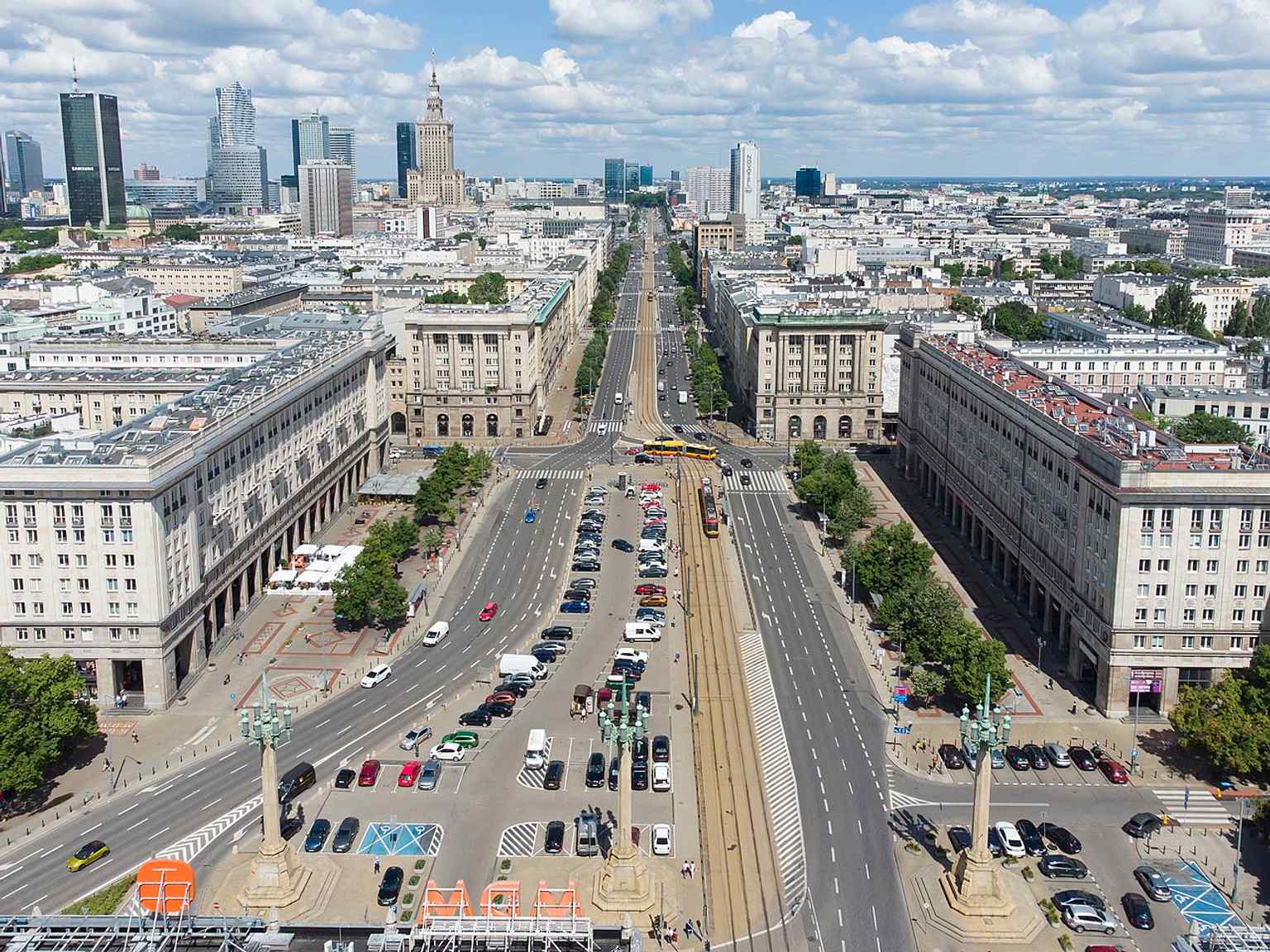
A drone view from the south showing the square’s modern traffic pattern and the MDM hotel at the edge.Photo: Emptywords, Wikimedia Commons, CC BY-SA 4.0. Cropped & resized. 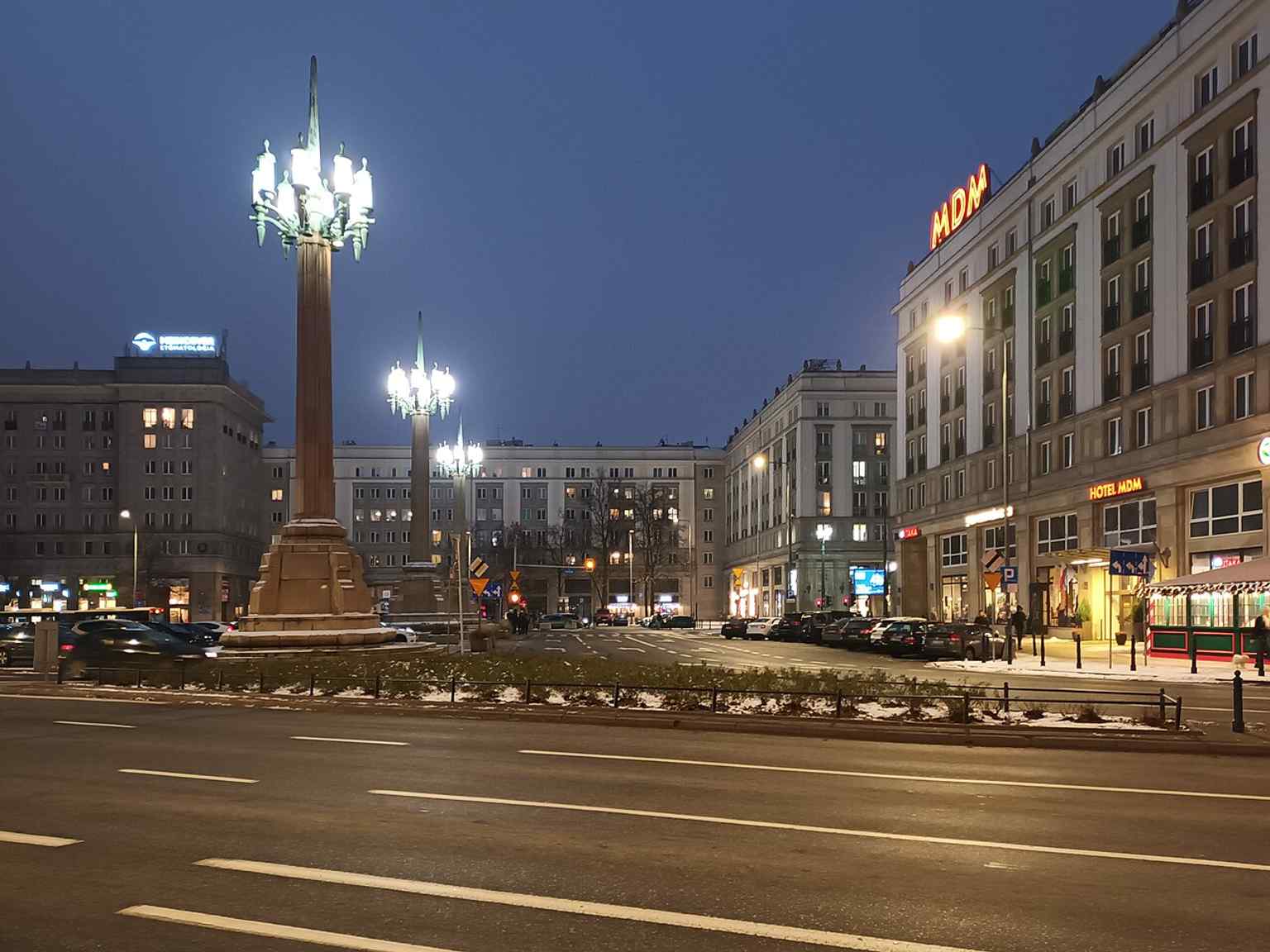
The square at dusk with its three tall candelabra lamps and dense MDM housing blocks.Photo: Cybularny, Wikimedia Commons, CC BY 4.0. Cropped & resized. 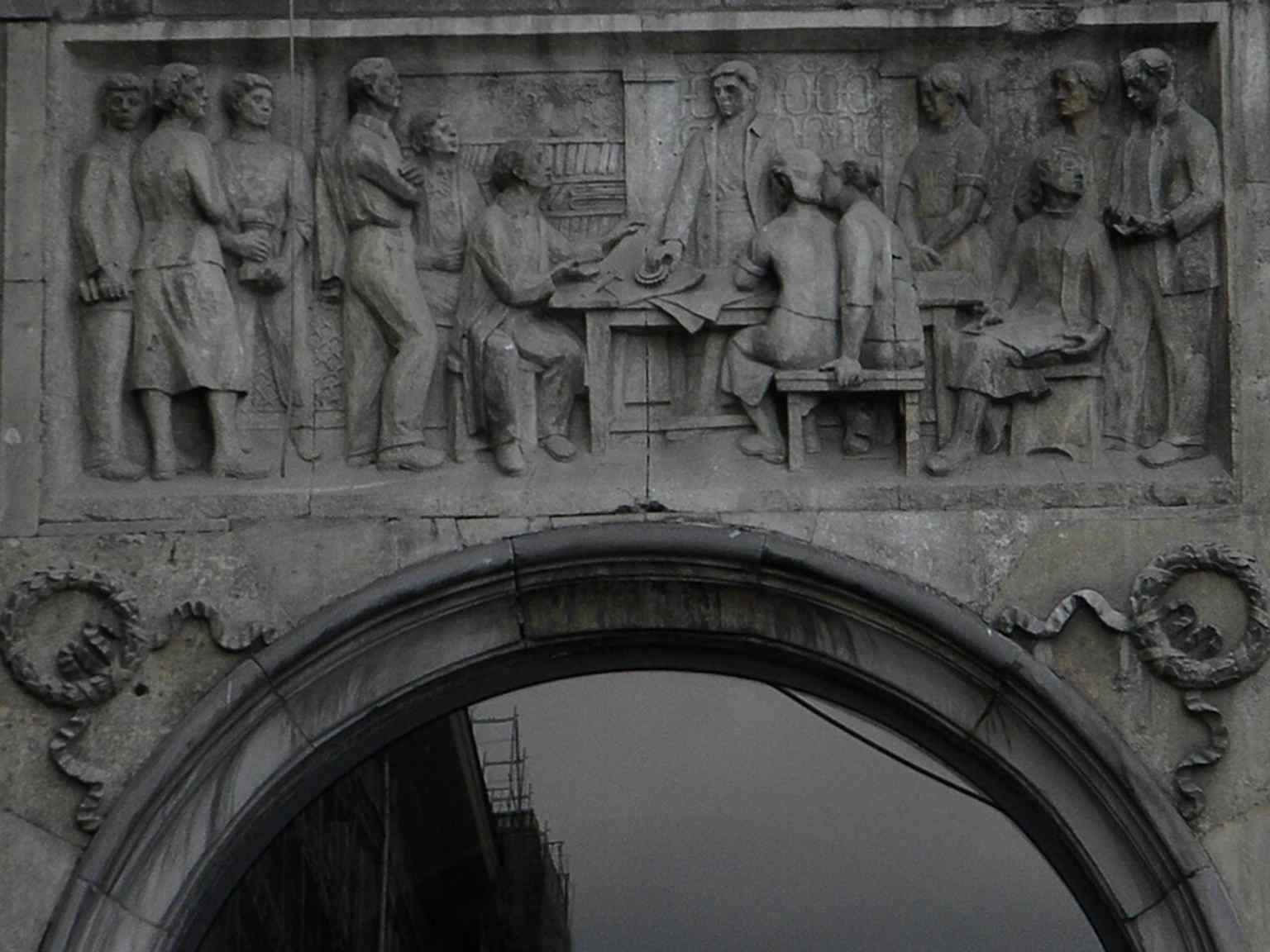
A façade relief on Constitution Square, one of the propaganda-era decorative details built into the architecture.Photo: Tothkaroj, Wikimedia Commons, CC BY-SA 4.0. Cropped & resized. 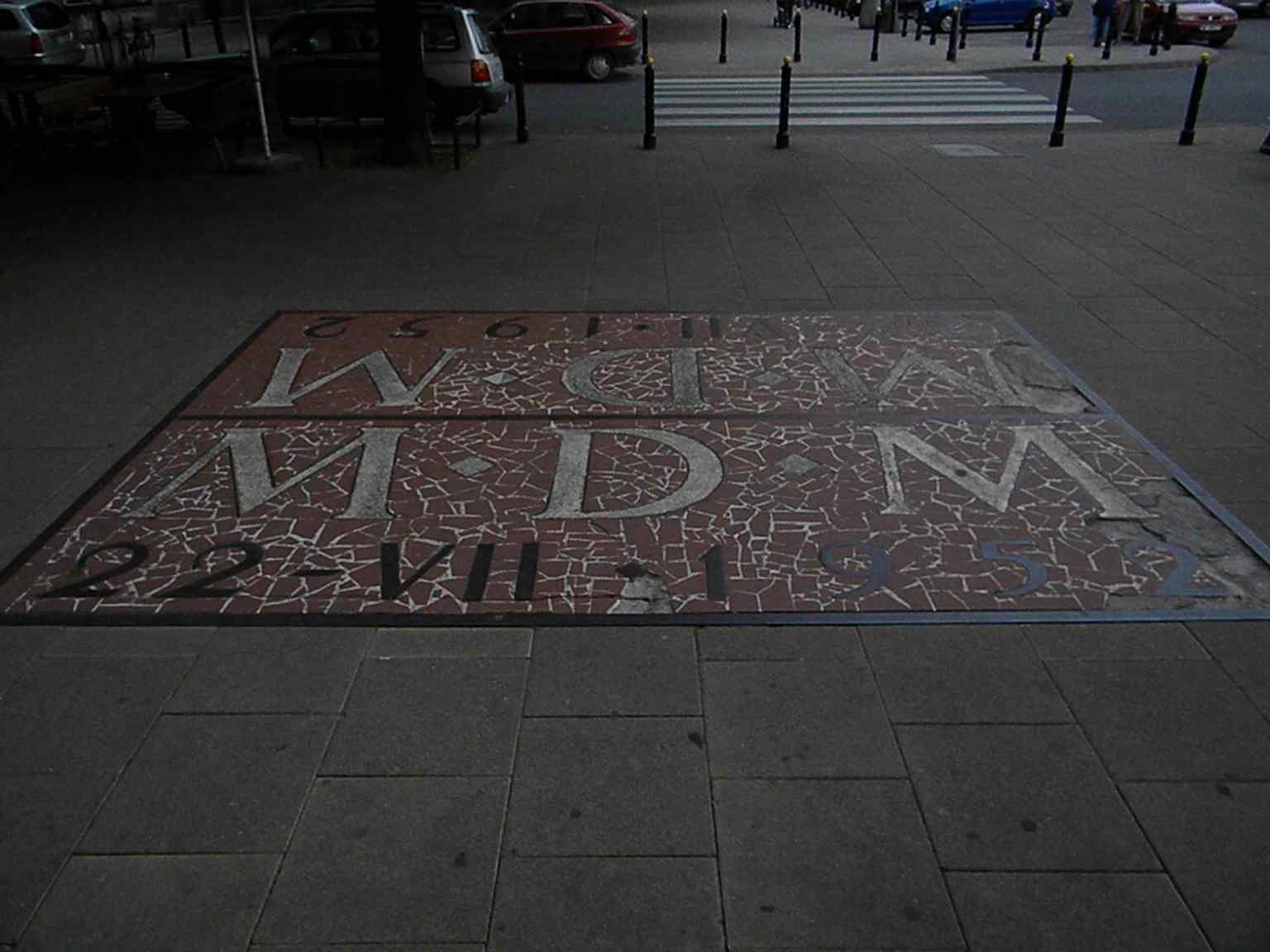
A street mosaic on the square, part of the decorative ground-level artwork that gives the district its character.Photo: Tothkaroj, Wikimedia Commons, CC BY-SA 4.0. Cropped & resized. 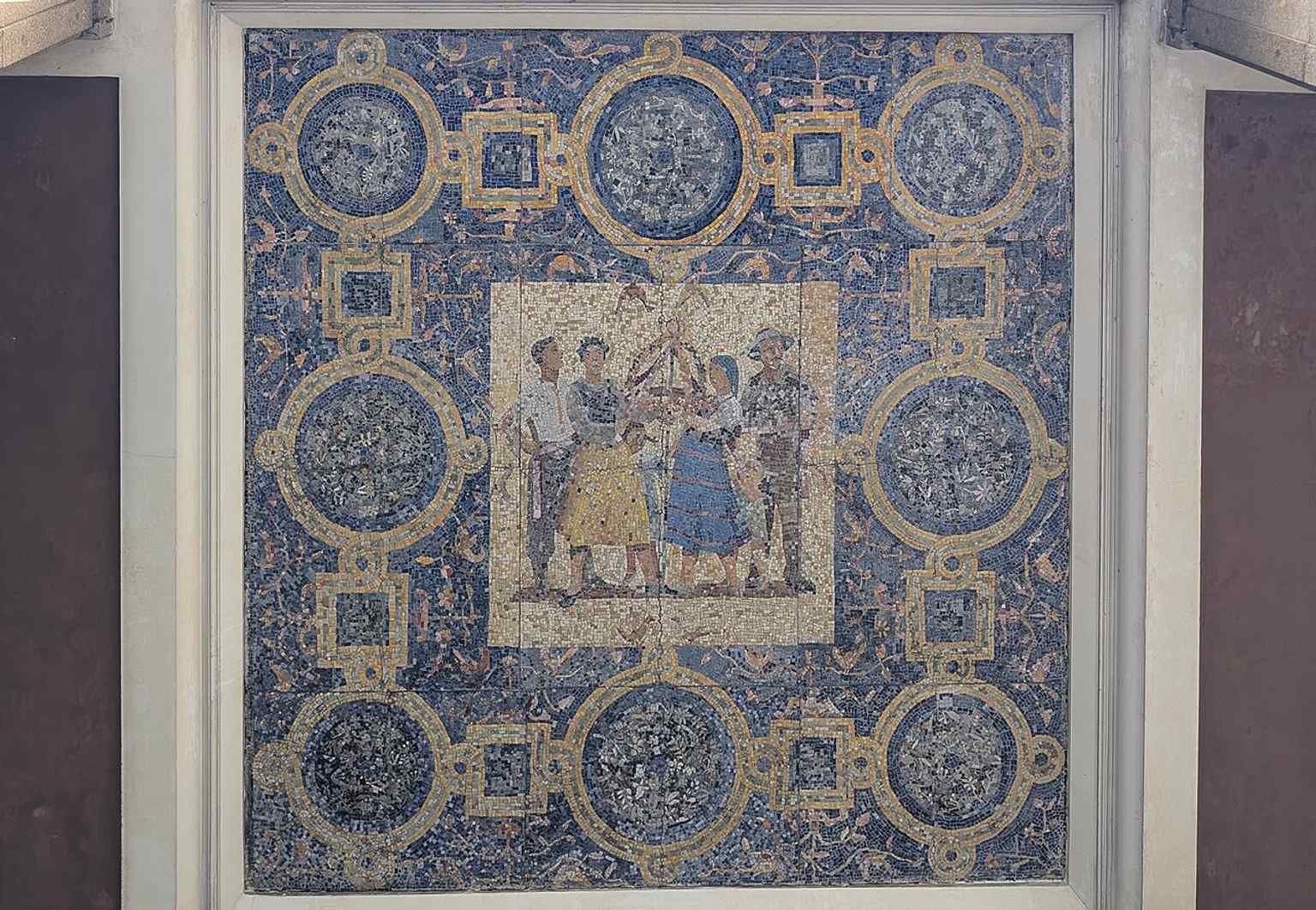
The 'Four Seasons' ceiling mosaic in an arcade, showing how everyday passageways were turned into art.Photo: Siarhei Besarab, Wikimedia Commons, CC BY-SA 4.0. Cropped & resized. 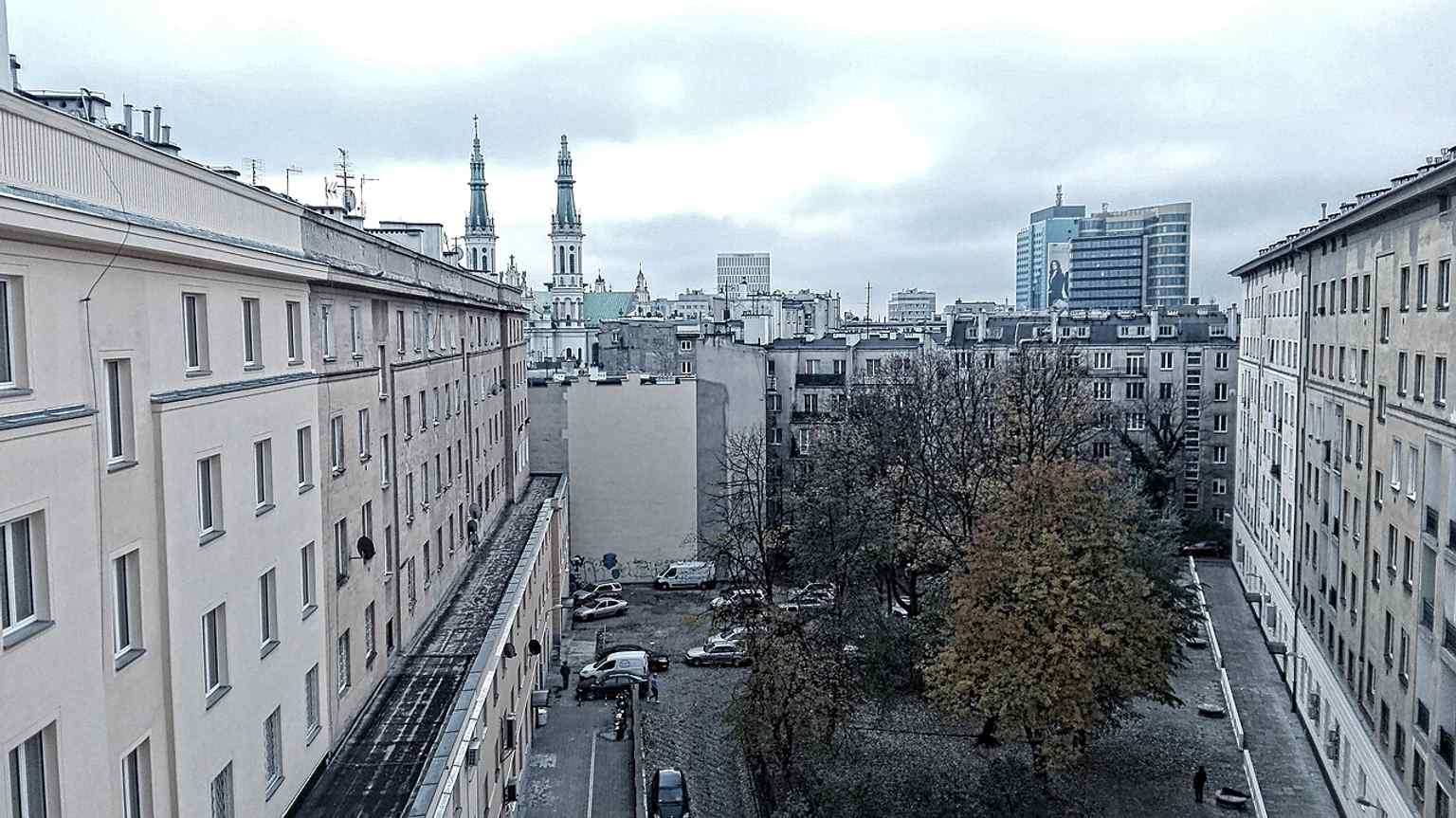
The courtyard of Hotel MDM, a reminder that the square was planned as part of a self-contained workers’ district.Photo: Halibutt, Wikimedia Commons, CC BY 3.0. Cropped & resized. Look for the broad square framed by pale granite arcades and tall, blocky apartment façades, with Hotel M-D-M closing the southern end like a carefully placed stone stopper. This…Read moreShow less
Open dedicated page →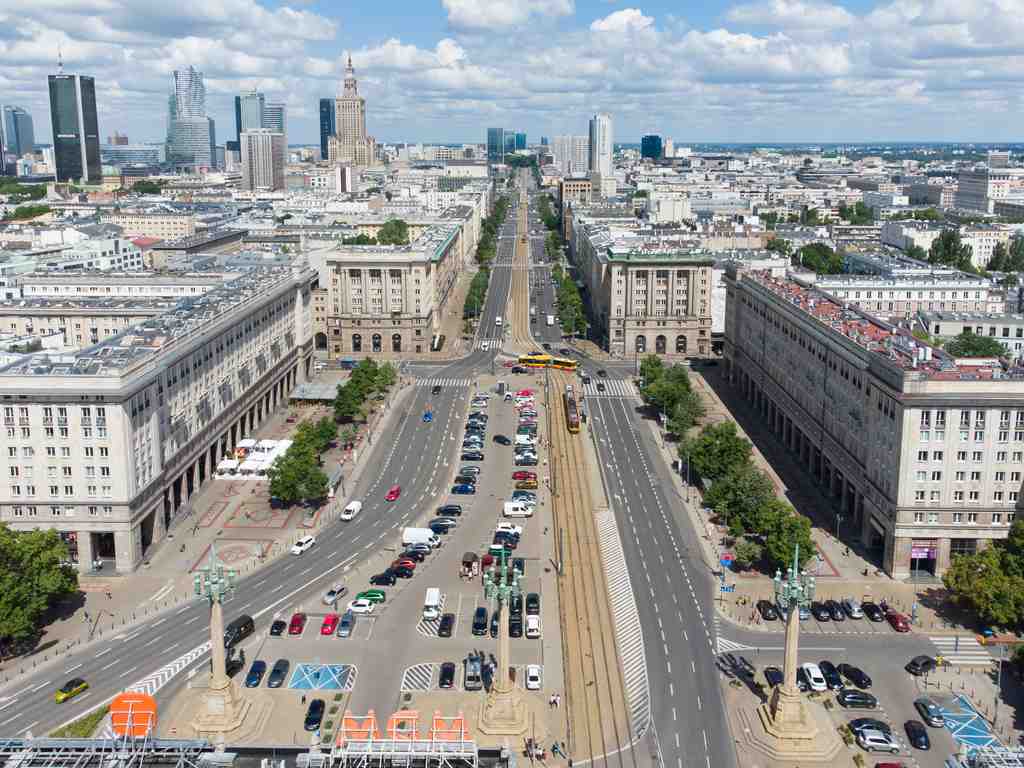
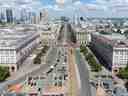
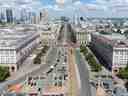
Constitution Square in WarsawPhoto: Emptywords, Wikimedia Commons, CC BY-SA 4.0. Cropped & resized. Look for the broad square framed by pale granite arcades and tall, blocky apartment façades, with Hotel M-D-M closing the southern end like a carefully placed stone stopper.
This is Constitution Square, the centerpiece of M-D-M, the Marszałkowska Residential District, opened on the twenty-second of July, nineteen fifty-two, the same day the communist state announced its new constitution. So yes, the square and the regime shared a birthday. Subtlety was not invited.
From here, seven streets converge. Marszałkowska cuts straight through with tram tracks, while Piękna, Koszykowa, Śniadeckich, and Waryńskiego feed the flow. It works as a monument, but also as a machine: people crossing, trams grinding past, traffic sorting itself out under all that ideological posture.
And here is the part locals like to mention when the place seems too easy to read. One of the core designers in the tight-knit “Tigers” team was Stanisław Jankowski, known as Agaton - a Warsaw Uprising veteran, a member of the wartime Home Army, and exactly the kind of man the Stalinist system usually distrusted. Yet he helped design one of its flagship spaces, working under chief architect Józef Sigalin despite that political baggage. So the square is not pure doctrine poured neatly into concrete. It also carries compromise, camouflage, and survival.
The materials tell a similarly grim joke. Those pale granite slabs on the ground floors and arcades did not come from an ordinary quarry order. Polish authorities found them in the recovered western territories, where Nazi Germany had stockpiled them for monumental victory memorials. The stone prepared for the Third Reich ended up dressing socialism in Warsaw. A remarkable career change for granite.
This whole ensemble replaced an older, dense neighborhood. Builders demolished most surviving tenements, broke the old street grid, redirected Piękna and Koszykowa, and pushed out Waryńskiego as a new route. If you glance at the before-and-after image on your screen, you can watch the same symmetry trade parade-era emptiness for the dense, ordinary city of later decades.
Hotel M-D-M, at the south end, was meant to have a taller companion tower and became controversial anyway. By sealing this view, it blocked the old sightline toward Plac Zbawiciela and its church, which many people read as more than an accident. Meanwhile, the center of the square never got the planned fountain. It became a parking area instead... ideology meeting the practical needs of drivers, which is almost touching.
At street level, life kept rewriting the script. Shops filled the arcades. A sports store lit up the famous neon volleyball player. Café Niespodzianka later turned into the Solidarity citizens’ committee in nineteen eighty-nine, with election results posted in the windows while crowds gathered below.
So even here, among the grand facades, certainty faded first at human height: in shopfronts, queues, tram stops, and people simply trying to get somewhere. When you’re ready, head on to the Main Library, about a four-minute walk away.
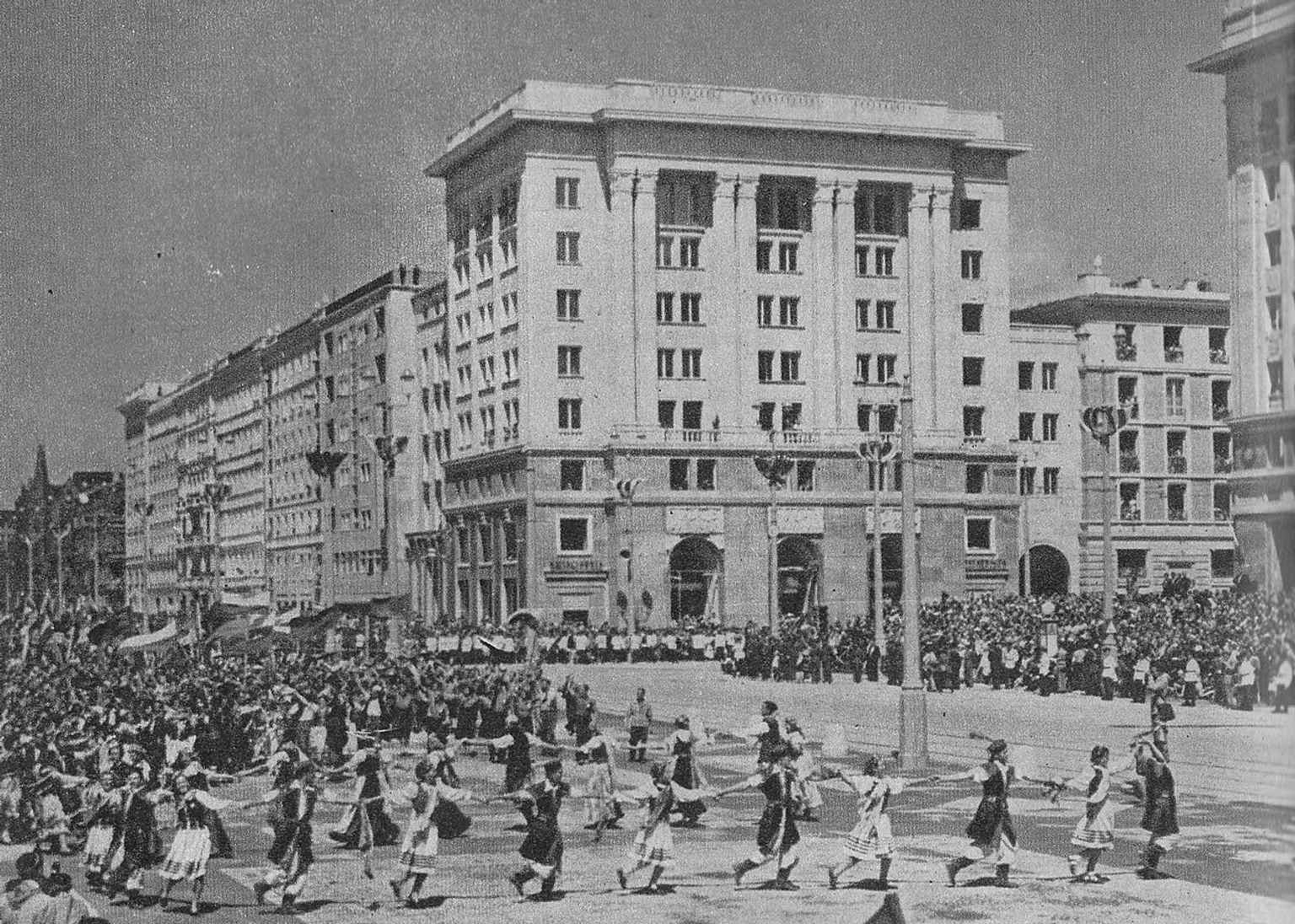
The official opening of MDM and Constitution Square on 22 July 1952 — the birthday of the socialist-realist ensemble that defined this part of Warsaw.Photo: nieznany/unknown, Wikimedia Commons, Public domain. Cropped & resized. 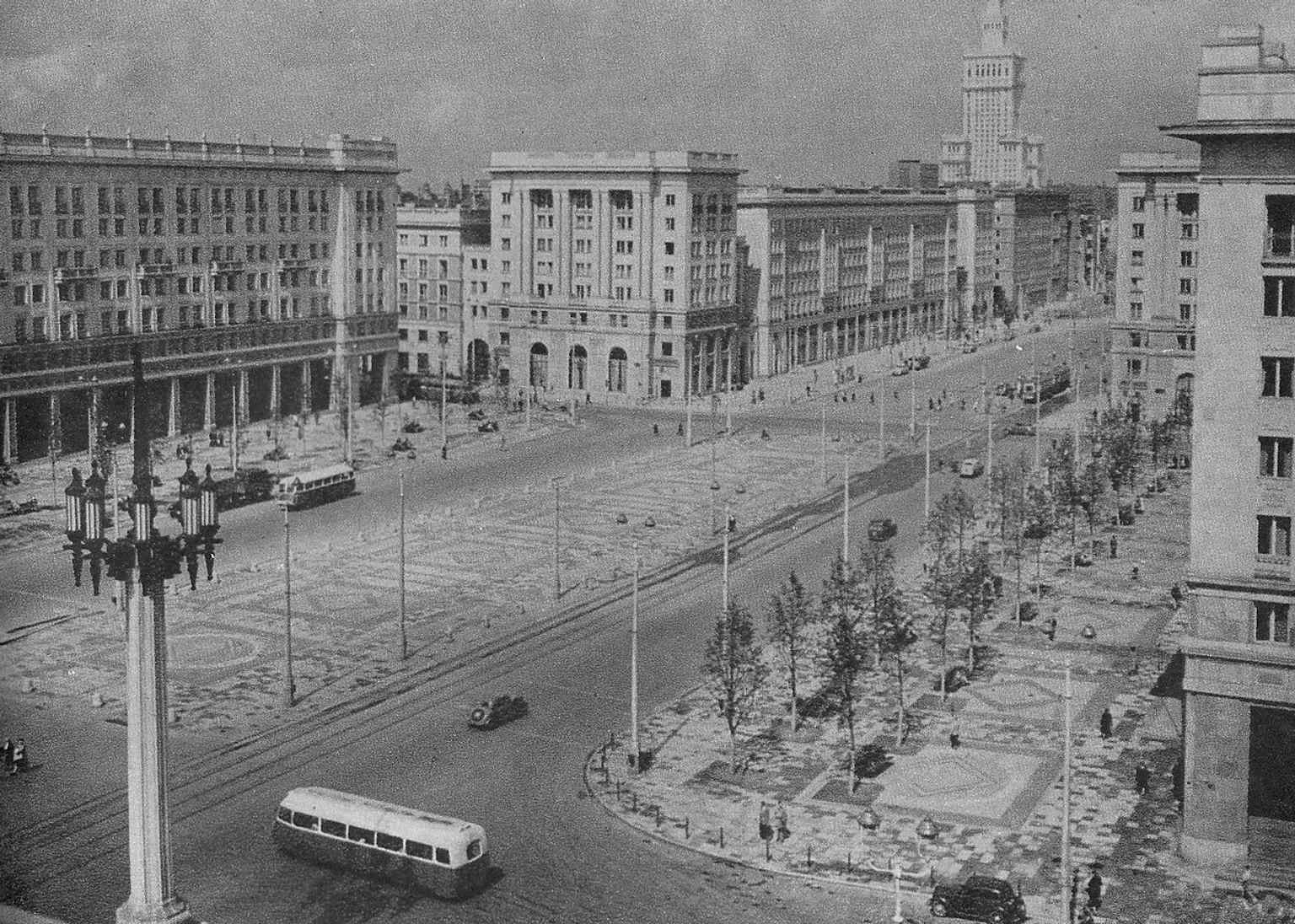
A 1950s view of the square before completion, showing how the new axis of Marszałkowska replaced older city fabric.Photo: nieznany/unknown, Wikimedia Commons, Public domain. Cropped & resized. 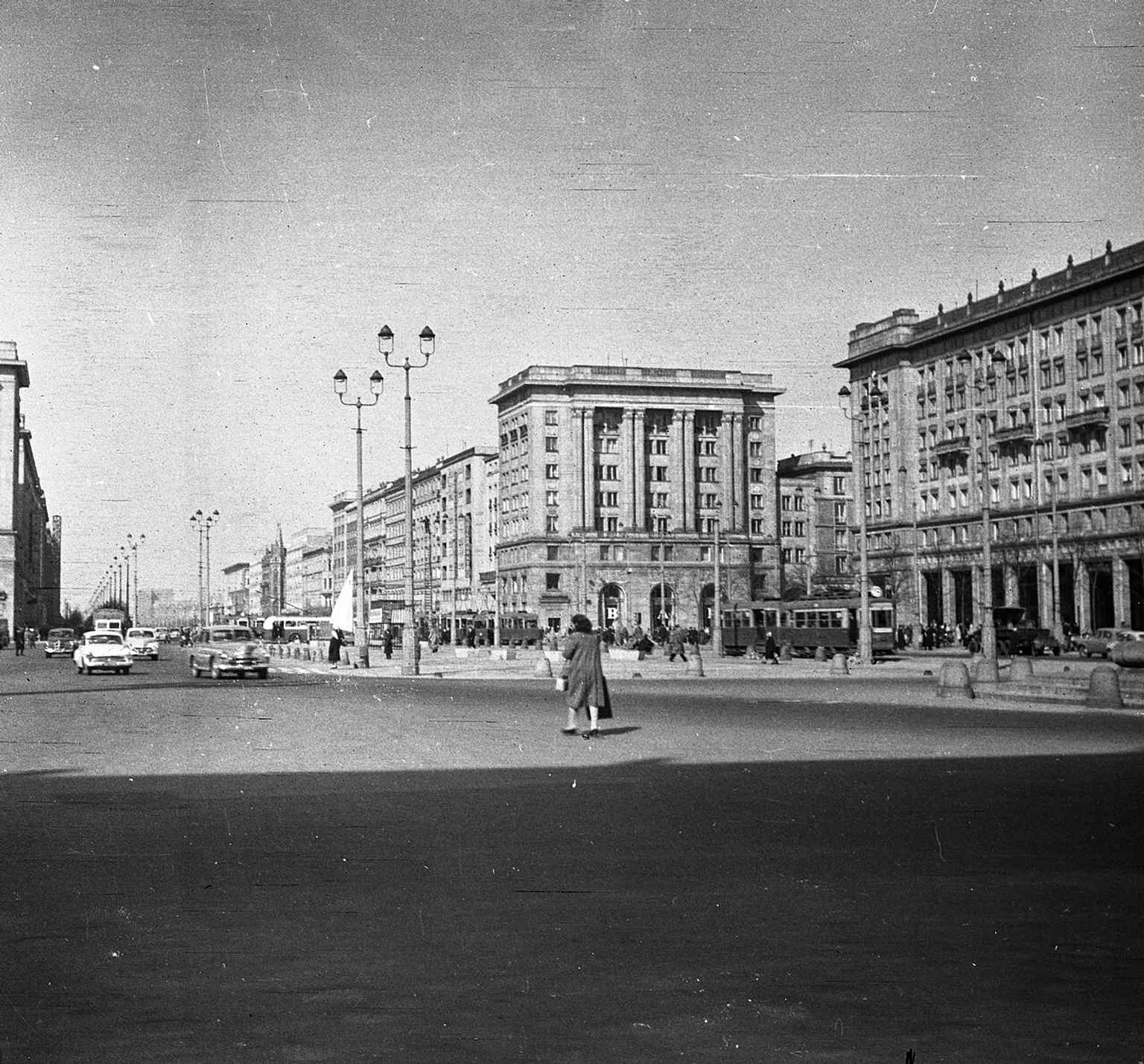
Constitution Square seen toward Marszałkowska in 1960, with tram tracks running along the avenue as described in the tour text.Photo: FOTO:Fortepan — ID 75021: Adományozó/Donor: Romák Éva., Wikimedia Commons, CC BY-SA 3.0. Cropped & resized. 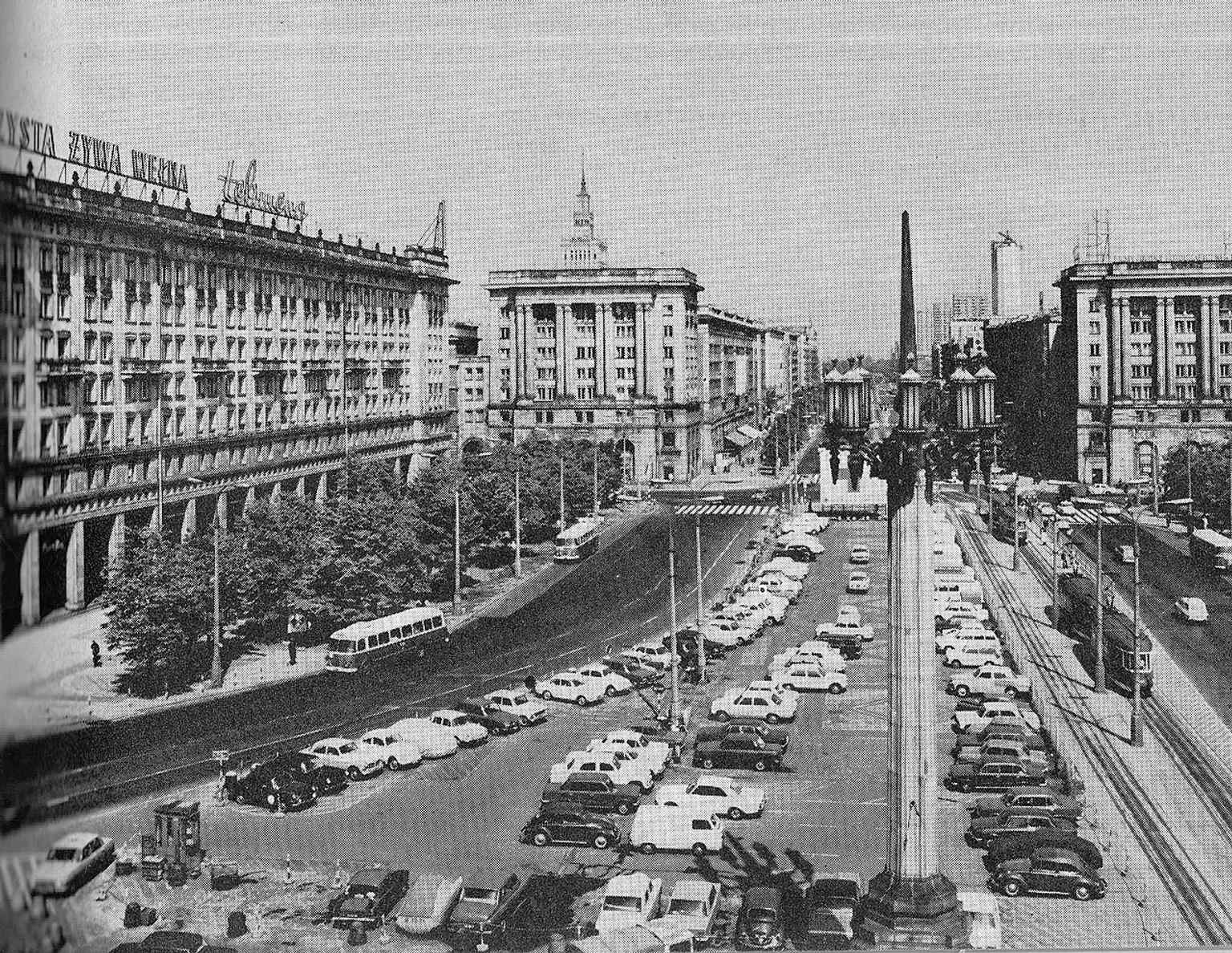
A 1975 view from Hotel MDM that captures the square’s open central space, later used as parking and for public gatherings.Photo: T. Hermańczyk, Wikimedia Commons, Public domain. Cropped & resized. 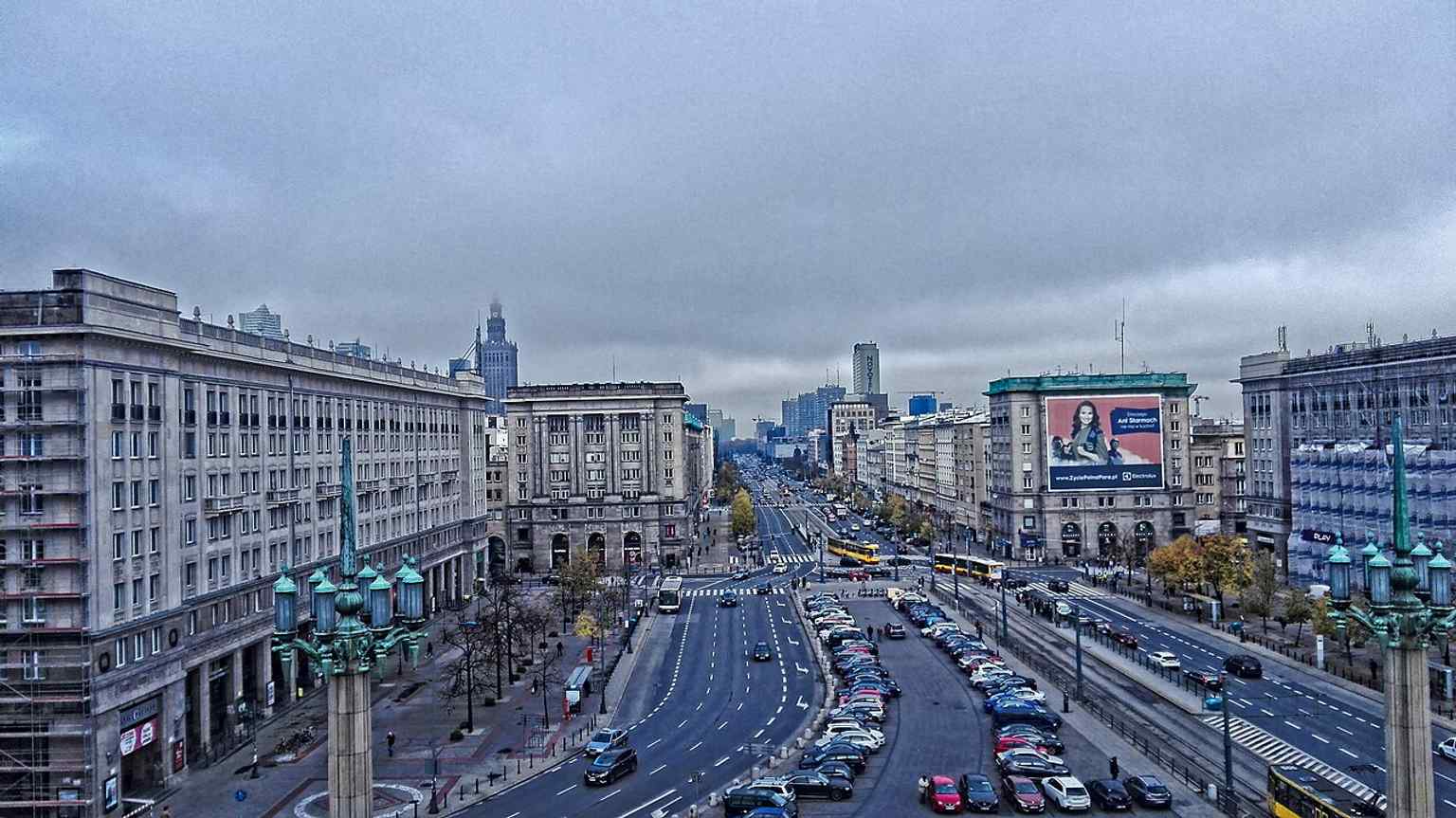
The square seen from Hotel MDM in 2016, emphasizing the grand socialist-realist façades and the long perspective toward the center.Photo: Halibutt, Wikimedia Commons, CC BY 3.0. Cropped & resized. 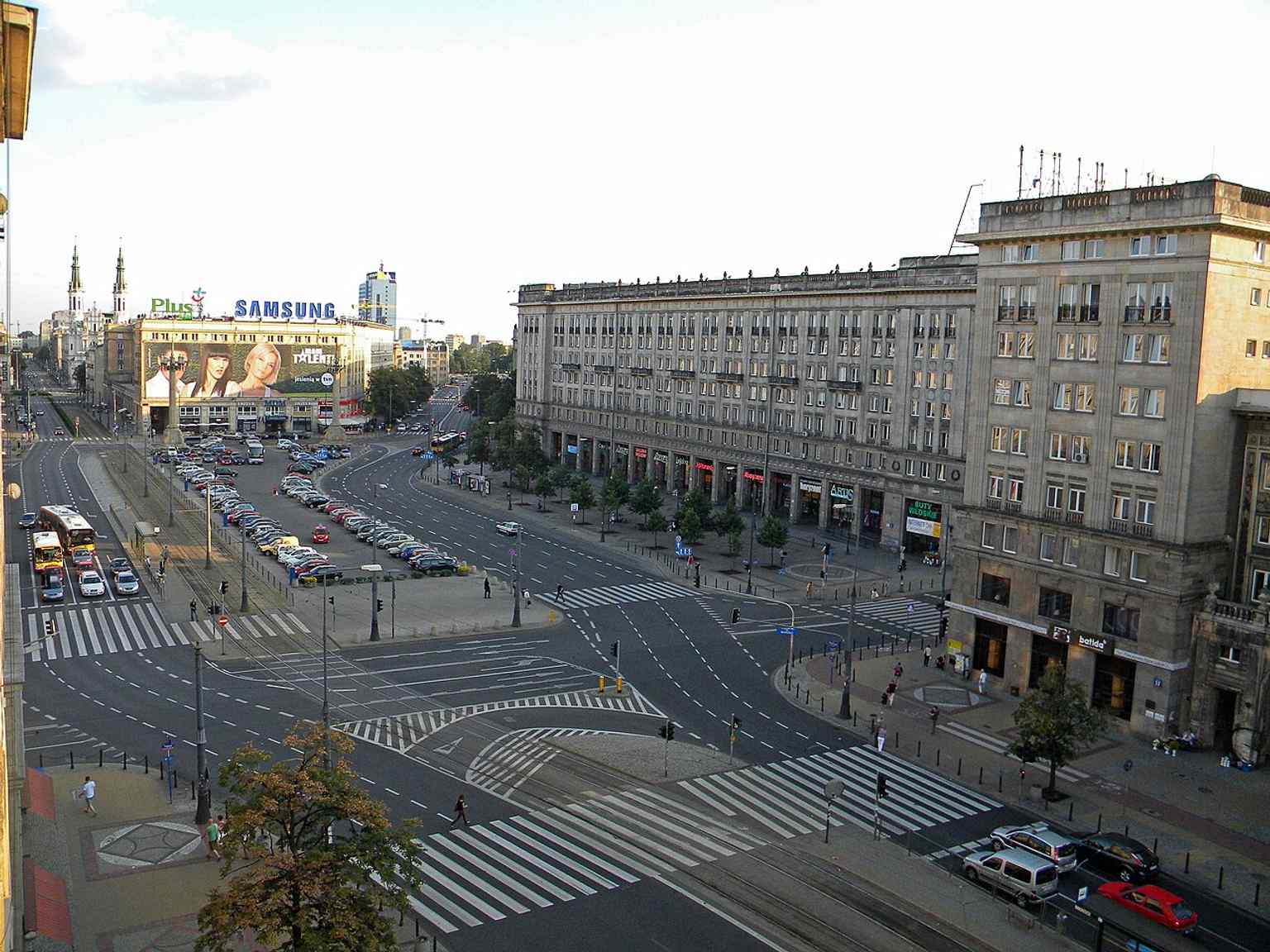
A wide panorama of Constitution Square that clearly shows the full urban layout and the branching streets around the MDM ensemble.Photo: Foma, Wikimedia Commons, CC BY-SA 4.0. Cropped & resized. 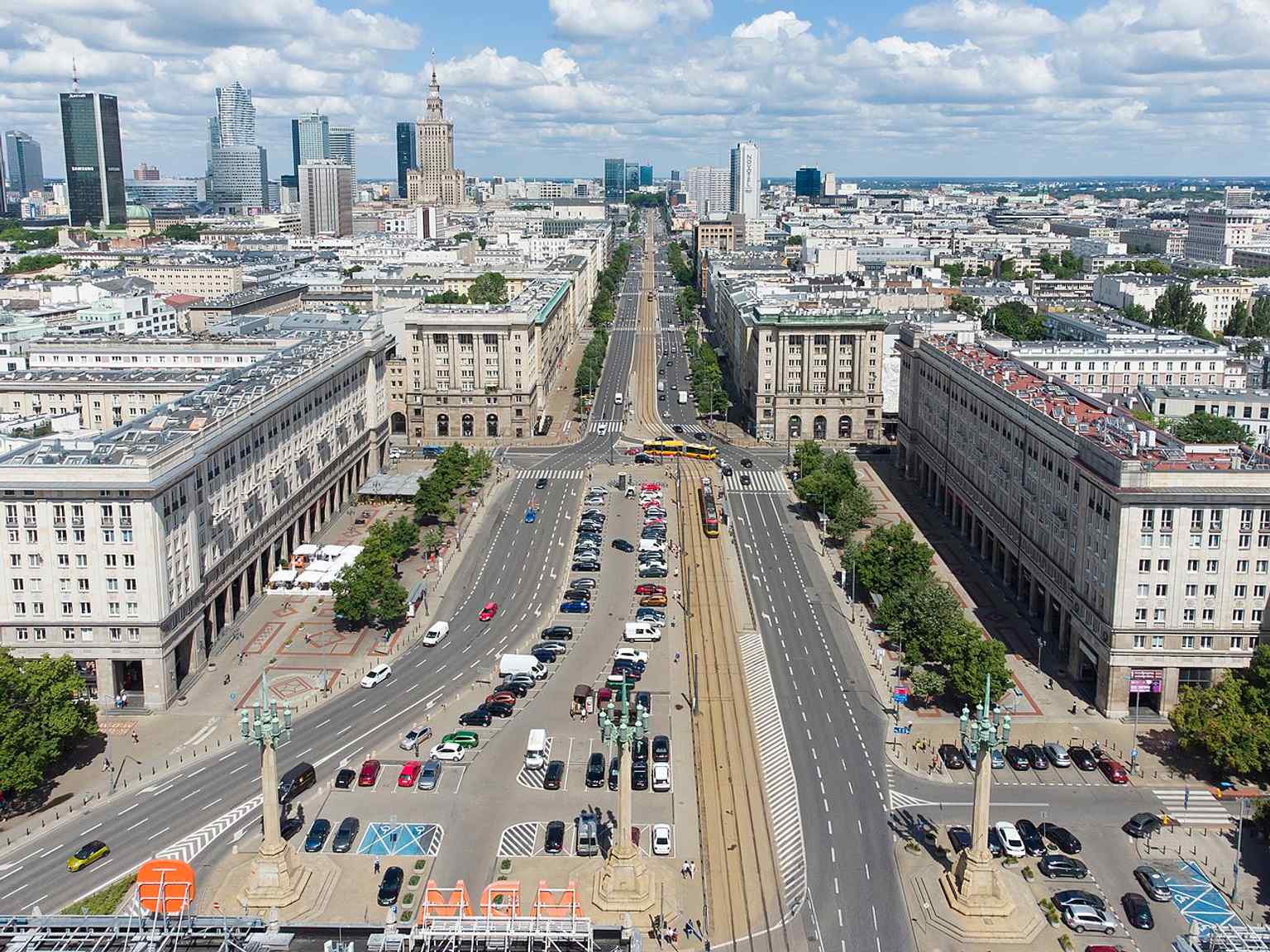
Drone view from the south, with Hotel MDM, Marszałkowska Street, and the square’s monumental symmetry all visible at once.Photo: Emptywords, Wikimedia Commons, CC BY-SA 4.0. Cropped & resized. 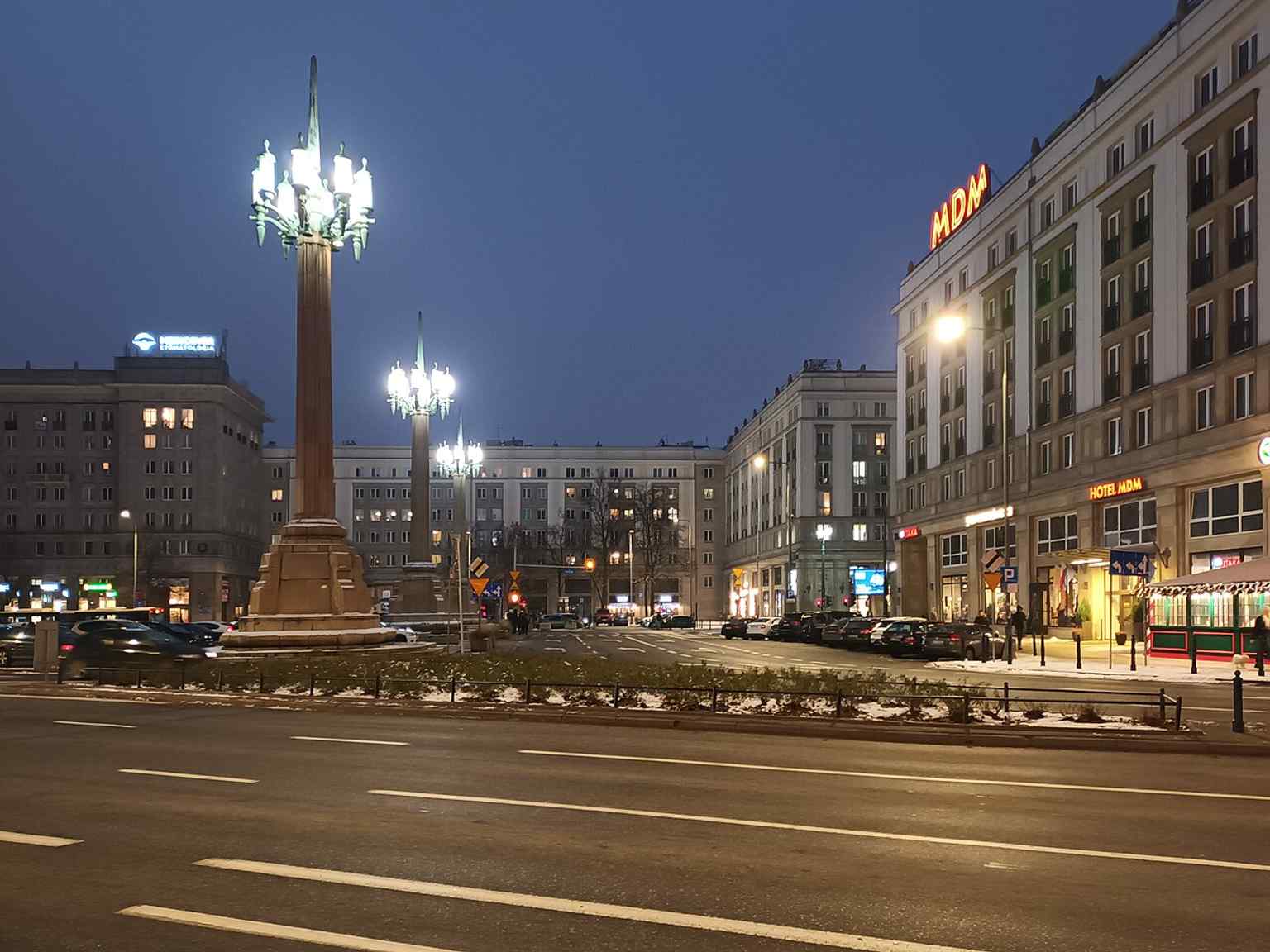
Evening view of the square with its three tall lamps — a good example of the dramatic lighting that became part of its postwar identity.Photo: Cybularny, Wikimedia Commons, CC BY 4.0. Cropped & resized. 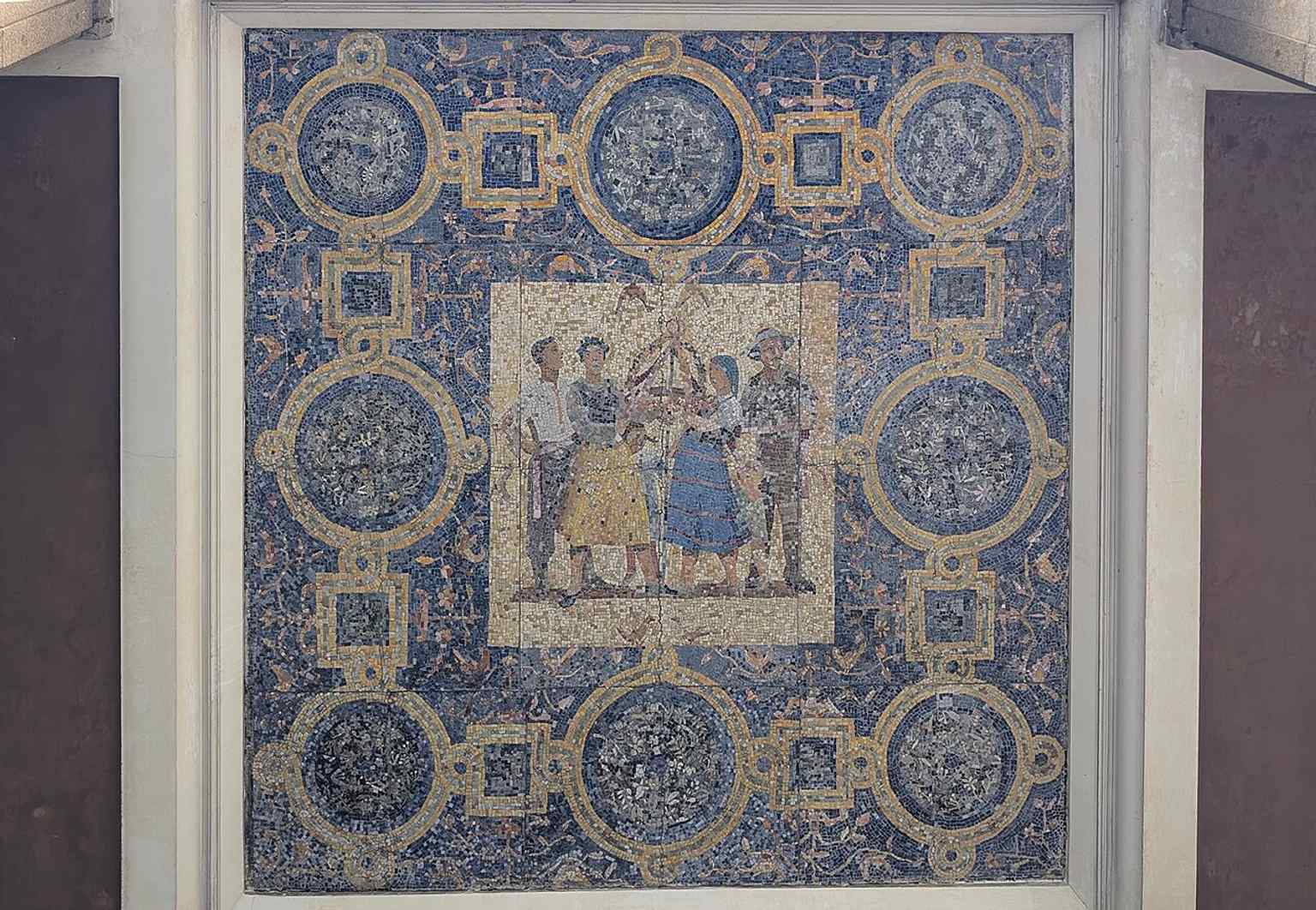
A ceiling mosaic in one of the arcades, echoing the decorative interiors and public-art layer built into the MDM complex.Photo: Siarhei Besarab, Wikimedia Commons, CC BY-SA 4.0. Cropped & resized. 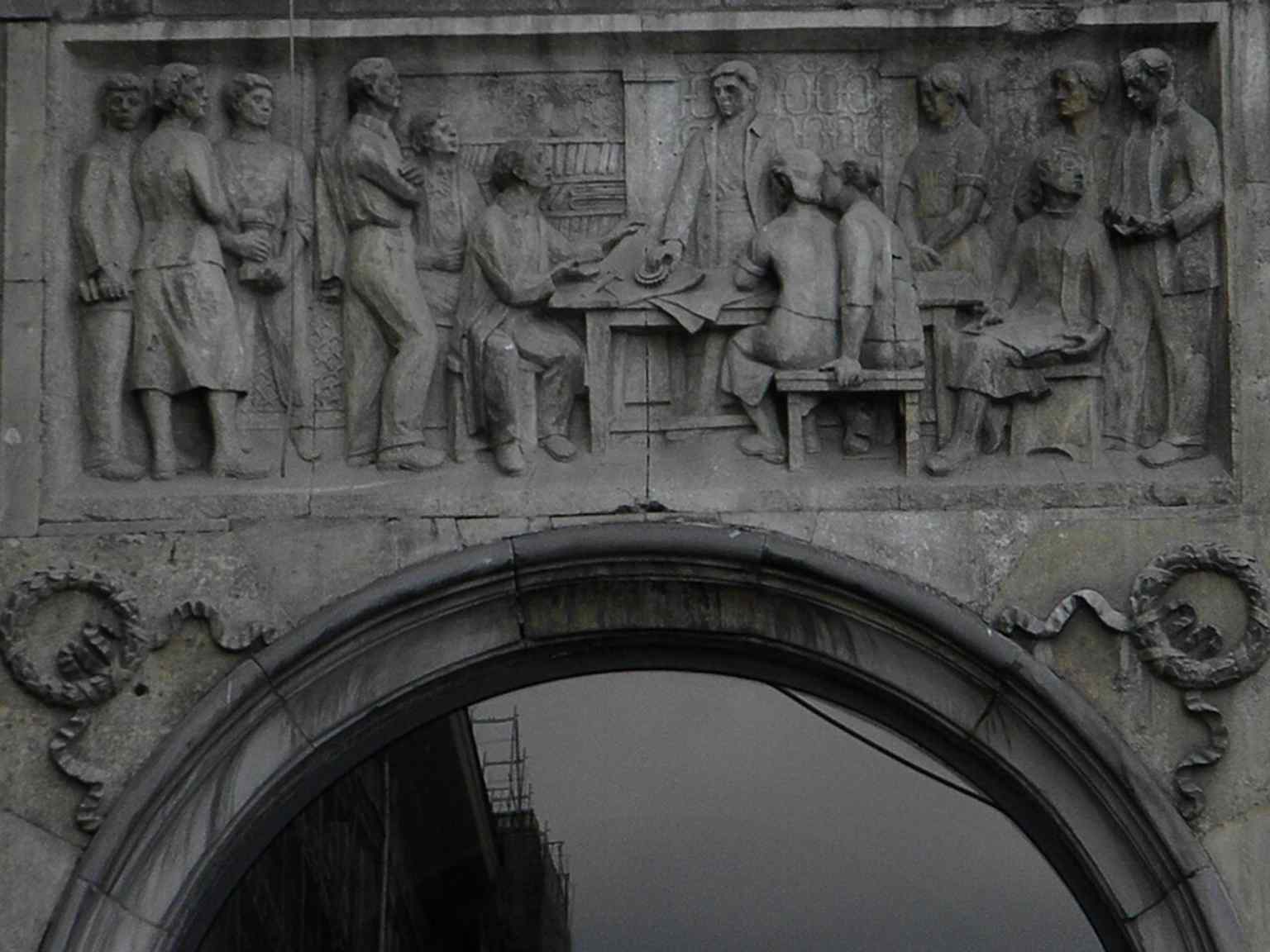
A relief on Constitution Square, showing how the ensemble mixes architecture with sculptural decoration.Photo: Tothkaroj, Wikimedia Commons, CC BY-SA 4.0. Cropped & resized. 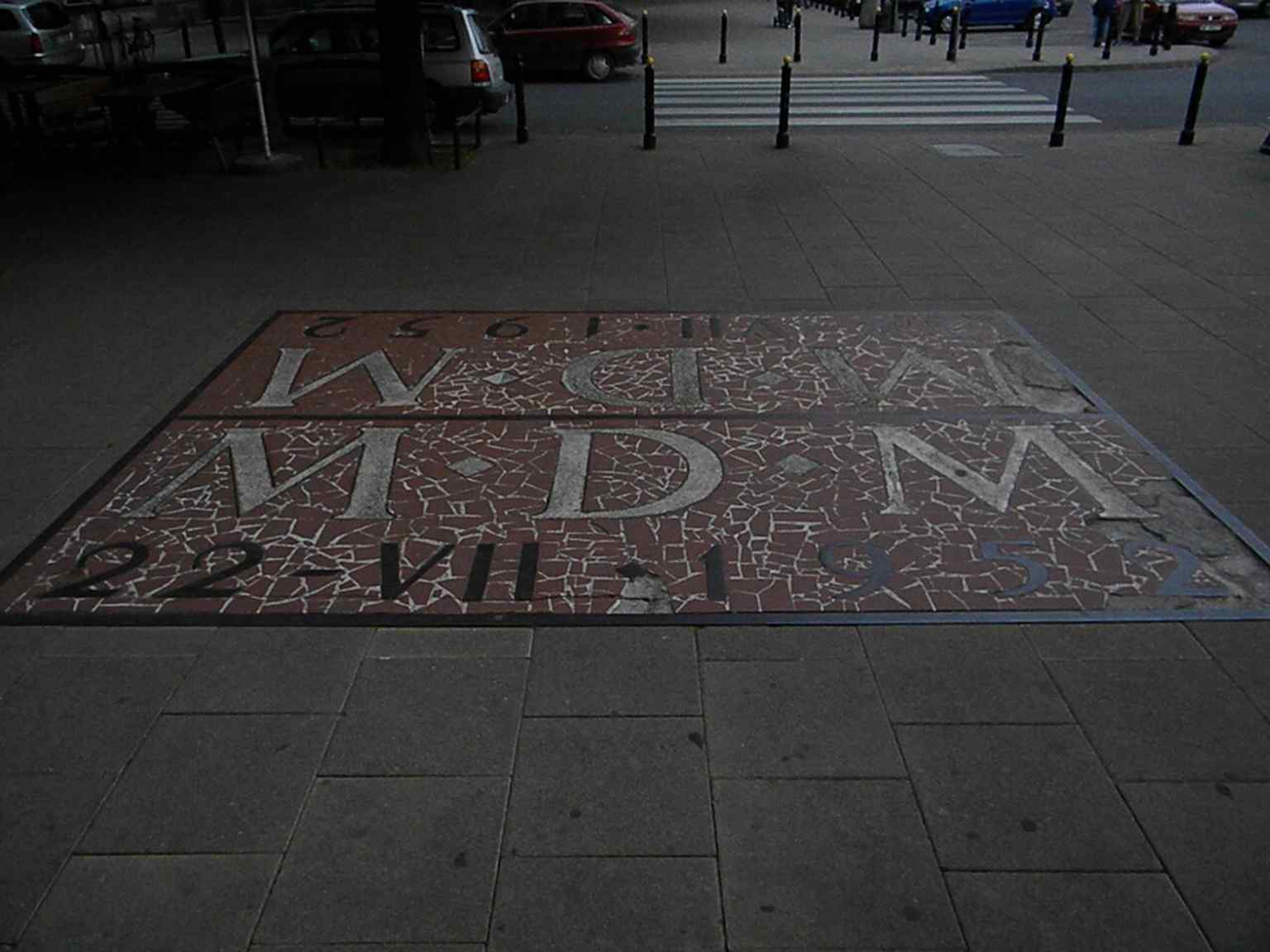
Street mosaic on the square — one of the decorative details that make the MDM frontage more than a simple housing block.Photo: Tothkaroj, Wikimedia Commons, CC BY-SA 4.0. Cropped & resized. 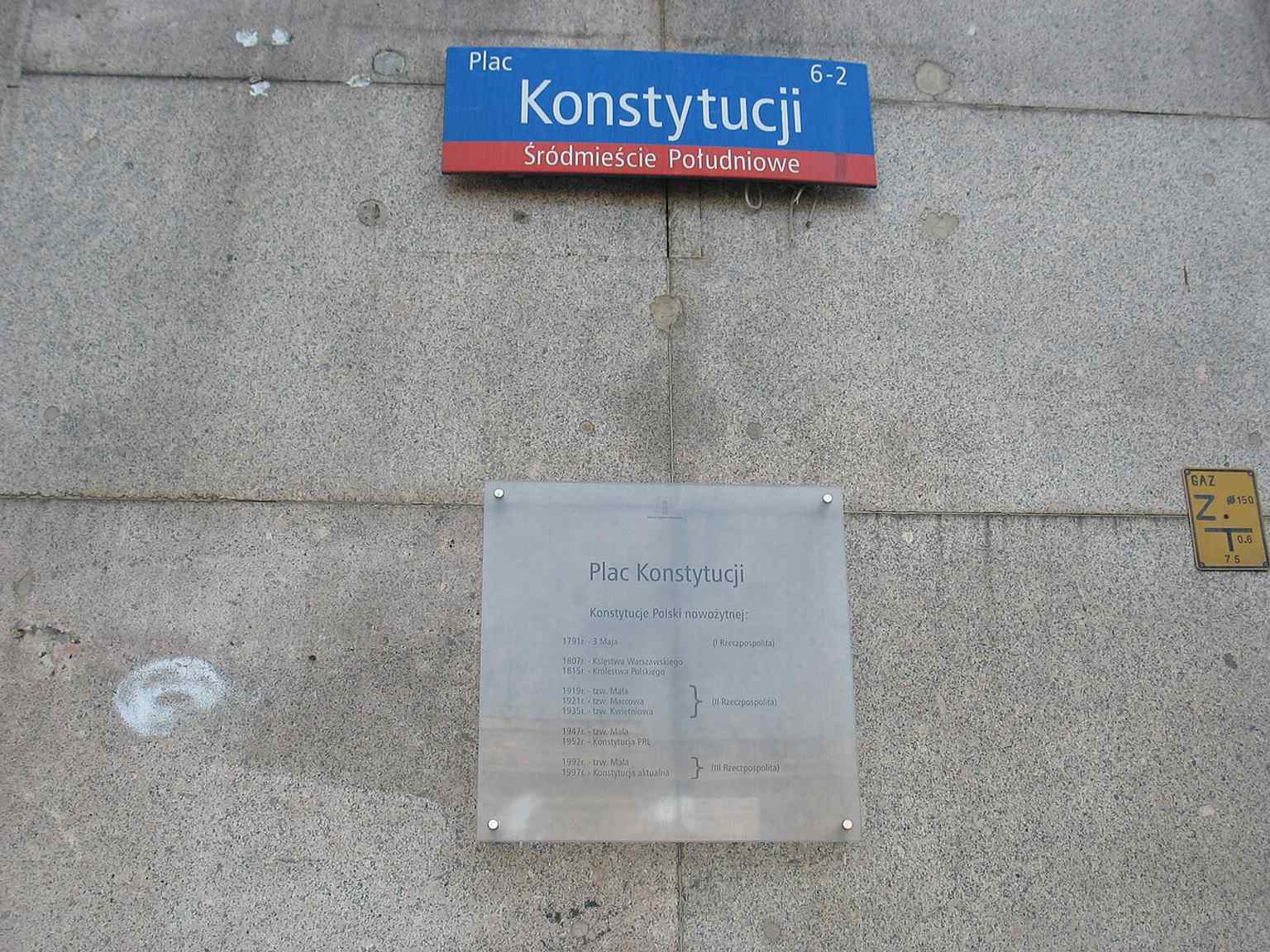
An information board for the square, useful for orienting visitors at the heart of the MDM district.Photo: Gophi, Wikimedia Commons, CC BY-SA 3.0. Cropped & resized. 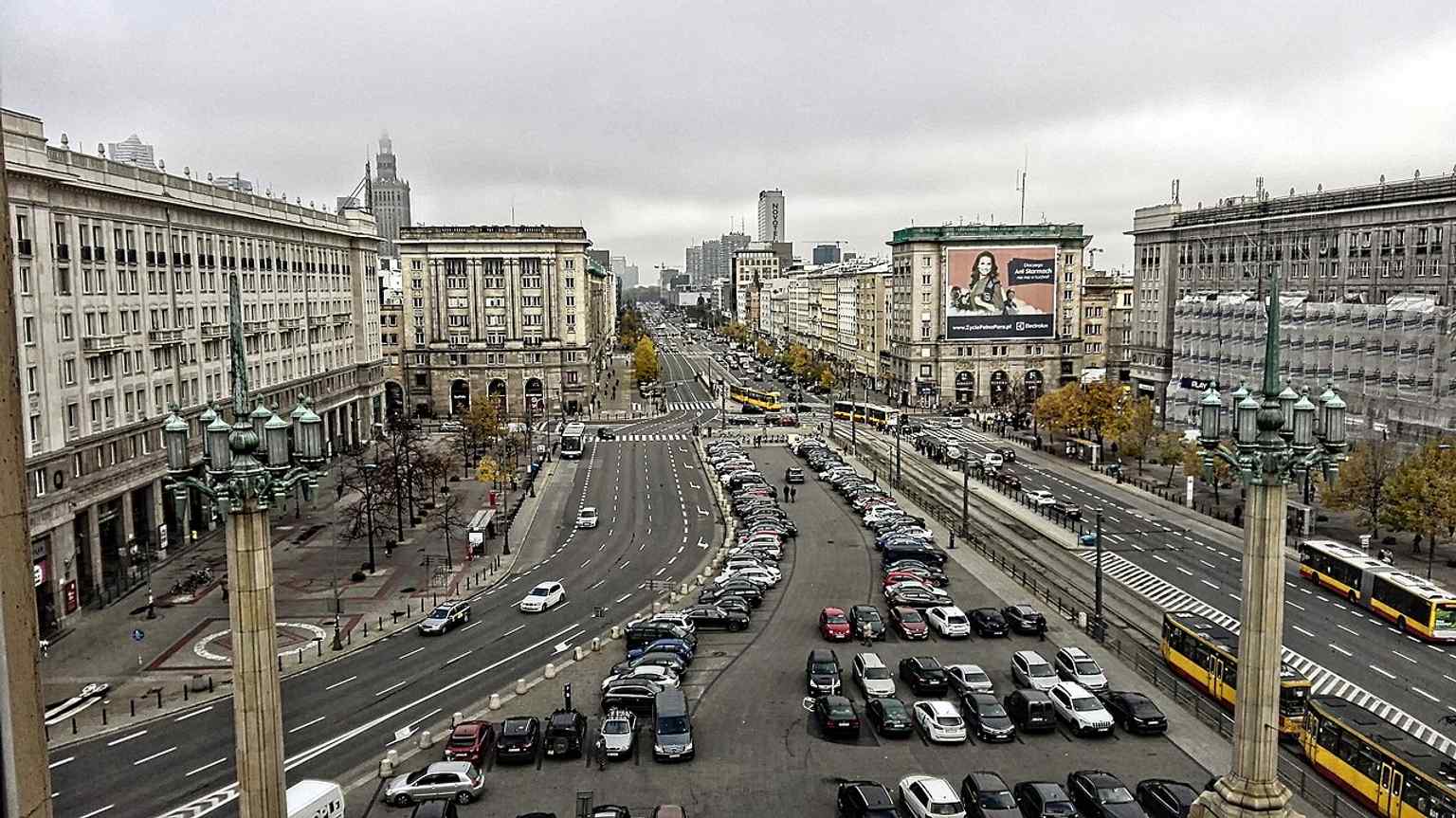
Another view from Hotel MDM, helpful for illustrating the hotel’s role as the southern closure of the square and its controversial impact on the historic sightline.Photo: Halibutt, Wikimedia Commons, CC BY 3.0. Cropped & resized. A broad paved crossroads opens around the pale stone rotunda of Saint Alexander’s Church, with radiating streets and the pink granite cross columns that still give the square its…Read moreShow less
Open dedicated page →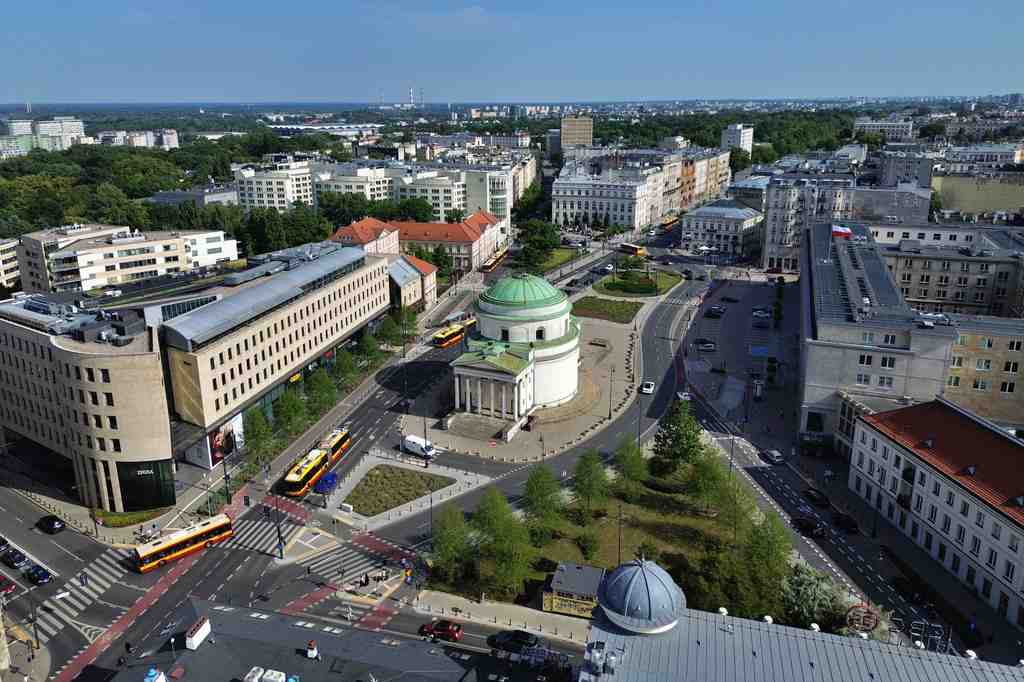
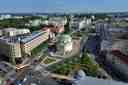
Three Crosses Square in WarsawPhoto: Kapitel, Wikimedia Commons, CC BY-SA 4.0. Cropped & resized. A broad paved crossroads opens around the pale stone rotunda of Saint Alexander’s Church, with radiating streets and the pink granite cross columns that still give the square its name.
Plac Trzech Krzyży is one of Warsaw’s great shape-shifters. The ground stayed put; the job description kept changing. It began as a fork in old roads leading out of the city, then turned into a sacred marker, then a market, then a traffic knot, then a place where politics and war arrived with very little patience.
In the early eighteenth century, this was a smaller junction of routes heading toward Solec, Ujazdów, Rakowiec, and Grzybów. Around seventeen twenty-five, King Augustus the Second funded two columns topped with gilded crosses here. They marked the start of the Kalwaria route, a devotional path modeled on the Way of the Cross, leading toward a symbolic Holy Sepulchre near Ujazdów Castle. Then in seventeen fifty-six, the crown marshal Franciszek Bieliński added a statue of Saint John of Nepomuk holding a cross... and that gave the place its third cross.
Here’s the detail locals like: one of those sacred-looking markers also celebrated something gloriously practical. Bieliński set up the saint to mark that Warsaw’s street paving had finally reached this point. A religious symbol, yes... but also a monument to municipal roadwork. Very Warsaw.
If you glance at the before-and-after image, you can see how the square kept its basic geometry while the city packed itself tighter around it.
In seventeen eighty-seven, traders took over part of the space. By the nineteenth century, the square had gained masonry buildings, then Saint Alexander’s Church between eighteen eighteen and eighteen twenty-five. The church exists because officials and private donors collected money for a triumphal arch honoring Tsar Alexander the First, and then redirected it into a church instead. Bureaucracy occasionally produces theology.
The square kept absorbing new roles. The Institute for the Deaf rose on the east side in eighteen twenty-seven. Horse trams arrived in eighteen eighty-one, electric trams in nineteen oh eight, and the first city bus crossed here in nineteen twenty-one. If you want one image of Warsaw growing up in public, this is it.
And then the arguments started arriving. In December nineteen twenty-two, supporters and opponents of President Gabriel Narutowicz’s election fought here, leaving more than a dozen people injured. In September nineteen thirty-nine, the green in front of the church became a temporary cemetery for bombing victims. Under German occupation, this lay inside the German district; even the tram line circling through here served occupiers only. During the Warsaw Uprising, barricades sealed the street mouths, and the fiercest fighting hit the eastern side. Luftwaffe bombs tore into the church and nearby buildings in September nineteen forty-four.
After the war, planners rebuilt and reshaped the square, and in twenty twenty-three old tram tracks and prewar paving were exposed again... another rewrite, never the last one. Once a square takes its name from a symbol, every later era has to bargain with it. When you’re ready, head toward Greetings from Aleje Jerozolimskie, about five minutes away.
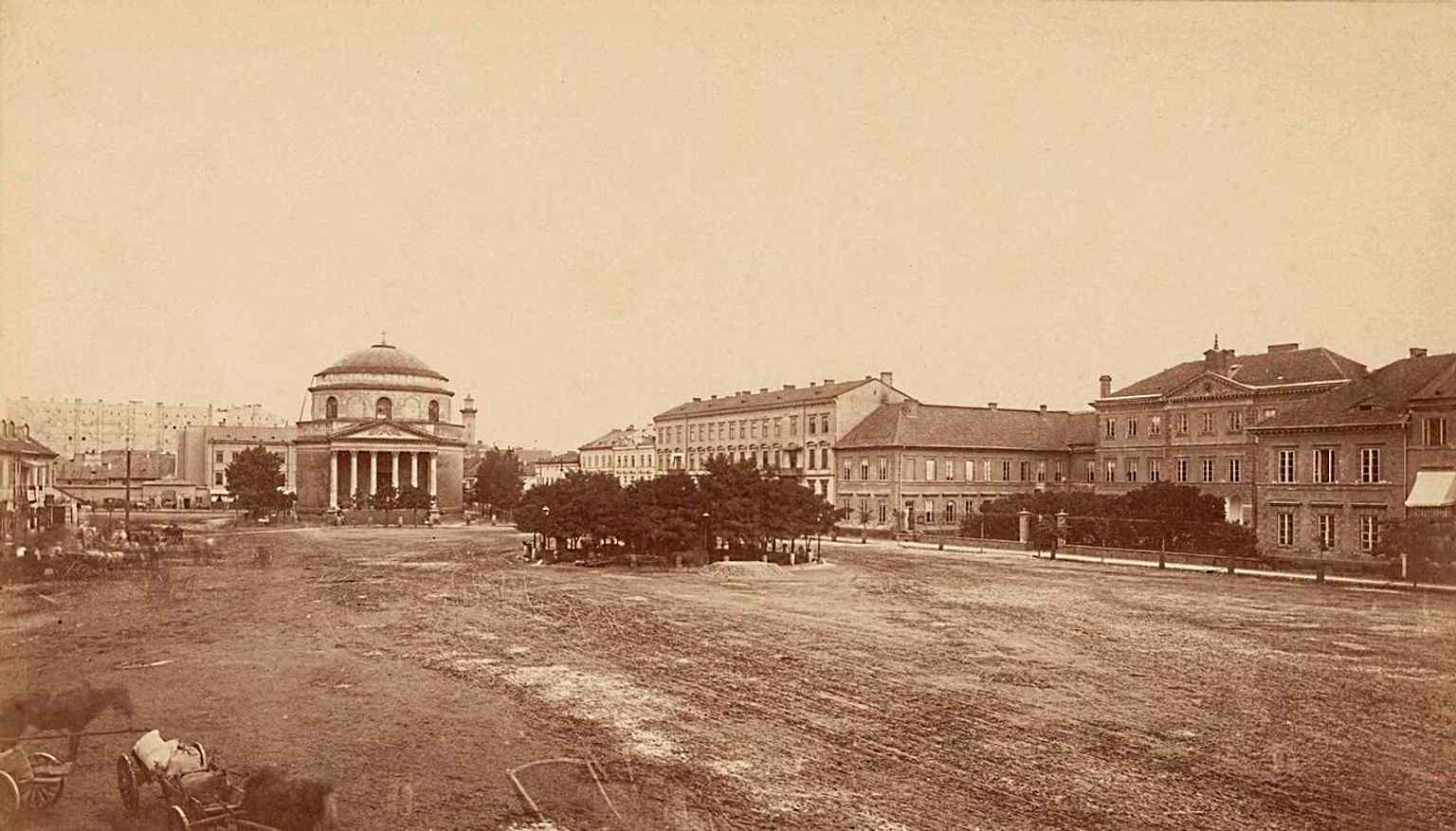
A rare 1870 view of Three Crosses Square before the modern rebuilds, with St. Alexander Church anchoring the scene.Photo: Konrad Brandel, Wikimedia Commons, Public domain. Cropped & resized. 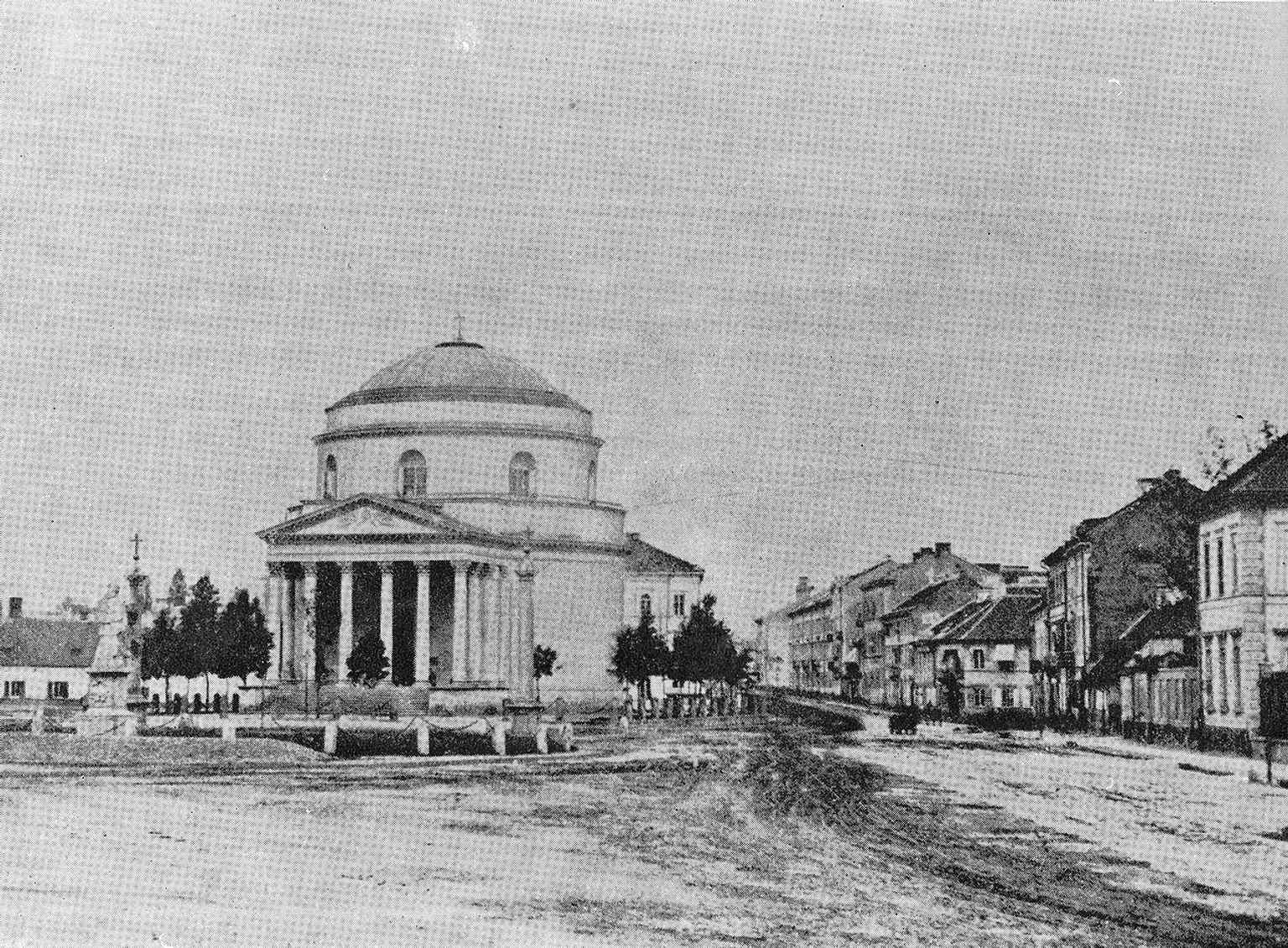
The square in the 1860s, when it was still known as Plac św. Aleksandra and the area looked far more open.Photo: Karol Beyer, Wikimedia Commons, Public domain. Cropped & resized. 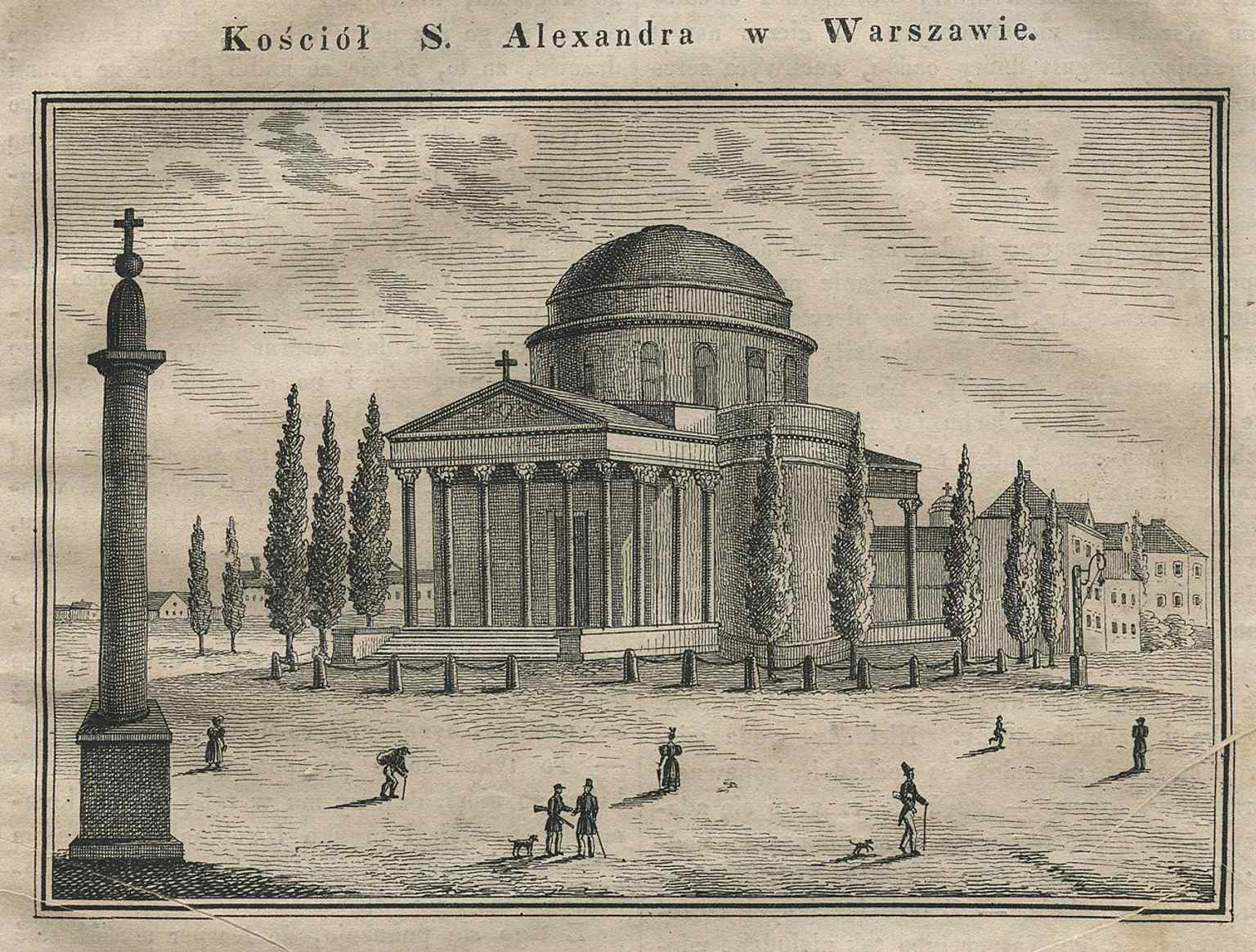
An 1835 depiction of St. Alexander Church, showing the landmark that gave the square one of its former names.Photo: Unknown, Wikimedia Commons, Public domain. Cropped & resized. 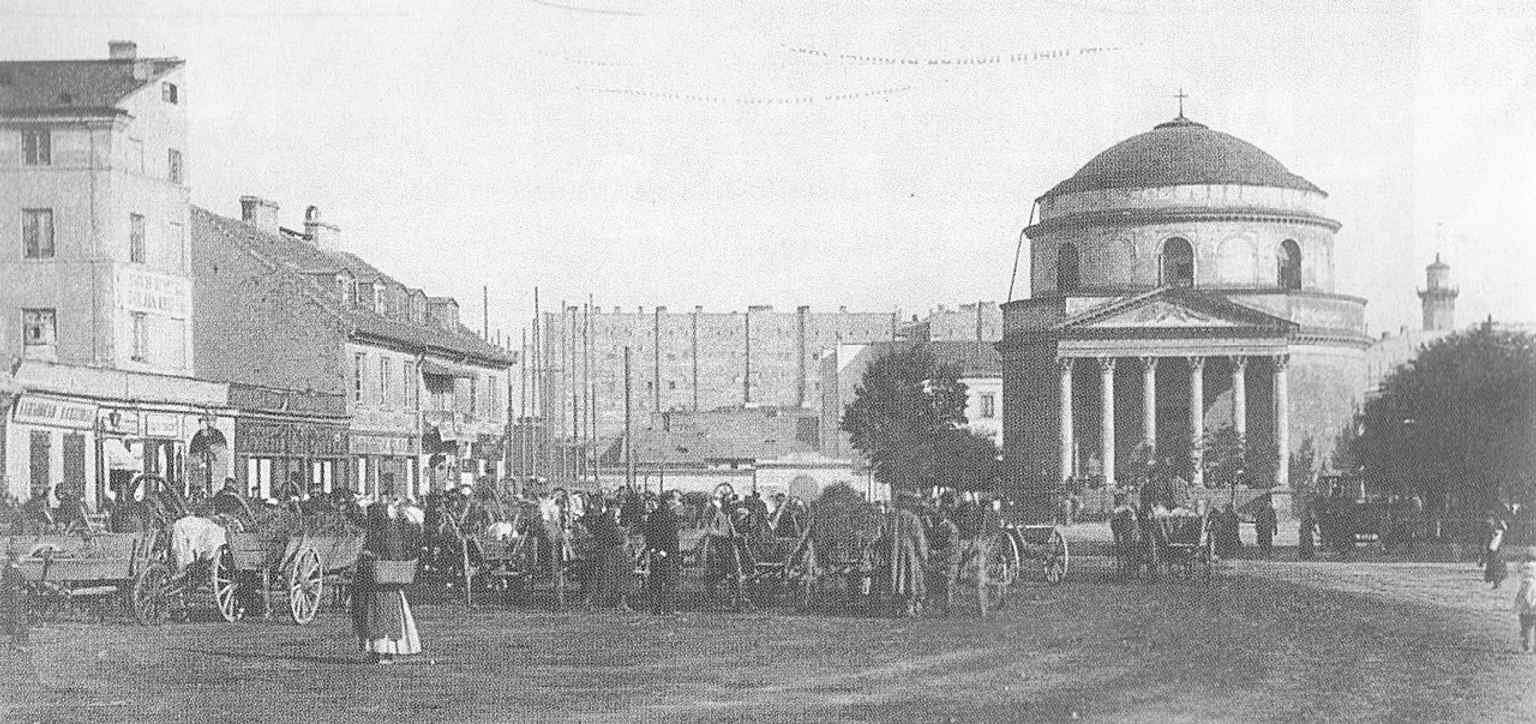
Konrad Brandel’s 1882 photograph captures the square’s 19th-century layout with St. Alexander Church on the right.Photo: Konrad Brandel, Wikimedia Commons, Public domain. Cropped & resized. 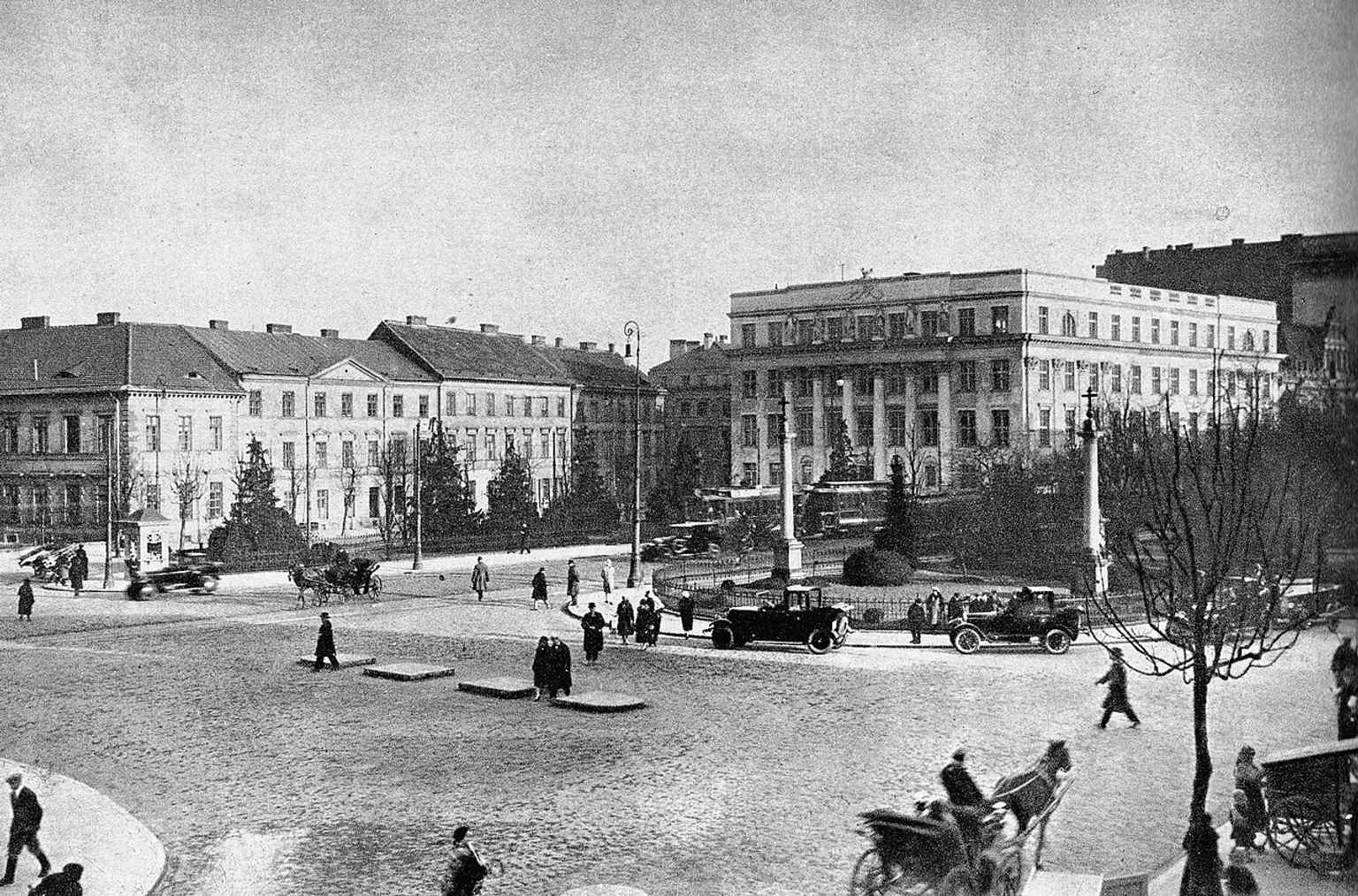
A pre-1939 view of the Queen Jadwiga Gymnasium building, one of the key interwar addresses on the square.Photo: nieznany/unknown, Wikimedia Commons, Public domain. Cropped & resized. 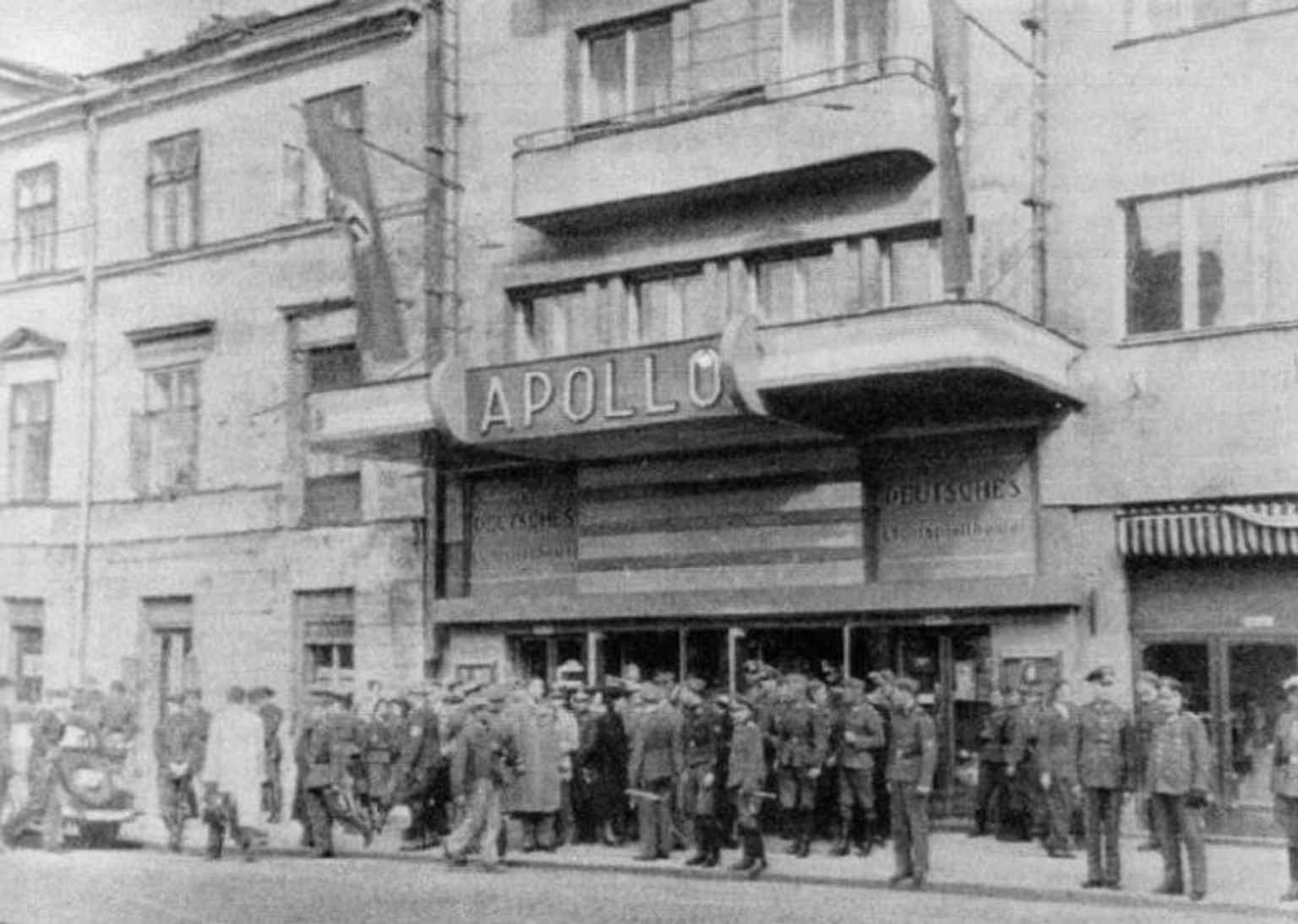
The wartime cinema Apollo, formerly Napoleon, recalls the Nazi-era use of buildings around the square in 1942.Photo: Unknown authorUnknown author, Wikimedia Commons, Public domain. Cropped & resized. 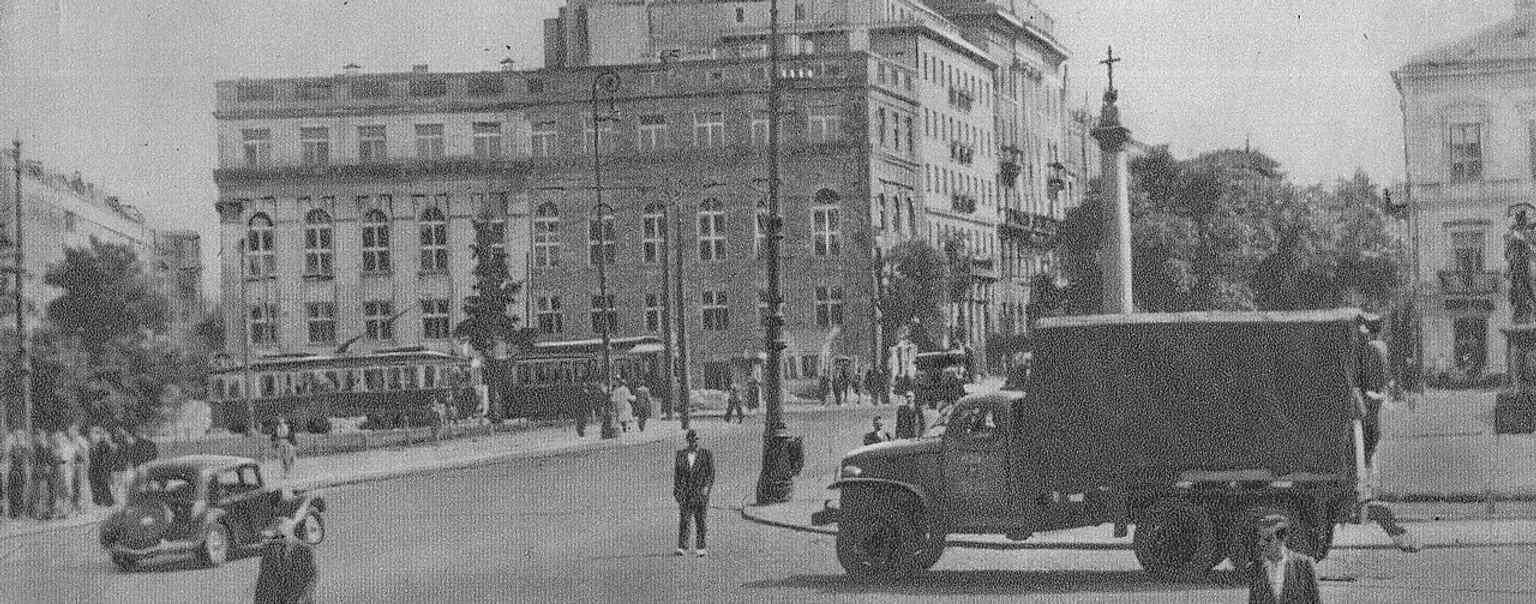
Late-1940s Warsaw on the square, just before postwar reconstruction reshaped the area.Photo: Tadeusz Bukowski, Wikimedia Commons, Public domain. Cropped & resized. 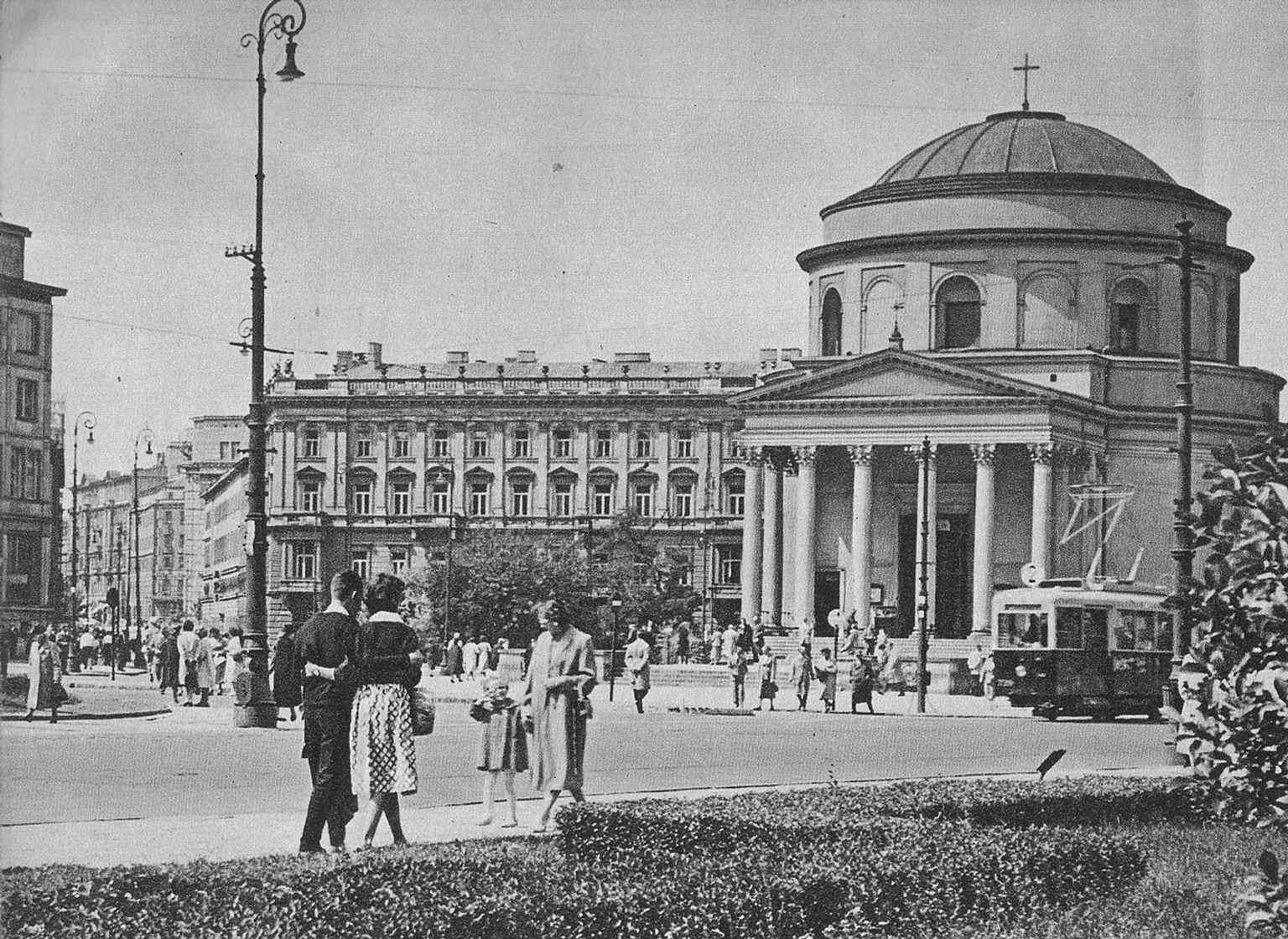
A 1960 view with a tram on Plac Trzech Krzyży, shortly before tram service disappeared from the square.Photo: Edmund Kupiecki, Wikimedia Commons, Public domain. Cropped & resized. 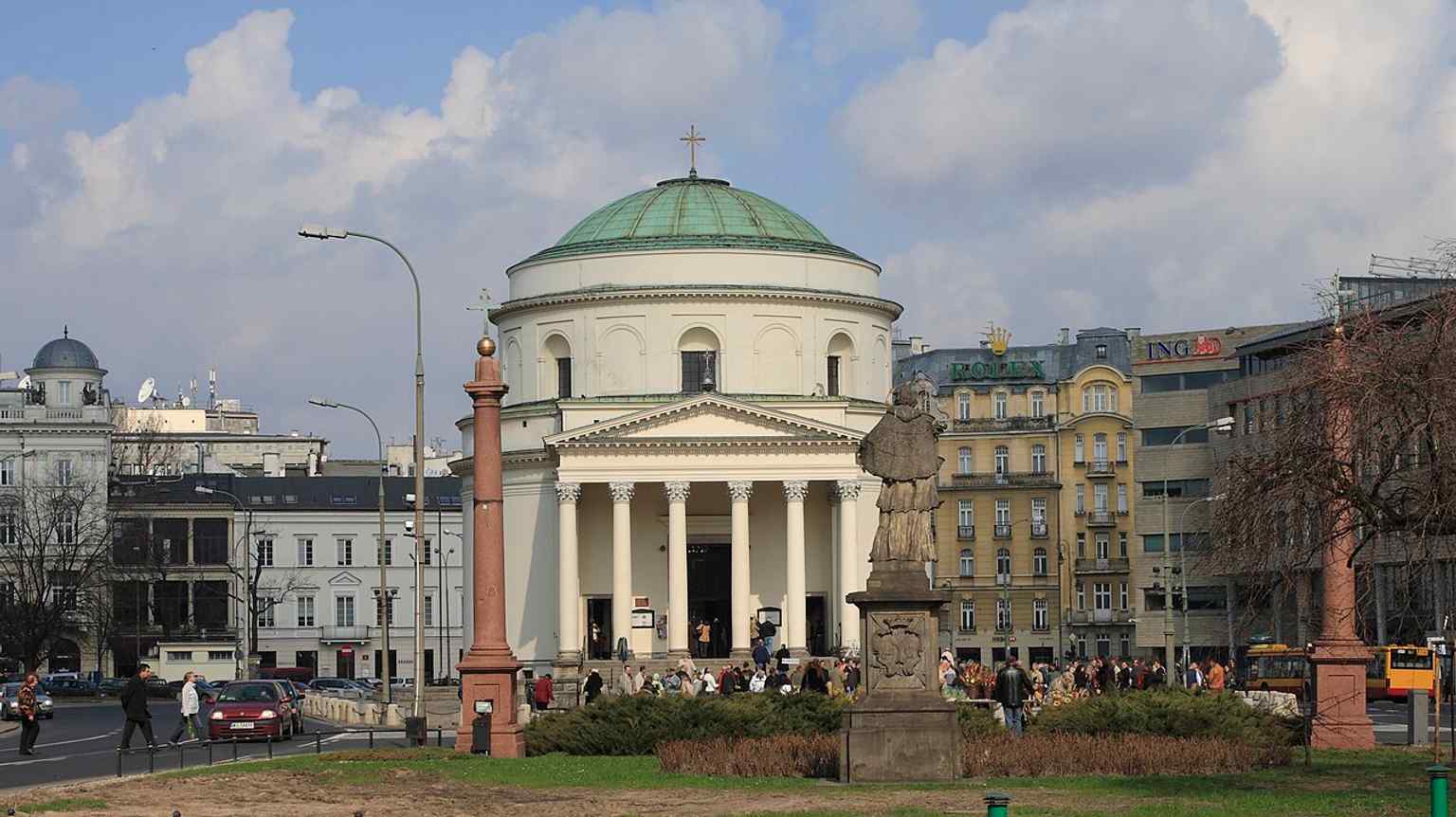
The statue of Saint John of Nepomuk still stands here, a reminder of the 1756 monument marking completed paving works.Photo: Polcia2010, Wikimedia Commons, CC BY-SA 3.0. Cropped & resized. 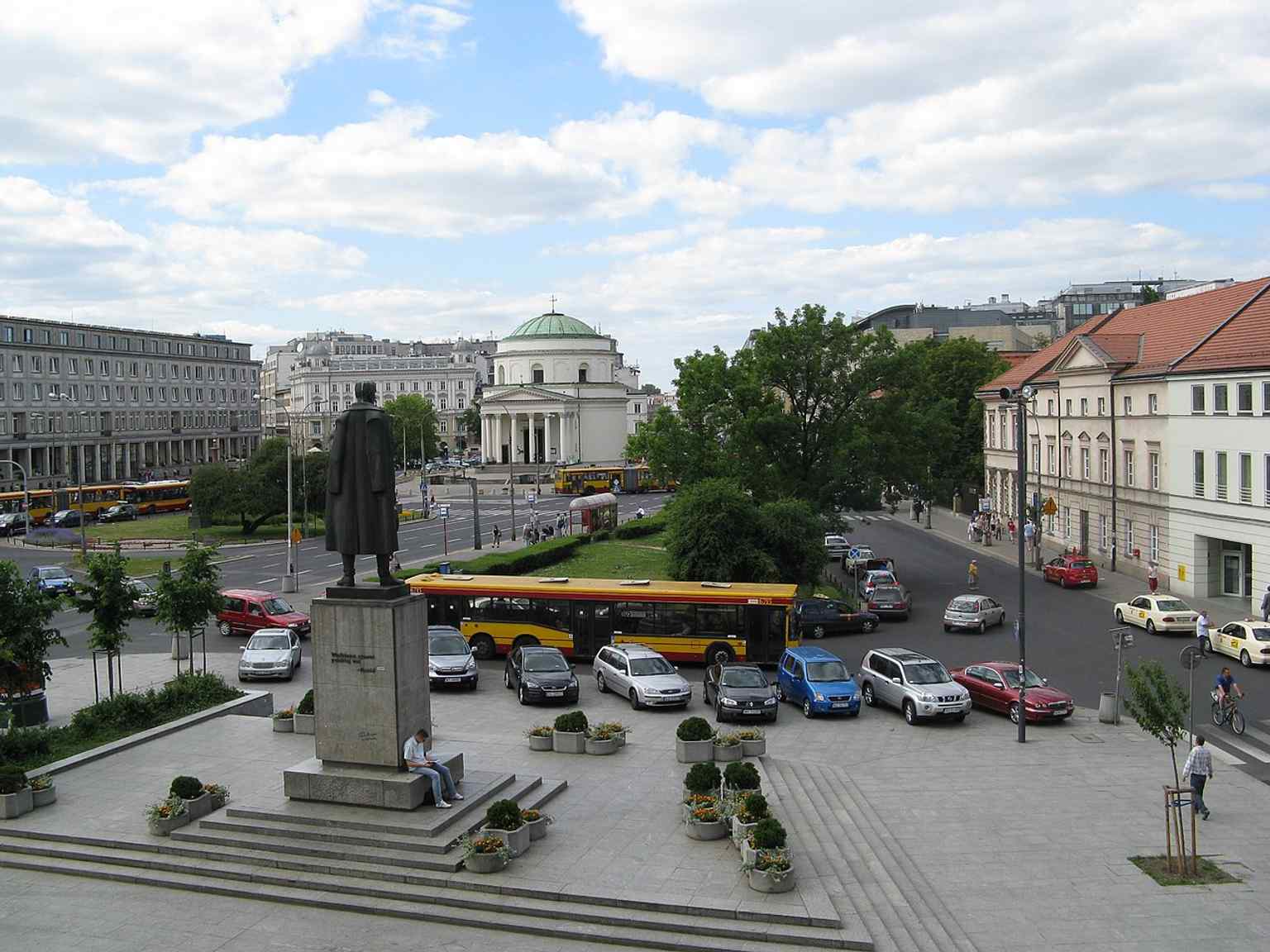
St. Alexander Church today, rebuilt after wartime destruction and still the square’s most recognizable landmark.Photo: Konrad Wąsik, Wikimedia Commons, CC BY 3.0. Cropped & resized. 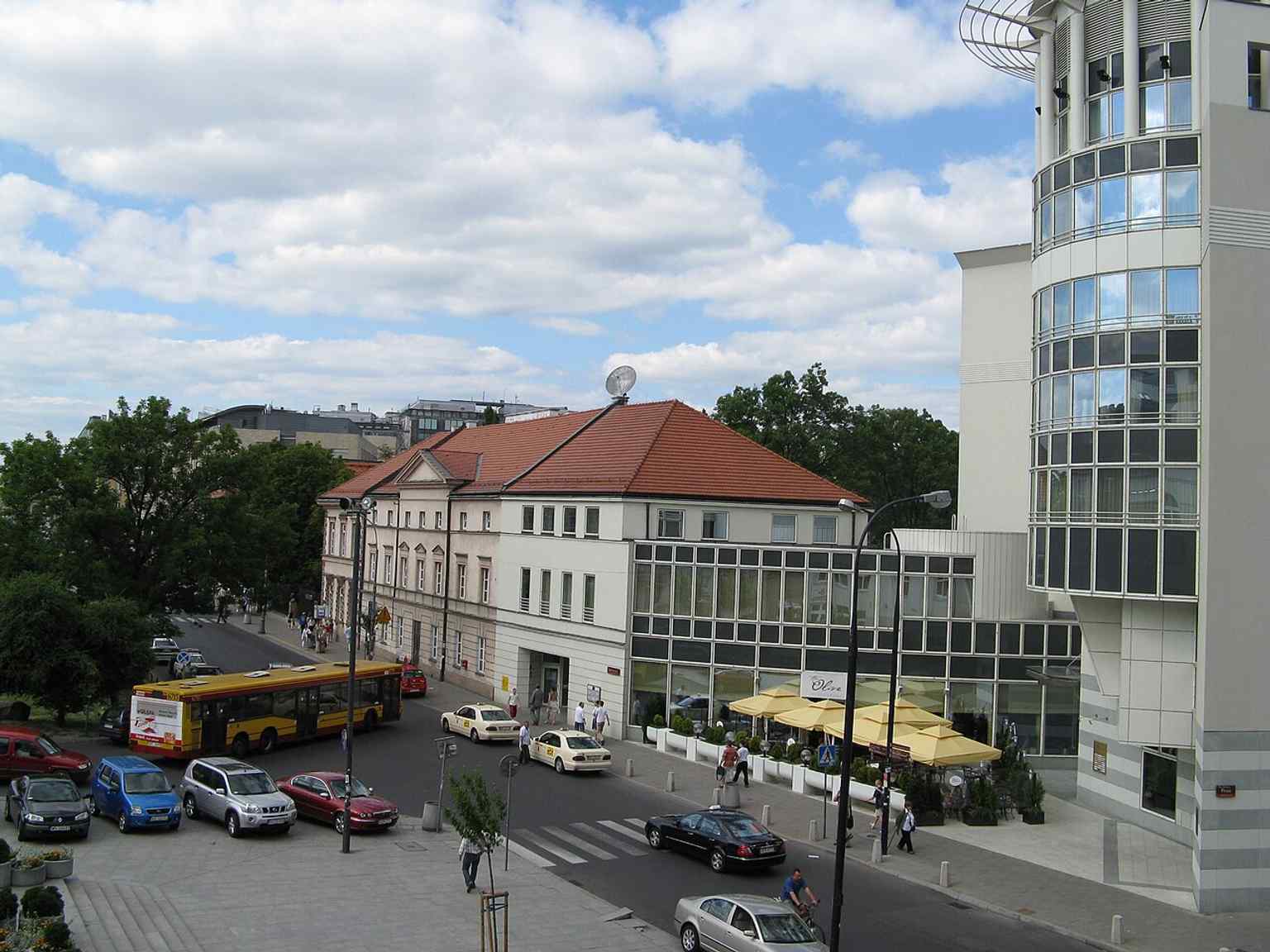
The Institute for the Deaf and Dumb, another historic anchor of the square’s eastern side.Photo: Konrad Wąsik, Wikimedia Commons, CC BY 3.0. Cropped & resized. 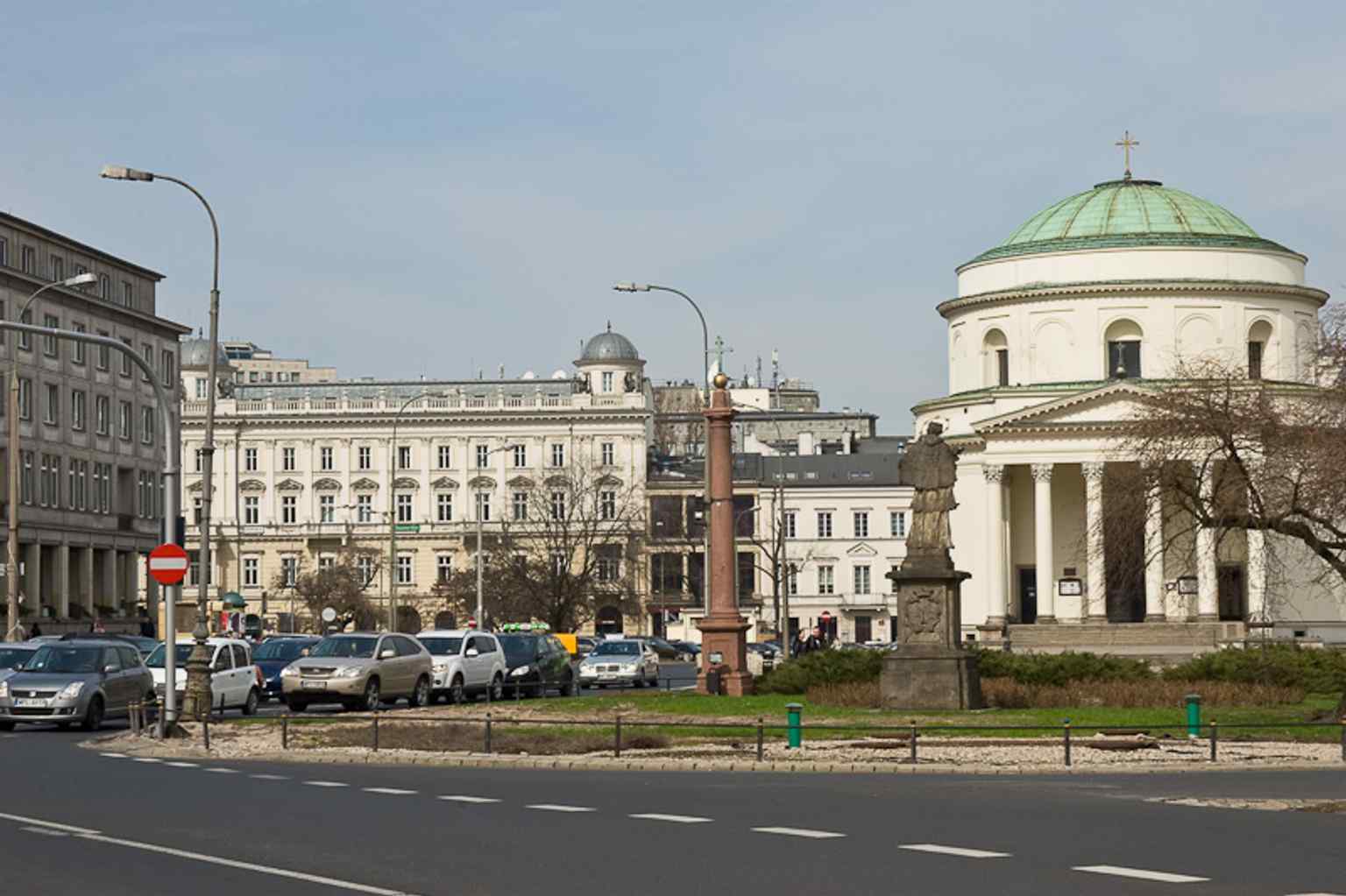
Kamienica Pod Gryfami at the square’s edge, part of the dense 19th-century frontage around Plac Trzech Krzyży.Photo: KamilKaminski, Wikimedia Commons, CC BY-SA 4.0. Cropped & resized. 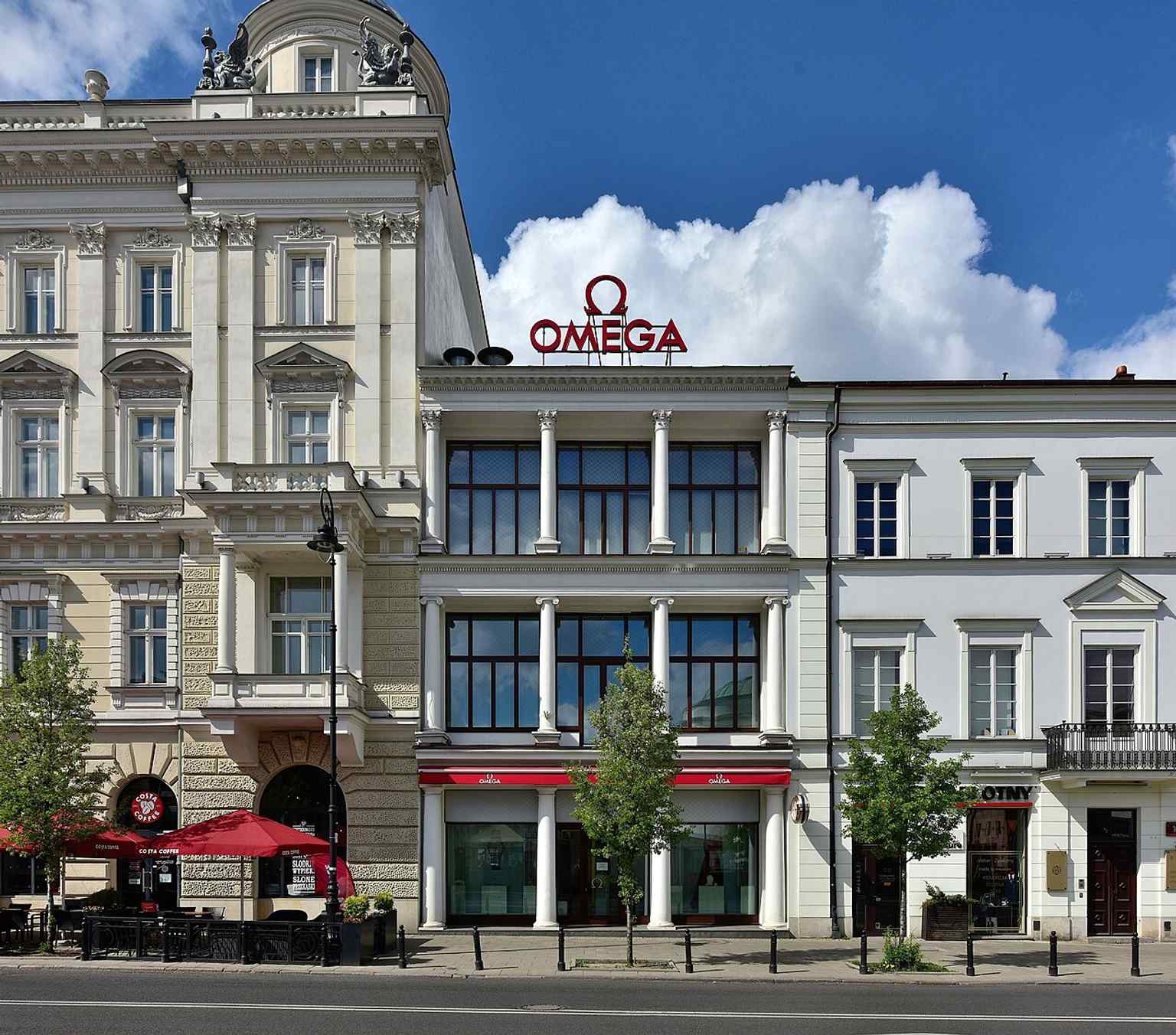
The rebuilt frontage at number 16a reflects the postwar filling-in of gaps left by demolished buildings.Photo: Adrian Grycuk, Wikimedia Commons, CC BY-SA 3.0 pl. Cropped & resized. 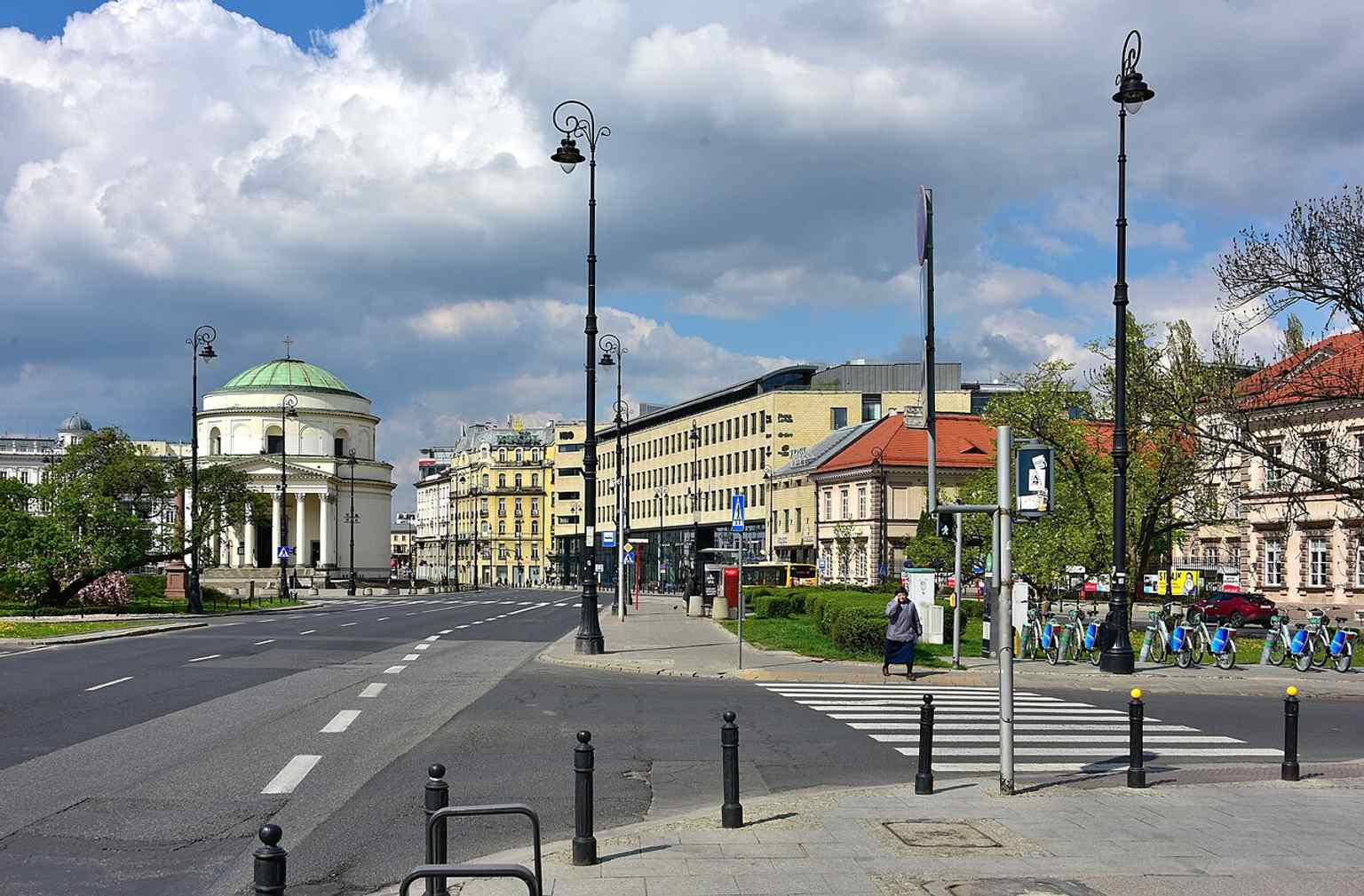
The eastern pierzeja in 2019, showing how the square now combines historic façades with modern infill.Photo: Adrian Grycuk, Wikimedia Commons, CC BY-SA 3.0 pl. Cropped & resized. 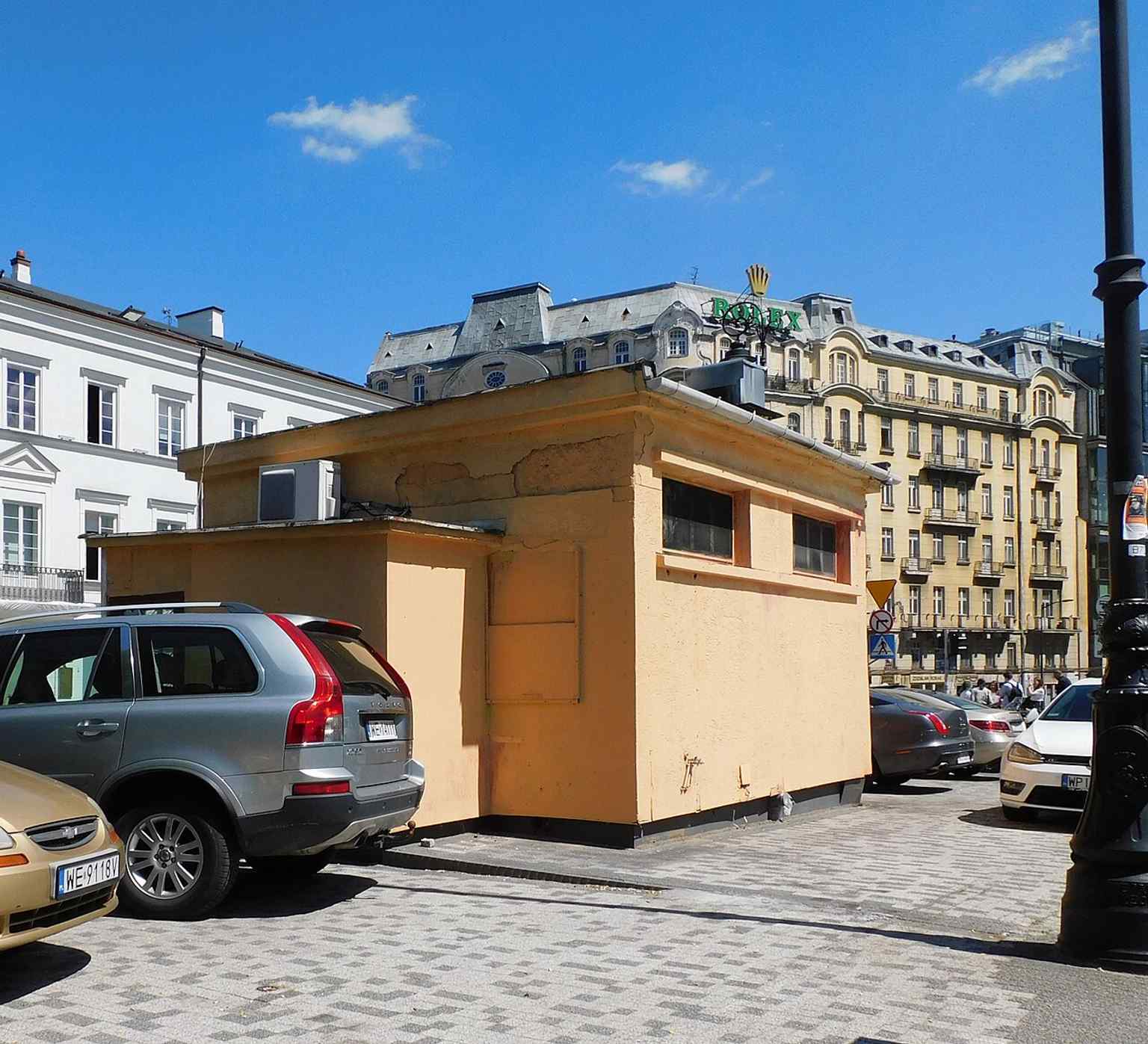
A surviving former public toilet on the square — one of Warsaw’s early modern amenities, built by a French company in 1892.Photo: Panek, Wikimedia Commons, CC BY-SA 4.0. Cropped & resized. Look for a straight run of pale stone and stucco facades with orderly window grids, and near Piękna seventeen to nineteen, a surviving wall fragment that quietly marks one of the…Read moreShow less
Open dedicated page →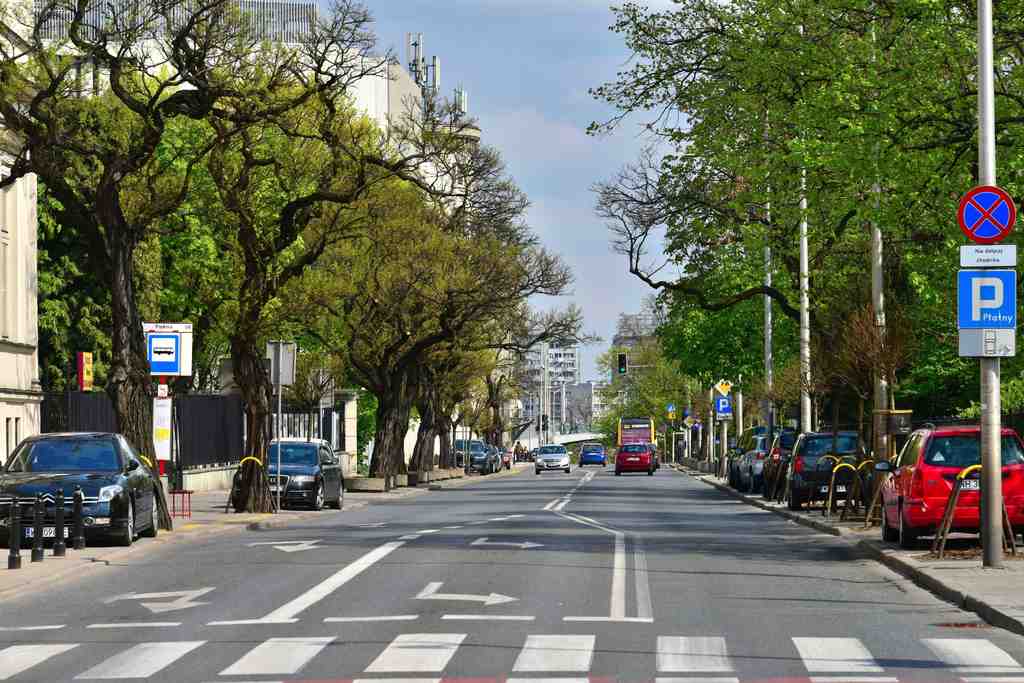
Piękna Street in WarsawPhoto: Adrian Grycuk, Wikimedia Commons, CC BY-SA 3.0 PL. Cropped & resized. Look for a straight run of pale stone and stucco facades with orderly window grids, and near Piękna seventeen to nineteen, a surviving wall fragment that quietly marks one of the street’s darkest chapters.
Piękna began as something much less polished: a rural boundary road, marking the edge between Warsaw’s fields and those of Ujazdów. City officials regulated it in seventeen seventy, lined it with trees, and gave it a name that matched its appearance. For once, “beautiful” was not a real-estate slogan.
That beauty changed shape. Until eighteen sixty-three, villas and small palaces stood here among gardens and cultivated land. By the late nineteenth century, tenement houses moved in, density replaced open ground, and Piękna matured from leafy edge into urban address. If Krucza grew practical and commercial, Piękna aimed a little higher. It wanted status.
You can see that ambition in its residents and institutions. In eighteen sixty-five, the industrialist and banker Wilhelm Ellis Rau bought a house at Piękna ten a. His villa still recalls the era when wealthy financiers treated this street as a proper calling card. A little later, in autumn eighteen eighty-three, Cecylia Plater-Zyberkówna opened her private girls’ school at Piękna twenty-four to twenty-six, funded from her dowry. She was one of Poland’s early feminists, and she used education as a tool for equality. So this street did not only display money... it also hosted social change.
Politics arrived with less grace. On the eleventh of December, nineteen twenty-two, opponents of President-elect Gabriel Narutowicz built a barricade of benches at the corner with Aleje Ujazdowskie, trying to block his route to the Sejm, the parliament, for the oath ceremony. Piękna was not just elegant frontage; it became one of the places where the young republic showed its nerves.
Around nineteen thirty, the street even changed identity and took the name Pius the Eleventh, honoring Achille Ratti, the papal envoy who stayed in Warsaw during the Battle of Warsaw while most diplomats evacuated. Then the German occupation renamed it Piusstrasse, because tyrannies also enjoy paperwork.
If you check the image in the app, you’ll see the stretch around numbers seventeen to nineteen. On the seventeenth of October, nineteen forty-three, German forces carried out a public execution at number seventeen. Then, in the Warsaw Uprising, insurgents fought for and captured the so-called small P-A-S-T-a at number nineteen, a telephone exchange, on the night of the twenty-second to twenty-third of August, nineteen forty-four. From the sixth of September until the uprising collapsed, the Home Army used that building as its headquarters.
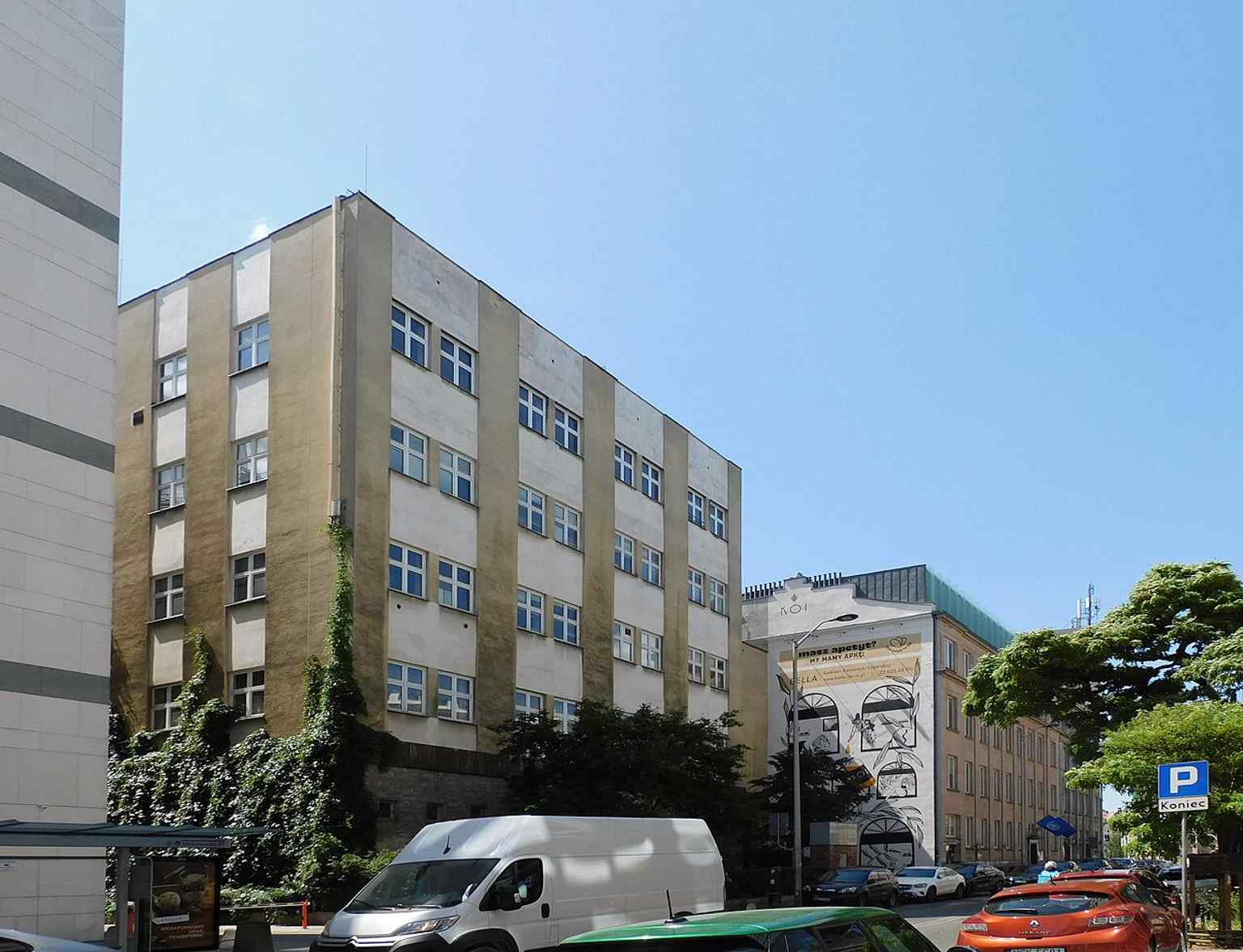
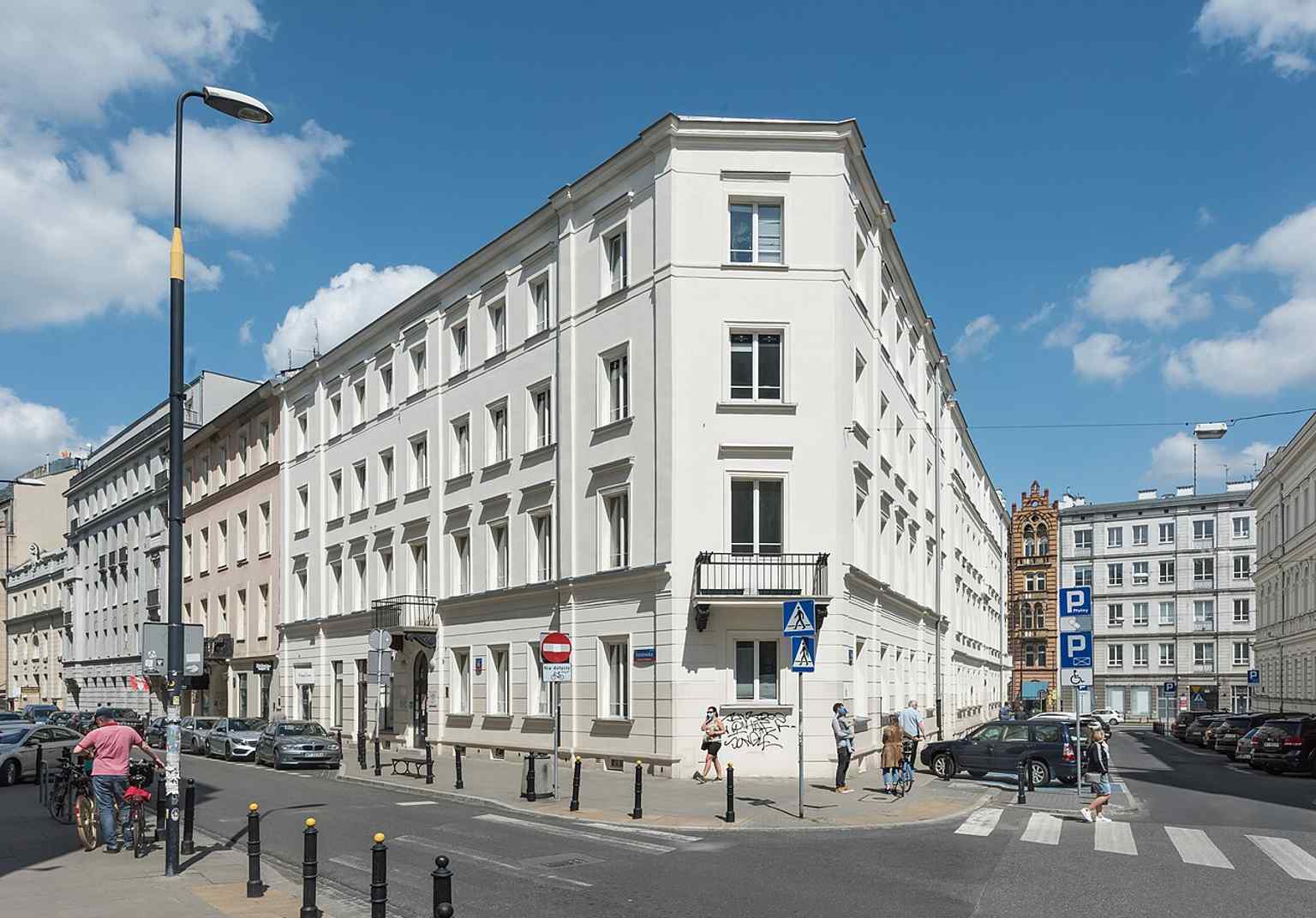
The block at Piękna 17–19 stands on a street marked by wartime terror and resistance; just nearby, the building at no. 17 was the site of a public execution in 1943 and no. 19 was the wartime “small PAST-a.”Photo: Panek, Wikimedia Commons, CC BY-SA 4.0. Cropped & resized. After the war, Warsaw restored the name Piękna in nineteen forty-nine, then shifted part of the street line during the construction of the Marszałkowska Residential District. Even the map got edited.
Ahead, the U-S Embassy shows what Piękna became: a prestigious address where private elegance gave way to state power. It’s about a four-minute walk.
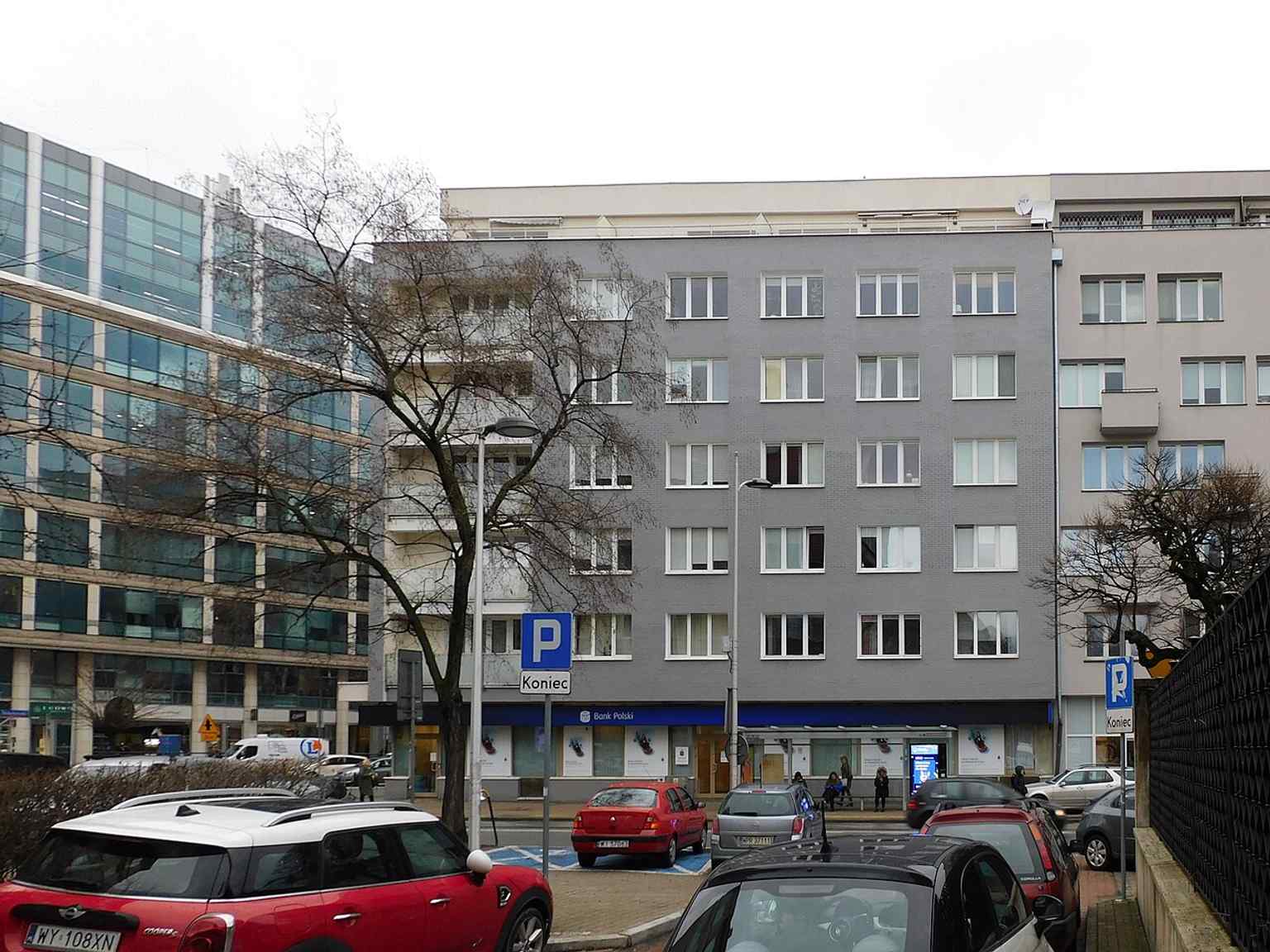
A contemporary view of Piękna Street near the Mokotowska stop, showing the modern city street that once carried tram and trolleybus traffic through Warsaw’s historic center.Photo: Panek, Wikimedia Commons, CC BY-SA 4.0. Cropped & resized. Look for the pale stone and glass library complex with broad rectangular wings, tall grid-like windows, and a recessed modern entrance set into the facade. This place tells a…Read moreShow less
Open dedicated page →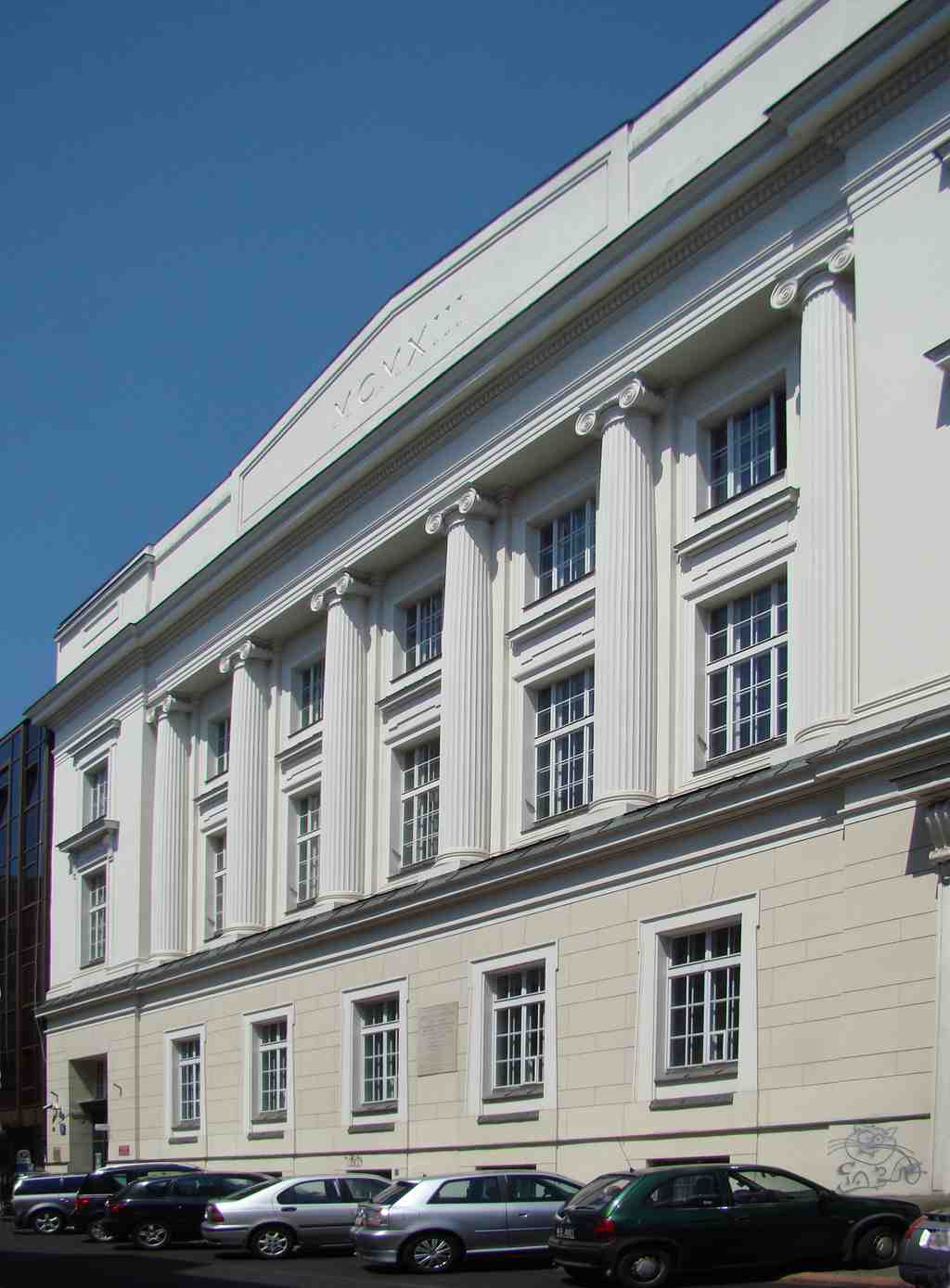
Public Library m.st Warsaw – Main Library of the Mazowieckie VoivodeshipPhoto: Szczebrzeszynski, Wikimedia Commons, Public domain. Cropped & resized. Look for the pale stone and glass library complex with broad rectangular wings, tall grid-like windows, and a recessed modern entrance set into the facade.
This place tells a quieter story of power... not who controls words, but who gets to reach them.
Long before this library formally opened in nineteen oh seven, Warsaw argued itself toward it. A local will tell you the real beginning sits back in the eighteen nineties, when people started insisting that a major city could not live on private collections and elite reading rooms alone. Jadwiga Szczawińska-Dawidowa pushed that argument into public view. In eighteen ninety-seven, she published a pamphlet saying Warsaw urgently needed a true public library, especially for young scholars who could not afford their own books. Very sensible. Also apparently controversial, because even books require lobbying.
The institution finally took shape after the looser association law of nineteen oh six made organizing possible. Its founders included Samuel Dickstein, Ludwik Krzywicki, Stanisław Michalski, and Stefan Żeromski. They wanted a library for science and education, open beyond narrow circles. The first headquarters stood elsewhere, on Rysia Street, now plac Dąbrowskiego, in rented rooms. By nineteen fourteen, the library moved here to Koszykowa, into a purpose-built home funded by Eugenia Kierbedziowa and designed by Jan Heurich the younger.
Inside, the argument continued. Faustyn Czerwijowski, who shaped the library from its earliest years and led it until nineteen thirty-seven, insisted it should serve both scholarship and the wider public. Dickstein leaned more academic. In other words, the classic civic dispute: should knowledge sit on a pedestal, or at a desk where people can actually use it?
If you check your screen, the modern reading spaces still carry that answer forward. And the information desk in the reading room named for Czerwijowski makes the point nicely: the system matters, but the welcome matters too.
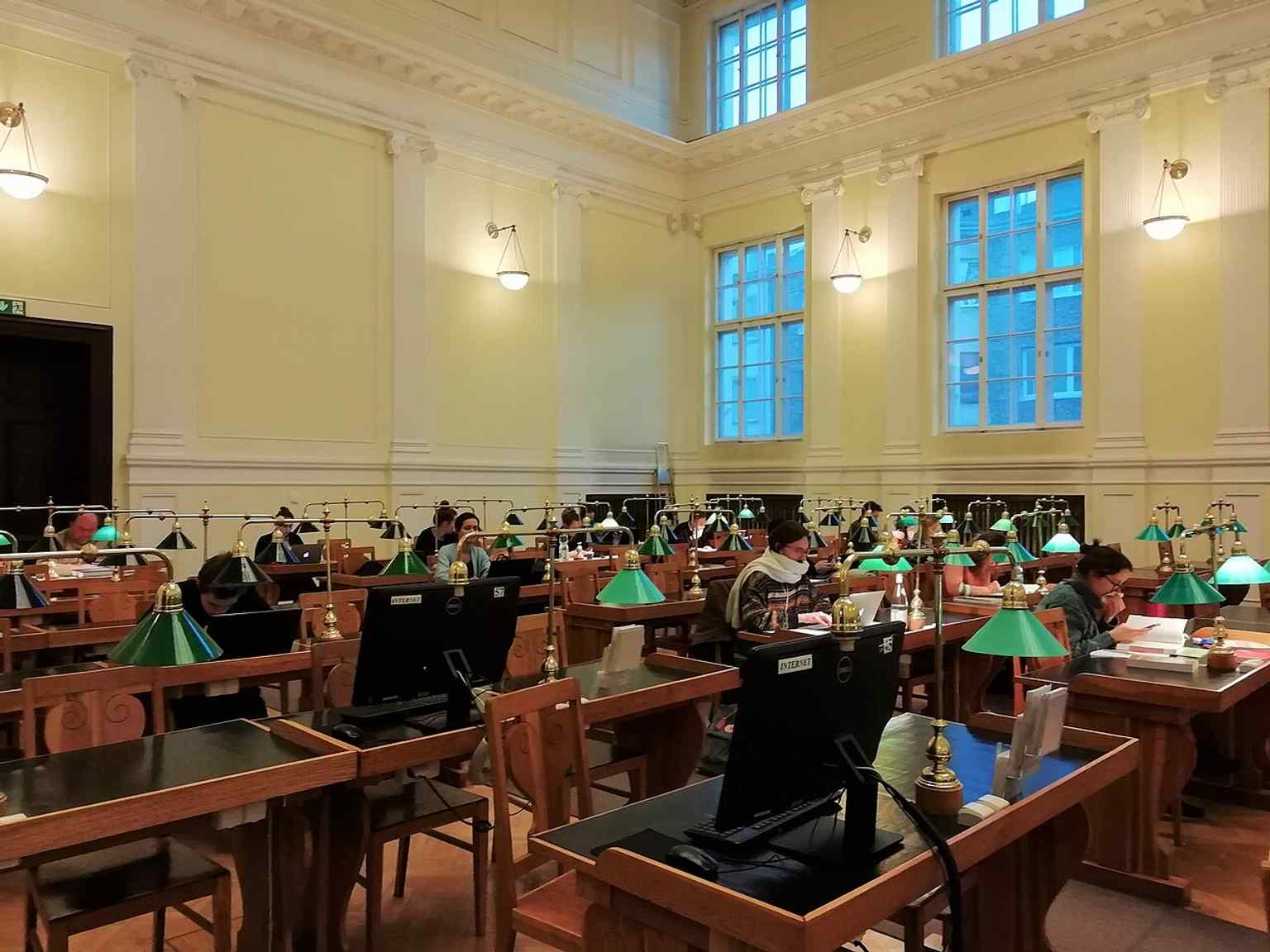
Another view inside the main library, showing the spacious reading areas that continue the institution’s 1907 mission of serving both science and the wider public.Photo: Klarqa, Wikimedia Commons, CC BY-SA 4.0. Cropped & resized. Today the library holds around one and a half million volumes, making it one of the biggest public libraries in Poland. Its shelves grew through donations, legal deposit copies, and stubborn rebuilding after catastrophe. During the war, it lost about eighty-four percent of its holdings. In January nineteen forty-five, retreating German forces set the main building on fire, and returning staff helped save part of it. Librarians with buckets do not usually get statues, which seems unfair.
If Mysia Street once stood for screened and restricted words, this place answers in another register: gather them, preserve them, share them. Cities are defended not only by monuments and protests, but by readers, teachers, and institutions that keep memory within reach.
When you are ready, continue to Mokotowska Street, about a two-minute walk from here. If you want to return inside, the library usually opens from one in the afternoon to eight forty-five in the evening on Monday, from nine in the morning to eight forty-five Tuesday through Friday, ten to four forty-five on Saturday, and ten to one forty-five on Sunday.
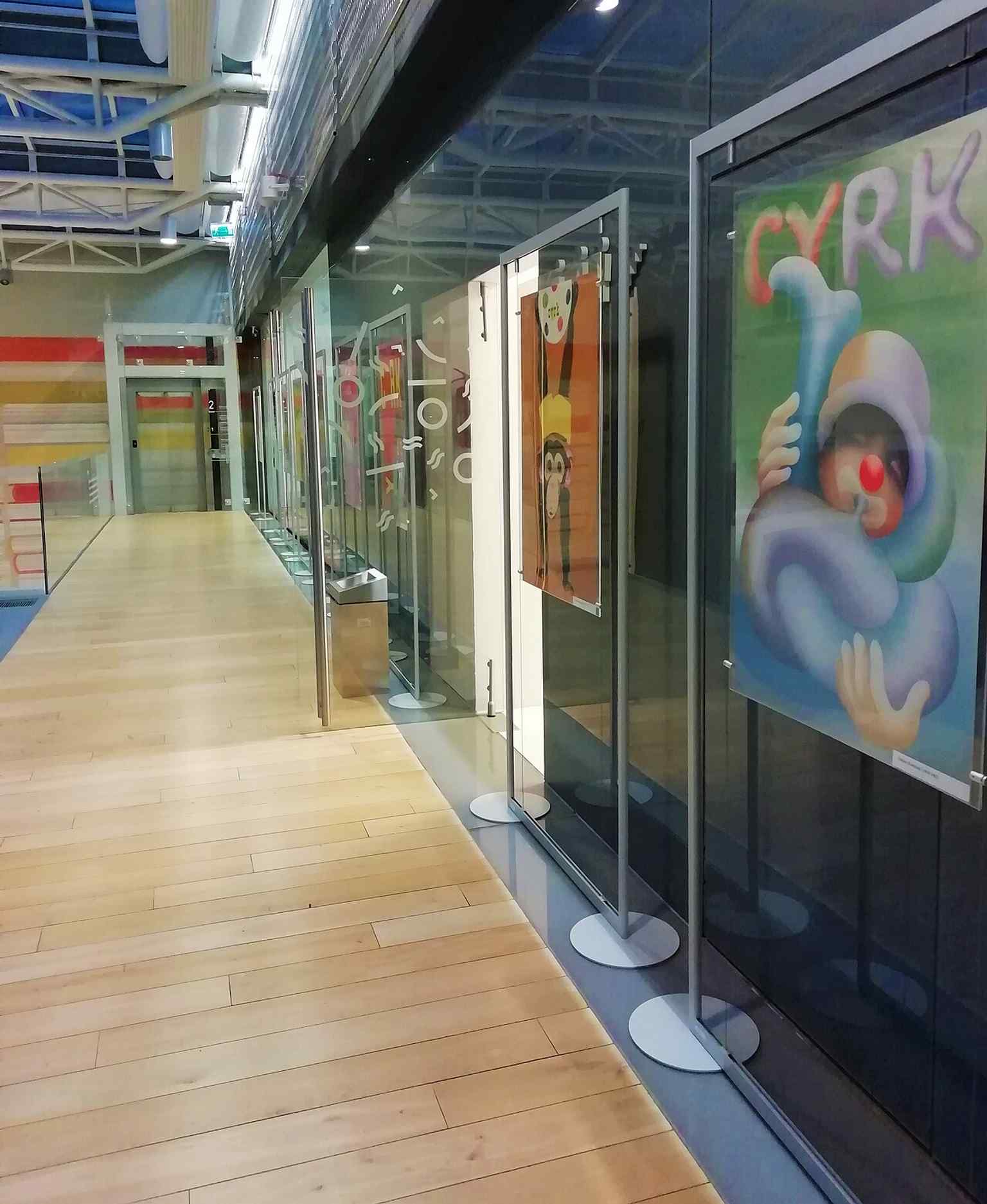
The art reading room at Koszykowa, part of the library’s modern expansion that keeps Warsaw’s main public library active for readers and researchers.Photo: Klarqa, Wikimedia Commons, CC BY-SA 4.0. Cropped & resized. 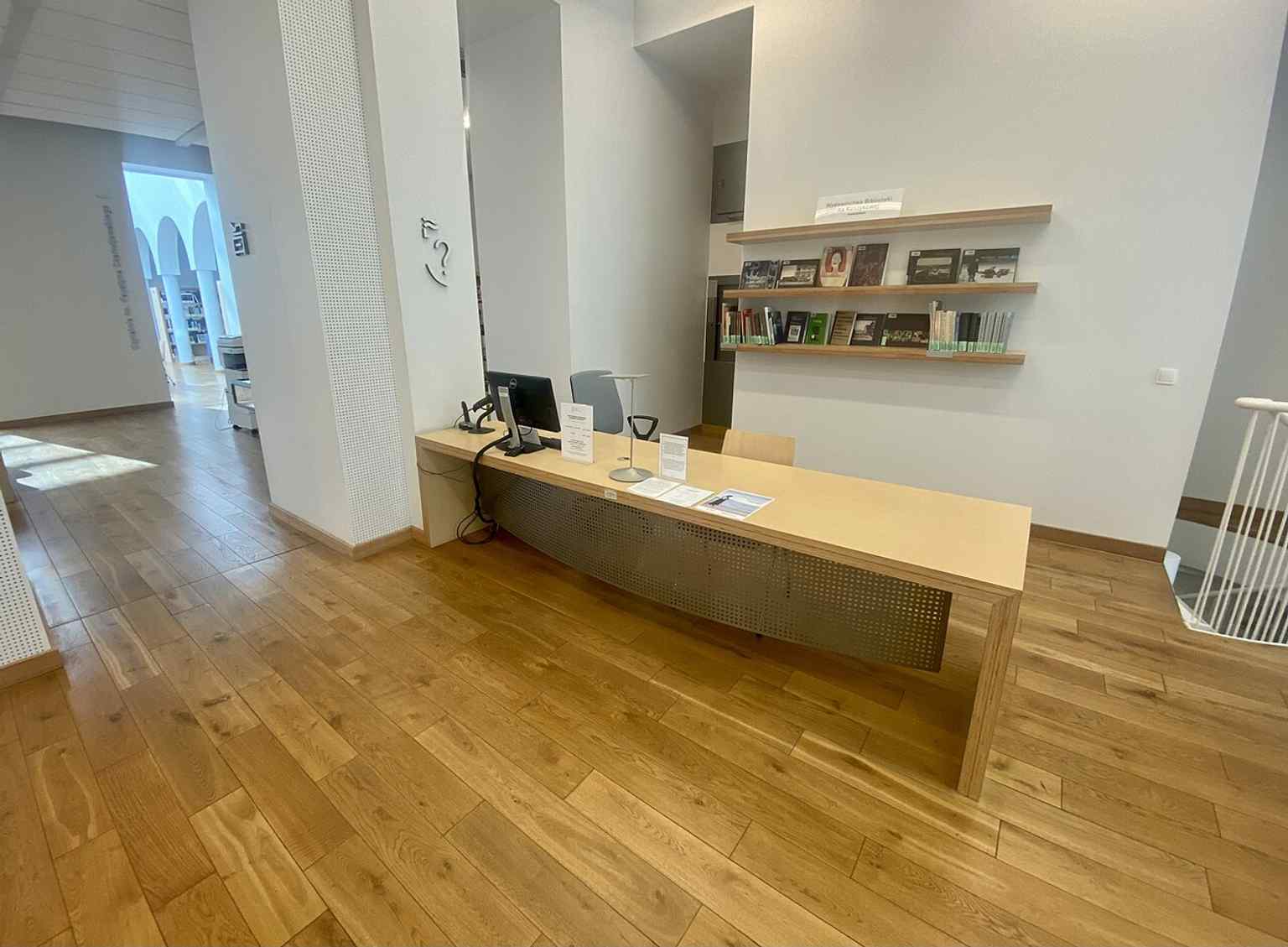
The information desk in the Faustyn Czerwijowski Reading Room, named for the library’s long-time director who shaped its public-service model.Photo: Libercatenatus, Wikimedia Commons, CC BY-SA 4.0. Cropped & resized. This is a long, elegant street corridor lined with stone and stucco tenements, their tall windows and balconies forming a continuous wall of façades, broken here and there by…Read moreShow less
Open dedicated page →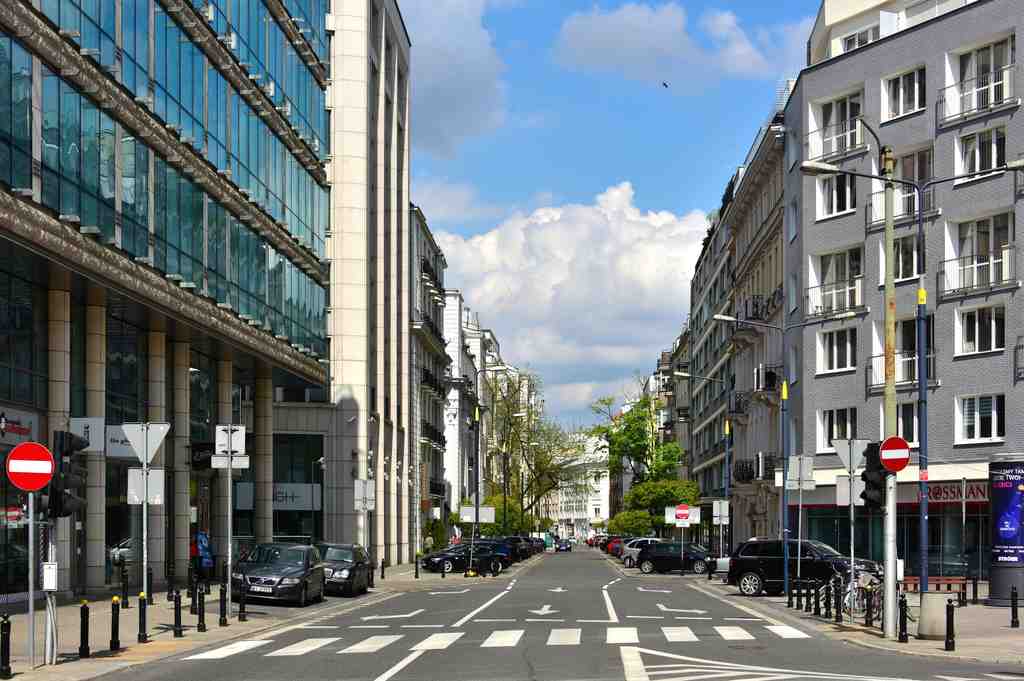
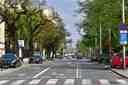
Mokotowska Street in WarsawPhoto: Adrian Grycuk, Wikimedia Commons, CC BY-SA 3.0 PL. Cropped & resized. This is a long, elegant street corridor lined with stone and stucco tenements, their tall windows and balconies forming a continuous wall of façades, broken here and there by standout corners and ornate entrances.
Mokotowska began with a very practical job: in the fourteenth century it was the road from Warsaw to the village of Mokotowo, part of the route toward Czersk. Then, in seventeen seventy, planners folded it into the Stanisław Axis, straightened it as far as Polna, and planted trees. Warsaw took a country road, gave it geometry, and called that civilization.
At the start of the nineteenth century, this was still loose and semi-rural: wooden houses, orchards, vegetable gardens, even fish ponds. Building stopped around Piękna. Then the city tightened its grip. In the later nineteenth century, rental tenements marched in one after another, and around the turn of the century many arrived in Art Nouveau dress, with the kind of façades that quietly demand better posture.
The street also learned to write. At number forty-eight, in the low one-story house from eighteen sixty, Józef Ignacy Kraszewski lived and sent out his “Letters from Mokotowska Street.” Later, memorial plaques marked both him and Tytus Chałubiński on the façade. So this address became more than an address; it became a point from which Warsaw described itself... and occasionally argued with itself.
Other buildings kept adding chapters. Number twelve, completed in nineteen ten, became the tallest residential building in Warsaw, then served the Methodist community. If you want a look at that former skyscraper of domestic ambition, check the app image. Number thirteen turned from a parish hall into the Współczesny Theatre in nineteen forty-nine, a stage for bold postwar productions. Number twenty-five, the Sugar Producers’ Palace, held not just sugar executives but paintings by Siemiradzki, Brandt, Chełmoński, and even a work from the school of Guido Reni. Apparently even trade associations wanted excellent taste.
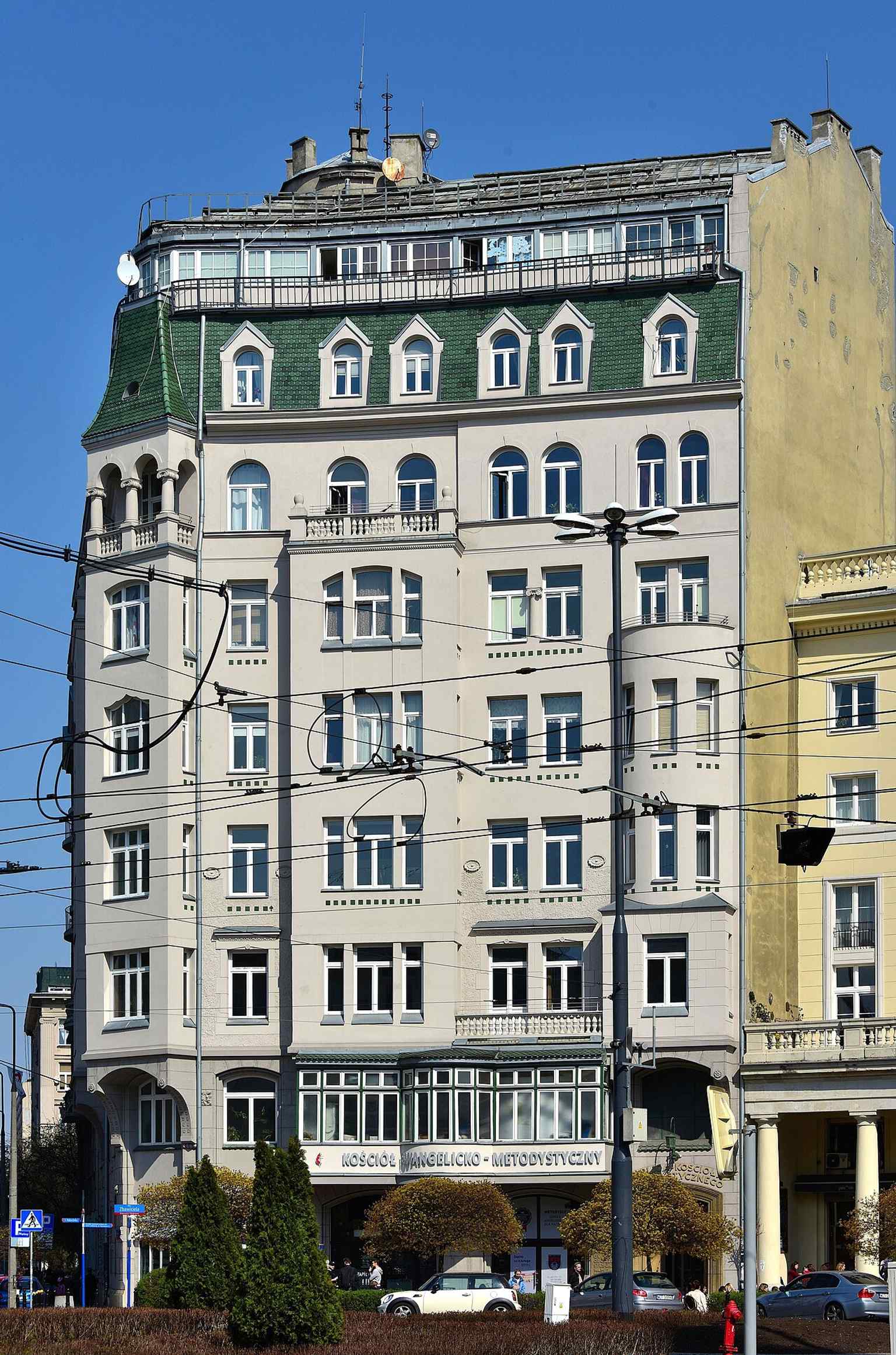
Kamienica at Mokotowska 12, once the tallest residential building in Warsaw, later became a center of the Methodist community.Photo: Adrian Grycuk, Wikimedia Commons, CC BY-SA 3.0 pl. Cropped & resized. History kept changing the script. In November nineteen eighteen, Józef Piłsudski stayed at number fifty just after returning from Magdeburg. In nineteen thirty-five, planners imagined extending Mokotowska into a grand representative district; war canceled the performance before the set was built. During the Warsaw Uprising, the Ruczaj Battalion defended this area. And yet, after destruction, the street kept much of its aristocratic bearing.
Even the surface has memory. During roadworks in two thousand seven and two thousand ten, crews uncovered prewar basalt blocks long hidden under asphalt; some returned to driveways and parking bays. Have a quick look at the before-and-after image for the Mokotowska and Piękna junction... it shows just how thoroughly the city rewrote the scene without erasing the line of the street.
Now Mokotowska is famous for boutiques and ateliers, but the older street never really left. As you look along the façades, see if you can catch one view where elegance, literature, war, trade, and ordinary errands all occupy the same frame.
We began by looking up at a single façade... and we end by realizing the whole district has been talking the entire time.
The corner of Mokotowska and Wilcza, a key point on the street where the prewar and modern city meet.Photo: Adrian Grycuk, Wikimedia Commons, CC BY-SA 3.0 pl. Cropped & resized. 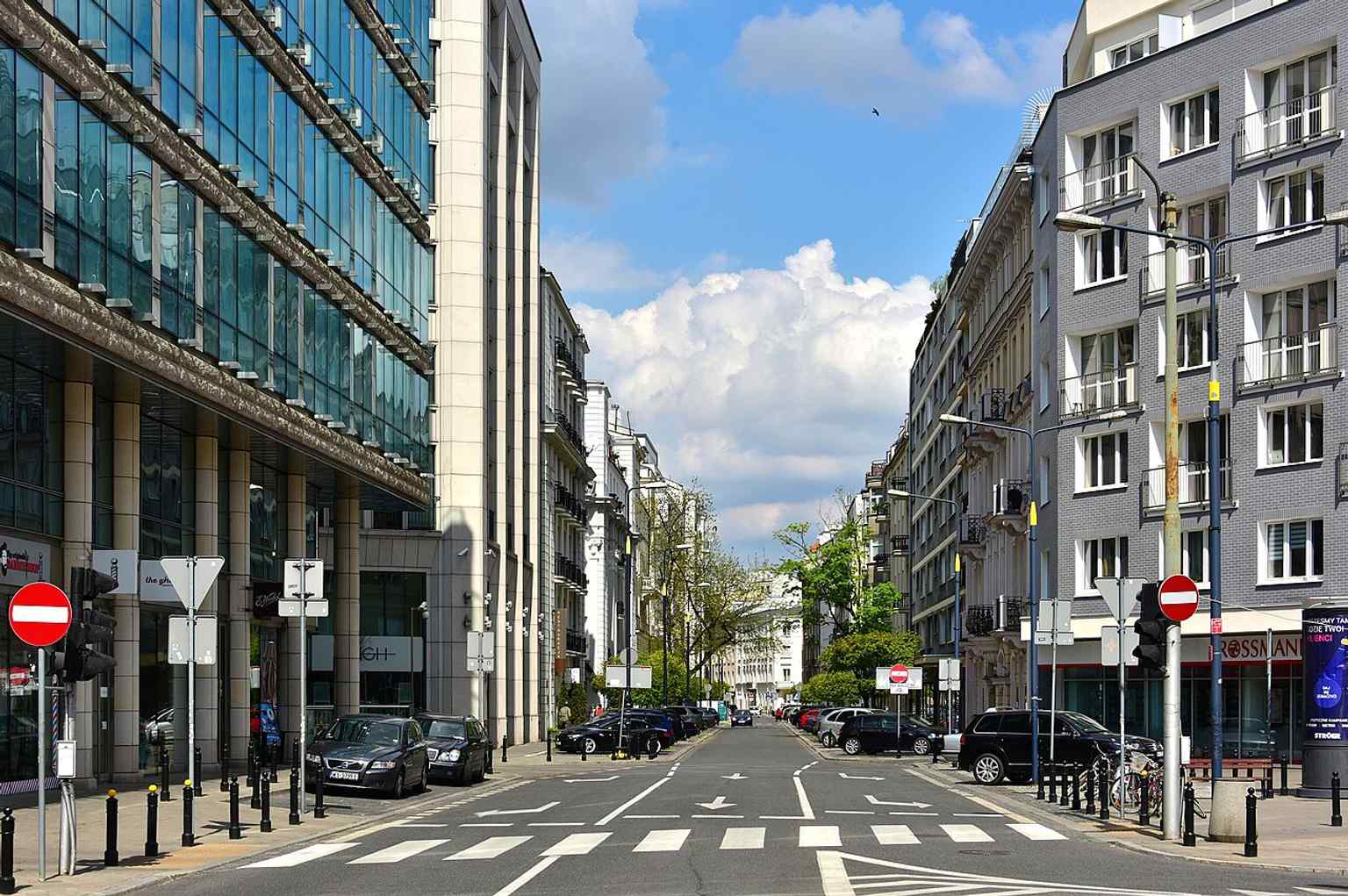
A broad view along Mokotowska near Piękna, matching the street’s elegant central section and restored urban character.Photo: Adrian Grycuk, Wikimedia Commons, CC BY-SA 3.0 pl. Cropped & resized. 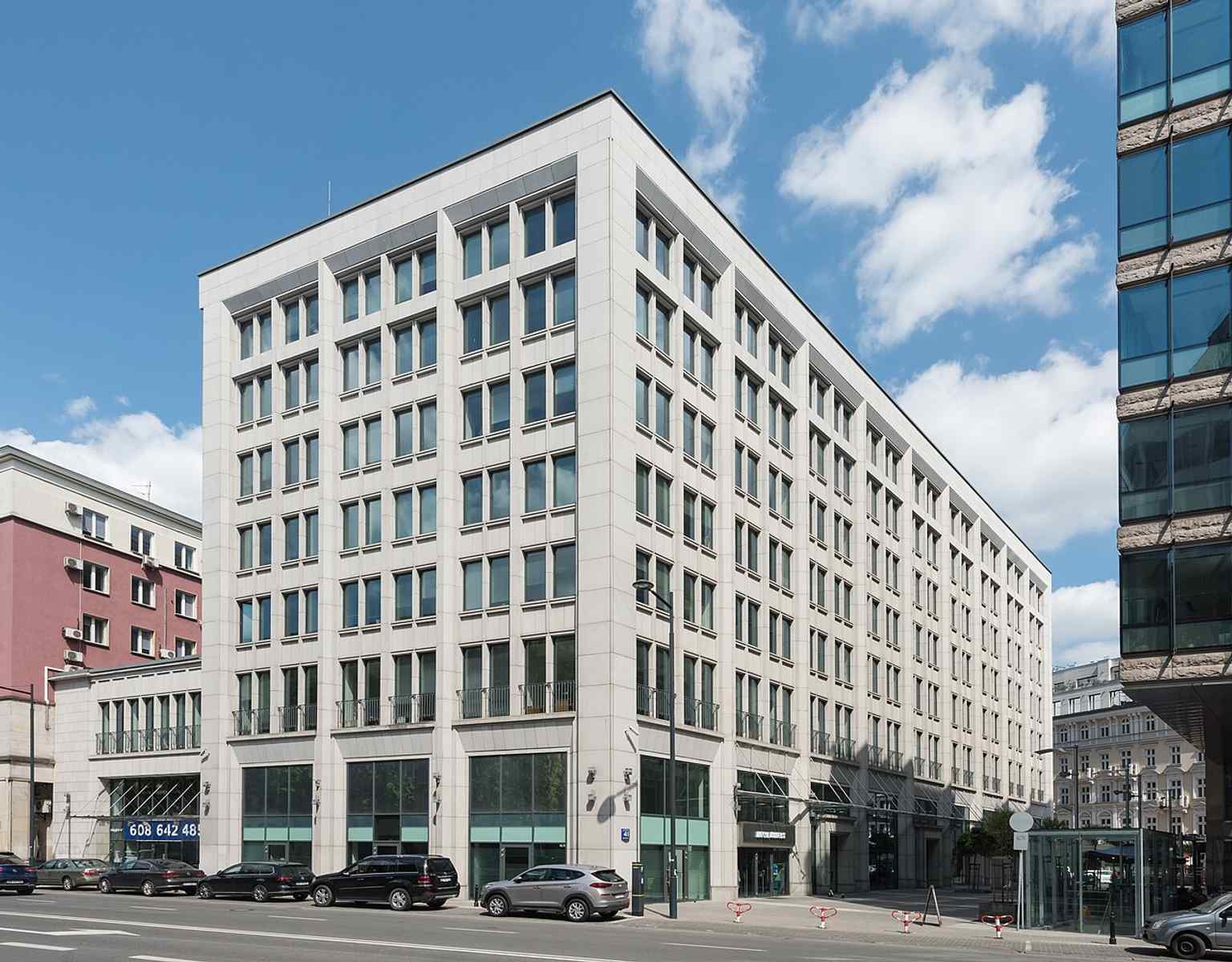
Mokotowska 49, a rebuilt office building that reflects the street’s postwar layer of modern commercial architecture.Photo: Adrian Grycuk, Wikimedia Commons, CC BY-SA 3.0 pl. Cropped & resized. 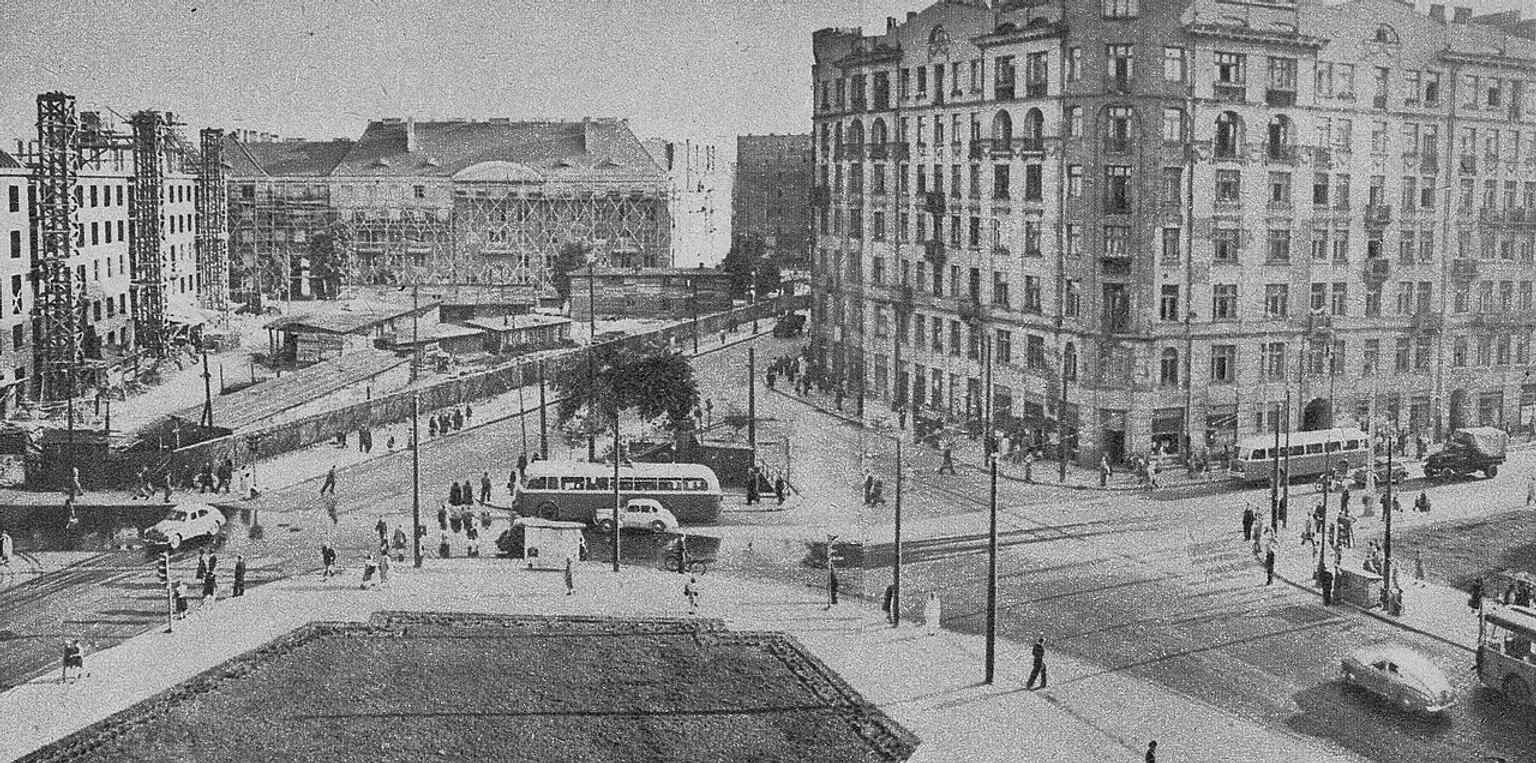
The Mokotowska–Krucza–Piękna junction in 1954, documenting the postwar streetscape after the destruction of World War II.Photo: nieznany/unkwnon, Wikimedia Commons, Public domain. Cropped & resized. 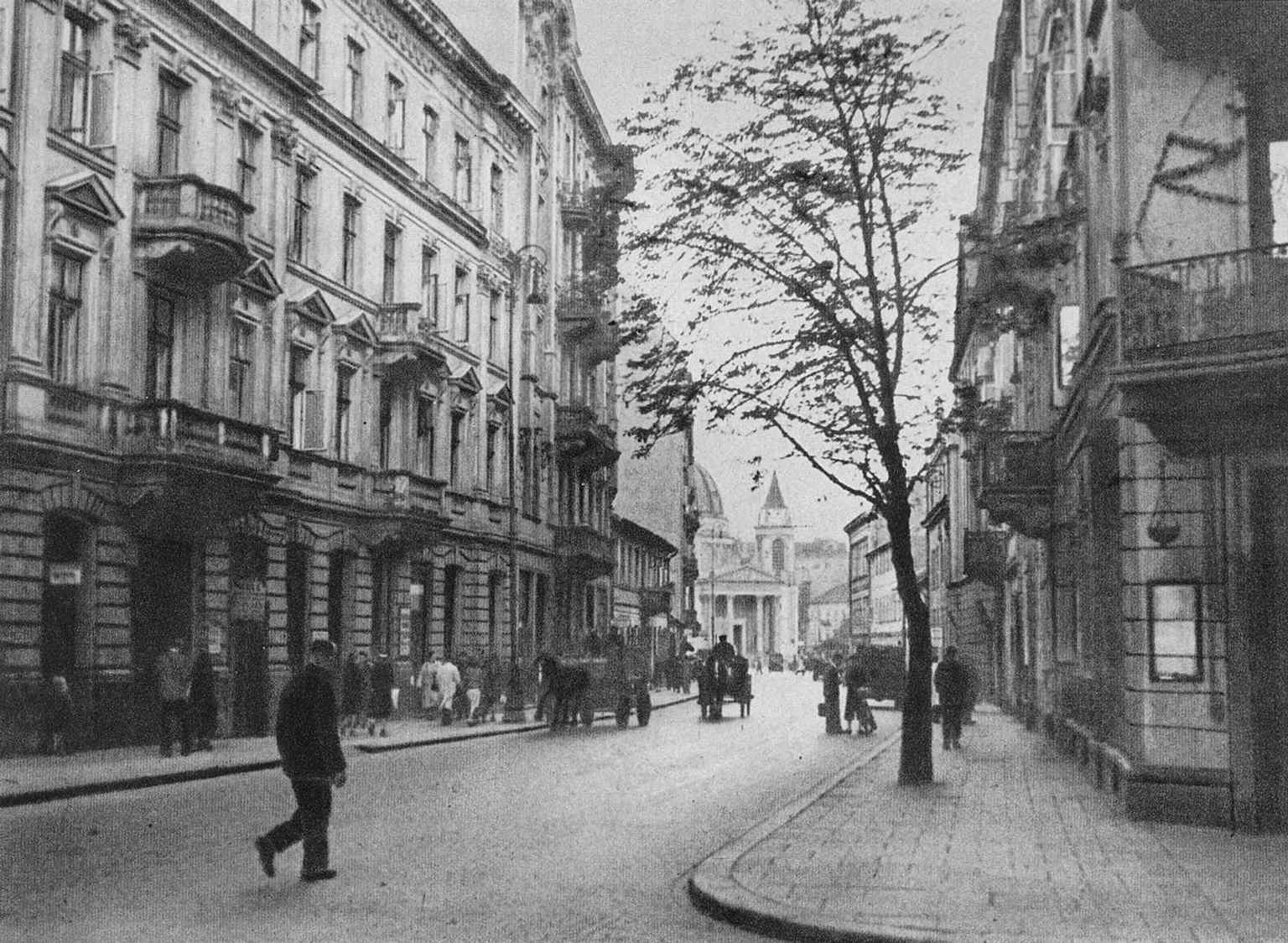
Pre-1939 Mokotowska at Wilcza, showing the street’s elegant prewar frontage near Plac Trzech Krzyży.Photo: nieznany/unknown, Wikimedia Commons, Public domain. Cropped & resized. 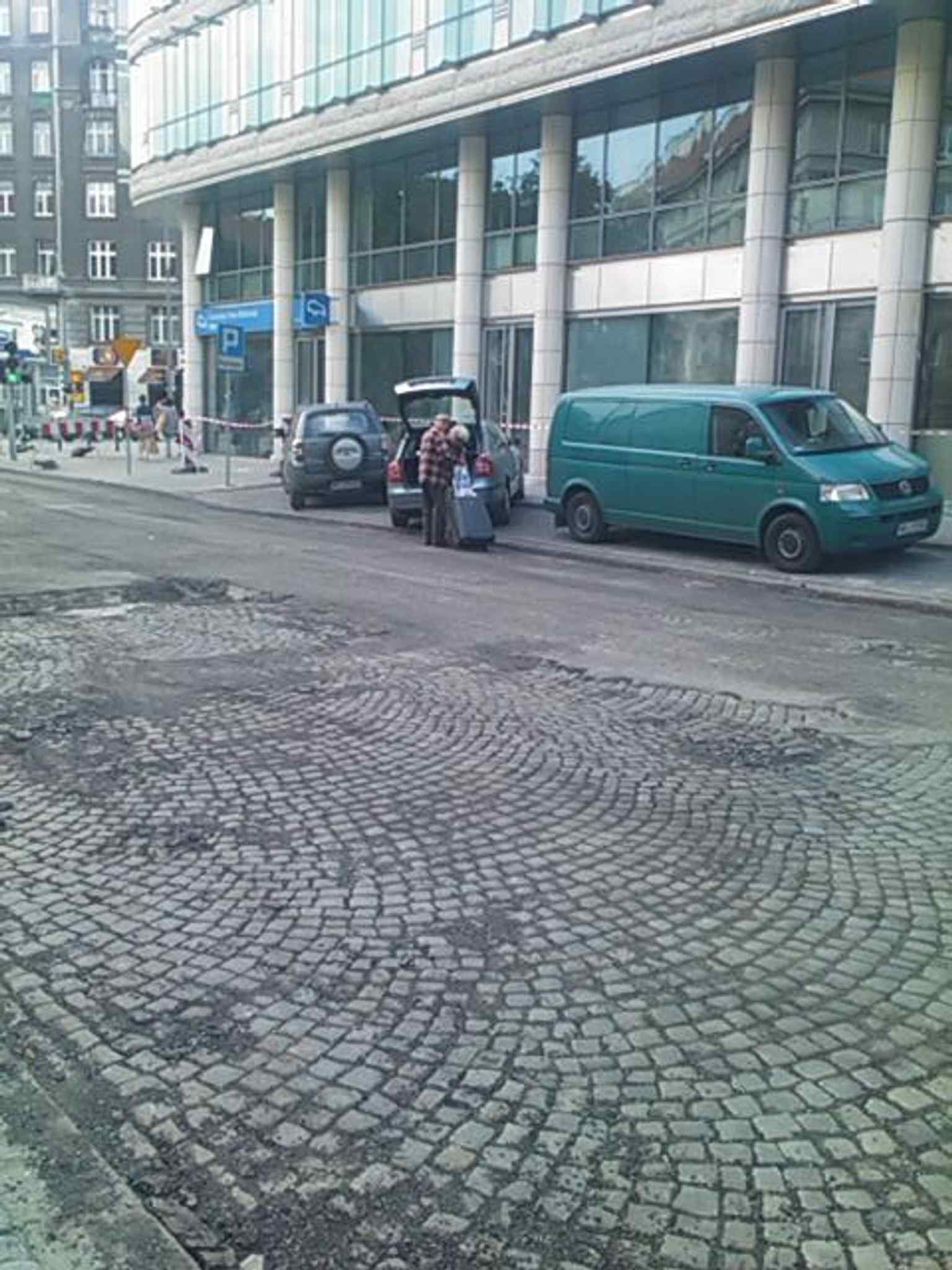
During the 2010 roadworks, the prewar basalt paving was uncovered and partially reused, revealing the street’s hidden historic surface.Photo: Chinique, Wikimedia Commons, CC BY-SA 3.0. Cropped & resized. 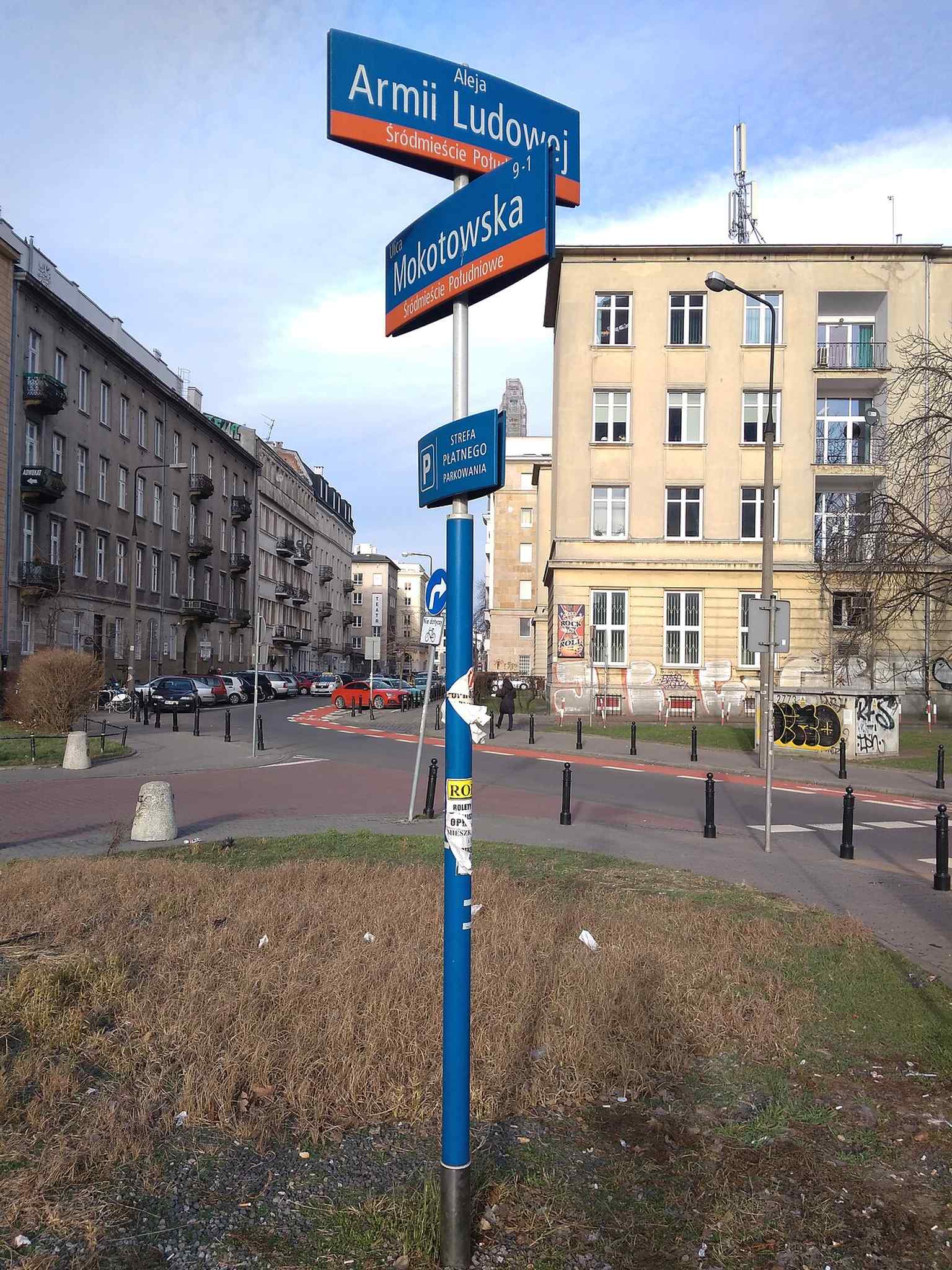
Old street-name plaques at Mokotowska and Armii Ludowej, a small but telling trace of Warsaw’s changing urban history.Photo: Cybularny, Wikimedia Commons, CC0. Cropped & resized. 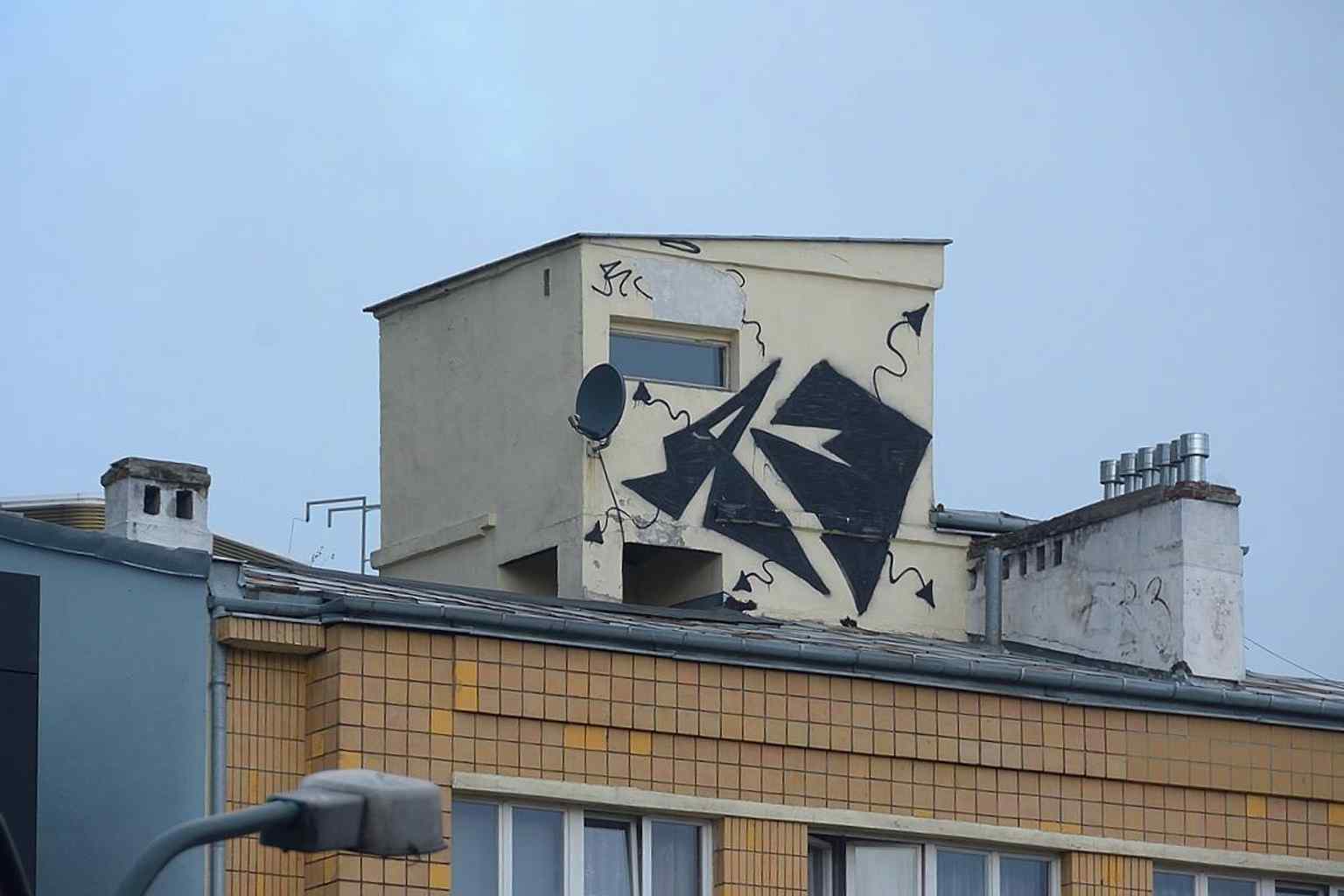
A civil-defense observation tower mounted on a Mokotowska tenement, an unusual reminder of the city’s Cold War layer.Photo: Łukasz Karolewski, Wikimedia Commons, CC BY-SA 4.0. Cropped & resized. 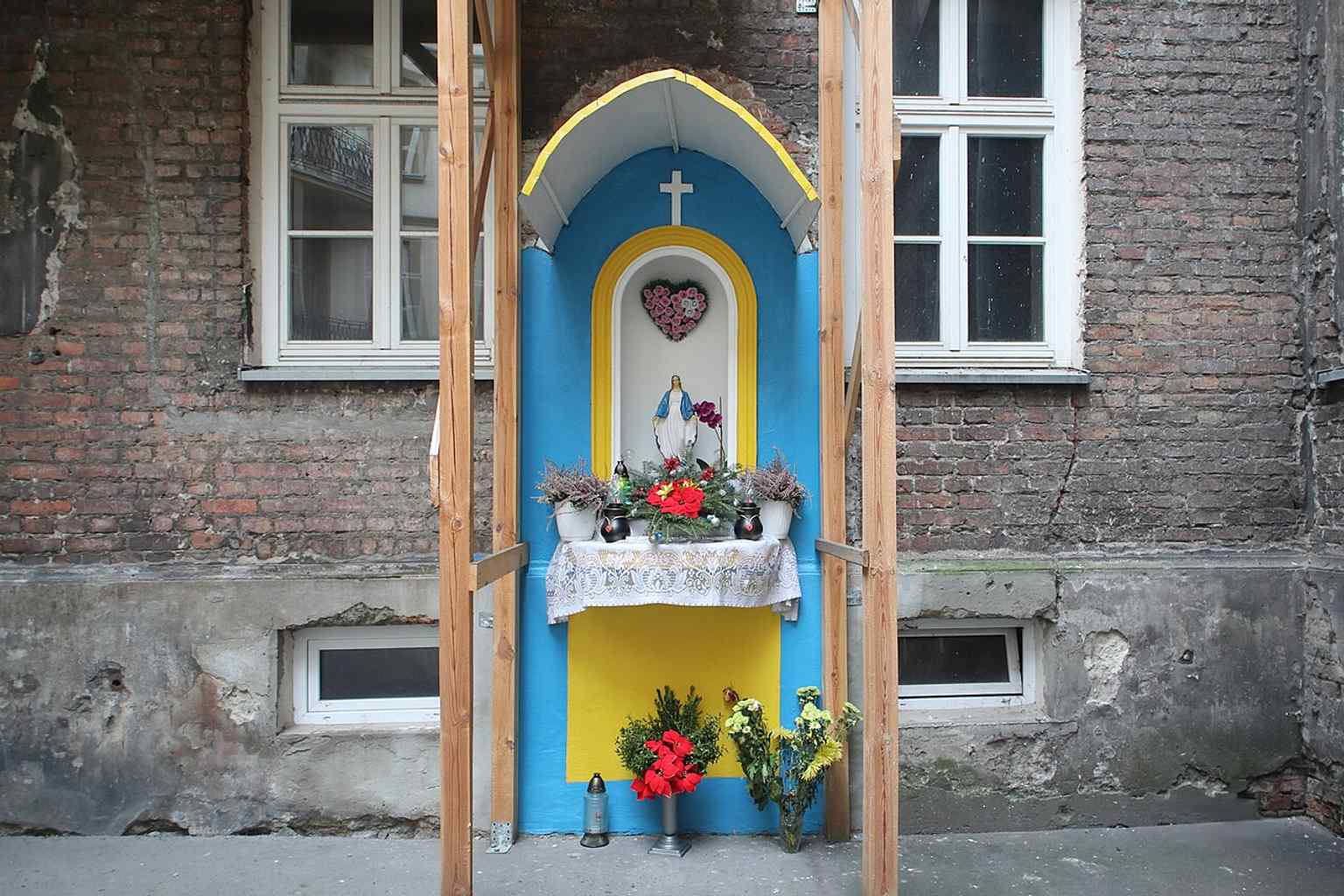
A Marian shrine in the courtyard of Mokotowska 65, showing the quiet everyday traditions that persist behind the façades.Photo: Cybularny, Wikimedia Commons, CC0. Cropped & resized. 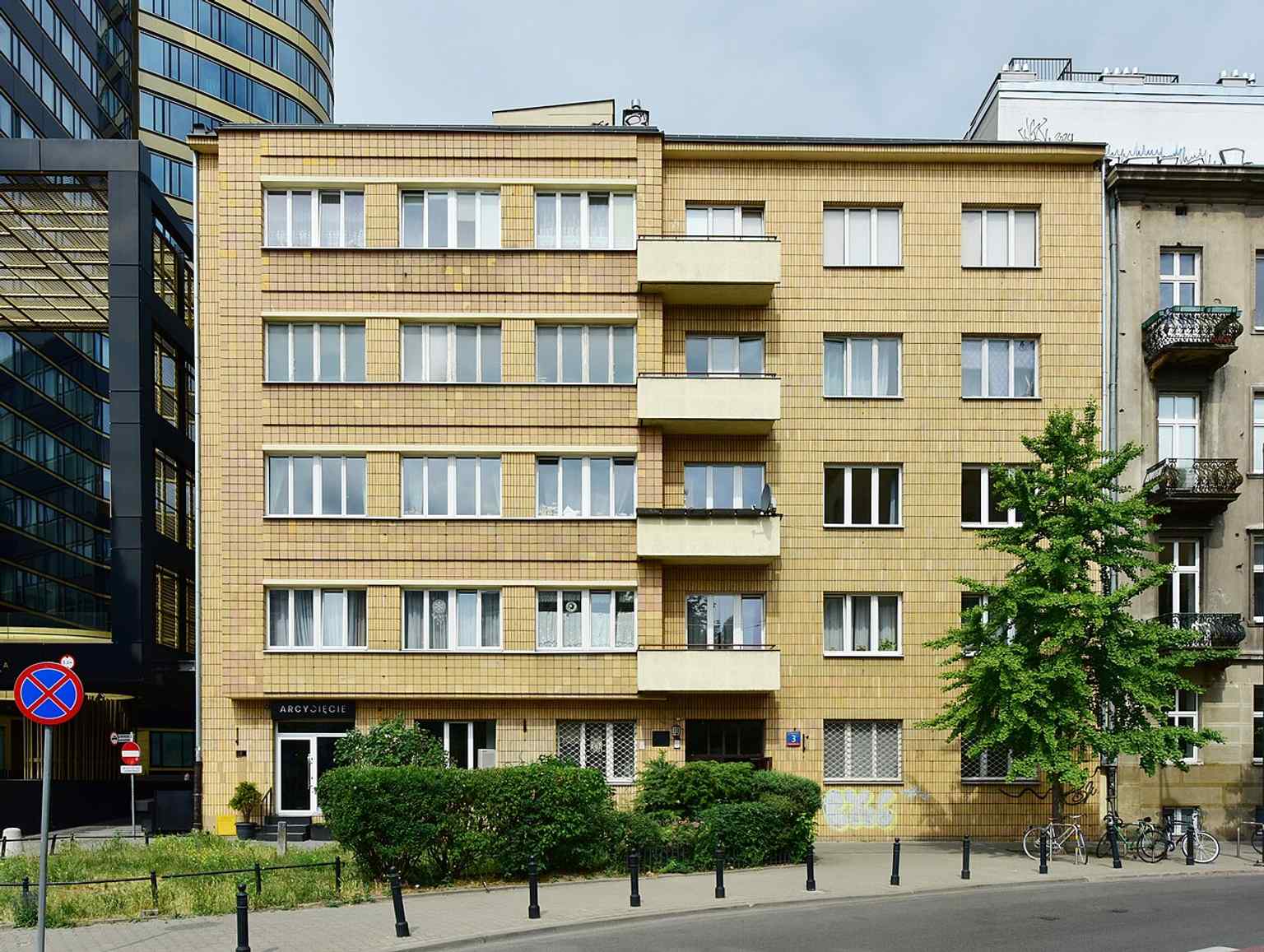
Mokotowska 3, site of an early industrial building once linked to Władysław Gostyński’s ironworks.Photo: Adrian Grycuk, Wikimedia Commons, CC BY 3.0 pl. Cropped & resized. 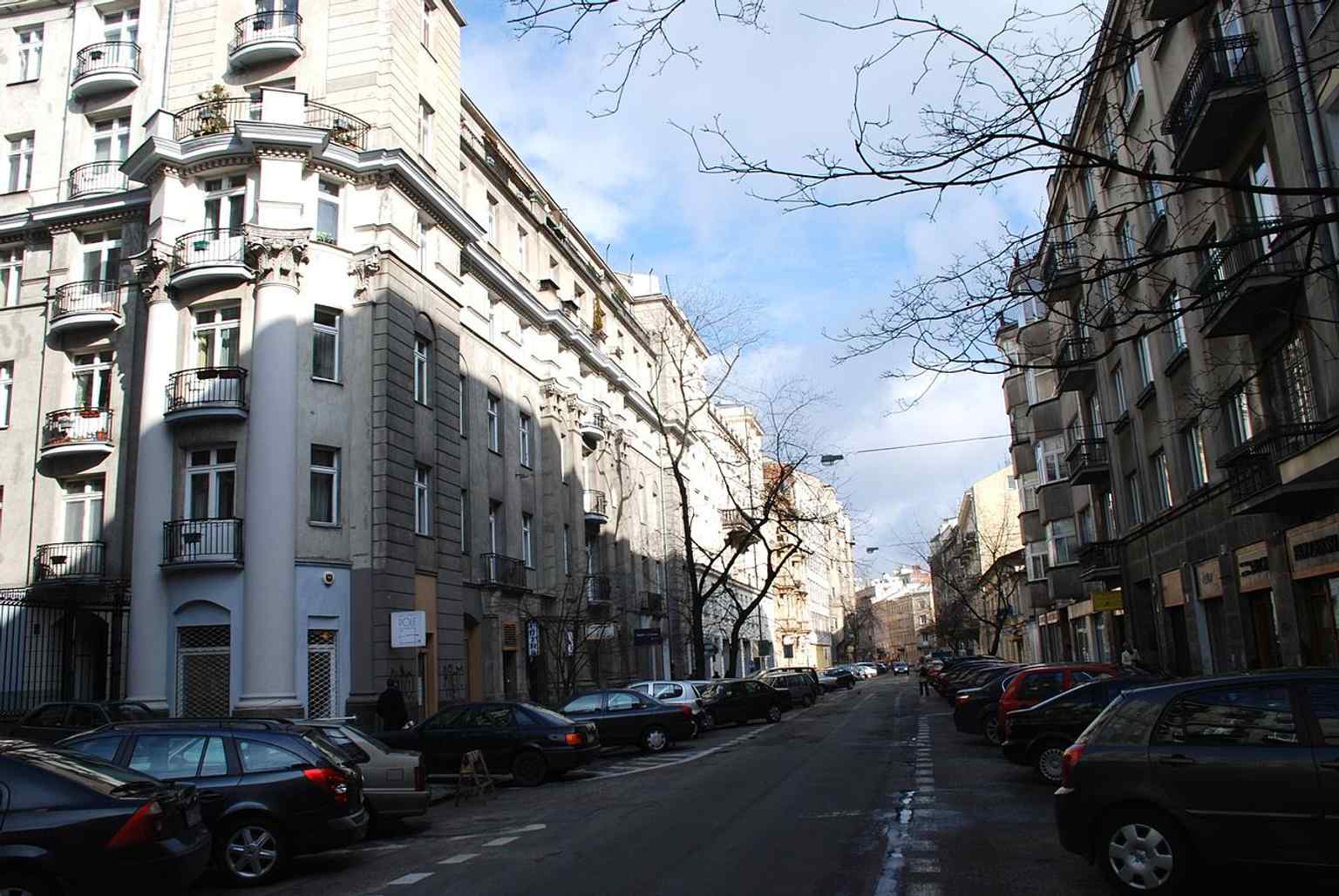
Mokotowska seen from Piękna, a modern streetscape that still follows the historic route toward the former Mokotowo village.Photo: No machine-readable author provided. Zuska assumed (based on copyright claims)., Wikimedia Commons, CC BY-SA 3.0. Cropped & resized. On your left once stood a giant steel arch, packed with artificial flowers and curved into a six-color rainbow at the center of Plac Zbawiciela. Julita Wójcik did not set out to…Read moreShow less
Open dedicated page →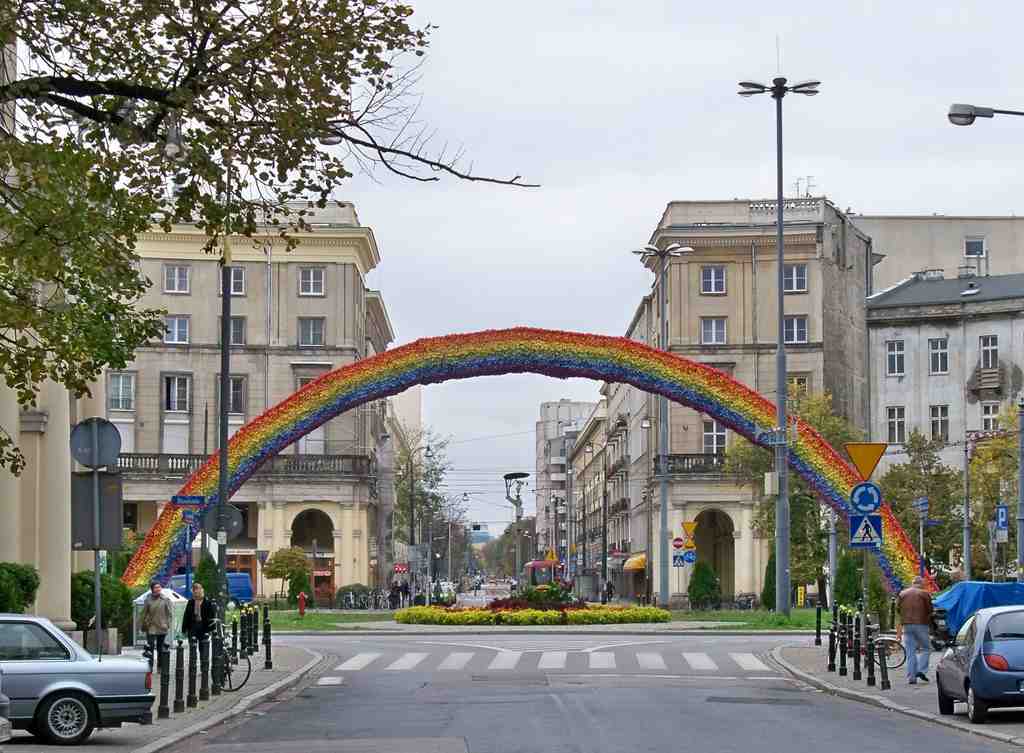
RainbowPhoto: Panek, Wikimedia Commons, CC BY-SA 4.0. Cropped & resized. On your left once stood a giant steel arch, packed with artificial flowers and curved into a six-color rainbow at the center of Plac Zbawiciela.
Julita Wójcik did not set out to build a national nervous breakdown. In the summer of two thousand twelve, the Adam Mickiewicz Institute brought her Rainbow here from an earlier version shown in Brussels during Poland’s presidency of the European Union. The idea sounded almost suspiciously wholesome: love, peace, hope... an apolitical sign anyone could claim.
Its roots were even more traditional. Wójcik first created a version in two thousand ten at the Camaldolese Monastery in Wigry, where it helped support crumbling walls and pointed to the biblical covenant between God and humanity. Then Warsaw got involved, and Warsaw, as usual, did not keep things simple.
More than one thousand volunteers - seniors, students, artists - gathered at Zachęta and spent weeks threading sixteen thousand artificial flowers onto wires. Wójcik called it cooperativism: shared labor creating beauty together. Which is a lovely plan, right up until beauty lands in front of a church and acquires six colors.
That is where The Rainbow Controversy began. Many people embraced it as open, generous public art. Far-right nationalist and Catholic groups read it as an L-G-B-T symbol planted in a loaded spot, directly before the Church of the Holiest Saviour. The artwork’s meaning expanded far beyond the artist’s brief and turned into a test of what the square, and the city, could tolerate.
By late two thousand thirteen, people had attacked it again and again - fires, damage, reconstruction, then more damage. The worst came on the eleventh of November, two thousand thirteen, during the Independence March. The flowers melted, black smoke rose, and the burning arch against the church became one of those images a country cannot unsee. If you want, take a quick look at the before-and-after image in the app... it shows the jump from cheerful landmark to cultural wreckage in one glance.
And then came the counter-voice. The next day, citizens pushed fresh real flowers into the charred metal frame. Couples held a kiss-in beneath it. Mayor Hanna Gronkiewicz-Waltz said the city would rebuild it as many times as necessary, and Warsaw spent more than one hundred thousand zloty on reconstruction, adding non-flammable flowers and even sprinklers. When a city keeps repairing an artwork after repeated attacks, is it defending free expression... or just proving how badly a symbol can get under people’s skin?
By August two thousand fifteen, the fight ended in removal. Workers stripped off the flowers and dismantled the steel frame, but even that became a public event. Crowds gathered, watched in silence, and pocketed discarded blossoms as souvenirs - a sad festival for an object made of plastic flowers and very real feeling.
From here, continue to Constitution Square, about six minutes away. The app oddly lists visiting hours as nine A-M to ten P-M, closed Sunday... disciplined scheduling for a landmark that now survives mostly in memory.
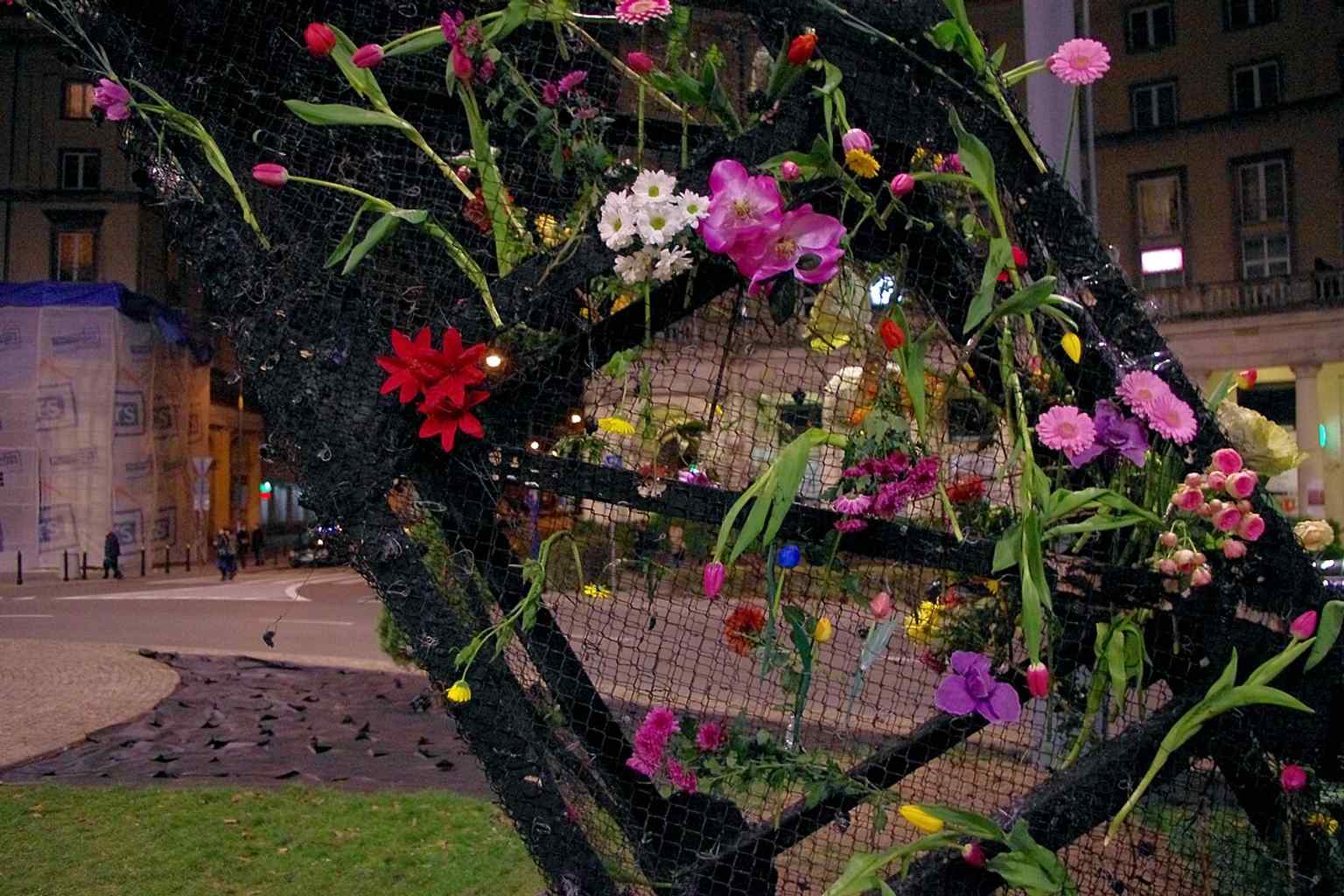
The day after the 2013 burning, when the devastated arch still stood in the square and drew crowds back to the site.Photo: Mateusz Opasiński, Wikimedia Commons, CC BY-SA 3.0. Cropped & resized. 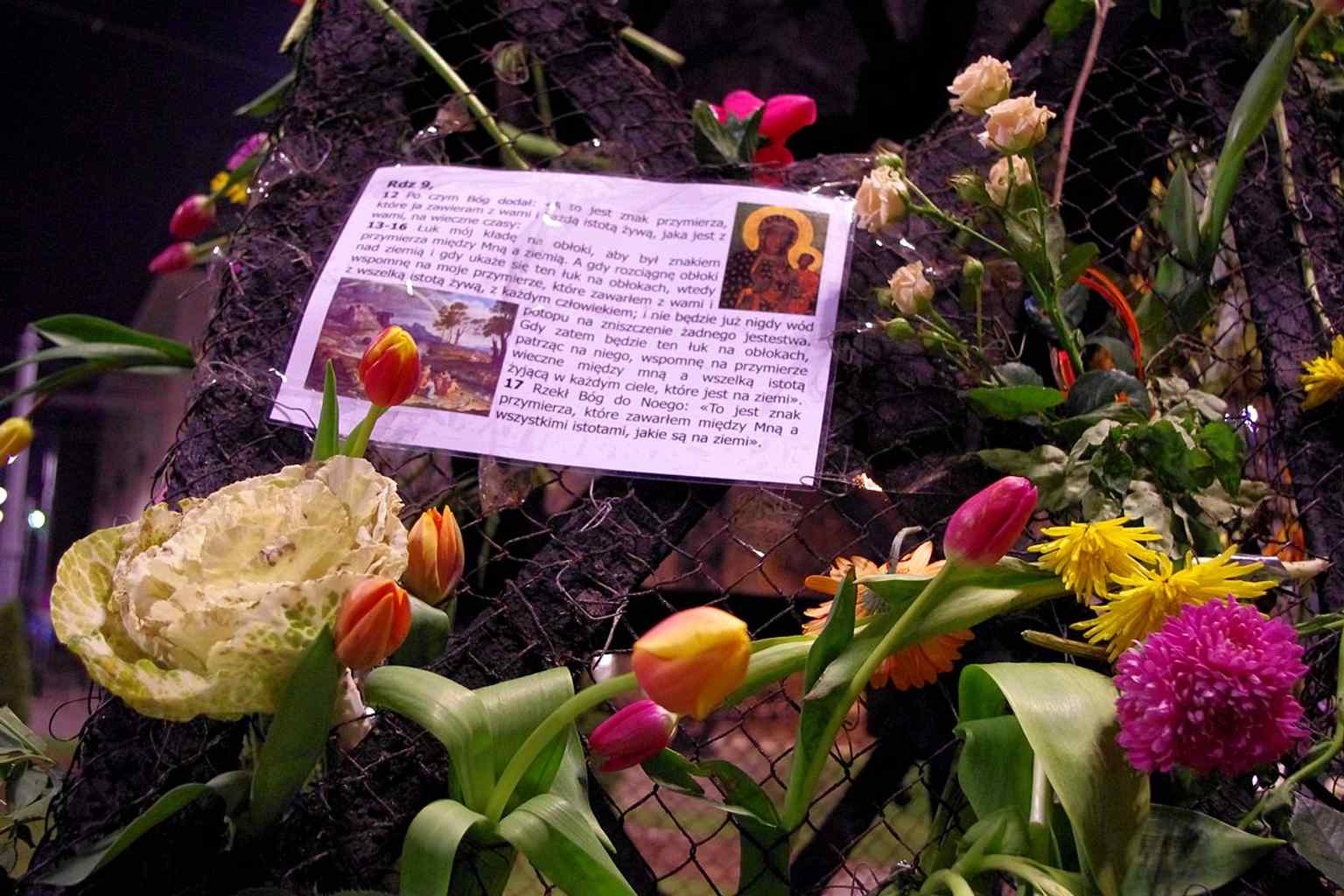
Another post-fire view from Plac Zbawiciela — useful for showing the scale of damage before the reconstruction.Photo: Mateusz Opasiński, Wikimedia Commons, CC BY-SA 3.0. Cropped & resized. 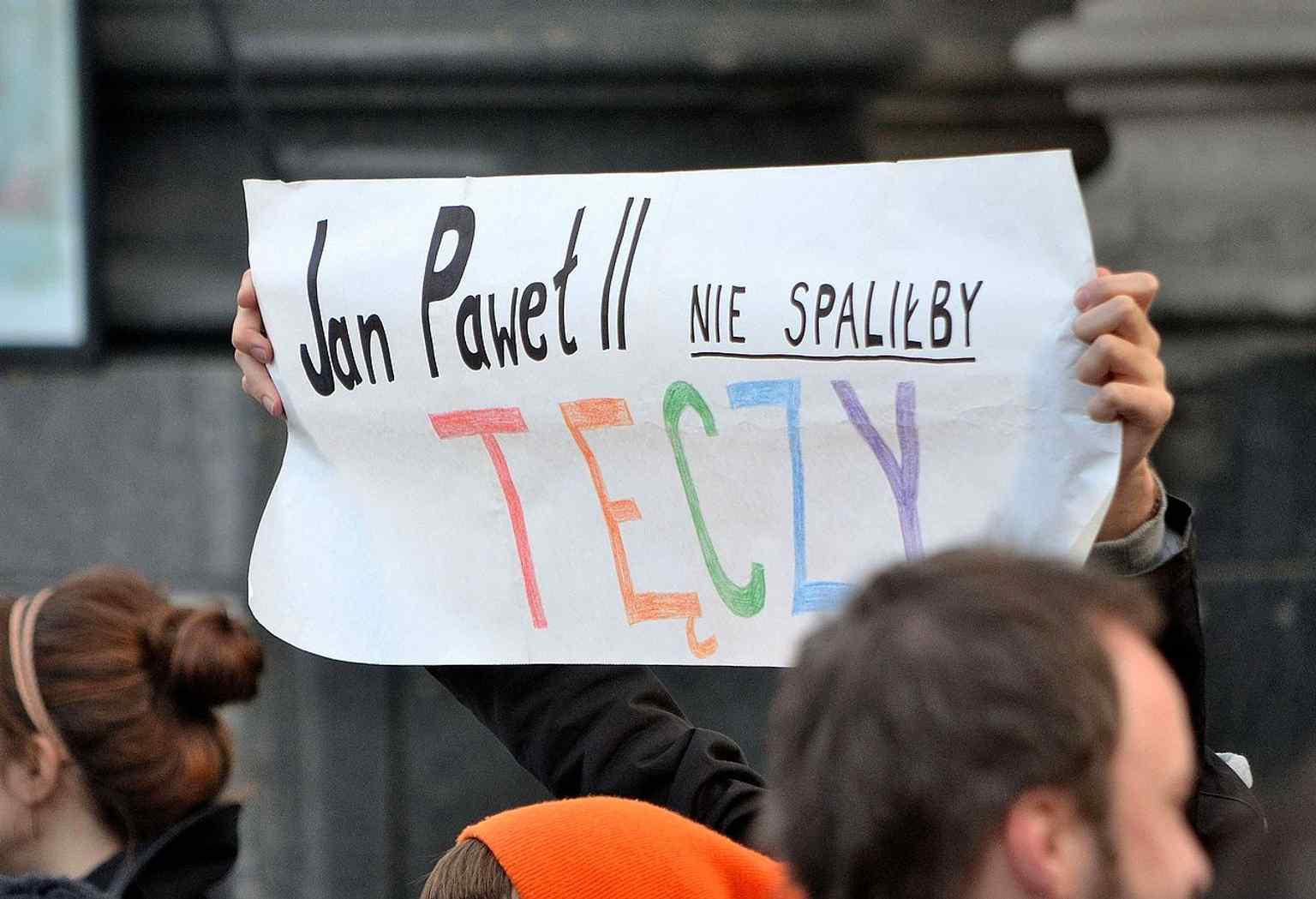
Supporters gathered with a sign defending the Rainbow in 2014, reflecting the public activism the artwork inspired.Photo: Adrian Grycuk, Wikimedia Commons, CC BY-SA 3.0 pl. Cropped & resized. 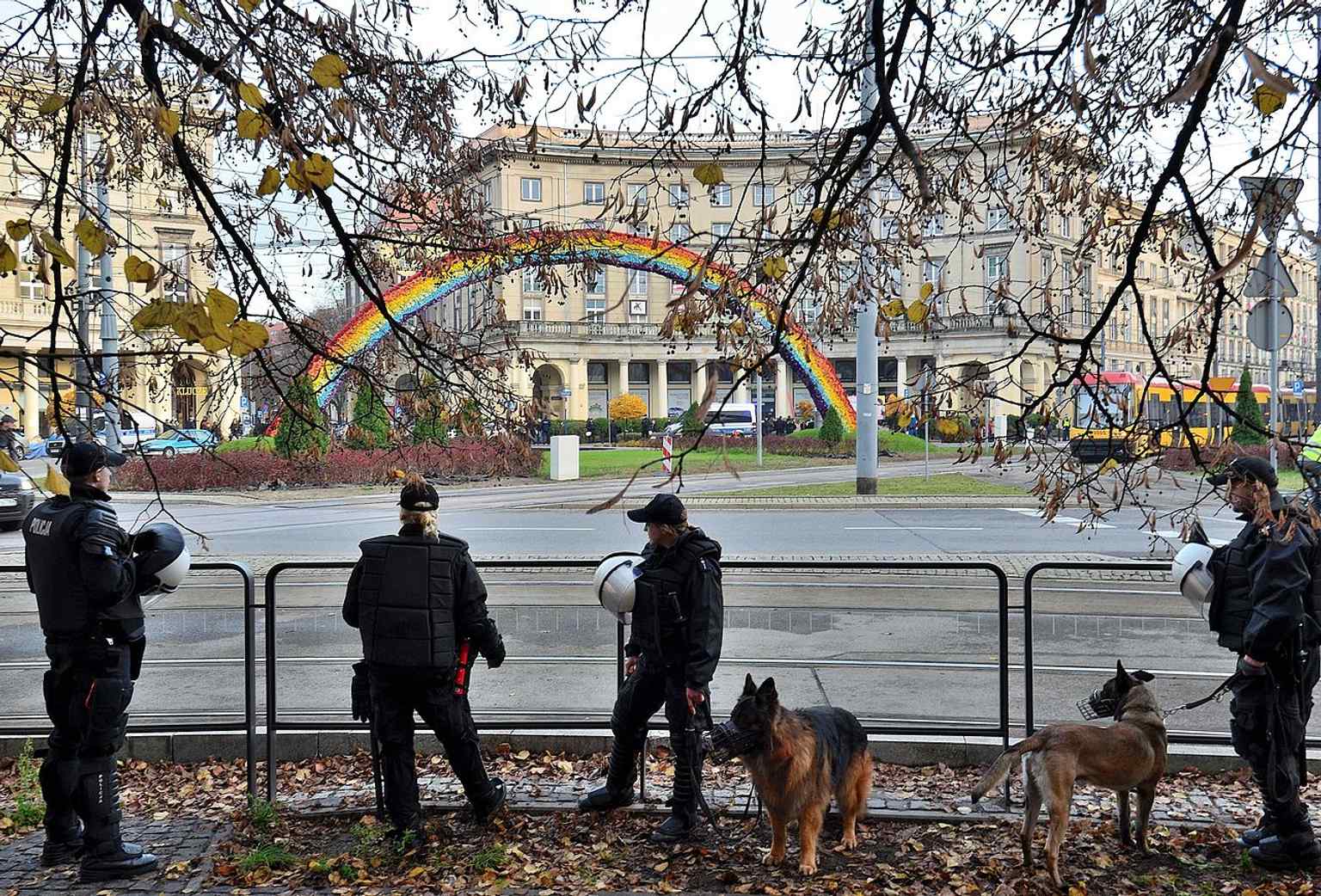
Police guarding the Rainbow on Independence Day 2014 — a sign of how politically charged the installation had become.Photo: Adrian Grycuk, Wikimedia Commons, CC BY-SA 3.0 pl. Cropped & resized. 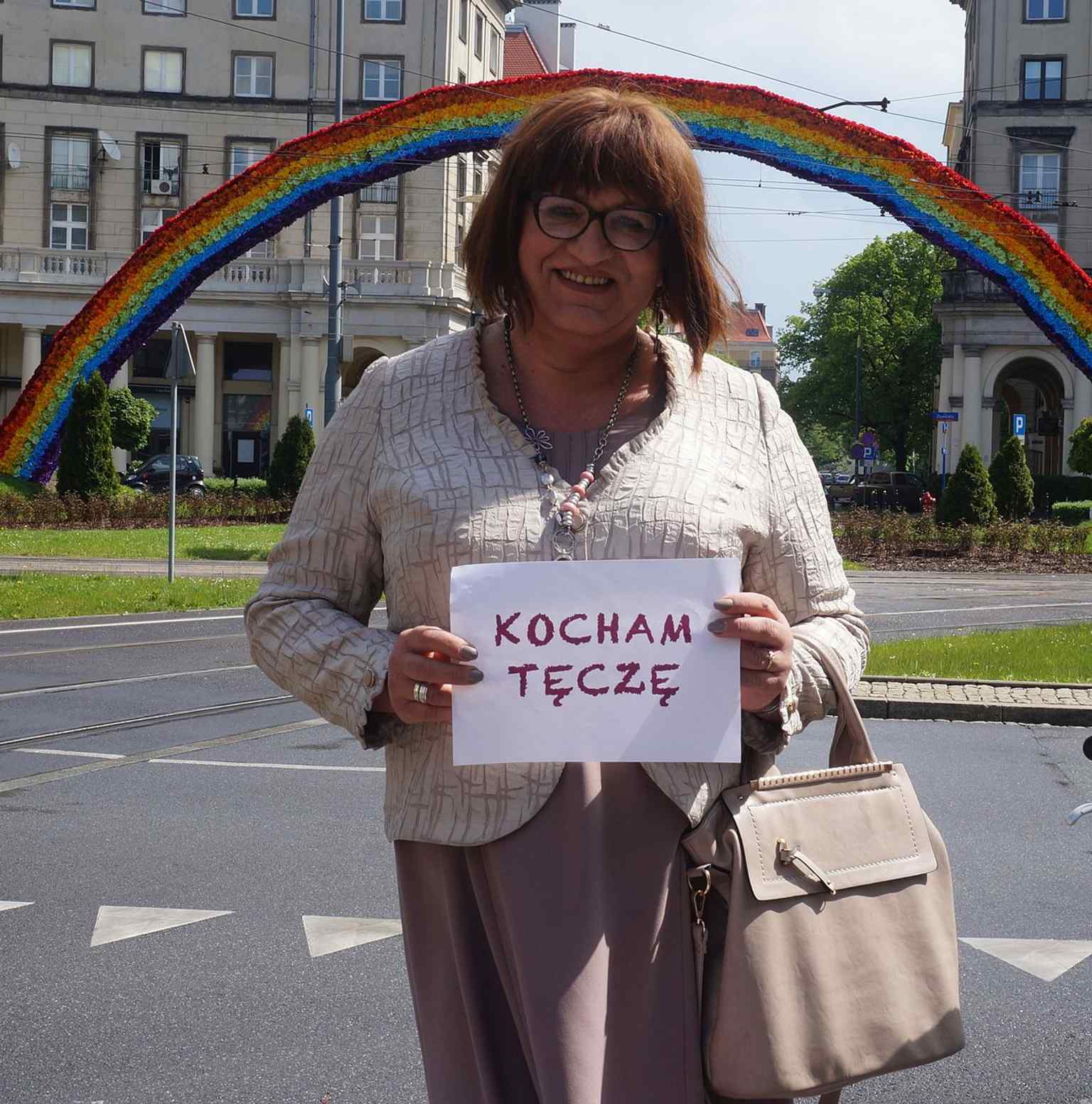
Anna Grodzka standing under the Rainbow in 2014, highlighting how the site became linked to LGBT visibility and support.Photo: LalkaPodobinska, Wikimedia Commons, CC BY-SA 4.0. Cropped & resized. 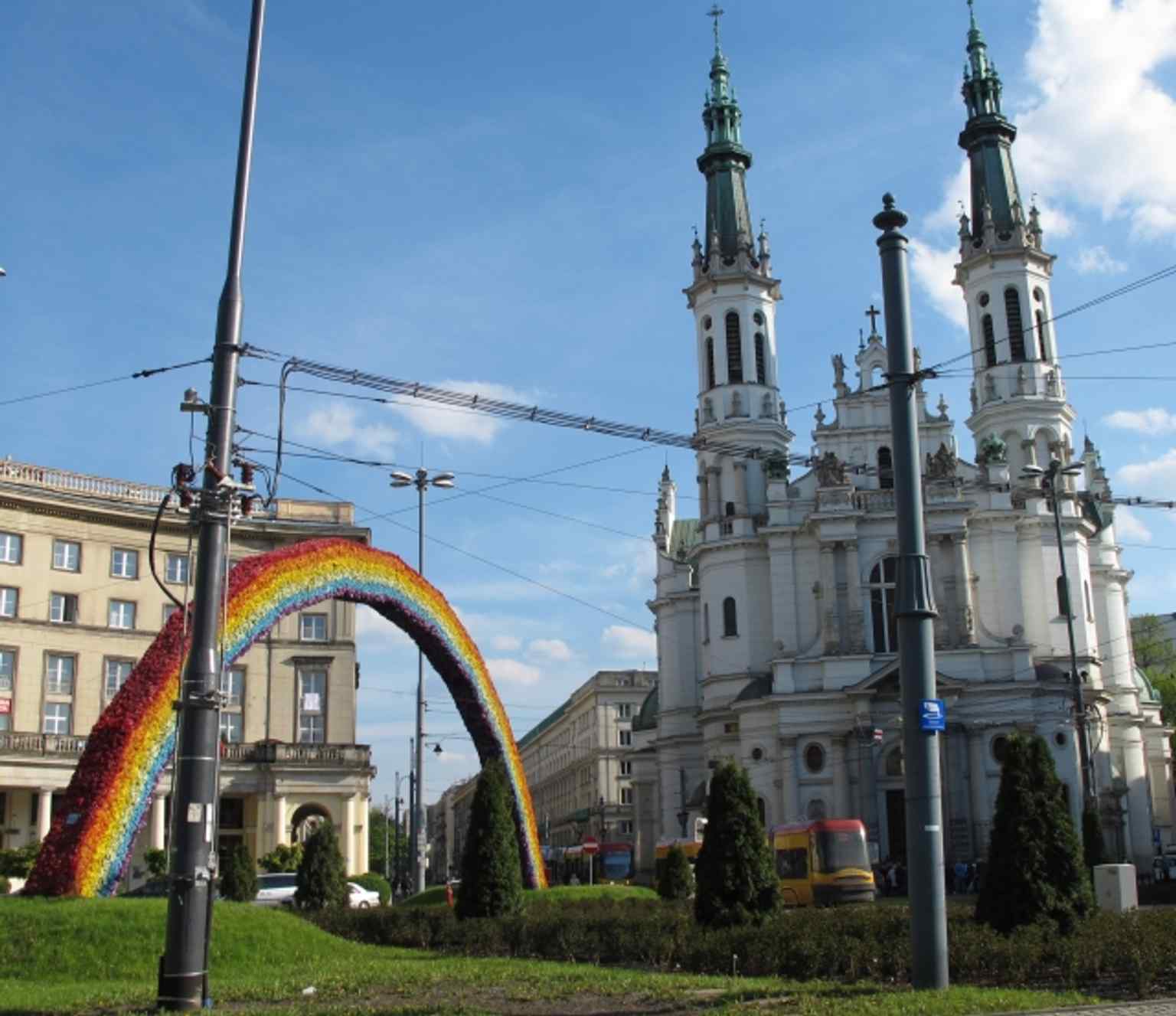
Plac Zbawiciela with the Church of the Holiest Saviour and the Rainbow together in 2015 — the square where art, religion, and politics collided.Photo: Ratoncito Perez, Wikimedia Commons, CC0. Cropped & resized. 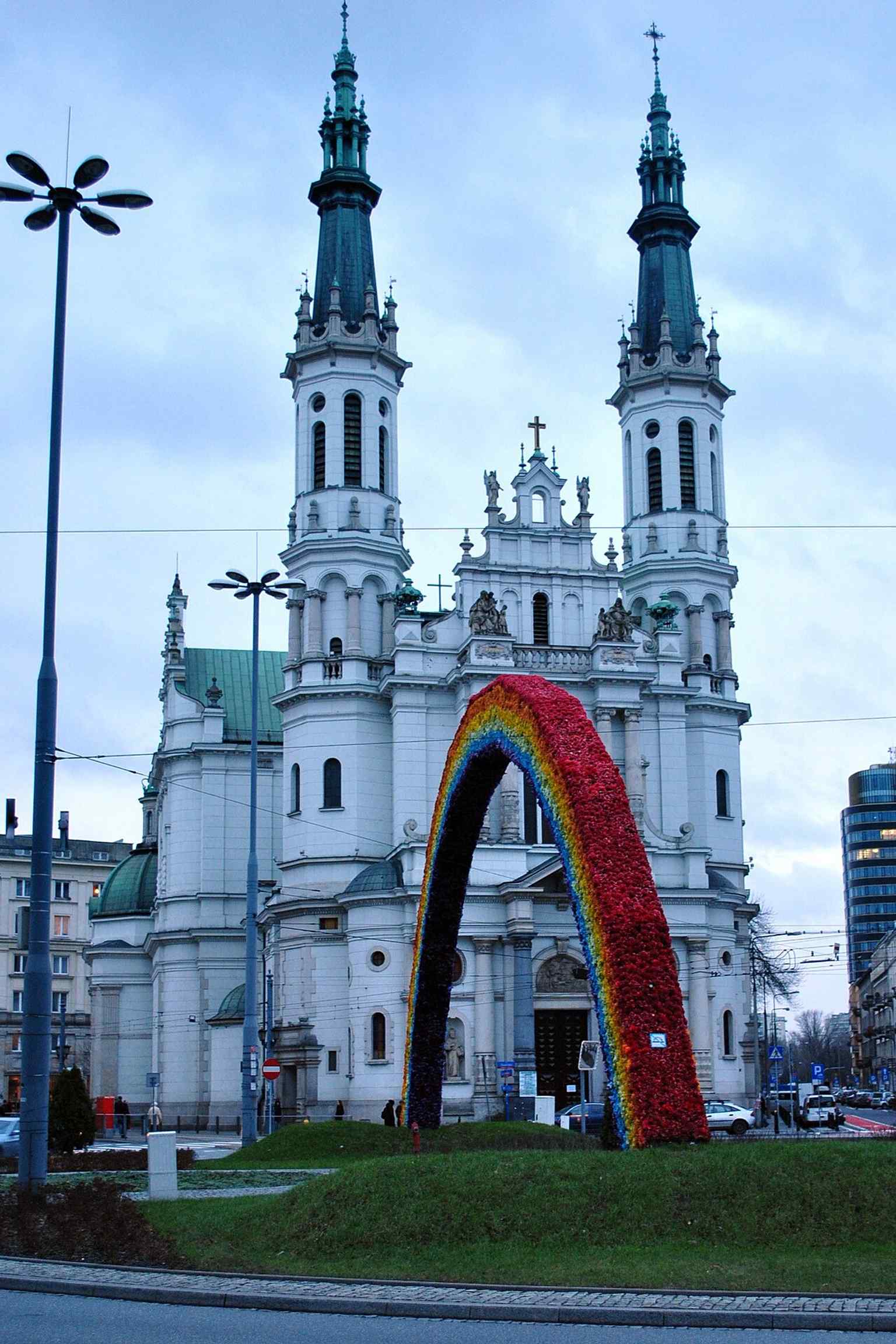
The Rainbow framed by the church in late 2014, a classic view of the installation in its urban setting.Photo: Marek Mróz, Wikimedia Commons, CC BY 4.0. Cropped & resized. 
A later 2014 view of Tęcza in Plac Zbawiciela, showing the rebuilt artwork after repeated vandalism.Photo: Qkiel, Wikimedia Commons, CC BY-SA 4.0. Cropped & resized. On your left, look for a long modernist block of pale stone and glass, laid out in firm horizontal lines, with a guarded recessed entrance and the embassy insignia set into the…Read moreShow less
Open dedicated page →
U.S. Embassy in WarsawPhoto: U.S. Department of State, Wikimedia Commons, Public domain. Cropped & resized. On your left, look for a long modernist block of pale stone and glass, laid out in firm horizontal lines, with a guarded recessed entrance and the embassy insignia set into the facade.
This building speaks in the language of state power... neat, controlled, expensive, and not especially interested in your opinion. But the ground under it tells a rougher story.
Before the embassy took over this site, the land belonged to the Czetwertyński family. In the Stalinist nineteen fifties, Stanisław Światopełk-Czetwertyński was arrested on a false charge of espionage, which conveniently helped the communist authorities seize the property. Then, in nineteen fifty-six, under an agreement between the Polish People’s Republic and the United States, the land passed to the Americans. The old manor here came down, and the family’s heirs spent years fighting unsuccessfully for compensation, arguing that everyone involved knew the legal ground was shaky. Diplomacy can be very elegant when standing on someone else’s loss.
The United States had already moved through a whole chain of Warsaw addresses before settling here: the Bristol, Foksal, Krakowskie Przedmieście, several villas on Ujazdowskie. Just before the war, the embassy worked out of the Lilpop villa at number twenty-nine. On the first of September, nineteen thirty-nine, Ambassador Anthony J. Drexel Biddle Junior woke to sirens and explosions and phoned President Roosevelt through Paris, becoming one of the first diplomats to report the invasion of Poland. Staff spread a huge American flag over the roof to discourage bombing. It did not work perfectly. Shrapnel still hit the villa, and Biddle later fled with his staff in a convoy strafed by the Luftwaffe on the road to Romania. Even great powers sometimes begin with a very bad morning and a telephone line.
After the war, the embassy returned to a new political map and a colder world. Arthur Bliss Lane, the first ambassador in communist Poland, watched the rigged elections of nineteen forty-seven and the repression that followed. Rather than pretend everything was fine, he resigned and later wrote I Saw Poland Betrayed. That set the tone for years: formal relations, little trust, a lot of hard smiles.
The present building opened here in the nineteen sixties, designed by Welton Becket and Associates from Los Angeles, with an annex added from Piękna Street in nineteen sixty-eight. Later, during martial law in nineteen eighty-one, candles burned in the embassy windows in solidarity with interned members of Solidarity. So this address has served as fortress, signal station, and bargaining table.
And that is the awkward truth of places like this: modern governments plant their flags on land already crowded with older claims, private griefs, and unfinished arguments. When you’re ready, continue to Swiss Valley, about four minutes away. The embassy is generally open on weekdays from eight thirty in the morning to five in the afternoon.
Look for a small terraced garden with stone retaining walls and steps dropping into a shallow hollow, marked by a fountain basin where the old concert stage once stood. This is…Read moreShow less
Open dedicated page →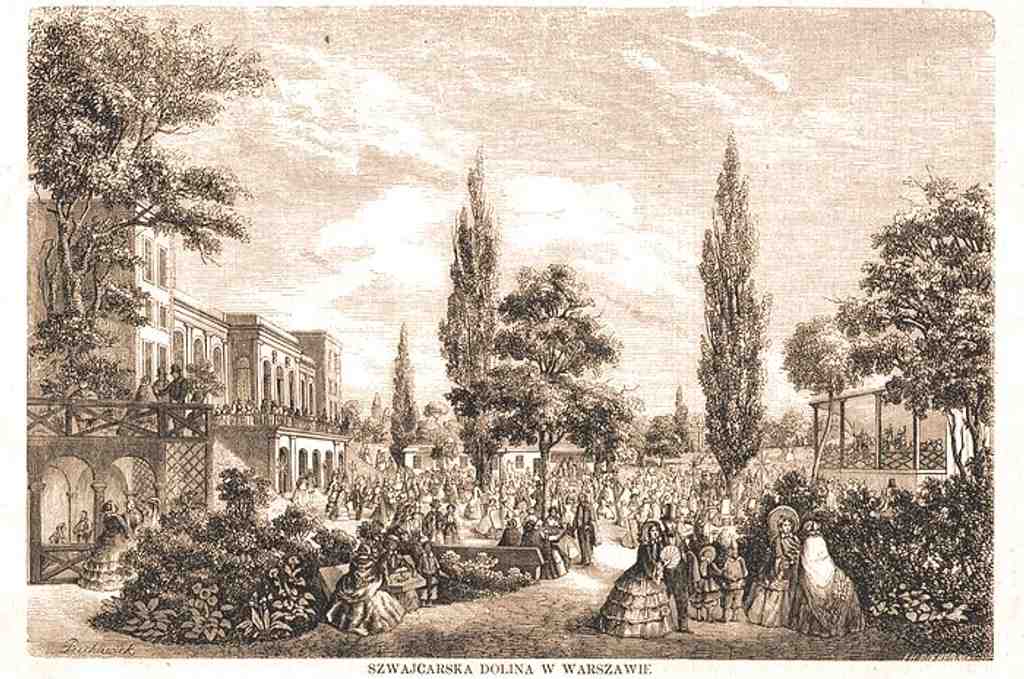
Swiss ValleyPhoto: UnknownUnknown , zm. przed 1930 r., Wikimedia Commons, Public domain. Cropped & resized. Look for a small terraced garden with stone retaining walls and steps dropping into a shallow hollow, marked by a fountain basin where the old concert stage once stood.
This is Dolina Szwajcarska, Swiss Valley... a lost pleasure garden, and one of the gentlest versions of old Warsaw still faintly visible. Before embassies, ministries, and parked cars claimed the edges, this was a place for strolling, music, coffee, flirtation, and the serious civic duty of being pleasantly idle.
Its story began in the late eighteenth century, but the place found its real character after eighteen twenty-five, when Captain Stanisław Śleszyński took the land on perpetual lease. He and his wife opened it to the public in eighteen twenty-seven and filled it with Swiss-style wooden pavilions, flower beds, winding paths, and little café structures rented to sellers of beer, sweets, and sausage. Civilization, in other words.
If you glance at the image on your screen, you can see how little of that world survived, pressed up against later government-era architecture. In the nineteenth century, this was far larger. In eighteen fifty-five the owners added the Salon of the Great Avenue, then the biggest concert hall in Warsaw. Benjamin Bilse drew huge crowds here. Edward and Johann Strauss performed here. So did Ignacy Paderewski. There were garden theaters, masked balls, magicians, clairvoyants, fire-eaters, and by eighteen ninety-nine one of Poland’s earliest film screenings, organized by Bolesław Matuszewski. Not bad for a garden that began with wooden pavilions and ambition.
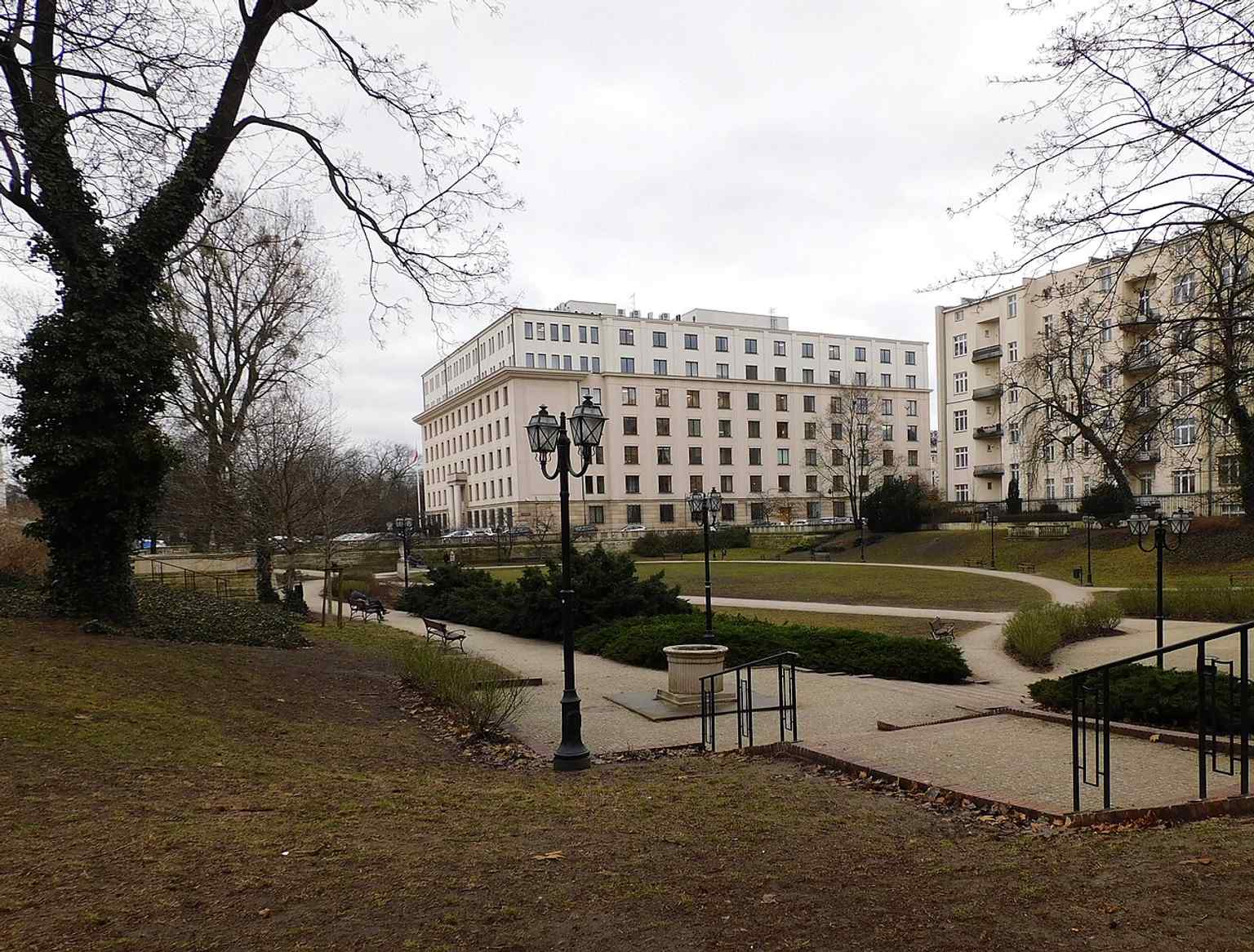
A current view of Swiss Valley with the former PZPR headquarters behind it, showing how the surviving garden fragment now sits against later government-era architecture.Photo: Panek, Wikimedia Commons, CC BY-SA 4.0. Cropped & resized. It also adapted with almost suspicious enthusiasm. In winter, from eighteen eighty-seven, it became one of Warsaw’s most fashionable skating rinks. There were tennis courts, a roller rink, flower parades, horticultural shows, and a children’s play garden called New Switzerland. Compared with the buying and rushing of Krucza, this was a city that once treated promenading and listening as valid use of an afternoon.
Then the space started shrinking. Aleja Róż cut through in the eighteen seventies. Chopin Street followed in the eighteen nineties. Buildings hemmed the garden in. A concert park turned into a tighter, noisier entertainment ground, then a sports and exhibition site, then a place for political rallies. By the war, its borders were already close to what you see now. The fighting of the Warsaw Uprising finished what parceling had begun.
After the war, planners kept only a fragment, about one sixth of Śleszyński’s original property. In nineteen fifty-one they redesigned this remnant with terraces, old trees, and a fountain set where the concert shell had stood. The rest sat behind new power: first a party headquarters, later state offices. Another look at the second image makes that compression painfully clear.
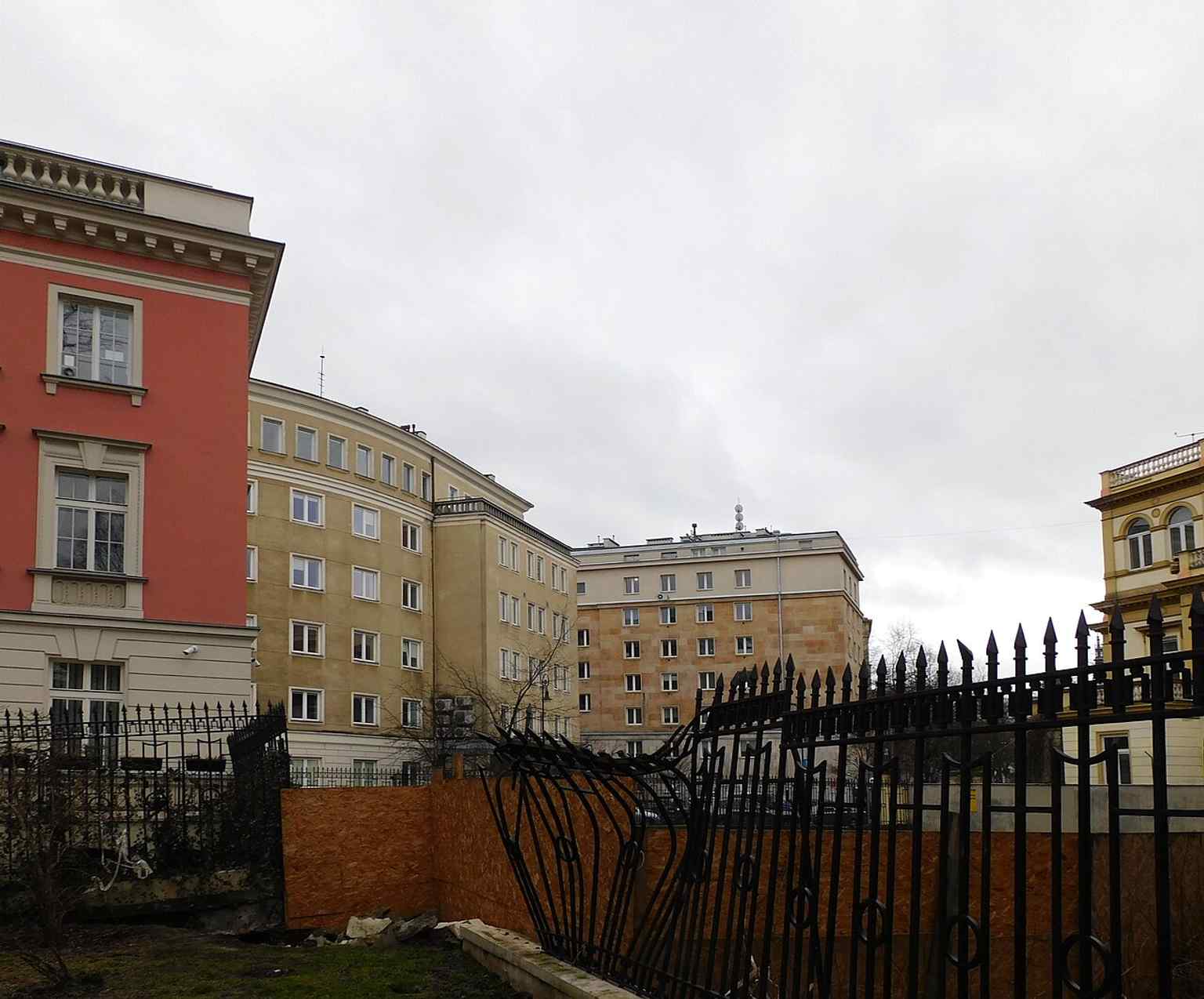
The southwest corner of Swiss Valley, where the garden is now tightly enclosed by surrounding city blocks—far from its 19th-century life as a concert-and-entertainment park.Photo: Panek, Wikimedia Commons, CC BY-SA 4.0. Cropped & resized. So here is the question this place leaves behind: if you could recover one layer of city life here... the concert garden, the promenade, the slower pace... what would you bring back, and what would you sacrifice to make room for it?
Not every vanished Warsaw disappeared in fire. Some of it was simply trimmed, reassigned, and fenced in. From here, Crossroads Square is about a nine-minute walk.
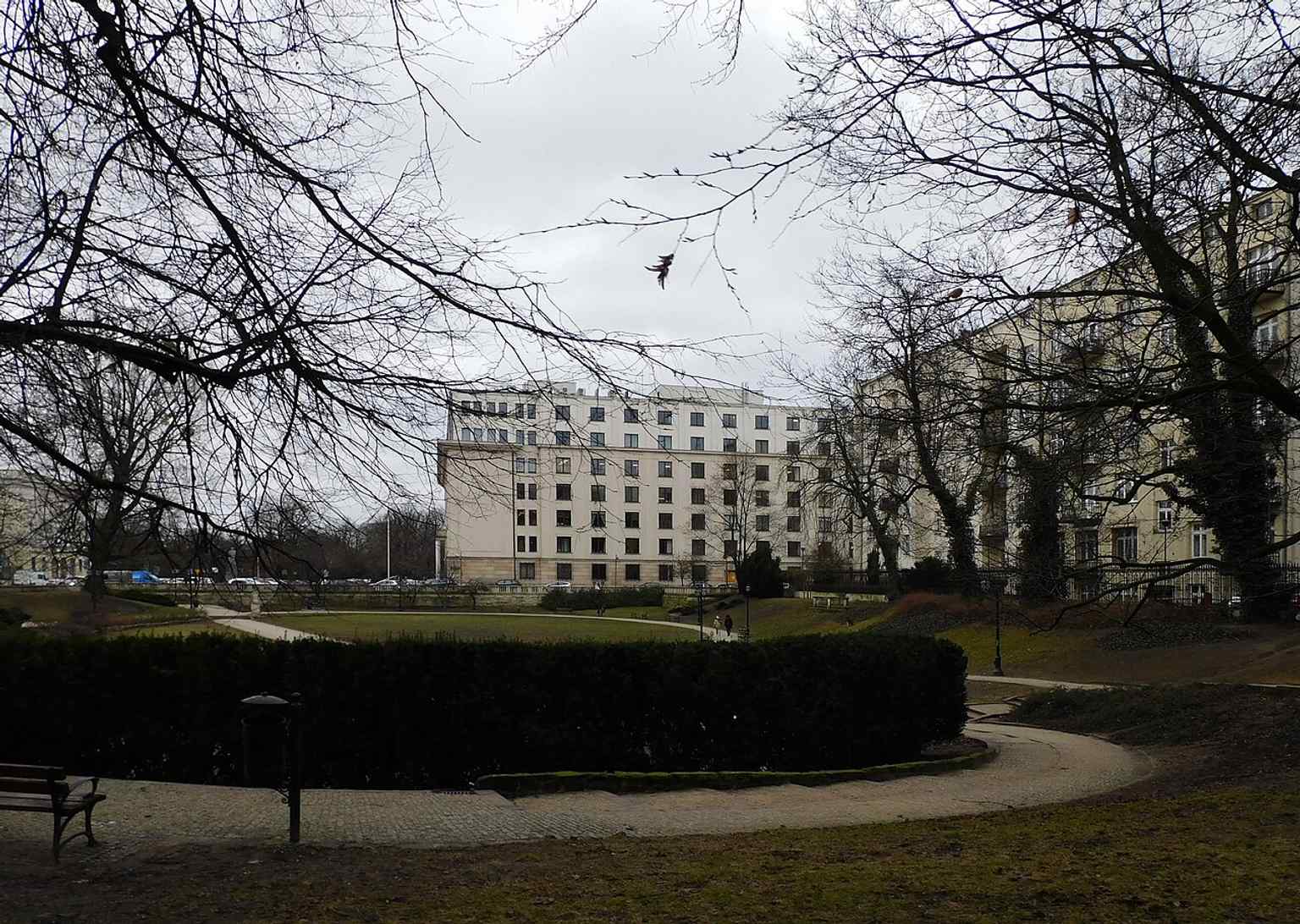
The park’s modern edge seen with the old party headquarters in the background, a reminder that only a small part of the original 1786 garden survived after the war.Photo: Panek, Wikimedia Commons, CC BY-SA 4.0. Cropped & resized. In front of you is a broad two-level square of asphalt lanes and concrete retaining walls, with a small circular upper plaza and fountain marking one side. Crossroads Square, or…Read moreShow less
Open dedicated page →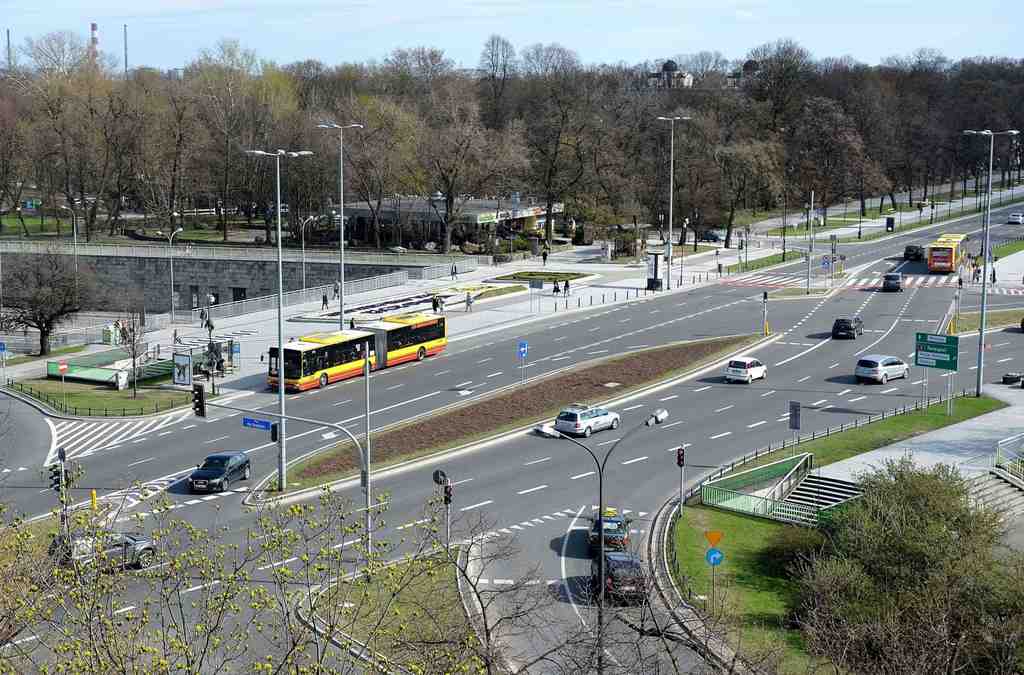
Crossroads SquarePhoto: Adrian Grycuk, Wikimedia Commons, CC BY-SA 3.0 PL. Cropped & resized. In front of you is a broad two-level square of asphalt lanes and concrete retaining walls, with a small circular upper plaza and fountain marking one side.
Crossroads Square, or Plac Na Rozdrożu, began in seventeen sixty-eight as something far more ceremonial than this road machine. August Fryderyk Moszyński placed it on the Stanisław Axis, an eighteenth-century urban plan that lined up roads and squares around Ujazdów Castle, so the city would feel both organized and faintly theatrical. Warsaw does enjoy a grand gesture.
Here is the part most people miss: through much of the nineteenth century, this was valued less as a junction than as an unpaved green viewing ground. It stayed open, lightly landscaped, and visually tied to the castle. So yes, this place once worked more like a prospect point than a traffic knot... which feels almost insulting to the buses.
Its identity kept shifting. In eighteen ninety-four, a Russian Orthodox church dedicated to Saint Michael the Archangel rose nearby at number twelve Ujazdów Avenue, serving Russian soldiers and civilians. After Russian forces withdrew in nineteen fifteen, the church sat mostly empty, decayed, and came down in nineteen twenty-three. One regime installs a symbol; the next removes it. Efficient, if grim.
For a brief stretch after nineteen oh one, the square even gained its only tenement house, and inside it the café Łobzowianka became a known address until it closed in nineteen thirty-five. During the interwar years the square went by Freedom Square, and planners imagined even bigger roles for it, including a grand Piłsudski monument and a whole new district radiating outward. None of that happened. Warsaw is full of ambitious blueprints that never made it past the drawing board.
Some plans did arrive with force. Between nineteen seventy-one and nineteen seventy-four, engineers drove the Baths Route through here. They cut in People’s Army Avenue, pushed traffic onto a lower level, and built a forty-six-meter tunnel under the square. That is when the old axis got bent diagonally, the pedestrian routes sank into underpasses, and the western side gained the little round plaza with the fountain. If you want a quick comparison, have a look at the before-and-after image in the app.
The square never stopped collecting political meaning. The building at eleven Ujazdów Avenue housed the German Criminal Police during the occupation, then the Ministry of Public Security after the war. Later came monuments: Roman Dmowski in two thousand six, still controversial because his racist and antisemitic views are impossible to airbrush away, and Ignacy Daszyński in two thousand eighteen, adding yet another argument in bronze.
So even standing in what looks like an interchange, you are really in a layered draft of Warsaw: royal geometry, green outlook, vanished church, unrealized monument, police power, expressway engineering. A square can be many things, even when traffic tries to simplify it.
From here, head toward Rainbow, about a nine-minute walk away.
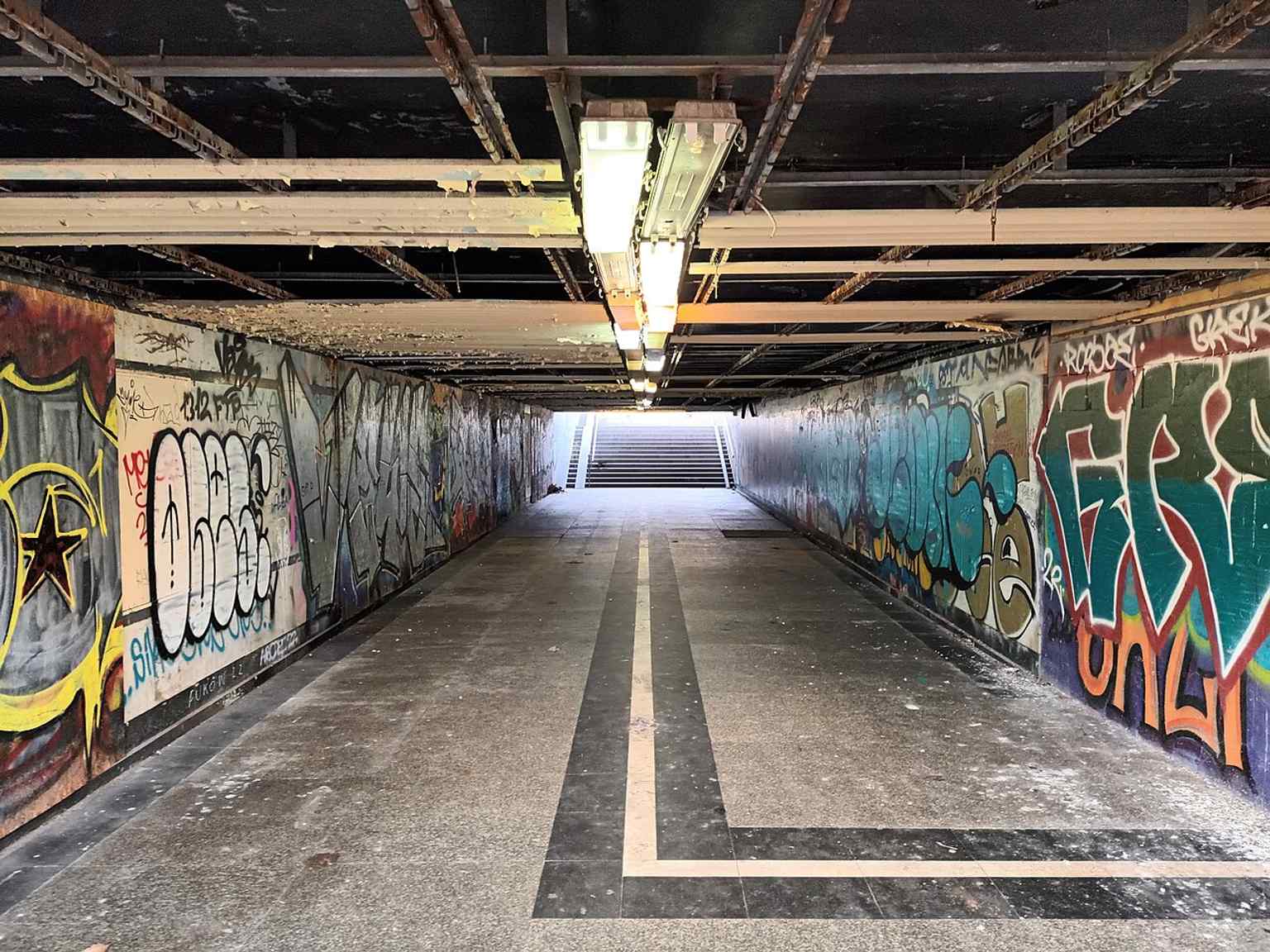
The underground passage beneath Crossroads Square is part of the 1970s redesign that pushed pedestrians below the expressway.Photo: Cybularny, Wikimedia Commons, CC0. Cropped & resized.

Frequently asked questions
How do I start the tour?
After purchase, download the AudaTours app and enter your redemption code. The tour will be ready to start immediately - just tap play and follow the GPS-guided route.
Do I need internet during the tour?
No! Download the tour before you start and enjoy it fully offline. Only the chat feature requires internet. We recommend downloading on WiFi to save mobile data.
Is this a guided group tour?
No - this is a self-guided audio tour. You explore independently at your own pace, with audio narration playing through your phone. No tour guide, no group, no schedule.
How long does the tour take?
Most tours take 60–90 minutes to complete, but you control the pace entirely. Pause, skip stops, or take breaks whenever you want.
What if I can't finish the tour today?
No problem! Tours have lifetime access. Pause and resume whenever you like - tomorrow, next week, or next year. Your progress is saved.
What languages are available?
All tours are available in 50+ languages. Select your preferred language when redeeming your code. Note: language cannot be changed after tour generation.
Where do I access the tour after purchase?
Download the free AudaTours app from the App Store or Google Play. Enter your redemption code (sent via email) and the tour will appear in your library, ready to download and start.
If you don't enjoy the tour, we'll refund your purchase. Contact us at [email protected]
Checkout securely with 






.jpg)


%20az%20ulica%20Marsza%C5%82kowska%20fel%C3%A9%20n%C3%A9zve.%20Fortepan%2075021.jpg)


%20Hanna%20%C5%BBu%C5%82awska%20Plac%20Konstytucji%20(2).jpg)


.jpg)


.jpg)


%2002.jpg)
%2003.jpg)


.jpg)
.jpg)


