
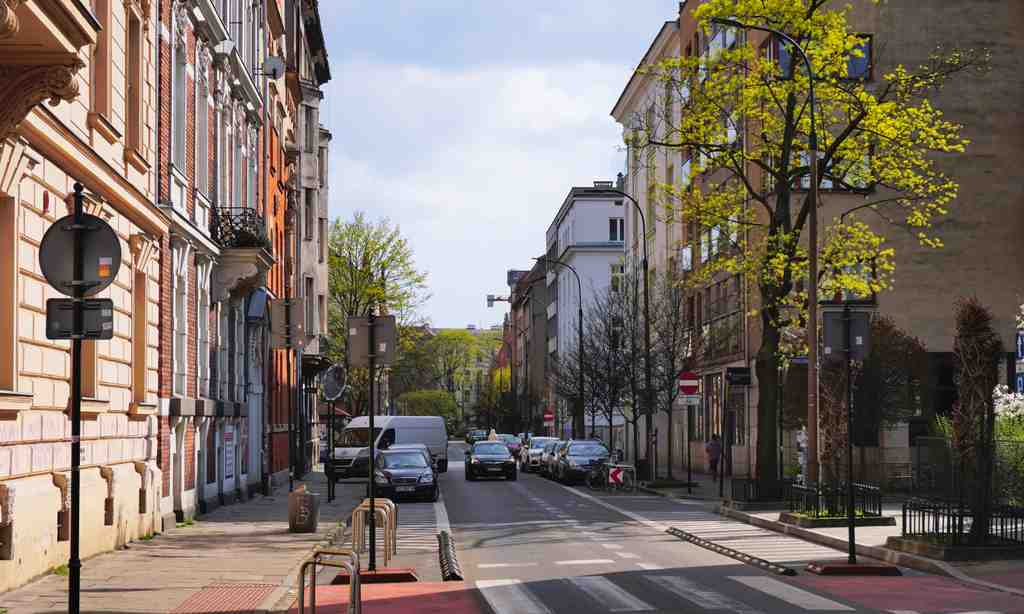
Look for a modest, straight street lined with cream and pale grey stucco townhouses, mostly three storeys high, with tall rectangular windows and touches of carved ornament across their flat facades.
Garncarska has the sort of face cities use when they are keeping their deepest memories to themselves. At first glance, this is simply a residential street in the old Piasek district, running from Krupnicza toward Józef Piłsudski Street. But under the present name lies an older one, and under that, an older life again.
From the sixteenth century, this area formed part of a settlement called Krupniki, within the suburb of Garbary. The people here were mostly krupnicy, craftsmen who processed grain into flour and groats. So before Garncarska became Garncarska, the street answered to Krupnicza or Krupniki. Even its naming tells you something rather moving about Kraków: what sounds fixed is often layered, and what looks permanent may only be the latest version.
The street took its present shape after regulations in the eighteen eighties and eighteen nineties. Most of the houses you see belong to that moment: late nineteenth- and early twentieth-century townhouses, two or three floors, eclectic in style, meaning they borrow from several older fashions at once, and occasionally touched by early modern simplicity. Respectable, urban, composed. And yet one address still carries a grudge.
At number five stood, in its first life, a charming low villa with a loggia, an open recessed porch, and a garden. Professor Zygmunt Lisocki, a scholar of Roman law, owned it. Then, in the nineteen thirties, developers raised it upward in the name of progress and stripped away its villa character, turning it into an ordinary rental house. People still remember that change as an architectural tragedy. It is a small but telling wound: not every improvement feels like care.
And then there is number four, where history turns inward and becomes domestic. During the German occupation, Józefa Onitsch, the widow of General Zygmunt Zieliński, gave shelter to the Vetulani family in her flat. Here the future neurobiologist Jerzy Vetulani spent his childhood years, in a home he later remembered as a place of discipline, honour, and warmth. His mother worked as a translator. She taught her sons patriotism not as a slogan, but as habit. On Sundays, the family sang Boże, coś Polskę together. In occupied Kraków, that ordinary apartment became a refuge, and refuge, as ever, began with one person deciding to make room.
A little farther along, number six bears a plaque to Stanisław Okoń, known as Sumak, commander of Kraków’s Grey Ranks, the underground scout resistance. When the Germans first arrested him in nineteen forty, he calmly ate the secret documents he carried before they could seize them. It saved him then. A second arrest sent him to Auschwitz, where he died in nineteen forty-two. One façade, one plaque, and a whole life of quiet courage.
That, I think, is the lesson of Garncarska. Streets like this do not announce themselves. They simply hold the rooms where people worked, argued, hid, endured, and tried to remain decent.
In a moment, we’ll step into General Władysław Sikorski Square, where many of these private strands gather into public memory. It’s about a two-minute walk from here.




